
When an enterprise sales deal shifts from an internal champion to the procurement department, the evaluation framework transforms completely. Champions champion tools that relieve daily departmental friction, advance career milestones, and elevate team output. Procurement teams, conversely, evaluate vendor viability, contractual enforceability, budget integrity, and enterprise risk exposure. Reusing the vision-centric presentation that closed your operational champion inside a procurement review produces friction, stalls approvals, and invites unnecessary legal redlines.
A procurement-facing sales deck is an operational and commercial audit artifact. Its primary mandate is to furnish sourcing leaders, corporate legal counsel, and finance analysts with documented verification that your firm is financially sound, that the proposed scope aligns with the quote, and that contract execution will not create technical or balance-sheet liabilities.
Champion Deck vs. Procurement Deck: The Strategic Priority Inversion
Operational champions seek clarity on usability, adoption speed, and team workflows. They engage with narratives highlighting existing bottlenecks and the transformed operational state following software deployment.
Procurement officers operate under an opposing incentive structure. Their performance metrics revolve around cost containment, regulatory compliance, standardized contract language, vendor insolvency protection, and enforceable delivery SLAs. While a champion deck explores future business upside, a procurement deck establishes how the commercial engagement will be governed.
As communication strategist Nancy Duarte demonstrates in her work on business storytelling, persuasive narratives require a single governing idea paired with the real stakes of taking or foregoing action. In a champion-facing deck, the risk is operational stagnation; in a procurement review, the risk is legal, technical, or financial exposure.
| Evaluation Dimension | Champion Pitch Deck | Procurement Evaluation Deck |
|---|---|---|
| Primary Audience | Line-of-business director or department lead | Category sourcing manager, procurement lead, corporate counsel |
| Governing Question | How does this platform accelerate team performance? | What is the total cost of ownership and organizational risk profile? |
| Critical Slide Content | Workflow features, UX architecture, user impact stories | Licensing tiers, deployment SOW, compliance certifications, SLA terms |
| Target Milestone | Internal sponsorship and business case sign-off | Commercial sign-off, redline clearance, and PO release |
The Five Core Slides of an Audit-Ready Procurement Deck
A procurement presentation must be modular, concise, and completely self-explanatory. Procurement teams review vendor documentation asynchronously across multiple internal departments. Each slide must carry its own burden of proof without an account executive narrating in real time.
1. Project Context and Champion Alignment
Ground the presentation in the approved departmental initiative. Procurement teams handle dozens of active purchase requests across separate business units. Open by restating the sponsoring department head, the assigned budget code or corporate initiative, and the technical milestones already validated during the discovery phase.
2. Statement of Work and Boundary Scope
Avoid high-level marketing descriptions. Explicitly define what the engagement includes and excludes:
- User seat counts, usage quotas, and infrastructure environment allocations.
- Structured onboarding schedule with formal go-live milestones.
- Customer support tiers, response-time brackets, and designated technical account coverage.
- Scope exclusions: documenting what is excluded prevents project creep and contractual ambiguity.
3. Total Cost of Ownership (TCO) Architecture
Procurement looks past headline software license fees to evaluate the five-year Total Cost of Ownership. Provide an itemized, predictable cost breakdown:
- Recurring software licensing or platform subscription baseline.
- Non-recurring implementation, data ingestion, and administrative enablement fees.
- Usage overage formulas, transaction thresholds, and spend-capping safeguards.
- Multi-year commitment discount structures demonstrating verified cost advantages over rolling annual contracts.
4. Technical Governance, InfoSec, and Data Privacy
Security validations routinely derail deals in closing stages. Preempt the security questionnaire by embedding foundational compliance standards directly in the deck:
- Verified external certifications such as SOC 2 Type II or ISO 27001.
- Data residency policies, encryption parameters for data in transit and at rest, and role-based access management.
- Backup schedules, historic platform availability records, and disaster recovery recovery-time objectives.
5. Service Level Commitments and Escalation Protocols
Conclude with operational delivery terms. Sourcing managers need certainty regarding support responsiveness. Detail guaranteed uptime percentages, financial credit structures for SLA breaches, tiered severity escalations, and the cadence of executive governance reviews across the contract lifecycle.
Managing Procurement Discount Pressures and Scope Tradeoffs
Procurement professionals are disciplined negotiators whose primary mandate is testing whether enterprise pricing reflects actual operational expenditure or arbitrary commercial markup.
To defend baseline margin integrity, tie every requested fee reduction to a matching scope concession. Unconditional discounting signals to procurement that your initial pricing lacked substance:
- If procurement demands an immediate percentage discount, condition that approval on multi-year contract terms, annual upfront billing, or formal customer reference commitments.
- If procurement seeks unlimited usage bands, clearly show the underlying computing and technical support costs that necessitate structured tiered capacity.
Supporting commercial conversations with structured documentation helps sourcing managers justify your selection to their Chief Financial Officer. Clearly distinguish verified customer benchmarks from operational working hypotheses to prevent pricing friction during executive approval.
Fixed Canvas Layouts vs. Fluid Formats for Asynchronous Diligence
Because procurement reviews occur asynchronously across legal, security, and finance teams, delivery formats carry significant weight. Reviewers copy slide exhibits into vendor evaluation rubrics, print PDF packets for review boards, and forward individual exhibits to internal specialists.
Non-linear interactive presentations and infinite whiteboard canvases perform poorly in enterprise procurement reviews because they cannot be cleanly archived, printed, or evaluated slide by slide. A disciplined, fixed-canvas deck remains the universal standard for enterprise procurement committees.
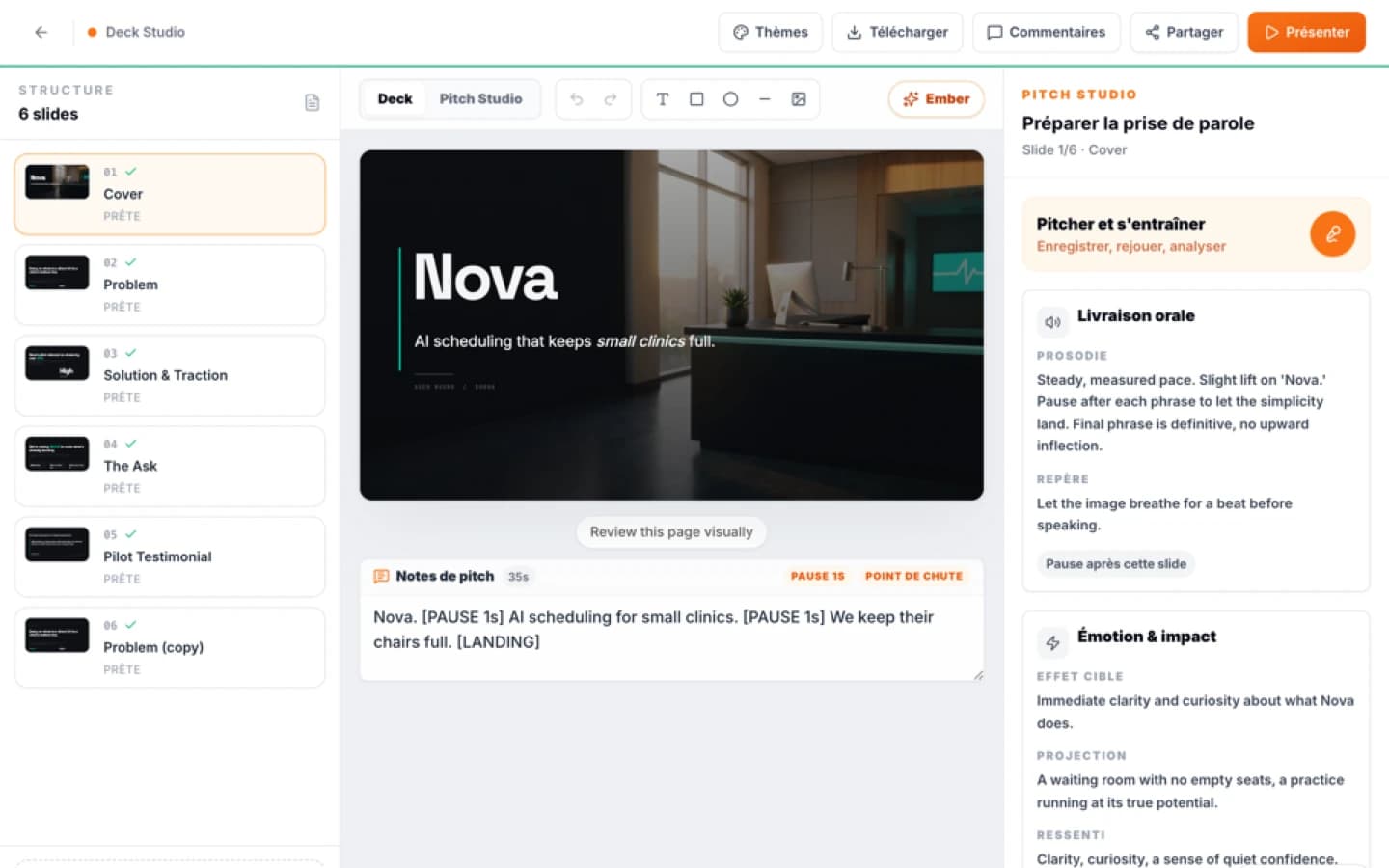
When preparing procurement artifacts, sales teams must adjust commercial details without rebuilding entire presentations from scratch. Within the Ember ecosystem, the Creation module generates and edits eight visual formats directly from project data, including presentation decks and one-page executive briefs.
The tool operates on a fixed canvas within the browser, allowing sales professionals to edit targeted zones, maintain metric audit trails, and export clean deliverables to PDF or PowerPoint. Every operational figure retains its reference data, while uncited projections are explicitly marked as working assumptions to maintain enterprise credibility.
Final Checklist Before Submitting to Sourcing
Before delivering the presentation to your procurement lead, verify the collateral against three enterprise diligence standards:
- Self-Sufficiency: Can an unaffiliated legal or finance reviewer understand the scope, cost profile, and operational governance within five minutes without a live walkthrough?
- Citation Discipline: Are all metric assertions and performance SLAs backed by documented operational data or clearly qualified as estimates?
- Export Integrity: Is the file rendered in a standardized, paginated format such as PDF or PowerPoint that integrates smoothly into enterprise vendor management repositories?
Sources
FAQ
Mini audit
Test your Pitch Deck
Get an initial diagnosis of substance, form and impact.