
Definition
When a business-to-business (B2B) sales team operates without an inbound marketing funnel, they cannot rely on passive lead acquisition metrics. Instead, weekly tracking must focus on active outbound sales for startups, measuring the direct inputs and early signals of the sales pipeline. In this environment, weekly measurement shifts from monitoring website traffic and content downloads to tracking active b2b prospecting, lead qualification quality, and conversation velocity.
For an early-stage founder asking who should an early-stage founder contact first, the priority is always the tightest definition of your Ideal Customer Profile (ICP). Rather than chasing broad markets, founders must target decision-makers who face the exact problem the product solves today. When considering how does a founder qualify B2B leads without a sales team, the answer lies in setting up a rigorous lead scoring framework based on actual buyer signals and company changes, rather than relying on manual, time-consuming research.
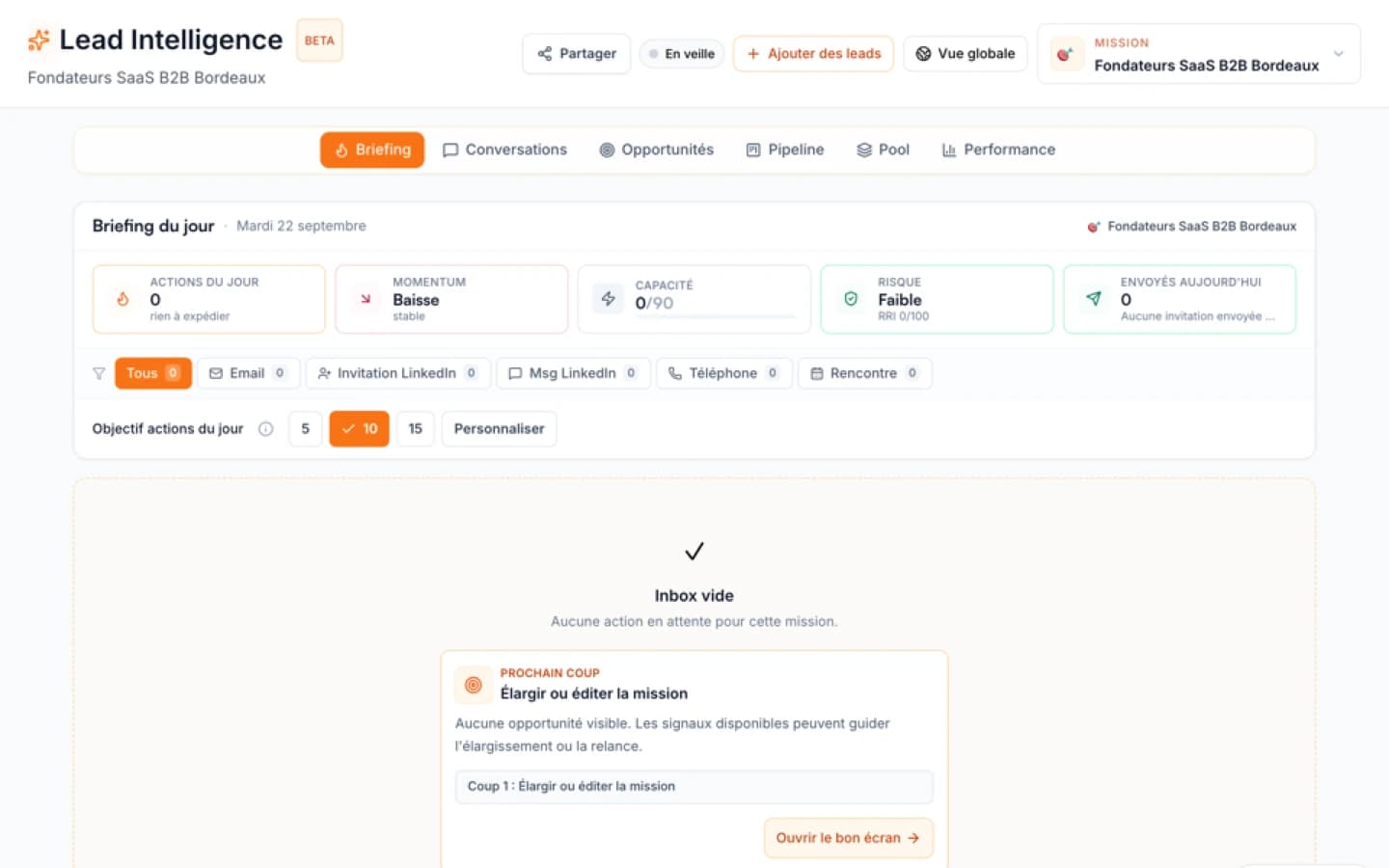
Building a prospect list from scratch requires a shift from quantity to quality. According to Apollo’s history page, Apollo.io, a platform focused on outbound activity, reached 150 million dollars in annual recurring revenue in May 2025, but a team without a marketing funnel must prioritize precision. Weekly metrics should track the percentage of qualified leads within the Customer Relationship Management (CRM) system, the response rate of highly targeted cold outreach, and the progression of these conversations into active sales opportunities. By focusing on these high-value indicators, a Sales Development Representative (SDR) or founder can maintain a healthy pipeline without wasting resources on unverified contacts. Modern platforms like Ember support this transition through Lead Intelligence, helping teams prioritize the conversations that deserve attention now based on context rather than raw database volume.
To place this decision in context, the Knowledge guides for sales brings together deeper guidance on the same field.
Prerequisites
surements require a shift from passive observation to active tracking of the outbound engine. Before a sales team can reliably measure weekly performance, they must establish several foundational prerequisites. These prerequisites ensure that the metrics tracked actually reflect market reality rather than vanity activity.
First, the team must have a validated Ideal Customer Profile (ICP). Without a clear definition of who the product is for, any outbound sales for startups will result in wasted effort and skewed data.
How does a founder qualify B2B leads without a sales team? A founder can qualify business-to-business (B2B) leads early by mapping target accounts against specific, observable business changes rather than relying on broad, static lists. This form of lead qualification ensures that b2b prospecting targets high-intent accounts.
Who should an early-stage founder contact first? When building a prospect list from scratch, an early-stage founder should contact first those buyers who have the most immediate, painful version of the problem, often indicated by recent organizational changes, technology installations, or hiring patterns.
Second, the team needs a clean data infrastructure to support lead scoring and track the health of the sales pipeline. Incumbent tools are highly effective for establishing this baseline. For example, Apollo (Apollo) presents itself as an AI system for Go-To-Market teams. According to Apollo’s history page, Apollo.io reached 150 million dollars in annual recurring revenue (ARR) in May 2025.
However, teams must watch the credit math associated with traditional databases. According to Factors.ai, some organizations outgrow Apollo's credit limits or need more flexible renewal options.
Alternatively, teams looking for highly customized data enrichment might use Clay (Clay), which acts as an infrastructure for Go-To-Market (GTM) teams to run agentic workflows, integrating with LinkedIn Sales Navigator (Clay Integrations) and sequencers like Outreach or Instantly (Clay Integrations).
Third, a closed-loop Customer Relationship Management (CRM) setup is essential. Every interaction, from cold outreach to booked meetings, must be logged to measure weekly progress. Without this, tracking metrics like the B2B sales funnel (SalesHive) or critical sales metrics (monday.com) becomes impossible. This setup allows Sales Development Representatives (SDRs) to focus on high-yield activities rather than manual data entry.
By establishing these prerequisites, teams can transition from raw volume to high-context prioritization, a methodology that tools like Ember's Lead Intelligence are designed to support by focusing on opportunity readiness rather than credit-metered databases.
Steps
To establish a weekly measurement routine for outbound sales for startups, teams must transition from passive tracking to active pipeline management. This structured approach to b2b prospecting requires a clear methodology for building a prospect list from scratch, qualifying leads, and tracking outbound activity. First, the team must focus on building a prospect list from scratch. When deciding who to contact first as a founder or an early-stage sales lead, the priority must always be high-fit accounts that match a strictly defined Ideal Customer Profile (ICP). Instead of purchasing massive, unverified databases that quickly decay, founders and Sales Development Representatives (SDRs) should identify a small, highly targeted group of decision-makers who are experiencing the specific pain points their product solves. Second, the team must establish a rigorous process for lead qualification. If you are wondering how does a founder qualify B2B leads without a sales team, the answer lies in looking for active buying signals rather than relying on manual lead scoring or guesswork. To understand how to qualify b2b leads early, a founder can monitor organizational changes, such as new executive hires or shifts in technology stacks, before initiating cold outreach. This ensures that every conversation is grounded in real-time context rather than generic assumptions. Third, the team should measure weekly activity inputs and conversion rates within their Customer Relationship Management (CRM) system. Tracking 15 critical sales metrics, as outlined by monday.com, allows teams to understand the health of their sales pipeline. However, teams must avoid the trap of prioritizing volume over quality. A volume-first approach, where teams count emails sent rather than conversations obtained, often leads to high credit costs and low conversion rates. This volume-heavy approach often leads to high credit costs and low conversion rates. Finally, teams can leverage advanced tools to streamline this weekly measurement. Ember offers a dedicated Lead Intelligence capability that helps founders and sales teams prioritize opportunities with their context. With usable targeting context, the first prioritized leads can appear in about 30 minutes, allowing the team to focus their weekly efforts on the conversations that deserve attention now.
To explore this point further, Full-Cycle Sales Calendar: Serve Buyers and Refill Pipeline details a step directly related to this decision.
Worked example
To make this worked example highly practical for sales teams, let us look at a concrete weekly tracking routine for a team running outbound sales for startups without any inbound marketing funnel to rely on. In this scenario, the traditional marketing qualified lead metrics do not exist. Instead, the team must measure the precision of their b2b prospecting and the velocity of their sales pipeline.
When designing this weekly routine, a common question arises: how does a founder qualify B2B leads without a sales team? Additionally, who should an early-stage founder contact first? The answer lies in moving away from raw volume and focusing on high-relevance signals.
For a team building a prospect list from scratch, a typical weekly scorecard should track three core areas: targeting precision, signal detection, and conversation quality.
First, targeting precision replaces passive lead scoring. Instead of measuring how many contacts were added to a database, the team measures the percentage of discovered accounts that strictly match the Ideal Customer Profile (ICP). Traditional tools like Apollo offer a contact database, sequence automation, and a Chrome extension, and Coldreach notes that, for some users, Apollo credits run out faster than expected.
Second, signal detection measures how many target accounts have experienced a recent trigger event, such as a leadership change or a technology shift. Platforms like Clay act as infrastructure for Go-To-Market (GTM) teams and Revenue Operations (RevOps) engineers to get data, run agentic workflows, and launch GTM plays, offering integrations with tools like Salesloft, Outreach, Instantly, Smartlead.ai, and HubSpot Sequencer, as shown on the Clay integrations page. Clay also offers an Sales Navigator data point for lead discovery and connection insights, as detailed on the Clay Sales Navigator integration page.
Third, conversation quality tracks how many cold outreach attempts turn into meaningful business discussions. Rather than focusing solely on the 15 critical business to business sales metrics that general Customer Relationship Management (CRM) platforms track, as outlined by monday.com, outbound sales for startups must prioritize metrics that reflect real engagement. This means measuring the ratio of positive replies to total outreach, rather than just open rates.
To make this operational, a founder or sales team can use Ember and its Lead Intelligence capability. Lead Intelligence helps founders and sales teams prioritize opportunities with their context. It reduces noise by focusing attention on opportunities that deserve action now. Instead of spending hours on manual lead qualification, the system finds accounts from the mission ICP and signals, then verifies useful sources. The weekly metric to track here is the readiness level of each opportunity, which helps the team decide who to contact first, why now, and with which angle, ensuring that every cold outreach effort is grounded in actual context rather than generic templates.
Common mistakes
When building an outbound sales engine without the safety net of inbound marketing, sales teams and early-stage founders frequently fall into predictable measurement traps. The most common error is managing by raw activity volume rather than conversation quality.
Many Sales Development Representatives (SDRs) and Customer Relationship Management (CRM) managers focus their weekly tracking on the sheer quantity of cold outreach sent. This volume-first mindset is common. According to Apollo’s history page, Apollo.io reached 150 million dollars in annual recurring revenue in May 2025, but a pure volume play creates hidden costs: when teams measure their weekly success by the number of emails sent, they ignore the compounding expenses of credit-based pricing models, and Coldreach notes that Apollo credits sometimes run out faster than expected.
Another critical mistake is failing to establish early lead qualification. This raises an important question for early-stage companies: how does a founder qualify B2B leads without a sales team? When a founder is acting as the sole salesperson, they cannot afford to waste hours on manual research or generic prospecting. Instead of building a massive, unverified list, they must learn who to contact first as a founder. The answer lies in identifying accounts that exhibit immediate, actionable signals rather than relying on static firmographic data.
When building a prospect list from scratch, founders and sales teams often overcomplicate their technology stack. They might attempt to build complex data pipelines using tools like Clay, which provides Go-To-Market (GTM) engineers with infrastructure to run agentic workflows and connect various sales engagement tools (source). While highly customizable, this infrastructure requires significant technical oversight. For smaller teams, it often leads to an administrative trap where more time is spent managing data integrations than having actual sales conversations.
To avoid these pitfalls, weekly tracking must shift from measuring static database exports to tracking active opportunity readiness. This is where a dedicated solution like Ember and its Lead Intelligence capability changes the dynamic. Instead of forcing you to manage complex integrations or pay for wasted contact credits, Lead Intelligence focuses on reducing noise. It uses your Ideal Customer Profile (ICP) and business context to prioritize opportunities that deserve action now. By identifying the exact signal, the right channel, and the best angle for each contact, it helps teams measure what truly matters: the velocity of meaningful business conversations.
This approach also connects with No Marketing Ops: Build a Four-State B2B Lead Queue, which clarifies the next choice.
Tools
To manage weekly metrics without a marketing funnel, sales teams must rely on a robust software stack that balances data enrichment with execution. Traditional tools excel when a company has dedicated resources to manage complex workflows. For instance, Apollo presents itself as "The AI GTM System for Go-to-Market Teams" (Apollo). According to Apollo’s history page, it reached 150 million dollars in annual recurring revenue in May 2025, and Factors.ai notes that some organizations outgrow its credit limits or need more flexible renewal options. For teams requiring highly customized data pipelines, Clay serves as an advanced infrastructure for Go-To-Market (GTM) teams and GTM engineers to gather data, run agentic workflows, and launch GTM plays (Clay). It integrates deeply with sales engagement platforms like Salesloft, Outreach, Instantly, Smartlead.ai, and HubSpot Sequencer (Clay Integrations), and includes a LinkedIn Sales Navigator data point for lead discovery and connection insights (Clay Sales Nav). While Clay is an exceptional tool for technical operations, it requires a clear strategy to avoid generating excessive noise. When executing outbound sales for startups, a common challenge is knowing how to qualify Business-to-Business (B2B) leads early without a dedicated sales team. How does a founder qualify B2B leads without a sales team? Instead of spending hours on manual lead scoring or managing complex databases, founders can use context-driven qualification. This answers the critical question of who should an early-stage founder contact first. When building a prospect list from scratch, the priority should always be prospects who exhibit active buying signals, rather than a generic list of cold accounts. This is where Ember offers a different approach. Through its Lead Intelligence capability, Ember helps founders and sales teams prioritize opportunities with their context, reducing the noise of traditional B2B prospecting. Instead of managing complex credit math or setting up intricate data pipelines, Lead Intelligence focuses attention on opportunities that deserve action now. It provides a clear next action, detailing who to contact, why now, which channel to use, and which angle to take. Because it is volume-independent, it works whether you start with 10, 100, or 1000 contacts, with no minimum contact threshold required to find meaningful patterns. By focusing on explainable priority and real-time signal monitoring, it turns cold outreach into structured, high-probability conversations.
When to use this method
This weekly tracking methodology is designed for specific operational scenarios where traditional, inbound-focused marketing metrics do not apply. If your sales pipeline relies entirely on proactive outbound prospecting rather than waiting for inbound form fills, implementing this framework prevents your team from flying blind. ### When launching outbound sales for startups Early-stage founders often face the challenge of establishing a Go-To-Market (GTM) motion from scratch without the support of a dedicated marketing department. When considering how does a founder qualify B2B leads without a sales team, the answer lies in adopting a highly disciplined, signal-based tracking routine. Instead of guessing who should an early-stage founder contact first, this method directs focus toward a narrow, well-defined Ideal Customer Profile (ICP). By focusing weekly metrics on active conversation starters rather than raw email volume, a founder can execute effective lead qualification without getting overwhelmed. This approach ensures that every outbound effort is grounded in real company changes or individual triggers, making cold outreach feel relevant and timely rather than intrusive. ### When building a prospect list from scratch When a Sales Development Representative (SDR) is tasked with building a prospect list from scratch, there is a high risk of importing low-quality data into the Customer Relationship Management (CRM) system. Tracking the health and readiness of your target list on a weekly basis helps maintain outbound momentum. This tracking method should be deployed when your team needs to transition away from static databases and toward dynamic lead scoring. According to Factors.ai and Coldreach, some teams find their Apollo credits too tight and report outdated data or bounced emails, a reminder that a massive contact database is not enough on its own. This weekly tracking method is highly effective when a team decides to optimize for conversation quality over raw activity metrics. By measuring the ratio of positive replies to total contacted accounts, sales leaders can identify which specific segments are actually engaging, allowing them to adjust their targeting parameters in real time. For teams looking to operationalize this approach without adding manual administrative overhead, Ember provides a direct solution. Through its Lead Intelligence capability, Ember helps founders and sales teams prioritize opportunities using their specific business context. This enables sales teams to maintain a rigorous weekly tracking cadence focused entirely on high-value conversations.
In practice, One Qualification Contract Across Every B2B Channel completes this framework with another angle on the same topic.
When not to use it
This weekly outbound tracking framework is not a universal solution for every business model. It should be set aside if your organization relies on a highly predictable inbound marketing funnel. When marketing consistently delivers high-quality leads, your primary focus should be on speed to lead and conversion rates, rather than tracking proactive outbound metrics.
Similarly, this methodology is not designed for early-stage founders who are still searching for product-market fit. If you are trying to understand how does a founder qualify B2B leads without a sales team, the answer is not to implement structured weekly outbound tracking. Instead, qualification at this stage requires manual, deep-dive research into specific company changes and pain points. When considering who should an early-stage founder contact first, the focus must remain on a small, highly curated list of early adopters who have a verified, immediate need, rather than running broad outbound campaigns.
Finally, this qualitative tracking approach is not suitable for organizations that rely on massive, automated outbound volume. For companies that have scaled their sales operations to support thousands of automated touchpoints per day, credit-based prospecting platforms like Apollo can be enough. In those environments, Revenue Operations (RevOps) teams require highly granular, activity-based metrics that align with credit-metered database usage. For teams that prefer to avoid the noise of high-volume outbound, Ember and its Lead Intelligence capability offer a way to focus on high-priority opportunities based on real context rather than sheer activity metrics.
Action plan
To transition from a blank slate to a predictable weekly rhythm, sales teams and early-stage founders must execute a structured, four-step action plan. This framework shifts the focus from vanity metrics to real, conversational momentum. Step 1: Establish the baseline and target list. Building a prospect list from scratch requires absolute clarity on your target audience. If you are wondering who should an early-stage founder contact first, the answer lies in identifying high-intent accounts that match your Ideal Customer Profile (ICP). Instead of scraping thousands of random contacts, focus on a tight list of high-value accounts. This approach is especially critical when using traditional outbound platforms. For example, according to Factors.ai, some organizations outgrow Apollo's credit limits, and credit-based pricing can compound costs as teams scale. To avoid wasted credits and high bounce rates, start with highly curated, signal-rich accounts rather than raw volume. Step 2: Qualify B2B leads early. How does a founder qualify B2B leads without a sales team? The secret is to automate the heavy lifting of lead qualification before initiating cold outreach. Rather than relying on manual research, founders can use modern intelligence tools to evaluate account readiness. This step ensures that your Sales Development Representative (SDR) or your own limited hours are spent only on prospects experiencing active trigger events, such as leadership changes or technology shifts. By establishing a clear lead scoring system based on real-time signals, you protect your sales pipeline from being clogged with unresponsive contacts. Step 3: Measure weekly conversational velocity. Instead of tracking raw email volume, which often leads to deliverability issues and high opt-out rates, measure the quality of your weekly interactions. Track how many meaningful conversations are initiated, how many prospects ask clarifying questions, and how many progress to a scheduled meeting. According to resources on B2B sales metrics from monday.com, monitoring the progression of deals through the pipeline is far more indicative of health than simply counting the number of outbound attempts. This focus on conversational velocity keeps the team aligned on revenue-generating activities rather than administrative busywork. Step 4: Centralize data in your Customer Relationship Management (CRM) system. Every interaction, positive or negative, must be logged to build a historical record of what works. A clean CRM ensures that your outbound sales for startups remains organized and repeatable. Over time, this data reveals the exact characteristics of the accounts that convert, allowing you to refine your targeting criteria for the following week. For teams looking to streamline this process without the complexity of traditional databases, Ember offers a direct alternative. Through the Lead Intelligence capability, Ember reuses your existing Business Plan, ICP, offer, and strategy to prepare a targeted sales mission. Instead of spending days building lists, the system finds accounts based on active market signals and delivers your first prioritized leads in about 30 minutes, with no minimum contact threshold required to start. This allows founders and sales teams to focus entirely on executing their weekly action plan and closing deals, rather than managing complex data pipelines.
Before deciding, Manual Lead Scoring With Overrides for Small B2B Teams helps connect this method with adjacent priorities.
Sources and methodology
Sources consulted on 2026-09-28: monday.com (15 critical B2B sales metrics), SalesHive (the B2B sales funnel), Apollo’s history page (Apollo.io revenue), Factors.ai and Coldreach (Apollo alternatives), Apollo, Clay, Clay integrations and Clay Sales Navigator data point.
Sources
FAQ
Free diagnostic
Test your sales file
Drop an Excel or CSV and check its readiness without sending its rows to Ember.