
What prioritizing means in 2026
For the head of a French SME in 2026, prioritizing means deciding what the company stops, what it protects and what it funds first when cash no longer allows everything to run at once. The question is not "which new initiatives should we launch?" but "which short list of actions does the most good for cash and growth over the next three to six months?".
A word on scope. In this article, an SME is the category defined by Insee, the French national statistics institute: a business with fewer than 250 people and either annual turnover of no more than 50 million euros or a balance sheet total of no more than 43 million euros. Microenterprises form a subcategory, with fewer than 10 people and turnover or balance sheet total not above 2 million euros. We deliberately stay with France, because the payment rules, the support schemes and the remedies discussed here are French, and because the figures come from the Banque de France, Bpifrance and the public administration.
Why such a narrow frame? Because the "SME priorities" advice circulating online often mixes countries, company sizes and economic cycles that have little in common. A survey of American executives says nothing about supplier credit in France, and a list of eleven generic tips does not tell you which lever comes first. We therefore set those sources aside and start again from open, dated French public data.
Here is the working definition we use. Prioritizing means ordering three things, in this sequence: first short-term cash (what you collect and pay out over the coming weeks), then available financing (bank credit, payment schedules granted by the tax and social authorities, public support), and finally the commercial actions that produce cash quickly. Every decision is judged on whether it improves that ranking, not on how new it is.
Ember, the publisher of this blog, offers tools that touch on this subject, notably Fund Your Growth and Lead Intelligence. We present them further down, in their proper place, after the public facts. To put this decision in context, the Knowledge guides on sales bring together the in-depth analyses of the same field.
Why cash comes before everything else
Three recent public signals explain why cash is the first priority.
The first is business failures. In its publication of 4 September 2026, the Banque de France reports that at the end of July 2026 there were 70,605 business failures over twelve rolling months, against 70,816 at the end of June. The figure therefore eased slightly from one month to the next, but it remains high, and the Banque de France links it to a degraded economic situation and successive shocks that have weakened the finances of some companies. The figure covers all companies, not only SMEs, and it does not say who will fail tomorrow: it describes the climate in which you decide.
The second signal is credit. On its business financing page, consulted on 29 September 2026, the Banque de France writes that twelve-month growth in credit outstandings is falling for every company size, at 2.2% for SMEs and companies of undetermined size, 0.8% for mid-caps and 6.3% for large companies. The cost of new financing in July is rising for SMEs, to 3.72%. The same page notes that outstanding cash credit fell 1.4%, after a 0.2% rise in June, without distinguishing company size in that sentence. In practice, an SME that counted on a cash line to absorb a shortfall cannot take access for granted, and it costs a little more than the month before.
The third signal comes from managers themselves. The quarterly barometer from Bpifrance Le Lab, produced with Rexecode and published on 19 May 2026, reports that 34% of very small businesses and SMEs are in a difficult cash position, that 46% of managers have invested or plan to invest this year, and that 61% of respondents cite demand constraints as the main brake on growth. In other words, when cash is tight investment becomes selective, and the sales question turns into a demand question: finding the right customers rather than more customers.
A fourth element, less visible, makes things worse: late payment. The 2024 annual report of the Observatoire des délais de paiement, published in July 2025, finds that persistent late payment penalizes the cash of SMEs and microenterprises by 15 billion euros. At the end of 2024 the average delay reached 13.6 days, and large companies remain the worst payers, with delays averaging 18 days. This means part of an SME's cash strain does not come from a lack of sales, but from money already earned and not yet collected.
That is why this article puts cash ahead of growth. It decides what you can still do, and in what order.
How to go about it, step by step
The method has five steps. It requires few tools and a lot of discipline. You can run it in a spreadsheet; the tools described at the end speed it up, they do not replace it.
Step one, look at cash squarely over thirteen weeks. Write down, week by week, what you expect to collect and what you must pay: salaries, social contributions, rent, suppliers, loan instalments, taxes. The goal is not accounting precision but spotting the first week when the balance turns negative and sizing the gap. Without that date, every other priority remains an opinion.
Step two, go and collect the money already earned. List your overdue invoices by customer and by age. Article L441-10 of the French Commercial Code, in the version in force consulted on 29 September 2026, provides that the period agreed between the parties for settling sums due cannot exceed sixty days after the invoice date, and that a maximum of forty-five days end of month may be agreed. Compare that ceiling with your real terms of sale and your observed delays. Chase the largest and oldest amounts first, then see whether your payment terms should be tightened for future invoices. The applicable version depends on the date of your contracts: if in doubt, have your adviser or accountant check.
Step three, know your financing remedies before you need them. Three public schemes exist for companies under pressure. According to the Banque de France, the Médiation du crédit is a local, free and confidential service, open to any company facing financing difficulties with its financial partners. For tax and social debts, the Commission des chefs des services financiers (CCSF) examines a staggered payment plan: according to justice.fr, referral is free and confidential and there is no publication at the commercial court. Finally, the tax administration offers individual support to financially fragile companies, through the departmental adviser for companies in difficulty at the public finance directorate.
Step four, narrow the commercial effort around a few accounts. When demand is the first brake, the classic mistake is to widen the net. Start from your best past customers: who paid fast, bought again, recommended you? Describe that profile in a few lines, then look for companies that resemble it and show a recent sign of need (hiring, opening a site, a tender, a change of manager). Thirty well-chosen conversations are worth more than three hundred cold messages.
Step five, prepare the story that makes all this defensible. A banker, an investor or a major customer decides faster when handed a clear plan: need, use of funds, assumptions, deadlines. That story is built once, then updated.
Ember can support steps three to five. Fund Your Growth guides the manager through the building blocks of the project and links assumptions, evidence, funding needs and action plan; the project's country is set when the file is created, with France offered as a direct option. Lead Intelligence serves step four: a prospecting mission reuses the context already entered to suggest whom to contact, why now and with what angle. Creation helps put the file into shape: three templates with a preview, useful questions asked before production, and a confirmation requested before anything is created.
To go further on preparing external financing, B2B revenue forecasting for investors without a finance hire details a step directly tied to this decision.
Prioritizing rather than funding everything: the difference
Faced with slowing growth, two reflexes compete.
The first reflex, which we will call the classic approach, is to add: more prospecting, more channels, more features, more hires, financed by more debt. It works when cash is comfortable and the market is buoyant. It rests on an assumption that public figures call into question: that money will be available when you need it. Yet, as we saw, credit to SMEs grows 2.2% over twelve months, more slowly than for large companies, and its cost is rising.
The second reflex, prioritization, is to subtract first. You keep the spending that protects collections, you pause what pays back after more than six months, and you concentrate commercial energy on a few accounts. The gain is not a growth miracle: it is time. A company with thirteen weeks of visibility negotiates better with its bank, decides better on a hire and copes better with a customer who pays late.
Take two fictional managers, for illustration. The first sees sales stall and launches three prospecting campaigns in parallel, financed by an overdraft. The second spends half a day laying out the next thirteen weeks, chases overdue invoices, keeps a single campaign and prepares a costed financing file before needing it. Neither is safe from a shock, but the second knows when it will hit and what to do.
The difference also lies in the order of the questions. The classic approach asks "how do we sell more?". Prioritization asks "what in my business turns effort into cash fastest, and what is stopping it today?". The answer is often less glamorous than a new channel: a forgotten invoice, a quote nobody followed up, a customer to call back.
This approach also benefits from being read alongside a guide to building a targeted investor list in B2B, which sheds light on the next choice when financing goes through investors.
A concrete example
The example below is illustrative: the company, its figures and its choices are invented to show the method. They describe no real business.
Imagine a French industrial services SME of 40 people that installs and maintains equipment at mid-sized customers. Its turnover has been flat for two years, its margin is slipping because of costs, and its manager, whom we will call Claire, has several ideas: open a second site, launch a remote maintenance offer, hire two salespeople.
Claire starts with cash. Building her thirteen weeks, she sees the balance dropping below zero in week nine, because two loan instalments and payroll fall before a large project is paid. She lists her overdue invoices: four customers are well past the sixty days from invoice date that she had set herself in her terms of sale. She chases the two largest first, which, in our scenario, is enough to push the low point back by three weeks.
She then prepares her remedies without triggering them: she identifies the contact for the credit mediation and the departmental adviser at the public finance directorate, and notes which documents each one asks for. This preparation costs nothing and shortens the delay if the need arises.
Then comes the commercial choice. Rather than hire two salespeople, she decides to use her history: her ten best customers all turn out to be mid-sized production sites that have just renewed their equipment. She looks for companies with a similar profile and builds a short list of accounts to approach with a precise angle. She describes the whole in Fund Your Growth, then uses Lead Intelligence to spot whom to contact and why, remembering that every message is still sent by hand.
That leaves the second site. Claire pauses it: her financing file would today show too many unproven assumptions. She sets two conditions to reopen it, a positive cash balance over thirteen weeks and two new customers from her short list. The project is not abandoned, it is conditional, and each condition can be measured.
What this example shows: the most useful decision was not a growth idea but the order in which Claire handled her topics.
Limits
This method has limits, and it is better to know them before applying it.
Public data are averages. The Banque de France's 70,605 failures cover all companies, and the 2.2% credit growth is an average for SMEs and companies of undetermined size, very small businesses included. Your sector, region and bank can differ sharply from these benchmarks.
The Bpifrance Le Lab barometer is a declarative survey of managers of very small businesses and SMEs. Its results reflect sentiment at a given moment, here spring 2026; they do not prove what will happen to your company. They help you tell whether your situation is shared or singular.
The late-payment figures date from the end of 2024. They are useful for understanding the mechanism, less so for sizing your current exposure. For that, only your own aged receivables list counts.
On the legal side, this article replaces neither a lawyer nor a chartered accountant. We cite Article L441-10 of the Commercial Code in the version consulted, whose page indicates a validity period ending on 1 January 2027: the text may therefore change, and its application to your contract depends on the contract's date and nature. The CCSF and credit mediation schemes have their own conditions, which their official sites describe; we give only their spirit here.
Finally, tools have limits. Ember does not guarantee that financing will be obtained, and a well-structured file is neither an accounting certification nor an investor's decision. Fund Your Growth is offered with progressive access, depending on the account and the rights enabled. Lead Intelligence does not replace your judgment about whom to contact: an enrichment wave processes at most 200 contacts, and sending messages stays manual by design.
In practice, Euro area and investors: how to structure your choice complements this framework with another angle on the same subject.
When this method fits
This approach is relevant in four situations.
When your cash margin is thin. If you cannot say today, to the week, when your balance risks turning negative, you are in the case where a thirteen-week table changes your decisions. This is also true for a profitable company: an SME can have a good accounting result and a bad cash month.
When your customers pay later than your terms provide. If your observed delays clearly exceed those in your contracts, the first job is not commercial, it is administrative. According to the Observatoire des délais de paiement, late payment weighs 15 billion euros on the cash of SMEs and microenterprises, and it is large companies that pay worst.
When demand is your main brake. That is the case for 61% of respondents in the Bpifrance Le Lab barometer of spring 2026. If you recognize yourself there, the useful question is which accounts to concentrate on, not how to multiply channels. A tool like Lead Intelligence helps here: it works whether you start from 10, 100 or 1,000 contacts, with no minimum threshold, and it ranks opportunities to show where to act.
When you are preparing a conversation with a funder. Banker, investor or public body: each reacts better to a file where assumptions are visible. Fund Your Growth keeps assumptions, evidence and funding needs in one context, separating declared, estimated and confirmed figures. At file creation you choose the objective (test an idea, raise funds, loan or grant, business plan) and the project's country.
Before deciding, Bootstrapped financing: use cases for Fund Your Growth helps connect this method to neighbouring priorities.
When not to use it
This method is not right in several cases.
If your company is already unable to pay its debts as they fall due, prioritization is no longer enough. The schemes for preventing and treating difficulties have their own procedures and contacts: commercial court, court-appointed administrator, legal counsel. Do not lose time equipping a plan: consult a professional in insolvency law. What we describe here, in particular the tax administration's support or the credit mediation, addresses difficulties that can still be handled by negotiation.
If your cash is comfortable and your market buoyant, the method needlessly weighs down your management. A thirteen-week table remains good practice, but you do not need to pause projects for the sole reason that the macroeconomic context is uncertain.
If your sales team already has a well-run prospecting process, with data and tools that work, changing tools can cost more than improving what exists. Lead Intelligence completes a process; it is not meant to replace a team that knows where it is going.
If your need involves prospects' personal data, keep the rule in mind: the CNIL states that prospecting professionals can rest on the organization's legitimate interest when the subject of the approach relates to the person's profession, provided the person has been informed and can object. A tool does not release you from this obligation. If you want mass, automatic prospecting without human review, that is not what Ember offers, nor what we recommend when cash is tight.
Finally, do not use Fund Your Growth as a promise of financing: a well-built file makes a request more readable, it guarantees neither a positive answer nor an amount.
What Ember can do, and what it does not
Ember is the publisher of this blog and of products that touch on this subject. You should know this to judge this section: we are talking about our own tools, and we limit ourselves to what they actually do. For their pricing, Ember's dedicated page is the reference.
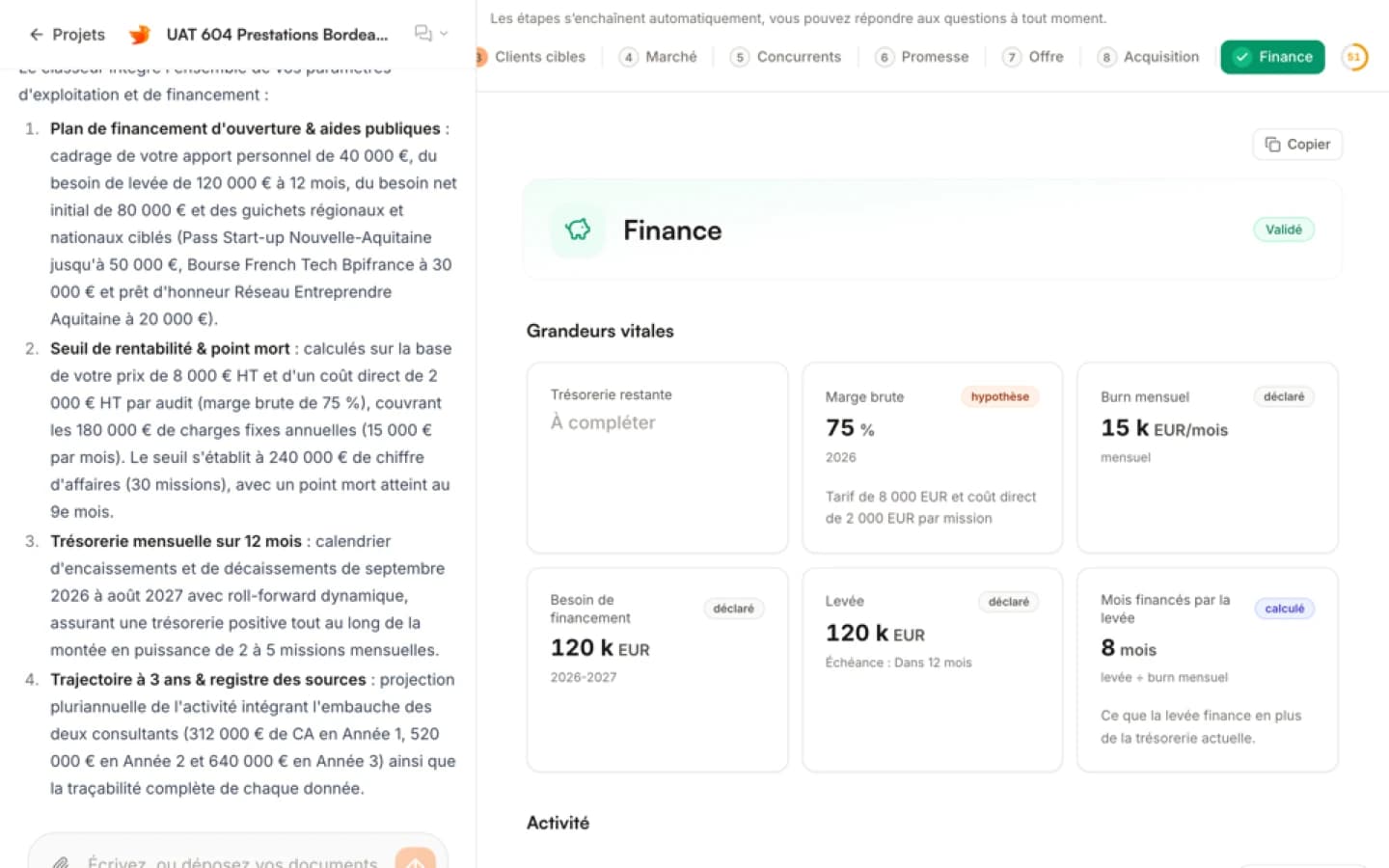
Fund Your Growth structures a project into building blocks (project, why, ideal customer, market, competitors, promise, offer, acquisition, finance), each with its versions, its evidence and its status. The agent asks only the questions still useful, and the manager approves, rejects or edits each proposal before it enters the file. The blocks are linked in a graph where weak points rise first, and decisions are tied to an action plan. The journey takes the project's country into account. For public support, the module relies on a partial base of references: when an amount is not established, it stays "to be confirmed", and nothing replaces reading the official source for the scheme. Access is progressive, depending on the account and the rights enabled.
Lead Intelligence turns a prospecting or fundraising mission into contacts, signals and next actions. It reuses the project context, looks for accounts according to your ideal customer, checks sources, ranks opportunities and suggests a channel and an angle. An enrichment wave processes at most 200 contacts, and sending stays manual: the cadence proposes, it never sends by itself. A candidate set aside by the engine is not deleted: it stays visible with the reason for its rejection, and a person can put it back to contact.
Creation produces editable materials from the context. It offers three templates with a preview, asks the useful questions, then requests confirmation before creating. Its rehearsal area is called Speaking practice.
What Ember does not do: it does not replace your chartered accountant, provides no legal or tax advice and guarantees neither financing nor a meeting. For a full overview of French support and financing, the official sites cited in this article remain the reference.
To move from analysis to action, Fund Your Growth presents the matching Ember journey.
The official figures to keep
To keep the essentials in mind, here are the benchmarks cited, with their source and scope. They are orders of magnitude, to be set against your own situation.
- Business failures: 70,605 over twelve rolling months at the end of July 2026, against 70,816 at the end of June (Banque de France, published 4 September 2026). All company sizes combined.
- Business credit: twelve-month growth of 2.2% for SMEs and companies of undetermined size, 0.8% for mid-caps and 6.3% for large companies; cost of new SME financing of 3.72% in July 2026 (Banque de France, page consulted on 29 September 2026).
- Cash credit: outstandings down 1.4% in July, after a rise of 0.2% in June (same page).
- Perceived cash position: 34% of very small businesses and SMEs judge their cash position difficult, 46% have invested or plan to invest in 2026, 61% cite demand as the main brake (Bpifrance Le Lab and Rexecode, second-quarter 2026 barometer, published 19 May 2026).
- Late payment: a 15 billion euro effect on the cash of SMEs and microenterprises, an average delay of 13.6 days at the end of 2024, 18 days on average for large companies (Observatoire des délais de paiement, 2024 annual report, published 11 July 2025).
- Legal terms: at most 60 days after the invoice date, or 45 days end of month if the parties provide for it (Article L441-10 of the Commercial Code, version consulted on 29 September 2026).
- Remedies: free and confidential credit mediation, file admitted within 48 hours, 105 territorial mediators (Banque de France); free and confidential CCSF to spread tax and social debts (justice.fr, sheet dated 27 November 2024).
Sources and methodology
This article was rewritten on 29 September 2026. It replaces a version that relied on an American survey and on unverified estimates. Every figure above comes from official or institutional pages that were open on that date, and each figure is cited with its source, scope and date.
Sources opened:
- Banque de France, Business failures, July 2026: twelve-month cumulative failures and context.
- Banque de France, Business financing, July 2026: growth of outstandings by size, cost of new financing, cash credit.
- Banque de France, Credit mediation: free of charge, confidentiality, admission time.
- Banque de France, 2024 annual report of the Observatoire des délais de paiement: late payment.
- Bpifrance, Le Lab and Rexecode barometer, second quarter 2026: cash, investment, demand.
- Légifrance, Article L441-10 of the Commercial Code: payment terms.
- Direction générale des finances publiques, individual support in case of economic and financial difficulties and Justice.fr, obtaining payment schedules from the CCSF.
- Insee, definition of an SME.
- CNIL, commercial prospecting by email, SMS-MMS and automated calls.
Method: we opened each page, noted the quoted sentences exactly as they appear there, and set aside any figure we could not find at the source. We could not open the JPMorgan Chase American survey cited by the previous version, so we no longer use it; likewise, we no longer reuse the revenue figures of software vendors, which say nothing about the priorities of a French SME. Information about Ember's products comes from their official description and their current behaviour.
Sources
FAQ
Mini audit
Test your Business Plan
Identify strengths, missing proof and the next priority.