
Symptom or signal
When a Business-to-Business (B2B) sales team attempts to build a lead scoring model with fewer than fifty closed deals, the primary symptom of failure is a system built on pure guesswork. Traditional lead scoring models rely on statistical significance to correlate prospect attributes with conversion rates. Without a deep history of successful sales, assigning arbitrary point values to static traits or website visits creates a false sense of security. Sales representatives end up wasting time on high-scoring leads that do not convert, while highly qualified prospects are ignored because they did not perform the specific sequence of actions the model expects.
A few concrete signs help spot it. Salespeople cannot explain why a lead is scored 80 rather than 60. The best customers of recent months had an average score. The rules were written once and never reviewed. The score changes when a weight is modified, but the team's decisions do not, because they contact the same people anyway. If you recognize two of these signs, the score reassures more than it decides.
The clear signal that your scoring model is failing is a mismatch between lead scores and actual pipeline velocity. To compensate for this lack of precision, teams often try to increase their outbound volume. But if the tool you use charges for every record enrichment or email verification, each extra action adds a cost, and more volume does not fix a poor ranking.
When data is scarce, the solution is not to guess at point values or spam the market, but to shift from static scoring to deep, contextual intelligence that prioritizes opportunities based on recent buying signals and fit.
To place this decision in context, the Knowledge guides for sales bring together deeper guidance on the same field.
What changed
The landscape of Business-to-Business (B2B) lead scoring has shifted from static, volume-heavy calculations to more contextual prioritization. Historically, sales teams relied on massive historical datasets to find statistical correlations. Contact databases are very useful when a team already knows its Ideal Customer Profile (ICP) cold and wants to build lists at scale. But when the tool charges for every enrichment or export, each step becomes a metered decision: as the team grows, wasted exports and bounced emails weigh more and more on the budget.
To bypass these limitations and score leads without a massive historical database, a team can combine several data sources with a qualitative strategy. Lead Intelligence, Ember's prospecting capability, monitors signals on people and companies to keep the context up to date. By matching them against your Ideal Customer Profile, you can identify priority opportunities without waiting for fifty closed deals to build a mathematical regression.
This means lead scoring is no longer about waiting for fifty closed deals to build a mathematical regression. Sales teams can focus their energy on accounts that show active relevance rather than relying on generic demographic guesses.
Facts and sources
Building a reliable Business-to-Business (B2B) lead scoring model when historical deal data is scarce requires relying on documented methods rather than guesswork. We reviewed three public guides, consulted on September 28, 2026. The guide from Clariant Creative, published on July 1, 2026, separates fit (who the contact is: role, company type, territory) from engagement (what the contact has done), and states that strong actions, such as a demo request, should not wait for a contact to accumulate enough points to cross a threshold. ZoomInfo, in a guide updated on January 7, 2026, explains that scoring creates a common language between sales and marketing for what "qualified" means, and that the most effective models combine fit and engagement. The Small Business Expo, in an article dated March 30, 2026, gives numeric examples of point assignment, such as 25 points for a "VP of Operations" against 5 for a "Coordinator". These examples show how a points-based score works, but not which weighting fits your market: only your own won and lost deals can tell you. Ember, the publisher of this article, offers Lead Intelligence, which finds accounts from the mission's Ideal Customer Profile (ICP) and signals, then verifies useful sources.
To explore this point further, Lead Scoring for Low-Data B2B Teams: Choose the Right Model details a step directly related to this decision.
Why the common explanation is incomplete
Traditional Business-to-Business (B2B) lead scoring guides, such as those from Clariant Creative or ZoomInfo, suggest assigning points to demographic or firmographic traits (job title, company size) and to online behaviors. The examples from The Small Business Expo add points when a prospect downloads an ebook or visits a pricing page, and subtract points for an unsubscribe. While this methodology is widely circulated, it remains fundamentally incomplete for teams operating with limited historical data. It relies on a luxury that early-stage or specialized sales teams do not have: a massive, statistically significant baseline of past conversions to prove which actions actually correlate with closed deals.
Without a large volume of historical transactions to analyze, setting up these point-based systems is little more than structured guesswork. Sales teams end up creating complex formulas based on assumptions rather than evidence. This statistical gap widens when the tool is built to support high-volume outbound activity rather than precise prioritization: producing more actions does not tell you whom to contact first. This volume-first approach does not solve the underlying prioritization problem for teams with scarce data.
When a sales team relies on volume-centric tools without a reliable scoring model, the trade-offs mount. If every enrichment, export and email verification consumes budget, wasted exports, bounced emails, and re-enrichment push the overall cost up as the team grows. Instead of helping sales representatives focus on the highest-value conversations, the common explanation of lead scoring encourages teams to burn through budget and contacts in search of statistical significance. For a team with very few closed deals, success requires moving away from arbitrary point systems and focusing instead on account context and recent buying signals.
The real problem
For sales teams operating with a limited history of closed deals, the real problem is the practical limit of traditional regression. Standard lead scoring models require a deep pool of historical data to calculate which variables actually correlate with a closed sale. When a team attempts to build a predictive model with very few closed deals, they inevitably fall into the trap of noise-driven scoring. They assign arbitrary point values to demographic or firmographic traits based on a tiny sample size, which misleads the sales team and misallocates valuable prospecting time.
In other words, the difficulty is not choosing the right formula but having enough evidence to justify any formula at all. With a handful of deals, every weight is an opinion, and the honest approach is to say so, keep the rules few and readable, and let each new conversation confirm or contradict them.
This data scarcity creates a secondary issue when paired with volume-centric sales tools: the more credits and sending capacity a team has, the more tempted it is to export and enrich contacts without knowing whether they are the right ones. When a sales team lacks a validated Ideal Customer Profile (ICP) and tries to solve the problem by increasing outbound volume, costs compound without any improvement in targeting quality.
With a dozen closed deals, a single large contract can tip all the weights. A criterion shared by two or three deals then looks decisive when it may only be a coincidence, and a criterion missing from those deals looks useless when it simply never had the chance to show up. The priorities a score proposes therefore remain hypotheses to check against real conversations. A team that knows an account well can legitimately deviate from the ranking, as long as it notes why in order to learn from it.
Without a statistically significant foundation of closed-won data, sales teams cannot rely on automated calculators to tell them who is ready to buy. Instead of predicting conversion based on past patterns that do not yet exist, teams must shift their focus. They need to evaluate opportunities based on recent buying signals, situational context, and direct indicators of intent rather than static demographic scores.
This approach also connects with How to Score B2B Leads Without CRM History or Marketing Automation?, which clarifies the next choice.
How the mechanism works
To build a reliable prioritization framework without a massive historical dataset, the scoring mechanism must shift from backward-looking statistical regression to forward-looking contextual reasoning. This is how Lead Intelligence operates. Instead of calculating mathematical correlations from hundreds of past transactions, the system uses an agentic workflow that researches, analyzes and turns the available context into next sales actions.
The process begins with an understanding of your business foundation. Rather than asking a sales team to assign arbitrary numerical points to static firmographic criteria, Lead Intelligence reuses your Business Plan, Ideal Customer Profile (ICP), offer and strategy to prepare a sales mission. This strategic context serves as the baseline for evaluating every potential opportunity.
Once this foundation is set, Lead Intelligence searches for accounts from the ICP and the mission's signals, then verifies useful sources. It then monitors signals on people and companies to keep the context up to date. Because the system understands context and human relationships, it detects movements of people and companies to adjust priorities, which a rigid, point-based calculator does not do.
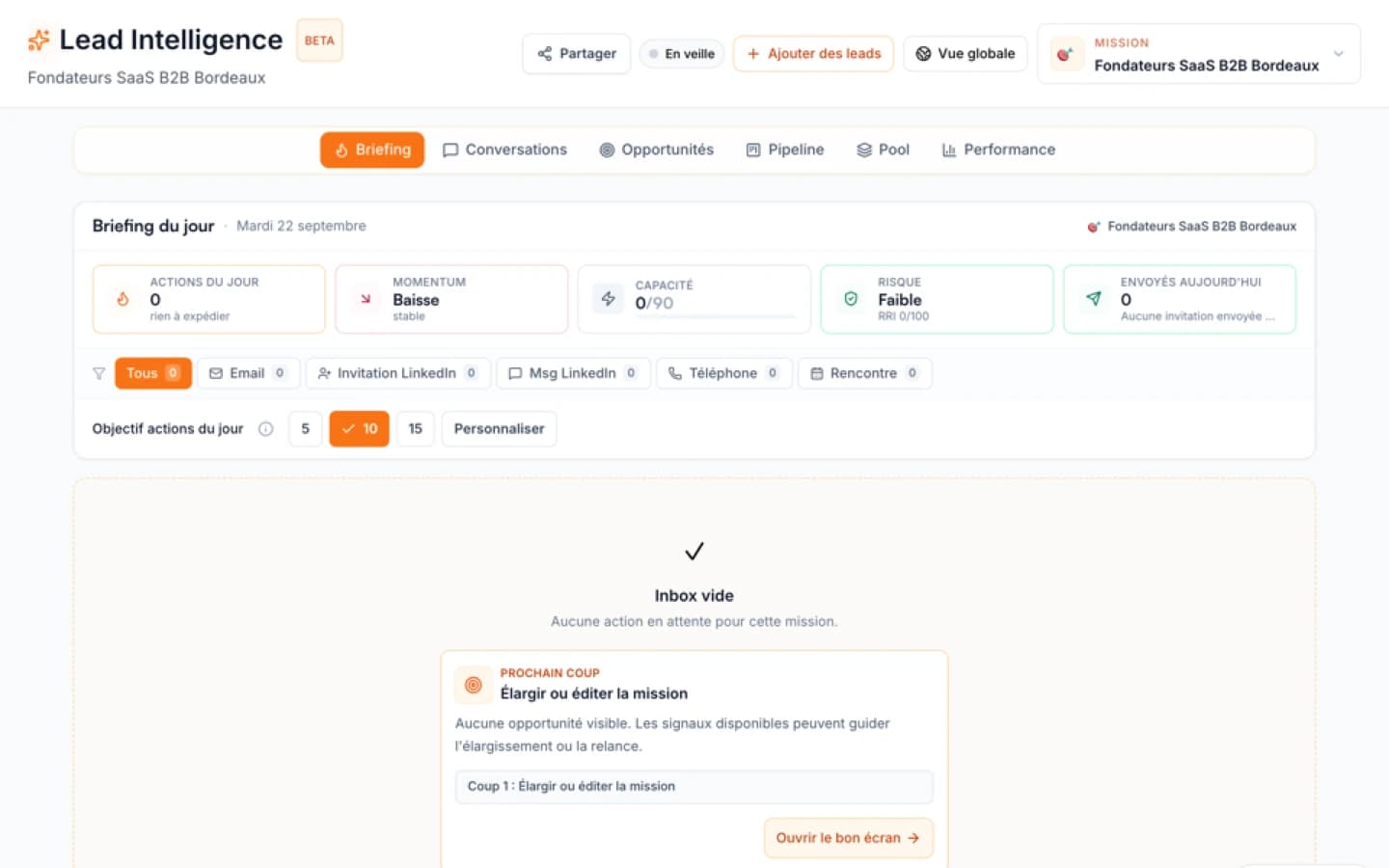
Instead of producing a generic numerical score that offers no guidance on execution, Lead Intelligence classifies accounts into explained opportunities: to watch, to act on, or to set aside. The priority can be explained from the context, the signals and the opportunity's level of readiness. The sales team receives a clear next action: whom to contact, why now, through which channel and with what angle.
This context-driven approach reduces the dependency on high volumes of historical data. Traditional scoring models fail when data is scarce, whereas Lead Intelligence searches for contacts itself and prioritizes them whether the team starts with ten, one hundred, or one thousand contacts, with no minimum contact threshold. With a usable target context, the first prioritized leads can appear in about 30 minutes. By focusing on signal relevance rather than the sheer volume of the database, the team can identify priority conversations earlier, without waiting for a sales history.
Concrete examples
Consider a hypothetical Business-to-Business (B2B) software-as-a-service company that has secured only a dozen closed-won deals. Under traditional lead scoring frameworks, the sales team might assign ten points for a webinar attendance and fifteen points for a Vice President title. Without a statistically significant volume of historical transactions, these point values are purely speculative. The sales team quickly finds their Customer Relationship Management (CRM) system flooded with high-scoring leads who have no actual buying intent, wasting valuable outbound capacity on arbitrary metrics. For teams that already know their Ideal Customer Profile (ICP) cold, a high-volume outbound strategy using established databases can be highly effective. However, when a sales team has fewer than fifty closed deals, they do not yet have a stable, proven ICP. If the tool charges for every export, email verification and record enrichment, these expenses compound as the team grows, and wasted exports and bounced emails inflate the budget without improving targeting. Now consider a hypothetical medical device startup with a small handful of closed deals. Instead of guessing point values or exporting thousands of unverified contacts, the sales team uses Lead Intelligence to run a targeted search. They input their specific project context, such as targeting regional clinics that have recently expanded their outpatient services. Because Lead Intelligence does not require a massive historical database or a minimum contact threshold, it can find and prioritize contacts whether the team starts with 10, 100 or 1,000 contacts. With a usable targeting context, the first prioritized leads can appear in about 30 minutes, allowing the sales team to focus on the most promising conversations without relying on statistical guesswork.
Finally, imagine, as a hypothetical example, a team of two salespeople selling a planning tool to consulting firms. It decides to track only four criteria: the size of the firm, the job title of the person contacted, recent team growth and a demo request. It handles the demo request outside the score, by calling right away. After about fifteen conversations, it finds that firm size distinguishes nothing, while job title clearly separates the contacts who reply from those who do not: it drops the first criterion and reinforces the second. The score stays small, readable and corrected by facts.
When to use this diagnosis
This diagnosis is critical for sales teams facing specific operational inflection points. First, use this approach when your historical Customer Relationship Management (CRM) data is too sparse to support traditional statistical regression. Statistical models need many observations to calculate reliable correlations. If your sales team has fewer than fifty closed-won deals, attempting to run a predictive regression model will only yield statistical noise. Second, apply this diagnosis when launching a new product line or pivoting your Business-to-Business (B2B) go-to-market strategy. Even established organizations with deep historical databases lose their predictive baseline during a pivot. When your Ideal Customer Profile (ICP) changes, your past closed deals no longer represent your future buyers. Third, this framework is essential when your sales process is highly targeted and relationship-driven rather than volume-dependent. Volume-oriented tools are effective for teams that already know their target market cold and have the budget to absorb credit-based costs, but they help less when precision is required. If your strategy relies on precision rather than spamming thousands of contacts, multiplying outbound actions creates unnecessary noise and expense. This is where Lead Intelligence, Ember's capability, comes in. It does not require a massive historical database: it is designed to help sales teams prioritize opportunities from the available context and the signals it monitors. Because it operates independently of volume, it is relevant whether your sales team starts with ten, one hundred, or one thousand contacts, with no minimum contact threshold.
Fourth, use it when your team is small and every contact counts: with few salespeople, a poor ranking costs weeks of prospecting, whereas a simple ranking, reviewed after each series of conversations, is quickly corrected. It is also useful when nobody in the company can explain today why a given lead received its score, because that opacity prevents anyone from correcting the rules.
In practice, B2B Lead Scoring Models for Sales Teams Under 5 People completes this framework with another angle on the same topic.
When not to use it
Traditional, backward-looking lead scoring models are not a universal solution. If your sales team operates in a high-volume transactional market with thousands of historical customer records, a mathematical regression model is highly effective. In these scenarios, a score calibrated on your sales history is relevant, and guides such as the one from ZoomInfo or the one from Clariant Creative describe how to set it up.
Conversely, if you already have a rich history but poor-quality data (empty fields, duplicates, poorly recorded sales stages), the first task is to clean this data before building a statistical model: a model trained on incorrect data reproduces its errors. In that case, invest first in the quality of your CRM records, then revisit the scoring question once the history is reliable.
Similarly, a contextual scoring model is unnecessary if you are running a pure volume-based outbound strategy where you already know your Ideal Customer Profile (ICP) cold and simply need to maximize outreach. If your primary goal is to scale up the raw number of emails sent and you have the budget to support credit-based pricing, traditional sales engagement tools are the right fit.
However, if your sales team has limited historical data, or if you want to avoid the friction of credit-based pricing where every search and enrichment consumes budget, relying on volume-based platforms can lead to high bounce rates and wasted effort. For teams that need to focus on high-value, consultative sales cycles without a massive database of past deals, Ember offers another path. Through Lead Intelligence, you can prioritize your outreach based on recent contextual signals and account readiness, so that your Revenue Operations (RevOps) and sales development teams focus their energy on the conversations that are ready to move forward.
Finally, this diagnosis is not enough if the problem lies elsewhere. A poorly positioned offer, a message that does not speak to the right buyer or a poorly chosen market will give poor results whatever the score. Before refining a ranking, check that a few well-targeted conversations do spark interest. If they do not, first revisit the offer and the Ideal Customer Profile, then rebuild the score.
Next step
To transition from a static, data-starved scoring system to an active prioritization model, sales teams must shift their focus from arbitrary point accumulation to recent context. When historical data is thin, the most effective next step is to map your outreach based on immediate buying signals and situational readiness rather than waiting for a statistically significant pool of closed-won deals.
Concretely, here is a sequence of a few days. First, write your Ideal Customer Profile in a few lines and review your won and lost deals to spot what distinguishes your buyers: job title, company size, purchase trigger, urgency. Next, keep only five to ten criteria, and write down for each one why it matters. Separate two families: fit criteria, which describe the contact and their company, and interest signals, which describe what they have done recently. Then apply these criteria to a small list of accounts and contact those at the top of the ranking first. Finally, after the first replies, compare the ranking with what you observed: a criterion that never distinguished a good contact from a poor one leaves the score, and a criterion whose absence caused you to miss a good opportunity is added. Repeat this cycle after each series of conversations: the score becomes a tool that improves with your exchanges, without waiting for fifty deals.
When a tool charges for every export and every enrichment, a small sales team has to be very selective with its resources. Instead of treating lead qualification as a rigid math problem, teams should adopt tools that evaluate the qualitative fit of an account dynamically.
This is where Ember's Lead Intelligence can change the workflow. By aligning your defined Ideal Customer Profile (ICP) with monitored signals, Lead Intelligence helps sales teams prioritize opportunities with their context. Instead of assigning a static numerical score that tells you very little about how to engage, the platform proposes the next action and channel that fit the lead's situation. This allows your Sales Development Representatives (SDRs) to focus their energy on conversations that actually deserve attention now, turning sparse data into a structured, targeted outreach strategy.
Before deciding, Key Signals Founders Must Watch Before Their Pitch Deck helps connect this method with adjacent priorities.
Sources and methodology
This analysis relies on three public guides consulted on September 28, 2026: the scoring guide from ZoomInfo (updated January 7, 2026), the guide from Clariant Creative (July 1, 2026) and the examples from The Small Business Expo (March 30, 2026). Ember, the publisher of this article, describes its own capabilities based on how the product currently works. The companies used as examples are hypothetical, and the recommendations are methodological advice, not measured results.
Sources
FAQ
Free diagnostic
Test your sales file
Drop an Excel or CSV and check its readiness without sending its rows to Ember.