
Symptom or signal
For sales teams operating without a deep Customer Relationship Management (CRM) history or a fully integrated marketing automation stack, the primary symptom of a broken pipeline is not a lack of contacts. Instead, it is the paralyzing noise of unstructured data. Traditional lead scoring models often assume a mature digital footprint, relying on historical website tracking, email engagement, and form fills to assign point values, as outlined in Outfunnel's guide to lead scoring. When these internal data streams do not exist, Business-to-Business (B2B) sales teams are left guessing which accounts to target first, leading to wasted outreach and administrative fatigue.
This challenge is amplified when teams turn to traditional sales engagement platforms. For example, Apollo is a sales engagement and prospecting platform that gives access to a database of millions of business contacts. While effective for structured outbound, this credit-based model sees its cost rise with usage as a team grows, as noted on Factors.ai. Without historical CRM data to filter these contacts beforehand, teams risk spending their budget on low-intent accounts.
On the other hand, highly customizable data orchestration tools like Clay allow Go-To-Market (GTM) teams and GTM engineers to build custom enrichment workflows from scratch, as described on Clay's homepage. Clay provides powerful options, such as an official LinkedIn Sales Navigator integration for lead discovery, as shown on Clay's integration page, and structures its access across 4 plans, including Free, Launch, Growth, and Enterprise tiers, according to Clay's pricing details. Derrick App also points to a steep learning curve. For sales teams without dedicated engineers, building a custom scoring model from raw data sources is often too complex.
The true signal of a modern, lightweight scoring model lies in shifting focus from internal historical logs to external triggers. Instead of waiting for a prospect to fill out a form, sales teams can score opportunities based on recent changes among people and inside companies. This allows teams to prioritize high-intent conversations without the overhead of a massive software stack or a clean CRM history.
To place this decision in context, the Knowledge guides for founders brings together deeper guidance on the same field.
What changed
The transition from traditional lead scoring to modern prioritization represents a fundamental shift in how business-to-business (B2B) sales teams identify opportunities. Historically, scoring models required a deep Customer Relationship Management (CRM) history and a fully integrated marketing automation stack to track website visits, email opens, and content downloads. For teams operating without this legacy infrastructure, this approach was impossible to implement.
What has changed is the rise of context-driven intelligence. Instead of relying on historical activity logs, modern lead scoring evaluates the situational readiness of an organization. It looks at active business signals, movements among people, and company-level changes to determine if an opportunity is worth pursuing right now.
For some organizations, established tools are highly effective. Teams with dedicated Revenue Operations (RevOps) resources and the technical bandwidth to design custom workflows often benefit from platforms like Clay, which provides data infrastructure for GTM teams, as outlined on the Clay website. Similarly, for sales teams focused on high-volume outbound campaigns with well-defined targets, Apollo positions itself as a unified sales platform, according to its homepage.
However, these traditional approaches carry clear tradeoffs. Usage-based pricing models see their costs rise when sales teams attempt to scale their operations, as discussed on Factors.ai. Furthermore, building and maintaining custom data pipelines requires significant engineering effort.
For sales teams that want to focus on selling rather than managing data infrastructure, the modern alternative is an agentic, context-first approach. Instead of requiring a massive historical database or complex manual workflows, Ember leverages your existing business strategy, Ideal Customer Profile (ICP), and offering to evaluate market opportunities.
Through Lead Intelligence, Ember eliminates the need for a minimum contact threshold. The system finds and prioritizes contacts automatically, whether a team starts with a small list or a larger pool. By shifting the focus from sheer database volume to situational relevance, sales teams can bypass the noise of unstructured data and immediately identify which conversations deserve attention today.
Facts and sources
Traditional lead scoring models have historically relied on tracking deep engagement metrics, as outlined in the Outfunnel Lead Scoring Guide. However, for sales teams operating without a massive historical database, modern platforms offer alternative paths. For instance, Apollo is positioned as a unified artificial intelligence sales platform designed to simplify the sales stack and manage the pipeline, according to the Apollo homepage. It is a sales engagement and prospecting platform that gives access to a database of millions of business contacts. While volume-oriented databases provide immediate access to contacts, they introduce operational challenges: according to an analysis from Factors.ai, costs rise as usage-based limits bite once a sales team scales up, and Coldreach notes that entry is cheap but the cost climbs with seats and credits. To avoid the limitations of a single rigid database, some Revenue Operations (RevOps) teams turn to data orchestration. Clay positions itself as infrastructure for Go-To-Market (GTM) teams and GTM engineers to aggregate data, run agentic workflows, and launch campaigns, as shown on the Clay homepage. Clay offers 4 plans, which include Free, Launch, Growth, and Enterprise tiers, using a two-metric pricing model based on actions and data credits, as described on the Clay pricing page. Derrick App also notes its steep learning curve. Additionally, Clay provides an official LinkedIn Sales Navigator integration to assist with lead discovery and connection insights, as described on the Clay integrations page. For smaller businesses, establishing a scoring model without a complex marketing automation stack requires focusing on immediate fit and external signals rather than historical tracking. As Distribution Engine puts it, a score only works when it is operationalized, meaning tied to concrete actions. Sales teams can therefore leverage modern orchestration and contextual intelligence to prioritize prospects based on recent changes and company fit, bypassing the need for a legacy Customer Relationship Management (CRM) history entirely.
To explore this point further, B2B Lead Scoring Models for Sales Teams Under 5 People details a step directly related to this decision.
Why the common explanation is incomplete
Traditional advice on Business-to-Business (B2B) lead scoring, such as the frameworks detailed in the Outfunnel Lead Scoring Guide, typically assumes that a company already possesses a rich history of Customer Relationship Management (CRM) data and a fully deployed marketing automation stack. These classic models rely on tracking digital body language, such as website visits, email interactions, and form submissions, to assign numerical points to prospective buyers.
For sales teams operating without this legacy infrastructure, this common explanation is fundamentally incomplete. When you lack historical data, you cannot calculate statistical correlations between past customer behaviors and closed deals. Furthermore, if you do not have tracking scripts running across a high-traffic website, you cannot score leads based on real-time web activity. Attempting to force-fit a traditional scoring model under these constraints leads to a pipeline paralyzed by unstructured noise.
Some platforms attempt to bypass the lack of historical data by focusing purely on outbound volume. For instance, Apollo is a sales engagement and prospecting platform that gives access to a database of millions of business contacts. However, as noted in analyses of Apollo alternatives on Factors.ai, a volume-oriented model with credit-based pricing sees its cost rise with usage as the team grows. This model presents a recurring tension for sales teams and Revenue Operations (RevOps) managers who must balance the desire for pipeline coverage against compounding credit costs.
On the other end of the spectrum, highly customizable tools like Clay, which positions itself as data infrastructure for Go-To-Market (GTM) teams on Clay's homepage, allow companies to build complex enrichment pipelines. Yet Derrick App points to a steep learning curve that does not suit every team. For a sales team that needs to know who to contact next without building database logic from scratch, both the pure-volume and the pure-infrastructure approaches fall short. They solve for data accumulation or data piping, but they fail to provide an out-of-the-box prioritization model when you have zero historical context to guide your decisions.
The real problem
For sales teams operating without a massive Customer Relationship Management (CRM) database or a complex marketing automation stack, trying to implement traditional lead scoring is a recipe for operational paralysis. Traditional frameworks, such as those outlined in the Outfunnel Lead Scoring Guide, rely on tracking web activity, form submissions, and email engagement. Without these tracking systems in place, sales teams are forced to choose between two equally challenging alternatives: high-volume outbound automation or complex, manual data engineering.
The first alternative is to rely on traditional sales engagement platforms. For example, Apollo operates as a unified Business-to-Business (B2B) sales platform designed to simplify the stack and build pipeline, as detailed on Apollo. It gives access to a database of millions of business contacts, which makes this workflow volume-oriented. However, this approach introduces a significant financial tradeoff: the cost rises as the sales team scales, as highlighted by buyers searching for alternatives on Factors.ai and Coldreach.
The second alternative is to build a custom data pipeline. Platforms like Clay provide the infrastructure for Go-To-Market (GTM) teams to gather data and run agentic workflows, as shown on Clay. Clay structures its offering across 4 plans, including Free, Launch, Growth, and Enterprise, using a pricing model based on actions and data credits, as detailed on Clay Pricing. It also offers advanced features like an official LinkedIn Sales Navigator integration for deep lead discovery, as described on Clay Integrations. While highly powerful, this methodology is best suited for Revenue Operations (RevOps) and growth teams that possess the technical bandwidth to design and maintain complex enrichment logic. Derrick App also notes Clay's steep learning curve.
The real problem for most sales teams is that they have neither the budget to absorb the wasted costs of high-volume credit systems nor the engineering resources to build custom data pipelines. They are left choosing between spamming massive lists of unverified contacts or spending their days acting as data engineers instead of talking to qualified prospects.
How the mechanism works
To score leads without a historical database, the mechanism must shift from tracking past behavior to analyzing current context. Traditional lead scoring models, as explained in the Outfunnel Lead Scoring Guide, rely heavily on tracking engagement metrics like website visits and email engagement. When those historical data points do not exist, a modern model must evaluate external fit and active market signals instead. In the wider sales technology market, established platforms address this data-gathering challenge in different ways. For instance, Apollo positions itself as a unified sales platform, as detailed on Apollo. This volume-oriented approach is highly commercialized. According to Apollo (company history and Series D announcement), Apollo reported $150 million in annual recurring revenue in 2025, with a $1.6 billion valuation and about $250 million in total funding. However, because its pricing model is credit-based, its cost rises with usage as teams scale, as discussed on Factors.ai. Alternatively, Clay positions itself as data infrastructure for Go-To-Market (GTM) teams and GTM engineers to run agentic workflows, as described on Clay. It operates on a two-metric model of actions and data credits across 4 plans, including Free, Launch, Growth, and Enterprise, as outlined on Clay Pricing, and offers integrations such as a dedicated LinkedIn Sales Navigator data point integration. While these tools are powerful for Revenue Operations (RevOps) specialists who want to build custom data pipelines, they still require significant manual configuration and stack integration to produce a functional scoring system. A modern cold-start mechanism bypasses this infrastructure complexity by substituting historical Customer Relationship Management (CRM) tracking with intent-driven context. Instead of waiting for a lead to fill out a form, the system analyzes the company's current operating environment. It looks at signals about people and companies to determine if an organization is ready to buy. This is the exact mechanism behind Lead Intelligence in Ember. Rather than forcing sales teams to build complex scoring formulas or purchase multiple data subscriptions, Ember uses your existing strategic context to run targeted sales missions. It automatically discovers relevant accounts, monitors signals about people and companies, and prioritizes opportunities based on actual readiness. Because it does not rely on historical CRM volume, Lead Intelligence is completely independent of contact thresholds. It can find and prioritize contacts whether you start with 10, 100, or 1,000 contacts. Once your targeting context is validated, the first prioritized leads appear in about 30 minutes, giving your sales team a clear, actionable starting point without the overhead of a traditional marketing automation stack.
Concrete examples
To understand how a sales team can score leads without historical data, it is helpful to look at how different modern methodologies handle the challenge in practice.
The first approach is the structured outbound model, which is highly effective for teams that already know their target market well. A unified sales platform like Apollo is well suited for this scenario, as it simplifies the sales stack by combining pipeline management and closing tools. Sales teams can build lists from a large contact database, apply filters, and run structured sequences. However, this volume-oriented model relies on credit-based pricing. According to an analysis of outbound workflows on Factors.ai, costs rise as usage-based limits bite once a sales team scales up under a credit-based model.
The second approach is the data-orchestration model, which is designed for teams with the technical resources to build their own scoring logic. An infrastructure platform like Clay allows Go-To-Market (GTM) teams and GTM engineers to combine multiple data sources and run custom workflows. For example, a sales team can use the official LinkedIn Sales Navigator integration, as detailed on the Clay Sales Navigator integration page, to discover leads and gain insights into professional connections directly in their tracking sheets. This setup suits teams that want to write custom enrichment logic and push the results into an existing software stack. However, managing this infrastructure requires significant technical bandwidth, as well as navigating a two-metric pricing model across the four plans, which include Free, Launch, Growth, and Enterprise tiers, listed on the Clay pricing page.
The third approach is the context-first agentic model, which is built for sales teams that need immediate prioritization without the complexity of engineering custom databases or the waste of bulk credit exports. Instead of relying on past Customer Relationship Management (CRM) records or building custom Application Programming Interface (API) connections, this model uses current business context to evaluate opportunity readiness. Within Ember, the Lead Intelligence capability allows sales teams to run targeted prospecting missions. By monitoring signals about people and companies, it identifies who to contact, why the timing is right, and which angle to use. This removes the need for historical data or marketing automation tracking, turning lead scoring into an active, context-driven guide for daily sales actions.
When to use this diagnosis
This diagnostic framework is designed for Business-to-Business (B2B) sales teams facing specific operational inflection points. It is not a universal replacement for traditional enterprise scoring, but rather a targeted methodology for teams that must generate pipeline without the luxury of deep historical databases.
First, this diagnosis applies when a sales team is launching a new product, entering a fresh vertical, or starting outbound campaigns where no historical Customer Relationship Management (CRM) data exists. Traditional lead scoring models, such as those outlined in the Outfunnel Lead Scoring Guide, rely heavily on tracking past interactions. When those interactions do not exist, waiting to accumulate months of tracking data before prioritizing prospects creates an expensive bottleneck.
Second, this approach is critical when a team needs to transition away from high-volume, unprioritized outbound prospecting. Unified sales platforms like Apollo, whose annual recurring revenue reached 150 million dollars in May 2025 according to Apollo, excel at scaling outreach volume. However, relying solely on volume can lead to escalating costs. As noted in discussions about outbound alternatives on Factors.ai and Coldreach, the cost of credit-based pricing models climbs when teams scale. This diagnosis helps teams shift from a volume-first mindset to a context-first mindset, ensuring they only burn credits on high-probability opportunities.
Third, this framework is built for sales teams that lack the engineering resources to build and maintain complex data pipelines. While advanced data enrichment platforms like Clay offer powerful infrastructure for Go-To-Market (GTM) teams and GTM engineers to build custom workflows, as detailed on the Clay Homepage, many sales teams do not have dedicated technical resources to configure these systems. If your team needs to prioritize leads immediately without writing code or managing complex API integrations, a context-driven model is the most viable path forward.
For teams in these situations, Ember provides a direct way to execute this modern scoring model. Through Lead Intelligence, sales teams can reuse their existing strategy and Ideal Customer Profile (ICP) to automatically research and prioritize opportunities. Instead of waiting for complex CRM integrations or building custom data pipelines, Lead Intelligence analyzes signals and context to deliver a clear next action, showing you exactly who to contact, why to reach out now, and which angle to use.
When not to use it
A context-driven, history-free lead scoring model is not a universal solution for every business. Sales teams should avoid this approach under three specific scenarios where traditional systems or specialized developer tools perform better.
First, if your business already possesses a mature marketing automation stack and years of rich Customer Relationship Management (CRM) history, traditional scoring models remain highly effective. When you have the infrastructure to track deep engagement metrics like email clicks and form submissions, the frameworks outlined in the Outfunnel Lead Scoring Guide are perfectly adequate for mapping the buyer journey. In these environments, you do not need to bypass historical data because your systems are already capturing it reliably.
Second, this model is not designed for Go-To-Market (GTM) teams that want to build and maintain highly customized data engineering pipelines. If your organization has dedicated Revenue Operations (RevOps) engineers who prefer to orchestrate their own data flows, write custom enrichment logic, and connect multiple external databases, a developer-centric infrastructure is a better fit. For instance, the platform offered by Clay is aimed at GTM engineers who want to run custom agentic workflows. According to the Clay Pricing Page, they offer 4 plans, including Free, Launch, Growth, and Enterprise, which rely on a two-metric model of actions and data credits. For teams with the technical bandwidth to design and maintain these workflows, building custom pipelines is often the preferred path.
Third, if your sales strategy relies on high-volume, static outbound campaigns where you already know your Ideal Customer Profile (ICP) with absolute certainty, a classic database-driven sales engagement platform is highly efficient. For example, Apollo operates as a unified sales platform that simplifies the sales stack by focusing on pipeline and closing. This volume-oriented workflow suits teams that want to build large contact lists, apply standard filters, and sequence outreach. While the cost of credit-based pricing can climb as the team scales, as detailed on Factors.ai, it remains an excellent choice for teams that prioritize sheer database volume over contextual signals.
Next step
To transition from a blank slate to an active outbound motion, sales teams must shift their focus from tracking past behaviors to capturing present context. The immediate next step is to establish a lightweight, signal-based framework that does not require a complex Customer Relationship Management (CRM) setup or an expensive marketing automation stack. First, define your Ideal Customer Profile (ICP) based on firmographic realities rather than historical assumptions. Instead of waiting for website visits or form fills, look for external triggers, meaning signals about people and companies. Second, select the tool that matches your technical resources. If your team has dedicated Go-To-Market (GTM) engineers who can design custom data flows, infrastructure platforms like Clay provide the necessary framework to run agentic workflows and integrate data points like LinkedIn Sales Navigator, as detailed on the Clay Sales Navigator Integration Page. If you prefer a unified sales platform to build lists and sequence outreach directly, Apollo offers a volume-oriented database to simplify your stack. However, keep in mind that the cost of credit-based pricing rises with usage, as noted in discussions on Factors.ai Apollo Alternatives and Coldreach Apollo Alternatives. If you want to bypass the complexity of building scoring algorithms from scratch, Ember offers a context-driven alternative. Through Lead Intelligence, sales teams can leverage their existing strategy and ICP to launch targeted sales missions. Instead of managing complex databases or worrying about minimum contact thresholds, the system analyzes your target accounts and identifies key signals. When provided with a usable targeting context, Lead Intelligence can surface the first prioritized leads in about 30 minutes, proposing the exact next action and channel that fit the situation of each lead. This allows your sales team to focus on high-value conversations immediately, turning raw context into active pipeline without the overhead of traditional scoring models.
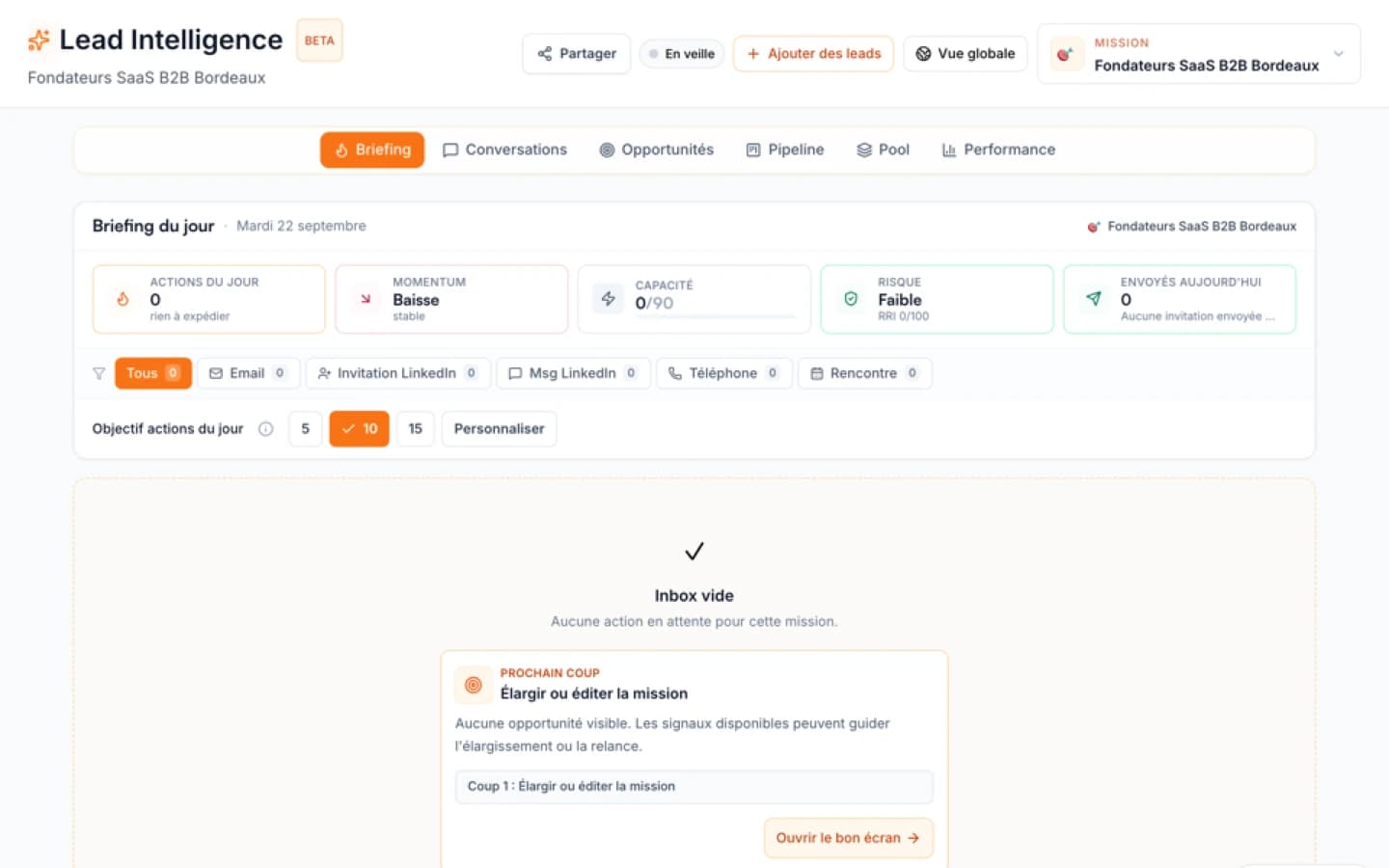
To move from analysis to action, Lead Intelligence presents the corresponding Ember workflow.
Sources and methodology
To define a modern lead scoring framework that operates independently of historical Customer Relationship Management (CRM) databases, this methodology synthesizes industry practices and platform architectures. We examined foundational Business-to-Business (B2B) lead scoring principles from resources such as the Outfunnel Lead Scoring Guide and the Small Business Expo B2B Lead Scoring overview to understand how growing sales teams can evaluate prospect engagement without deep historical data. Additionally, we read the Distribution Engine article on lead scoring models to contrast enterprise setups with agile alternatives. To evaluate the technical execution of signal-based scoring, we reviewed the operational models of leading sales tools. This includes volume-oriented platforms like Apollo, whose revenue figures come from Apollo (company history and Series D announcement) and whose cost growth with usage is discussed by Factors.ai and Coldreach. We also analyzed data orchestration infrastructures like Clay, focusing on its official integrations such as the Clay Sales Navigator Integration, its pricing structure which spans 4 plans as described on the Clay Pricing page, and the learning curve noted by Derrick App.
Sources
FAQ
Free diagnostic
Test your sales file
Drop an Excel or CSV and check its readiness without sending its rows to Ember.