
| Criterion | HubSpot Sales Hub | Ember (Creation) |
|---|---|---|
| Positioning | "More selling. Less everything else.": sales software with a CRM and AI | Generates and edits eight visual formats (decks, LinkedIn posts, one-pagers, etc.) from the project context |
| Starting point | Contact records, deal pipelines and deal scoring | The project's context and data; the substance is analyzed and the narrative path structured before the slides |
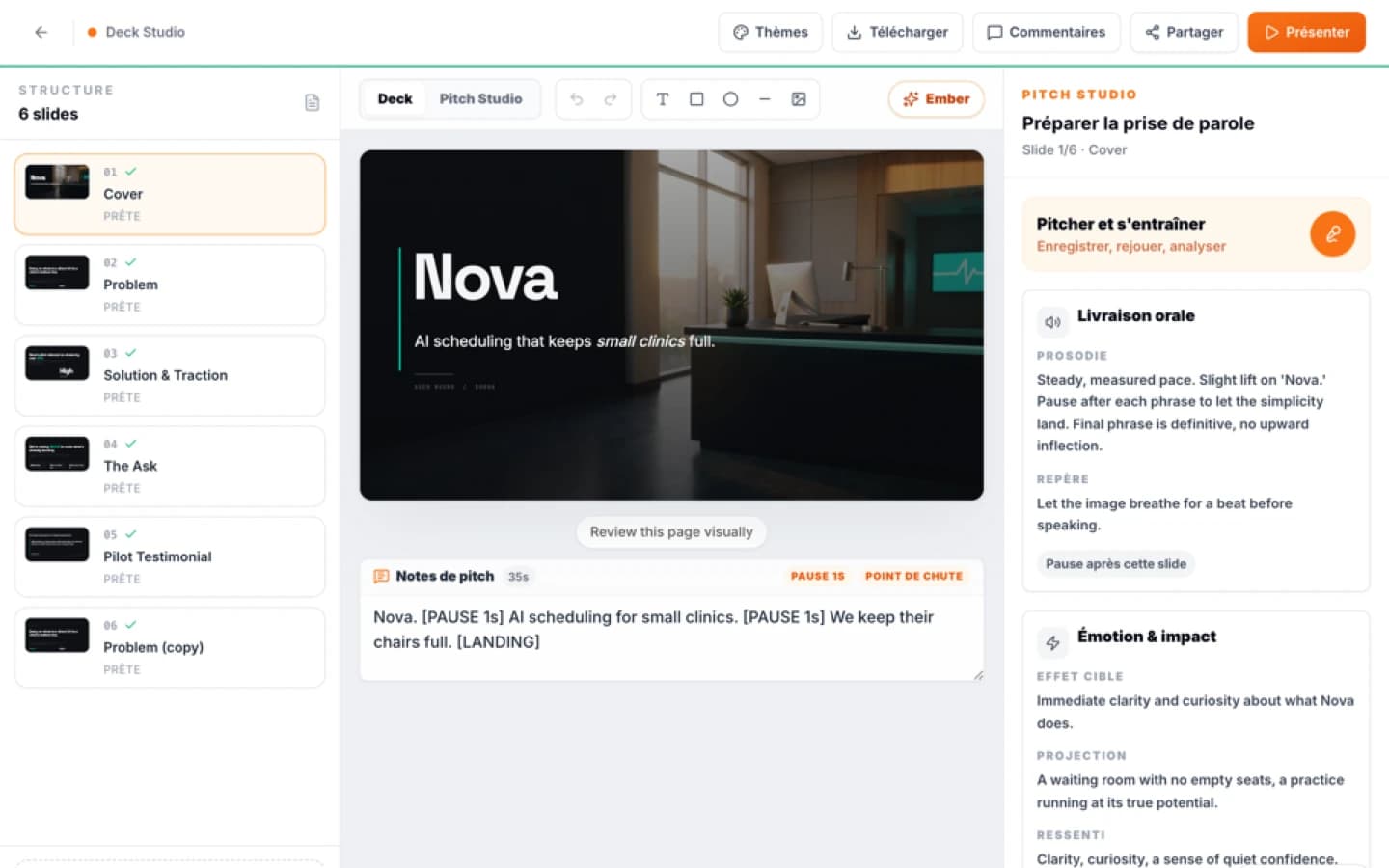
| Building presentations | The product page read describes no dedicated slide-building feature; it lists document management and playbooks | A deck editable page by page and zone by zone, with PDF and PowerPoint export |
| AI | A prospecting agent and the Breeze assistant for guided selling | Asks framing questions before generating and asks for confirmation before creating |
| Integrations and sharing | 2,000+ integrations through the HubSpot Marketplace | Sharing with an Ember user or team as read-only or editable, with comments anchored to slide objects |
Decision table
For a sales team that already runs its pipeline inside HubSpot Sales Hub, the real question is not whether another tool is prettier. It is whether the deck itself needs a different kind of work: pipeline tracking versus building a document that convinces a specific buyer to say yes.
HubSpot Sales Hub positions itself as AI-powered sales tools to build pipeline and close deals, for sales teams of all sizes source, and its strength sits in that pipeline layer: contact records, deal stages, and native integrations with Gmail, Outlook, Zoom, Microsoft Teams, Slack, Google Meet, and Salesforce source. Teams that live in those tools daily get real value from more than 2,000 custom integrations available in the HubSpot Marketplace source, and the free tools plan covers up to 2 users at no cost, with no credit card required source. For a small team whose main friction is scattered contact data and calendar chaos, that free tier plus its integration list can genuinely be enough. HubSpot's own product page does not describe a dedicated deck or slide generation capability; the closest features it lists on the page read on 29 September 2026 are document management and playbooks.
Creation sits in a different part of the workflow: it starts from the substance of the deal, not a blank template, and works on the reasoning, the narrative path and the structure before it works on slide design, so the deck argues a case rather than just listing features. The practical decision for a sales team is this: if the gap is pipeline visibility and tool connectivity, HubSpot's native integrations already solve that. If the gap is a deck that has to carry a real decision, funding, procurement, an executive sign off, then the presentation itself needs the same rigor as the pitch, which is the territory Creation works in, keeping every slide editable so the rep stays in control of the final argument.
To place this decision in context, the Knowledge guides for founders brings together deeper guidance on the same field.
Do they solve the same need
HubSpot Sales Hub describes its own purpose plainly: AI-powered sales tools to build pipeline and close deals, for sales teams of all sizes source. That description centers on deal tracking, contact records, and the machinery around a sale, not on producing the slide deck a rep walks into a room with. Its free tools plan covers up to two users at no cost, with no credit card required source, which fits a small team standardizing its pipeline before it worries about how any single deck looks or argues. HubSpot Sales Hub also connects natively to tools reps already live in, including Gmail, Outlook, Zoom, Microsoft Teams, Slack, Google Meet and Salesforce source, which keeps calendar, email and calls organized around the deal record. None of that touches the question a rep actually faces the night before a pitch: whether this specific deck will make a skeptical buyer understand the offer, believe the numbers, and act. That is a different need, and it is the one Creation is built around. Rather than starting from a blank template, it works from the project's own context and data, structures the narrative path an audience needs to follow, and only then produces slides, so the deck argues a specific case instead of repeating a generic structure. Every slide stays editable, and a rep can ask for changes in natural language while keeping control over what actually gets modified. So the fair answer is that HubSpot Sales Hub and Creation are not really competing for the same job. One keeps the pipeline, the contacts and the follow up cadence in order. The other exists to build the document that has to change one person's mind in a room. A sales team can reasonably keep HubSpot Sales Hub for everything it already organizes well, and still reach for a separate tool the moment a meeting demands a deck built to convince, not just a deck built to exist.
Neutral presentation of the competitor
HubSpot Sales Hub is built as a pipeline and deal management platform for business-to-business (B2B) sales teams, not as a tool for building a slide deck. HubSpot itself describes the product as AI-powered sales tools to build pipeline and close deals, for sales teams of all sizes source, which places the emphasis on contact records, deal stages, and the operational layer around a sale rather than on the document a rep hands to a buyer.
Its pricing follows a seat-based structure that scales with the size of the sales organization. A free tools plan covers up to two users at no cost and requires no credit card source, which suits a very small team testing the platform. The Starter tier runs $20 per seat per month billed monthly or $7 per seat per month billed annually, and includes 500 HubSpot Credits source. The Professional tier moves to $100 per seat per month billed monthly or $90 per seat per month billed annually, with a one time $1,500 onboarding fee and 3,000 credits source. Enterprise starts at $150 per seat with a one time $3,500 onboarding fee and 5,000 credits source. That structure signals a tool priced for teams that already run their pipeline at scale, where the seat cost and onboarding fee are absorbed across many reps.
Connectivity is a stated strength of the platform. HubSpot states that with more than 2,000 custom integrations in the HubSpot Marketplace, teams can connect HubSpot to their favorite tools in a few clicks source, and popular native integrations include Gmail, Outlook, Zoom, Microsoft Teams, Slack, Google Meet, and Salesforce source. For a sales team, this means the platform is designed to sit at the center of daily communication and scheduling tools, keeping deal activity logged automatically as reps work through email and calls.
None of these stated capabilities describe deck creation, narrative structure, or slide design. On the page read on 29 September 2026, HubSpot Sales Hub describes pipeline, sequence, calling and AI prospecting features, and no separate presentation builder.
To explore this point further, Protecting Deep-Work Blocks in a Customer-Owned Calendar details a step directly related to this decision.
Neutral presentation of Ember
Ember's relevant part of the stack for this comparison is Creation, the presentation module built primarily for founders, with sales teams named as a secondary audience in its own right. Where HubSpot Sales Hub organizes the pipeline around a deal, Creation works on the document a rep or a founder actually carries into the room.
The mechanism starts before any slide exists. Creation analyses the substance of the pitch and structures a narrative path first, asking about the audience and the intended impact, offering three template previews, and asking for confirmation before creating. Slides are then generated from that structure and from the available project context, and the presentation stays editable afterward: a user can request changes in natural language and keep control over each version rather than accepting a fixed output.
Two capabilities matter specifically for a sales context. The finished presentation can be exported to PowerPoint or to a portable document format (PDF) file for whatever workflow the team already runs, and a separate rehearsal space lets a rep record a take and get it analysed for rhythm, clarity, impact and structure, so the practice covers the delivery, not only the visuals.
Alongside Creation, Ember's Second Brain assistant can turn project data or a multi-sheet Excel workbook directly into charts, preserving units, formats, source cells and up to sixty periods. For a sales deck that needs to show real account or pipeline numbers rather than a generic placeholder chart, that is the difference between an illustration and evidence.
None of this touches deal tracking or contact records, and that is a fair boundary: a team that needs to manage its pipeline still needs a customer relationship management (CRM) system alongside whatever builds the deck. Creation's job stops at the point where the presentation is built, reasoned through, and rehearsed enough to be defended in front of a buyer.
Key differences
The clearest way to see the difference is to ask what each tool actually produces at the end of a work session. HubSpot Sales Hub produces an updated deal record, a logged call, a synced calendar entry, or a new automation trigger, because it is built as a pipeline and deal management platform where AI-powered sales tools help build pipeline and close deals for sales teams of all sizes source. Creation produces a document: a presentation meant to make a specific buyer understand, believe, and act, built from the substance, the form, and the intended impact of that specific pitch.
That difference in output shapes everything else. HubSpot Sales Hub's strength is connective tissue: it lists Gmail, Outlook, Zoom, Microsoft Teams, Slack, Google Meet, and Salesforce among its popular native integrations source, and it advertises more than 2,000 custom integrations in the HubSpot Marketplace that connect to other tools in a few clicks source. A sales team already living inside that ecosystem gets real value from keeping everything in one place, and for reps whose main job is tracking activity across many small deals, that breadth of integration is a legitimate reason to stay put. Creation does not compete on that ground: it has no claim to pipeline tracking, call logging, or CRM (customer relationship management) integrations, and it should not be evaluated as if it did.
Where the two diverge sharply is on the specific moment a rep has to walk into a room and defend a deal. HubSpot Sales Hub's free tier covers up to two users at no cost, with no credit card required source, which is enough for a small team mostly managing contacts and follow ups. But nothing in that description addresses the work of building a narrative arc, structuring slides around a buyer's actual objections, or rehearsing delivery before the meeting. Creation's mechanism is built for exactly that gap: it analyses the substance of the pitch and structures the narrative path before producing slides, keeps every element editable through natural language requests, and lets a rep record, replay, and rehearse the presentation before it goes in front of a prospect. The promise is not to add another slide generator on top of the customer relationship management workflow. It is to help the presentation build understanding and move a decision forward beyond visual polish, which is a different job than logging where a deal sits in the pipeline.
So the decision is less about which tool is better in the abstract and more about which moment you are optimizing. If the recurring pain is disorganized follow ups, scattered contact history, or disconnected tools across the sales stack, HubSpot Sales Hub's integration breadth speaks directly to that problem. If the recurring pain is a deck that looks fine but does not convince the one buyer in the room, that is a narrative and delivery problem, and it sits squarely in Creation's territory, not in pipeline software.
This approach also connects with What Proof Asset a Zero-Budget B2B Founder Needs First?, which clarifies the next choice.
When the competitor is the better fit
If your sales team's main week to week job is keeping a pipeline current, not building slide decks, HubSpot Sales Hub is likely already enough. HubSpot describes Sales Hub as artificial intelligence (AI) powered sales tools to build pipeline and close deals, for sales teams of all sizes source, a description centered on deal tracking rather than deck production. For a team that needs its customer relationship management (CRM) system to talk to the rest of its stack, HubSpot points to more than 2,000 custom integrations in its Marketplace source, including native connections such as Gmail, Outlook, Zoom, Microsoft Teams, Slack, Google Meet and Salesforce source. If those connections already cover your calendar, email and video stack, that alone can be reason enough to stay put.
Budget also plays a role. HubSpot's free tools plan covers up to two users at no cost, with no credit card required source, and Sales Hub Starter lists at $20 per seat per month billed monthly or $7 per seat per month billed annually, with 500 HubSpot credits included source. For a small team whose bottleneck is pipeline hygiene rather than the deck itself, that entry price is hard to beat with a presentation focused tool. The step up to Sales Hub Professional runs $100 per seat per month billed monthly or $90 per seat per month billed annually, plus a one time $1,500 onboarding fee and 3,000 credits source, and Sales Hub Enterprise starts at $150 per seat per month with a one time $3,500 onboarding fee and 5,000 credits source. At that range the product is clearly priced and built for teams that live inside the CRM daily, not for a founder or rep who mainly needs to walk into a handful of pitch meetings well prepared.
None of this touches what actually happens on the slide itself. HubSpot Sales Hub's own positioning is about pipeline and deal closing, not about structuring an argument, a narrative arc, or a rehearsal source. If your team's real friction is the deck, not the deal record around it, that is exactly the gap Creation was built to work on, shaping the reasoning and the audience's journey before it shapes a single slide, then keeping every element editable so the presenter stays in control of the result. Choose HubSpot Sales Hub when the job is pipeline and deal management with the deck as an afterthought. Reach for Creation when the presentation itself is the thing that has to change someone's mind.
When Ember is the better fit
For a sales team, the signal that Ember's Creation is the better tool is simple: the deck in question has to carry a decision, not just report on a stage in the pipeline. HubSpot Sales Hub is built and positioned around the deal record, described as AI-powered sales tools to build pipeline and close deals, for sales teams of all sizes source. That is the right job when the presentation is a byproduct of the pipeline. It is the wrong job when the presentation is the product: a renewal at risk, a competitive deal about to be lost on substance, a board or executive pitch where the argument itself is what is being judged.
Creation starts from the substance a rep already has rather than a blank template: it analyses the reasoning and structures the narrative path before a single slide gets produced, so the deck argues a specific case instead of restating a generic structure that every prospect has already seen. Every element stays editable afterward, so a rep adjusts the story as the deal evolves instead of requesting a new export each time the pitch angle changes. That is the concrete difference from a tool built to log activity: the goal here is a presentation built to make people understand, believe and act, not a document that sits in a stage field until it goes stale.
When the deck is heading into a live executive room, the rehearsal step matters as much as the slides: recording, replaying and rehearsing the presentation exposes rhythm, clarity, impact and structure before the real meeting, which closes a gap that pipeline software was never designed to close. HubSpot's own strength runs the other direction, with more than 2,000 custom integrations in the HubSpot Marketplace connecting tools such as Gmail, Outlook, Zoom, Microsoft Teams, Slack, Google Meet and Salesforce source source. None of that integration depth touches how the deck itself gets structured, designed or rehearsed.
So the practical decision for a sales team is not which tool is better in general. It is which job is open right now. If the week's work is keeping accounts and activities current, that is HubSpot's territory. If the week's work is winning one specific meeting with a deck that has to hold up under real scrutiny, that is where Creation earns its place, including for sales teams, who are a named audience for it alongside founders, not an afterthought bolted onto a founder tool.
In practice, HubSpot Sales Hub vs Lead Intelligence: Small B2B Sales Teams 2026 completes this framework with another angle on the same topic.
When neither is sufficient
There are situations where neither tool is the right answer, and it is worth naming them plainly instead of forcing a verdict.
If the sales team's real problem is that the pipeline itself is messy, meaning deals are not logged, follow ups slip, and nobody agrees on what stage an opportunity is in, no presentation tool fixes that. HubSpot Sales Hub is built for exactly that layer, described as AI-powered sales tools to build pipeline and close deals, for sales teams of all sizes source, and its native integrations with Gmail, Outlook, Zoom, Microsoft Teams, Slack, Google Meet, and Salesforce source exist to keep that record current. Creation does not touch that problem at all. A team asking Creation to compensate for an unmanaged pipeline is asking the wrong tool to do the wrong job.
Conversely, if the deck itself is the bottleneck because reps are shipping generic, templated slides that fail to build understanding or move a decision, HubSpot Sales Hub's pipeline tooling will not close that gap either. Its stated purpose is pipeline and deal management, not narrative construction, and nothing in its documented feature set claims to structure an argument or a persuasion path. That is a different failure mode than a messy pipeline, and it needs a tool built to work on substance, structure, and impact, which is closer to what Creation is for.
There is also a middle case worth admitting honestly: a rep who needs to send a quick recap deck after a call, with no real stakes attached, may not need either tool's full weight. A plain document or a lightweight template can carry that job fine, and reaching for an AI presentation tool at all would be over engineering a five minute task.
The practical decision test is this: identify whether the actual friction sits in the deal record or in the deck's ability to persuade. If it is neither, meaning the pipeline is already tracked well and the deck is a low stakes formality, the honest answer is that neither Ember nor HubSpot Sales Hub needs to be in the loop for that particular moment.
Limits
HubSpot Sales Hub's real limits show up in the way its plans are built, and they say something clear about where the tool's attention is: on the deal record, not on the deck itself. The Starter plan caps a team at three email snippets, three email templates, 500 calling minutes and a single deal pipeline source, and even the Professional and Enterprise tiers scale the same variables further, up to 3,000 or 12,000 calling minutes, 15 or 100 pipelines, and 5,000 sequences per account source. None of these limits describe slide count, narrative depth, or design control, because that is simply not what the product measures. The free tools plan, capped at two users with no credit card required source, is generous for keeping a pipeline current, but it says nothing about the quality of a document meant to carry an executive decision. The same pattern holds for HubSpot's integration story. More than 2,000 custom integrations in the HubSpot Marketplace connect the platform to tools like Gmail, Outlook, Zoom, Microsoft Teams, Slack, Google Meet and Salesforce source. That breadth keeps a deal record synchronized across a sales team's communication stack, which is a real strength for pipeline hygiene, but it is a different job from structuring the argument, the slide sequence, or the visual proof a sales team needs when the deck itself is the thing under scrutiny in the room. Creation has its own limit worth naming plainly: it builds the narrative path and generates slides from the substance already present in the project's context, so a sales team still has to bring the underlying data, the numbers, and the story it wants to tell. The tool structures and strengthens that material, it does not invent the case from nothing. Every generated element stays editable, and the person in the room keeps the final call on what changes and what ships. Creation also does not track deal stages, calling minutes, or sequences, so a team that needs that kind of pipeline visibility still needs a system built for it, which is exactly the territory HubSpot Sales Hub is built to cover.
Before deciding, How Do You Prioritize a B2B Product Roadmap When Sales Keeps Asking for One-Off Features? helps connect this method with adjacent priorities.
Contextual recommendation
For a sales team choosing between these two tools in 2026, the decision comes down to one question: is the job to manage where a deal sits in the pipeline, or to build the actual argument that gets a stakeholder to say yes? HubSpot Sales Hub is built and marketed around the first job. HubSpot describes Sales Hub as AI-powered sales tools to build pipeline and close deals, for sales teams of all sizes source, and its strength sits in the connective tissue around a deal record: more than 2,000 custom integrations in the HubSpot Marketplace let a team attach Gmail, Outlook, Zoom, Microsoft Teams, Slack, Google Meet and Salesforce to that record in a few clicks source, with popular integrations including Gmail, Outlook, Zoom, Microsoft Teams, Slack, Google Meet and Salesforce source. A small team can even start for free, since HubSpot's free tools plan covers up to two users at no monthly cost and asks for no credit card source. None of that, however, is a claim about building the deck itself: HubSpot's pages do not describe a HubSpot capability that structures a narrative, drafts slides, or rehearses delivery, so on that specific question the HubSpot page read on 29 September 2026 shows none of these capabilities. That gap is exactly where the recommendation splits. If a sales team's actual friction is fragmented tools around the deal, meaning the recording, the calendar link and the deal notes live in different places, HubSpot's integration depth is a legitimate reason to stay put, since connecting existing tools to one record is precisely what it is built for. But if the friction is the deck itself, meaning a rep is staring at a blank presentation the night before a executive review and needs it to carry conviction rather than just list features, that is a job HubSpot Sales Hub is not positioned to do and Ember's Creation is built for. Creation's premise is that a presentation should do more than produce slides: it should build a presentation that moves a decision forward, working the substance, the structure and the intended impact rather than stopping at visual polish. For a sales team, the practical difference shows up in the brief itself: instead of starting from a blank template, the deck starts from the project's context and data, which means the argument is grounded in the same material the rep is trying to defend, not a generic layout borrowed from a slide library. The next useful action is not to compare feature checklists but to look at the deck that failed last quarter and ask which of the two problems it actually had: a pipeline nobody trusted, or an argument nobody bought.
To move from analysis to action, Second Brain presents the corresponding Ember workflow.
Sources and updates
On HubSpot Sales Hub specifically, the sourced facts stay narrow by design: what the tool is built to do, how it prices its entry tier, and which integrations it ships natively, all pulled directly from HubSpot's own product and pricing pages and its marketplace listing. HubSpot positions Sales Hub as AI powered sales tools to build pipeline and close deals, for sales teams of all sizes source, and its free tier tops out at two users with no credit card required source. On the integration side, the marketplace lists popular native connections including Gmail, Outlook, Zoom, Microsoft Teams, Slack, Google Meet and Salesforce source. The pricing page read on 29 September 2026 describes four editions (Free, Starter, Professional and Enterprise), billed per seat for the paid ones, with monthly AI credits included; this article states nothing beyond what these pages say. That sourcing discipline matters more than it looks. A sales team comparing tools for how they build and deliver a pitch is not well served by a comparison that borrows numbers from unrelated categories or rounds up a vague industry consensus. Where no matching figure was available, the honest move was to stay qualitative or flag an estimate plainly, rather than presenting a guess as fact.
Sources
- Best AI Presentation Tools for Enterprise and B2B Sales Teams ...
- Best AI Tools for B2B Sales Presentations in 2026 (Tested & ...
- 12 Best AI Presentation Tools in 2026 (Tested on Real Decks)
- HubSpot Sales Hub
- HubSpot Sales Hub
- HubSpot Sales Hub
- HubSpot Sales Hub
- HubSpot Sales Hub
- HubSpot Sales Hub
- HubSpot Sales Hub
FAQ
Second Brain
Decide with project context
Ask a question and connect the answer to decisions already made in Ember.