
Definition
Modern Business-to-Business (B2B) lead generation in 2026 requires a fundamental shift in how sales teams identify and engage potential buyers. Because buying groups are larger and most research happens silently before a sales team is ever contacted, traditional cold outreach must evolve. Generating qualified B2B leads is no longer about blasting high-volume, unsegmented lists. Instead, it is about identifying active intent and buying signals to build a highly targeted sales pipeline. For startups and growing companies, mastering outbound sales for startups means moving away from generic outreach and focusing on deep lead qualification based on up-to-date context. When considering who should an early-stage founder contact first, the answer lies in targeting the primary decision-makers who feel the pain point most acutely. Rather than reaching out to high-level executives who are insulated by layers of management, founders should target the specific operational leaders who manage the day-to-day problem their product solves.
To place this decision in context, the Knowledge guides for sales brings together deeper guidance on the same field.
Prerequisites
To build a healthy sales pipeline and execute effective outbound sales for startups, sales teams and founders must establish clear prerequisites before launching any cold outreach campaign. In an era where buying groups are larger and research happens silently, building a prospect list from scratch requires more than just scraping random email addresses. It demands a structured approach to lead qualification that aligns with how modern buyers make decisions.
For those wondering how does a founder qualify B2B leads without a sales team, the answer lies in shifting from volume-based spamming to signal-based prioritization. When deciding who should an early-stage founder contact first, the priority must always be the decision-makers who match the exact Ideal Customer Profile (ICP) and exhibit active buying signals. Uncalibrated outreach misses these buying signals.
Traditional platforms often gate their value behind metered usage. Apollo states on its pricing page, for example, that its trial includes 50 credits and almost all features of the chosen plan, with the option to move to a free plan with no time limit afterwards. However, credit-based pricing turns every action into a metered decision: an export credit is consumed each time a contact is exported outside Apollo, and Crustdata notes in its comparison that a credit model can look affordable for a few reps and then exceed the budget with a larger team.
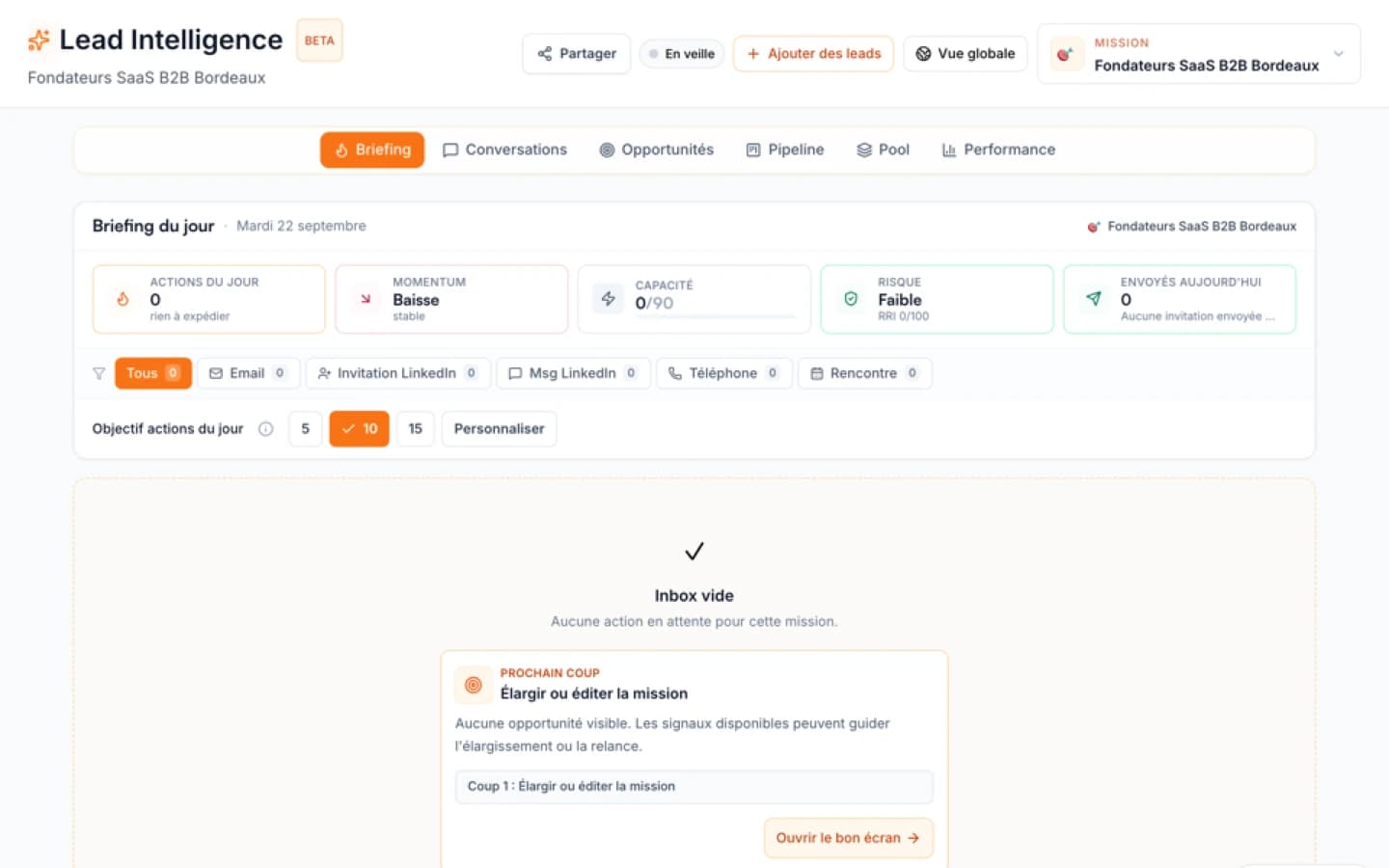
To avoid these compounding costs while maintaining a highly qualified sales pipeline, modern teams use advanced systems to streamline B2B prospecting. Ember's Lead Intelligence capability allows teams to prepare and import up to 3,500 valid contacts from Excel or Comma-Separated Values (CSV) files into the Pool. Before import, a local score measures the readiness of the complete file. Each enrichment wave processes up to 200 contacts and exposes its progress, which helps teams understand how to qualify B2B leads early without wasting resources. Once the targeting context is defined, Lead Intelligence finds and prioritizes the contacts itself.
By establishing these prerequisites, founders and Sales Development Representatives (SDR) can ensure that their Customer Relationship Management (CRM) systems are populated only with high-intent opportunities, saving time and budget while accelerating revenue growth.
Steps
To navigate a landscape where buying groups are larger and research is done in secret, sales teams must execute a structured, four-step approach to modern Business-to-Business (B2B) prospecting. First, establish a foundation by defining the Ideal Customer Profile (ICP) based on strategic context rather than generic firmographics. Traditional databases like ZoomInfo or Apollo fit when you need raw contact volume. Apollo states on its pricing page, for example, that its trial includes 50 credits and almost all features of the chosen plan. However, building a prospect list from scratch using only these filters often leads to high noise. With credit-based pricing, every contact export becomes a metered decision. To qualify B2B leads early, teams should instead anchor their search in strategic business context. Second, prepare and clean contact data with strict quality controls before initiating any cold outreach. Rather than uploading unverified lists directly to a Customer Relationship Management (CRM) system, sales teams can use Ember's Lead Intelligence to prepare and import up to 3,500 valid contacts from Excel or comma-separated values (CSV) files into the Pool. Before the import occurs, a local score measures the readiness of the complete file, allowing for search, pagination by 50, and individual selection. Each enrichment wave processes up to 200 contacts and exposes its progress. Third, monitor signals about people and companies to prioritize the accounts that are genuinely in a buying phase: Lead Intelligence monitors them to keep context current and classifies accounts into explained opportunities to watch, act on or set aside. Fourth, turn priority into action: for each account you keep, choose the next action and the channel that fit the situation, then measure the number of useful conversations rather than the volume of messages sent.
To explore this point further, Clay vs Ember: when each one fits details a step directly related to this decision.
Worked example
To understand how these principles function in practice, let us look at a worked example of modern Business-to-Business (B2B) prospecting and lead qualification. Consider an early-stage software startup aiming to build its sales pipeline from scratch. If you are wondering how does a founder qualify B2B leads without a sales team, the answer lies in shifting from high-volume cold outreach to context-driven prioritization. Instead of hiring a full team of Sales Development Representatives (SDRs) or immediately deploying a complex Customer Relationship Management (CRM) system, a founder can leverage agentic workflows to handle the heavy lifting of lead scoring. When determining who should an early-stage founder contact first, the priority must always be the buyers who have the highest immediate pain and the strongest contextual fit with your Ideal Customer Profile (ICP). Rather than building a prospect list from scratch using generic databases, founders should target decision-makers who are actively experiencing the specific problem their product solves. For sales teams running structured outbound, traditional platforms like Apollo are common. Apollo states on its pricing page, for example, that its trial includes 50 credits and almost all features of the chosen plan, with the option to move to a free plan with no time limit afterwards. The tradeoff is that credit-based pricing turns every action into a metered decision: an export credit is consumed each time a contact is exported outside Apollo, which can push costs up as teams scale. This is where Ember's Lead Intelligence capability changes the dynamic. Instead of forcing you to calculate the cost of every single click, Lead Intelligence prepares a sales mission by reusing your existing Ember Business Plan, ICP, offer, and strategy. You can search and import profiles through LinkedIn or Sales Navigator from a connected account, or prepare and import up to 3,500 valid contacts from an Excel or CSV (Comma-Separated Values) file into your pool. Before importing, a local score measures the readiness of the complete file, allowing you to search, paginate by 50, and make individual selections. Each enrichment wave processes up to 200 contacts and exposes its progress. By monitoring signals about people and companies to keep your context current, Lead Intelligence helps you avoid reaching out blindly. Once the targeting context is defined, Lead Intelligence finds and prioritizes the contacts itself, which allows founders and sales teams to execute outbound sales for startups with high precision, ensuring that you know how to qualify B2B leads early and effectively before any message is sent.
Common mistakes
When building a sales pipeline, many sales teams fall into predictable traps that stall their outbound sales for startups. The most common mistake is treating Business-to-Business (B2B) prospecting as a game of raw volume. Instead of building a prospect list from scratch with precise context, teams often scrape massive databases and launch generic cold outreach campaigns. This spray and pray approach ignores the reality of modern buying groups, which are larger and conduct most of their research silently before ever engaging with a vendor.
This volume first mindset often leads to a second critical error: getting trapped in credit based pricing models. When teams rely on legacy databases, every single action becomes a metered decision. Exporting contacts consumes export credits, which can push costs up as the team grows. For sales teams, ignoring the Ideal Customer Profile (ICP) and the role of the Sales Development Representative (SDR) in early qualification means contacting the wrong people from the start, a mistake that undermines the entire pipeline.
This approach also connects with What does a defensible B2B lead generation process look like in 2026 for a team that cannot rely on a single channel?, which clarifies the next choice.
Tools
To execute modern Business-to-Business (B2B) prospecting, sales teams have access to a mature ecosystem of data and enrichment platforms. Traditional databases suit established sales organizations with dedicated resources. For example, Apollo.io is a powerful option for teams running structured outbound campaigns managed by a Sales Development Representative (SDR) or a Revenue Operations (RevOps) leader. However, its credit based pricing model deserves attention: an export credit is consumed each time a contact is exported outside Apollo, as its pricing page states.
For teams focused on deep data orchestration, Clay presents itself as data infrastructure: teams can buy data from more than 200 providers and connect to sales engagement tools such as Salesloft, Outreach, Instantly, Smartlead and HubSpot, according to its home and integrations pages. ZoomInfo, for its part, presents in its guide an AI-agent-based GTM workspace and an account-based marketing (ABM) platform.
When to use this method
Use this method when your sales team is small, buying groups are large and you cannot contact everyone: it helps you choose who to contact first and why now. It also suits a founder with no sales team and no marketing function who must qualify leads alone.
If you already have a dedicated outbound team, with SDRs and a RevOps leader who need continuous data extraction, combine it with your existing tools rather than replacing them.
In practice, Apollo vs Ember Lead Intelligence for Founder Conversion completes this framework with another angle on the same topic.
When not to use it
Traditional database platforms fit when your organization has already established a dedicated outbound sales team with structured workflows. If your company employs full-time Sales Development Representatives (SDRs) and Revenue Operations (RevOps) managers who require continuous, high-volume data extraction to feed an existing Customer Relationship Management (CRM) system, these databases are a strong fit. For instance, Apollo.io is well-suited for teams focused on pipeline coverage and workflow speed. Sales teams can easily test these capabilities, as Apollo provides a trial that includes 50 credits and almost all features of the chosen plan, with the option to move to a free plan with no time limit afterwards, as detailed on the Apollo Pricing Page. However, this high-volume database model introduces friction for smaller teams: credit-based pricing turns every prospecting action into a metered decision, and an export credit is consumed each time a contact is exported outside Apollo. This administrative and financial overhead is particularly challenging for early-stage companies. If you are wondering how does a founder qualify B2B leads without a sales team, the answer is not to spend hours managing credit allocations or cleaning raw databases. Instead of building a prospect list from scratch using unverified bulk data, a founder needs to know exactly who to contact first to secure early traction. When your primary goal is relevance over raw volume, a signal-driven approach is better suited than traditional cold outreach. For teams that prefer context over noise, Lead Intelligence, published by Ember, offers an alternative. Instead of starting with blank search filters, the platform reuses your existing Ember Business Plan, Ideal Customer Profile (ICP), offer, and strategy to prepare a targeted sales mission. It monitors signals about people and companies to keep your context current, and allows you to search and import profiles through LinkedIn or Sales Navigator from a connected account. If you already have a list of targets, you can prepare and import a large number of valid contacts from Excel or Comma-Separated Values (CSV) files into your pool. Before the import occurs, a local score measures the readiness of the complete file, allowing you to search, paginate, and make individual selections. Each wave enriches up to 200 contacts and exposes its progress. This allows sales teams to focus on conversations that deserve immediate attention rather than managing database logistics.
Action plan
In 2026, the traditional playbook for Business-to-Business (B2B) prospecting has shifted because buying groups are larger and buyers complete most of their research anonymously before engaging with sales teams. ZoomInfo describes in its guide How to Generate B2B Sales Leads: 2026 Guide Go-To-Market (GTM) workflows triggered by buying signals rather than static lists. To build a highly targeted sales pipeline, sales teams and early-stage founders must transition from high-volume cold outreach to context-driven lead qualification. When building a prospect list from scratch, a common question arises: how does a founder qualify B2B leads without a sales team? Without a dedicated Sales Development Representative (SDR) or Revenue Operations (RevOps) manager, founders must rely on structured context rather than manual scraping. Instead of chasing every lead, founders should use their core business strategy to filter opportunities. This leads to another critical decision: who should an early-stage founder contact first? The answer lies in identifying accounts that exhibit immediate pain points matching your specific value proposition, rather than targeting broad industry categories. Traditional outbound sales for startups often rely on platforms like Apollo.io, which offers a trial containing 50 credits and almost all features of the chosen plan with the option to move to a free plan with no time limit afterwards, as detailed on the Apollo Pricing Page. However, credit-based pricing models turn every single action into a metered decision: an export credit is consumed each time a contact is exported outside Apollo. This model can create friction for smaller teams who need to focus on lead scoring and relationship building rather than counting credits. To bypass this friction, sales teams can leverage Ember's dedicated capability, Lead Intelligence. This module directly reuses your business plan, Ideal Customer Profile (ICP), offer, and strategy to prepare a sales mission, then finds and prioritizes the contacts itself.
Before deciding, What Does a Realistic Weekly Outbound Workload Look Like for a B2B Rep in 2026? helps connect this method with adjacent priorities.
Sources and methodology
Our analysis of B2B prospecting and lead qualification draws on the ZoomInfo guide How to Generate B2B Sales Leads: 2026 Guide and The Smarketers' The Complete B2B Lead Generation Playbook for 2026. Information on Apollo comes from its pricing page; information on Clay from its home and integrations pages; the observation on credit-based models from the Crustdata comparison. The description of Lead Intelligence reflects what the product does in Ember, which publishes this article: preparing and importing valid contacts from a spreadsheet, with a local readiness score, and enriching in waves.
Sources
FAQ
Free diagnostic
Test your sales file
Drop an Excel or CSV and check its readiness without sending its rows to Ember.