
Definition
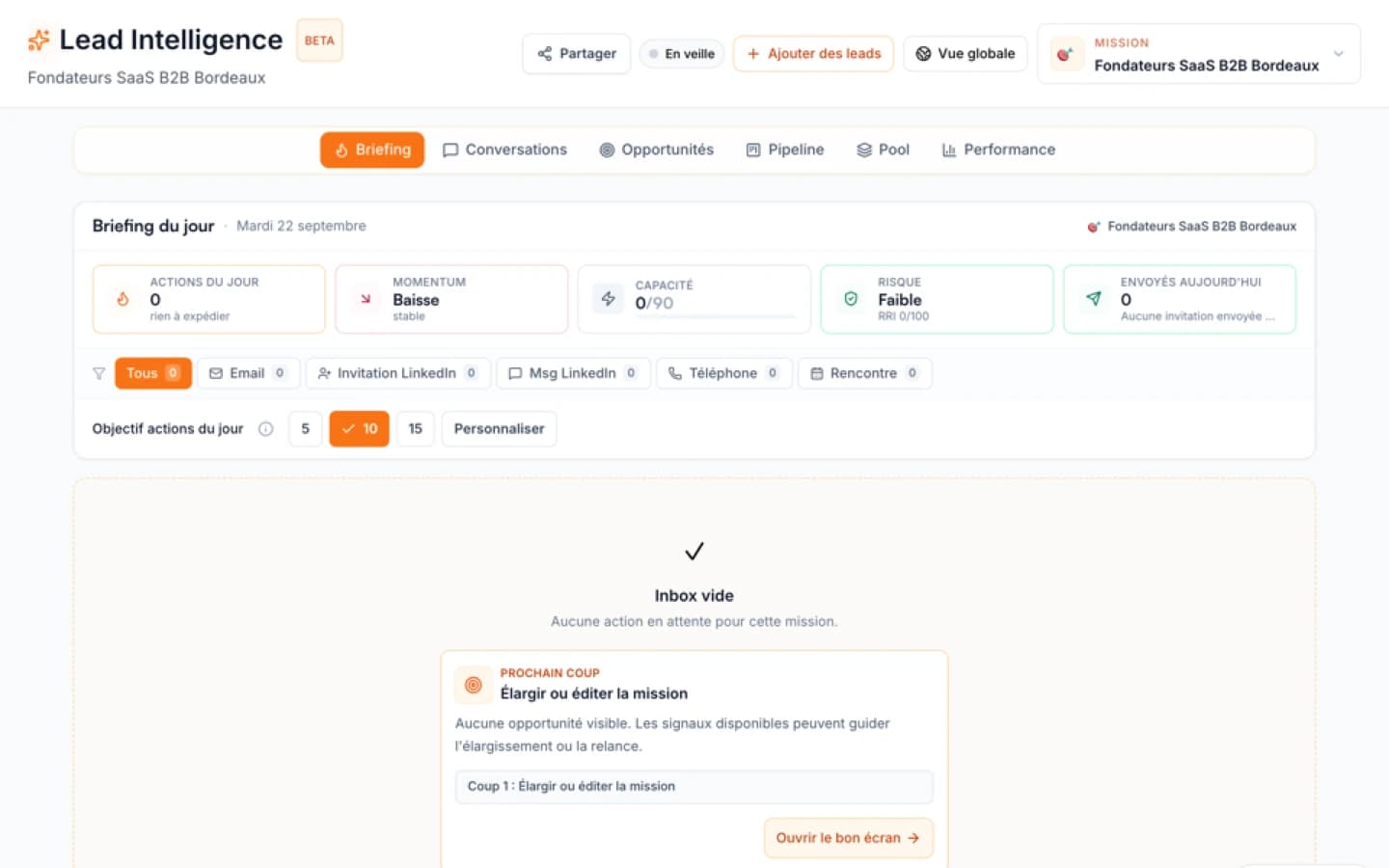
In 2026 a defensible Business-to-Business (B2B) lead qualification framework for a team with no marketing function and no scoring tool is a lean, action-first process that replaces complex software with immediate situational relevance. When considering how does a founder qualify B2B leads without a sales team, the focus must shift from passive lead scoring to active, signal-based validation. Traditional frameworks like BANT (Budget, Authority, Need, Timeline), MEDDIC, or CHAMP are typically presented as rigid scoring rubrics, but for a team without a dedicated Customer Relationship Management (CRM) administrator, the real challenge is identifying the 3 or 5 questions a sales development representative (SDR) or founder can actually answer during a 10-minute call. Instead of managing bloated databases, lean teams require a framework that protects the sales pipeline from wasted effort during cold outreach. When determining who should an early-stage founder contact first, the answer lies in prioritizing accounts based on real-time organizational changes and verified fit rather than building a prospect list from scratch using raw volume. When building a prospect list from scratch, the priority must be aligning leads with the Ideal Customer Profile (ICP) to avoid high bounce rates and wasted outreach. While massive platforms like Apollo combine broad channel coverage to help teams simplify their stack Apollo and reported $150 million in annual recurring revenue in 2025 Apollo, or Clay provides complex infrastructure for Go-To-Market (GTM) teams to run agentic workflows Clay with integrations like LinkedIn Sales Navigator Clay Integrations, these setups often require heavy administrative overhead. For smaller teams, modern lead qualification checklists from Highspot and Launch Leads show that defensibility comes from focusing on immediate, actionable context. This is where a targeted approach succeeds: Ember's Lead Intelligence finds and prioritizes the contacts itself, whether the team starts with 10, 100, or 1,000 contacts, with no minimum contact threshold. By analyzing the specific situation of each prospect, it proposes the next action and channel that fit the lead situation Lead Intelligence, allowing founders and sales teams to maintain a highly qualified pipeline without complex scoring tools.
To place this decision in context, the Knowledge guides for sales brings together deeper guidance on the same field.
Prerequisites
For sales teams operating without a dedicated marketing function or automated lead scoring tools, Business-to-Business (B2B) prospecting requires a lean, action-oriented approach. Traditional frameworks like Budget, Authority, Need, and Timeline (BANT) are often presented as heavy scoring rubrics. However, for a lean team without a Customer Relationship Management (CRM) administrator, the real challenge is identifying which three or five questions a Sales Development Representative (SDR) can actually answer during a brief 10-minute call. Instead of relying on passive databases, startups must build an active sales pipeline by focusing on immediate situational relevance.
When exploring how does a founder qualify B2B leads without a sales team, the process must rely on clear, observable triggers rather than subjective scores. If you are wondering who should an early-stage founder contact first, the answer is simple: target prospects who are actively experiencing the specific pain point your product solves, rather than building a massive prospect list from scratch. This ensures that cold outreach efforts are concentrated where they have the highest probability of conversion. Establishing a clear Ideal Customer Profile (ICP) based on actual business pain, rather than generic demographic data, serves as the foundation for this lead qualification process in 2026, as discussed by Launch Leads.
A broad database can help with coverage, but a small team still needs to decide why a particular account deserves contact. Lead Intelligence can find and prioritise contacts from the mission’s customer profile and signals without requiring a minimum starting list. Review the source and the reason for priority before making contact.
Steps
Start with the customer profile and write down three to five questions that a salesperson can reasonably answer in a short conversation: does the account fit, what problem is active, who owns it, what has changed recently, and what next step would be useful? Record the evidence for each answer. A simple shared sheet can be enough for the first test. Compare the answers with subsequent conversations before adding a score or automating the process.
To explore this point further, How can a bootstrapped founder generate B2B leads without buying an expensive contact list? details a step directly related to this decision.
Worked example
Imagine a founder selling software to small manufacturers. She starts with companies that match her target profile and checks a public hiring change before contacting the operations lead. On a short call, she asks about the current process, the impact of delays and who joins the buying decision. She records what she learned and whether a second conversation is warranted. This gives her a reason to prioritise the account without treating a guessed numerical score as proof of purchase intent.
Common mistakes
The common mistake is to buy a large list before defining what a qualified account looks like. Another is to treat a signal as a purchase decision without checking its source or speaking with the prospect. Keep the criteria few enough for the team to apply consistently, then review where the first calls did and did not lead to useful conversations.
This approach also connects with What evidence should a pre-seed startup founder check before choosing Lead Intelligence?, which clarifies the next choice.
Tools
BANT, CHAMP and MEDDIC can prompt useful questions, but a small team does not need to implement every field before its first call. Use a shared sheet or the existing sales workspace to capture customer fit, the observed signal, the buyer’s answer and the next action. Lead Intelligence can help find and prioritise contacts; a person still verifies the context and decides whether to follow up.
When to use this method
Use this framework when a small team needs a repeatable way to choose who to contact before it has reliable historical conversion data. Begin with a small sample, review the source behind each signal and compare qualified conversations with the previous approach. Adjust the questions before expanding the process.
In practice, How should a B2B sales team score and prioritise leads in 2026 without a marketing team, a CRM admin, or a scoring tool? completes this framework with another angle on the same topic.
When not to use it
This lightweight qualification framework is not a universal solution for every sales organization.
For teams that require a massive, all-in-one outbound engine across multiple channels, established platforms are often a better fit. For example, Apollo is highly effective for teams that want to run outbound across email, phone, and social from a single tool. According to Apollo’s history page, Apollo reached $150 million in annual recurring revenue because of this breadth of channel coverage, combining a large Business-to-Business (B2B) contact database, email sequences, call dialing, and a Chrome extension for LinkedIn prospecting inside one platform. If your primary goal is to consolidate your entire sales stack into a single unified platform, an all-in-one tool is the logical choice.
Similarly, if your organization has dedicated Go-To-Market (GTM) engineers or Revenue Operations (RevOps) specialists who want to build highly customized, complex data enrichment pipelines, a simple framework will feel too restrictive. Platforms like Clay provide the infrastructure for GTM teams to get data, run agentic workflows, and launch GTM plays, as described on the Clay website. This includes advanced features like official LinkedIn Sales Navigator data points for lead discovery, as detailed in the Clay Sales Navigator integration guide. For highly technical teams that want to programmatically orchestrate their data, these advanced developer-centric platforms are superior.
Additionally, you should avoid scaling a basic framework when credit-based pricing models begin to strain your budget. As sales teams grow, credit-based pricing turns every action into a metered decision. Every export, enrichment and verification consumes credits, so costs add up, as noted by Factors.ai and Coldreach.
If you do not have a dedicated marketing function, a Customer Relationship Management (CRM) administrator, or a massive budget for complex data engineering, you need a way to prioritize your efforts without the overhead. This is where Ember provides a direct alternative. Through its Lead Intelligence capability, Ember finds and prioritizes the contacts itself whether the team starts with 10, 100 or 1,000 contacts, with no minimum contact threshold. Instead of forcing you to manage complex scoring rules or burn credits on unguided exports, it proposes the next action and channel that fit the lead situation. This allows smaller sales teams to focus on high-value conversations immediately, without the burden of over-engineered software.
Action plan
To build a defensible Business-to-Business (B2B) prospecting strategy without a dedicated marketing function or a complex lead scoring tool, sales teams must strip away the administrative bloat of traditional enterprise frameworks. Methodologies like Budget, Authority, Need, and Timeline (BANT) or Metrics, Economic Buyer, Decision Criteria, Decision Process, Identify Pain, and Champion (MEDDIC) are frequently marketed as rigid scoring rubrics. However, for a lean team without a Customer Relationship Management (CRM) administrator, the primary challenge is identifying which 3 or 5 questions a sales representative can realistically answer during a brief 10-minute discovery call. When considering how a founder qualifies B2B leads without a sales team, or deciding who to contact first as a founder, the action plan must focus on immediate situational relevance rather than arbitrary numerical scores. The first step is to establish a lightweight qualification process that relies on observable external signals rather than internal marketing data. This means building a prospect list from scratch by looking for indicators of immediate need, such as recent leadership changes, job openings, or shifts in company strategy, rather than waiting for inbound form fills. The second step is to manage the operational costs of cold outreach. Traditional outbound sales for startups often rely on massive database exports, but credit-based pricing models can quickly turn every prospecting action into a metered, high-cost decision. Wasted exports, bounced emails and repeated enrichment each consume credits and raise the overall expense. This compounding cost is a primary reason buyers seek alternatives to legacy data providers, as documented by industry analyses on Factors.ai and Coldreach.ai. While broad-coverage platforms like Apollo are highly effective for running multi-channel outbound campaigns, helping them reach 150 million dollars in annual recurring revenue according to Apollo’s history page, their pricing structure requires careful management. For example, their plans include a free tier and paid plans subject to credit limits, as shown on the Apollo Pricing Page. For a team without a marketing budget to absorb wasted data spend, qualification must happen before credits are spent, not after. The final step is to replace manual lead scoring with context-driven prioritization. Instead of spending hours configuring complex rules in a CRM, sales teams can leverage Ember to automate the heavy lifting of qualification. Through its Lead Intelligence capability, Ember finds and prioritizes the contacts itself, whether the team starts with 10, 100 or 1,000 contacts, with no minimum contact threshold. By analyzing the available context of your Ideal Customer Profile (ICP), Lead Intelligence reduces noise by focusing attention on opportunities that deserve action now. Rather than leaving sales representatives to guess the best way to follow up, the system proposes the next action and channel that fit the lead situation, as outlined on the Lead Intelligence Page. This approach allows lean sales teams to maintain a highly defensible, relevant pipeline without the administrative burden of traditional marketing operations.
Before deciding, Apollo vs Ember Lead Intelligence for Founder Conversion helps connect this method with adjacent priorities.
Sources and methodology
The Superhuman Prospecting framework guide, Highspot checklist and Launch Leads guide describe established qualification approaches.
Sources
- Frameworks like BANT, MEDDIC and CHAMP are usually presented as scoring rubrics. For a team without a CRM admin or marketing, the real question is which 3–5 questions a rep can actually answer in a 10-minute call. The article picks one fram
- Lead Qualification Frameworks for 2026
- Lead Qualification Process: The 2026 Sales Checklist
FAQ
Free diagnostic
Test your sales file
Drop an Excel or CSV and check its readiness without sending its rows to Ember.