
Symptom or signal
Minimum means complete, not busy
A solo founder does not need a miniature sales department. The routine only needs to preserve the complete path from evidence to conversation to next action.
Salesforce describes B2B prospecting as research, prioritisation, contact, nurturing and qualification (B2B prospecting guide). HubSpot also distinguishes inbound and outbound prospecting while keeping research and qualification inside the discipline (sales prospecting guide). A routine that sends new messages but ignores replies and qualification is therefore incomplete.
The minimum useful system has three queues: respond, advance and open.
What changed
Context changes when the source, person concerned, decision stage or follow-up capacity changes. Record that change precisely. Without a dated comparison point, the team may attribute the result to the latest visible action rather than the actual mechanism.
Facts and sources
Separate published facts, internal observations and assumptions. Keep a link for every external fact and a defined scope for every internal observation. An assumption remains explicitly revisable and never becomes a general promise.
Why the common explanation is incomplete
The common explanation often favours volume, channel or one label. It remains incomplete when it ignores information provenance, decision timing, contact constraints and the team's capacity to handle the next step properly.
The real problem
Queue 1: respond to buyers
Read new replies before starting new outreach. Classify each one by the action it requires:
- answer a factual question;
- propose a next step;
- clarify fit;
- respect a refusal or contact preference;
- record that no action is required.
Do not hide buyer responses inside an inbox. Every meaningful reply needs a dated next action, a closure reason or an explicit pause condition. This queue comes first because the buyer has already spent attention on the conversation.
Queue 2: advance existing conversations
Review open conversations and active opportunities. For each one, write the last verified fact and the next decision required.
Examples:
- The buyer asked for proof. Send one relevant case or explain that the proof is not available.
- The contact is interested but not the decision maker. Ask how the decision is made instead of guessing the org chart.
- The timing is wrong. Record the event or date that would justify reopening.
- Fit is weak. Close the record with the reason rather than adding another reminder.
An opportunity without a next action is not active. It is an unresolved record consuming attention.
Queue 3: open new accounts
Only create new conversations after the first two queues are under control. Each account must have four fields before contact:
- the ICP reason;
- the current evidence or signal;
- the relevant person or contact path;
- the question or useful observation that justifies the message.
If one field is missing, keep the account in research or reject it. Do not turn missing evidence into generic personalisation.
A definition of done for every account
An account leaves the weekly list in one of five states:
- next action dated: a person owns a specific continuation;
- waiting with a condition: a known event or date triggers review;
- not now: timing is wrong and the reason is recorded;
- not a fit: evidence contradicts the ICP;
- do not contact: a preference or objection blocks outreach.
"Follow up later" is not a state. It lacks an owner, condition and date.
What the minimum routine measures
Track only the numbers that help change a decision:
- prepared accounts that passed the evidence check;
- meaningful buyer replies handled on time;
- active conversations with a dated next action;
- conversations closed for poor fit;
- repeated objections;
- new accounts left uncontacted because evidence was weak.
The last measure is useful. A disciplined rejection protects time and reputation. Raw sends and opens may describe activity, but they do not prove fit or progress.
How the mechanism works
The weekly loop
Start of week: choose and prepare
Select a small working list that fits the available capacity. Review every active conversation first, then prepare new accounts. The list is complete when each account has a reason to contact, not when it reaches a round number.
During the week: run the three queues in order
At every outbound block:
- handle meaningful replies;
- complete promised next actions;
- open new conversations from the prepared list.
This ordering prevents new activity from displacing work already earned.
End of week: close the loop
Review every record touched during the week. Close, pause or date the next action. Record repeated objections, invalid targeting assumptions and signals that produced a useful conversation.
Then choose one process change for the following week. Changing several rules at once makes the result impossible to interpret.
Concrete examples
Example: two records look similar, but only one contains a recent, verifiable change. The team documents that fact, chooses a fitting action, sets a review date and keeps the other record as a control. It learns from the contrast without inventing certainty.
When to use this diagnosis
Use this diagnosis when a signal changes priority, an action consumes meaningful time or the team must explain why it pursues, postpones or closes an item. It is especially useful when several plausible causes compete.
When not to use it
Stop rules
Pause new outreach when:
- buyer replies are waiting;
- promised actions are late;
- active records have no clear state;
- prepared accounts lack evidence;
- objections or do-not-contact requests are not applied;
- the founder cannot complete the weekly closure review.
The remedy is to restore the three queues, not to add automation.
Next step
Choose a small scope, name the owner and review date, then record the fact, assumption, action and stopping condition. Correct one rule at a time so the team can tell what genuinely changed the outcome.
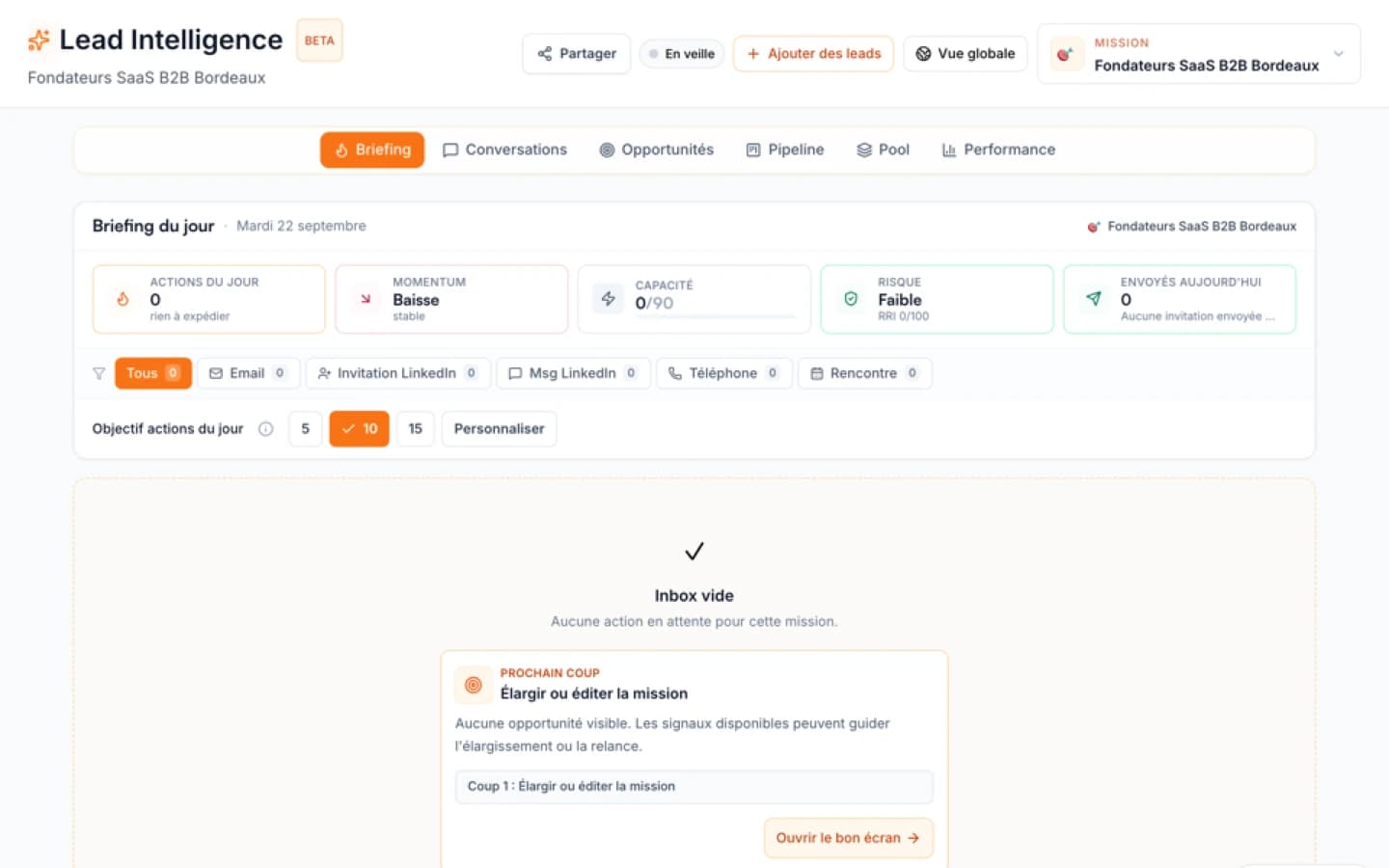
In Ember, Lead Intelligence prioritises opportunities from the available context. It classifies accounts into explained opportunities to watch, act on or set aside. It proposes the next action and channel that fit the lead situation. These capabilities support a review, but do not prove intent, consent, budget or an outcome.
Sources and methodology
External sources frame facts and limitations rather than promise a universal result. Recommendations are editorial analysis. Assumptions, unknowns and revision conditions remain visible throughout the article.
Sources
FAQ
Free diagnostic
Test your sales file
Drop an Excel or CSV and check its readiness without sending its rows to Ember.