
Definition
Lead qualification is the process of evaluating prospective buyers against specific criteria to determine their likelihood of purchasing a product or service. For a small Business-to-Business (B2B) sales team operating without a dedicated marketing department or a Customer Relationship Management (CRM) administrator, this process is the difference between a healthy sales pipeline and wasted effort in outbound sales for startups. Instead of treating all prospects equally, structured lead scoring helps a lean team identify high-value opportunities during cold outreach and B2B prospecting. When considering how to qualify B2B leads early, especially when deciding who to contact first as a founder, the choice of framework dictates how your sales pipeline is structured. For those wondering how a founder qualifies B2B leads without a sales team, or who should an early-stage founder contact first, the answer lies in matching the qualification complexity to your operational capacity. Most online guides list 7 frameworks side by side, but a practical approach must start from the buyer's actual decision moment and map each framework to deal size, cycle length, and committee depth.
To place this decision in context, the Knowledge guides for sales brings together deeper guidance on the same field.
Prerequisites
Before a small Business-to-Business (B2B) sales team can choose a qualification framework, they must establish a few critical prerequisites. Operating without a marketing team or a Customer Relationship Management (CRM) administrator means that any framework requiring heavy manual data entry or complex system configuration will fail. A small, resource-constrained team, such as a two-person sales team, cannot realistically run heavy, administrative qualification frameworks designed for enterprise organizations according to a guide on Superhuman Prospecting.
To understand how a founder qualifies B2B leads without a sales team, the primary prerequisite is shifting from volume-based prospecting to high-context targeting. Traditional outbound sales for startups often rely on massive databases to fuel cold outreach. However, platforms built for volume-driven outbound, like Apollo, present distinct challenges for small teams. On such platforms, credit-based pricing turns every action into a metered decision. When a sales team scales from one seat to five, the credit math does not just multiply linearly, as wasted exports and re-enrichment compound the cost, according to Factors.ai.
Therefore, the first prerequisite is a clear definition of your Ideal Customer Profile (ICP) and a structured approach to lead scoring that does not rely on manual CRM updates. When considering who should an early-stage founder contact first, the answer is not a random list of thousands of names, but a highly targeted group of prospects who display immediate signals of need. Instead of spending hours configuring complex fields for frameworks like Budget, Authority, Need, and Timeline (budget authority need timeline (BANT)) or Metrics, Economic Buyer, Decision Criteria, Decision Process, Identify Pain, Champion, and Competition (metrics economic buyer decision criteria decision process identify pain champion competition (MEDDICC)), small teams need automated context.
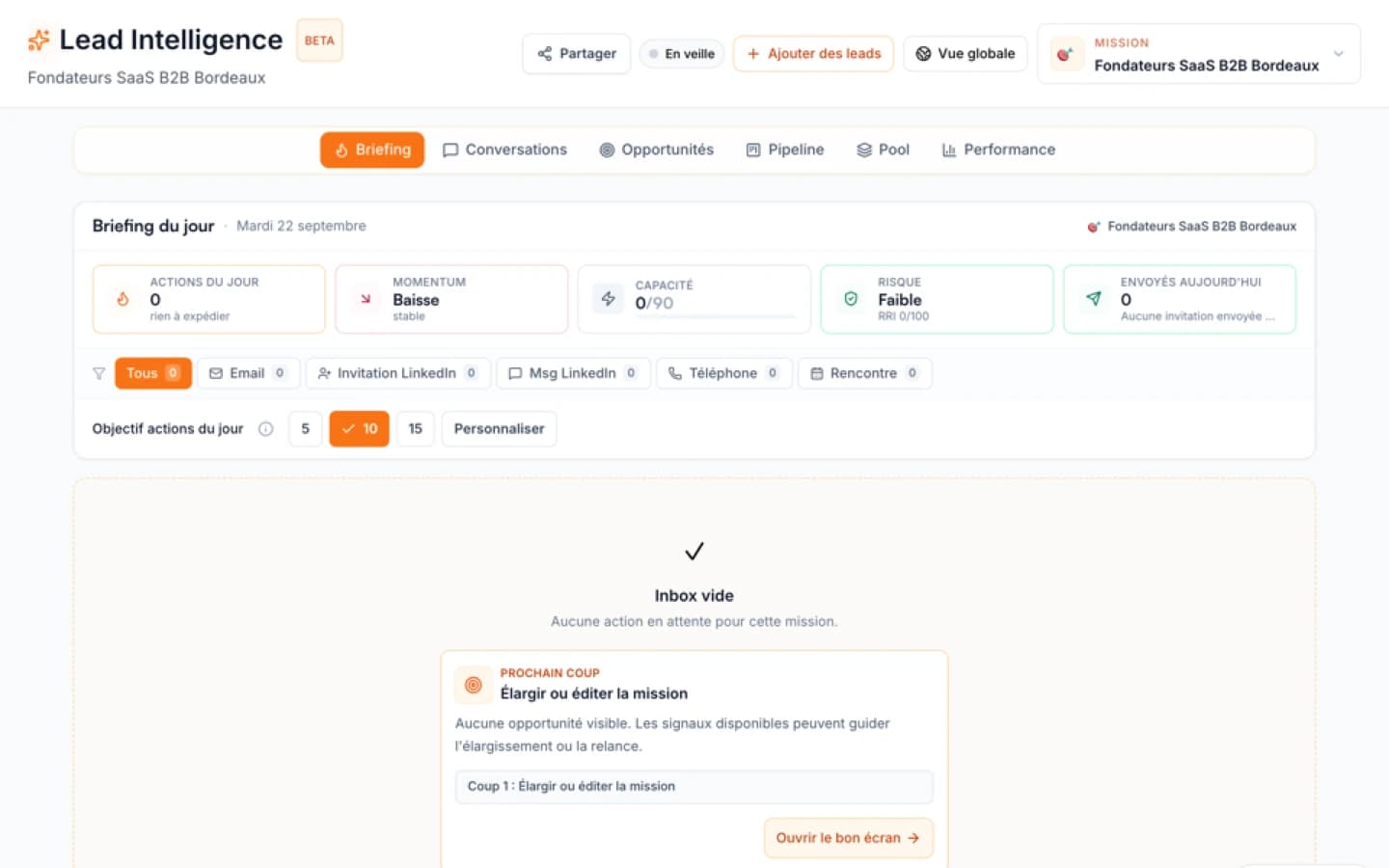
Ember addresses this challenge directly. Through its Lead Intelligence capability, teams can reuse their existing Business Plan, ICP, offer, and strategy to prepare a targeted sales mission, as detailed on the Ember Lead Intelligence page. Rather than requiring a CRM administrator to set up complex routing rules, Lead Intelligence finds and prioritizes the contacts itself, whether the team starts with 10, 100, or 1,000 contacts, with no minimum contact threshold, as outlined on the Ember Lead Intelligence page. This allows a small sales pipeline to remain active and focused on high-probability conversations without administrative overhead.
Steps
To choose the right lead qualification framework without a dedicated marketing team or a Customer Relationship Management (CRM) administrator, a small Business-to-Business (B2B) sales team must follow a structured selection process. Most industry guides list seven qualification frameworks side by side without practical context. However, a small team must start from the buyer's actual decision moment and map each framework to deal size, cycle length, and committee depth to identify which one a 2-person sales team can realistically run.
The first step is to evaluate the complexity of your typical sales cycle. If you are selling high-velocity, lower-priced offers with short cycles, a light framework such as BANT or ANUM is usually enough, because they prioritize immediate budget and authority. If your deals take longer and involve several decision makers, weigh the heavier options against what a 2-person team can actually maintain, and avoid frameworks that require a CRM administrator.
To explore this point further, trouver ses premiers clients startup: a practical guide details a step directly related to this decision.
Worked example
To understand how these methodologies function in practice, consider a small Business-to-Business (B2B) sales team trying to establish a sustainable outbound sales for startups workflow. A 2-person sales team can realistically run a simplified framework by focusing on the buyer's actual decision moment rather than administrative tracking, as discussed in the lead qualification guide by Superhuman Prospecting.
When executing cold outreach without a marketing team or a Customer Relationship Management (CRM) administrator, the team must choose a framework that does not require complex system configuration. Traditional frameworks like Budget, Authority, Need, Timeline (budget authority need timeline (BANT)) often fail in early-stage b2b prospecting because cold prospects rarely have a pre-allocated budget. A framework that starts from the prospect's pain or financial capacity, such as CHAMP or FAINT, fits early-stage prospecting better.
Common mistakes
The most frequent mistake is adopting a framework the team cannot maintain. Heavy frameworks such as MEDDICC or GPCTBA/C&I require deep administrative setup and continuous data entry that a small team without a CRM administrator cannot sustain. A second mistake is leaning on a volume-first platform such as Apollo (source). Its credit-based pricing model means that a team pays heavily for metered actions like exports and email verification. For a small team without a marketing department to filter out the noise, this volume-first approach leads to wasted effort and high bounce rates.
Similarly, teams often make the mistake of attempting complex data orchestration without Go-To-Market (GTM) engineering expertise. While platforms like Clay offer powerful infrastructure for GTM teams to run agentic workflows and get data (source), managing these setups requires technical skills that a small sales team without a customer relationship management (CRM) administrator rarely possesses. When founders take this route, they end up maintaining data pipelines instead of qualifying conversations.
This approach also connects with How should a B2B sales team generate leads in 2026 without relying on a single channel: outbound, inbound, or partnerships?, which clarifies the next choice.
Tools
Executing a modern lead qualification framework requires tools that match your team's operational capacity. For a small Business-to-Business (B2B) sales team operating without a dedicated Customer Relationship Management (CRM) administrator or marketing department, the technology stack itself often dictates which qualification methodology is actually sustainable.
If a team chooses a volume-heavy outbound sales for startups strategy, they frequently turn to platforms like Apollo. Apollo positions itself as a unified AI sales platform for modern sales and marketing teams to manage pipeline, closing, and stack simplification (source). This platform offers a massive B2B contact database, email sequences, call dialing, and a Chrome extension for LinkedIn prospecting. However, for a lean team, its credit-based pricing model turns every action into a metered decision where exporting contacts, enriching records, and verifying emails consume credits (source). When a sales team scales from one seat to five, the credit math does not multiply linearly, as wasted exports, bounced emails, and re-enrichment compound the cost (source). For example, a team that focuses on volume pays more in credits for those metered actions, rewarding volume over actual outcomes. This volume-first approach can quickly overwhelm a small sales pipeline with noise.
Alternatively, teams looking to build highly customized data pipelines might consider Clay. Clay provides infrastructure for Go-To-Market (GTM) teams and GTM engineers to get data, run agentic workflows, and launch GTM plays (source). It integrates with sales engagement tools like Salesloft, Outreach, Instantly, Smartlead.ai, and HubSpot Sequencer (source). While powerful, this infrastructure-heavy approach often requires technical setup and constant maintenance that a small team without a dedicated CRM admin or marketing team might struggle to support.
For founders wondering how does a founder qualify B2B leads without a sales team, the solution lies in shifting from volume-driven databases to context-driven prioritization. Instead of managing complex data enrichment pipelines or manual lead scoring, early-stage teams can leverage Lead Intelligence from Ember. Lead Intelligence reuses the existing Business Plan, Ideal Customer Profile (ICP), offer, and strategy to prepare a targeted sales mission, and finds and prioritizes contacts itself, as detailed on the Ember Lead Intelligence page.
When to use this method
Choosing the right lead qualification framework depends entirely on your operational constraints. For a small Business-to-Business (B2B) sales team operating without a dedicated Customer Relationship Management (CRM) administrator or marketing department, heavy frameworks like Metrics, Economic Buyer, Decision Criteria, Decision Process, Identify Pain, Champion, and Competition (metrics economic buyer decision criteria decision process identify pain champion competition (MEDDICC)) or Goals, Plans, Challenges, Timeline, Budget, Authority, Consequences and Implications (GPCTBA/C&I) are practically impossible to maintain. These methodologies require deep administrative setup and continuous data entry that distracts from active selling. While most industry guides list seven frameworks side by side, a small team must start from the buyer's actual decision moment and map each framework to deal size, cycle length, and committee depth, as detailed by Superhuman Prospecting.
If you are running transactional cold outreach with low contract values, Budget, Authority, Need, and Timeline (budget authority need timeline (BANT)) or Authority, Need, Urgency, and Money (ANUM) can work because they prioritize immediate budget and authority. However, if you are focused on outbound sales for startups where buyers do not have a pre-allocated budget, CHallenges, Authority, Money, and Prioritization (CHAMP) or Funds, Authority, Interest, Need, and Timing (FAINT) are better because they start with the prospect's pain or financial capacity rather than an active budget. For modern, value-driven B2B prospecting, Situation, Pain, Impact, Critical Event, and Decision (SPICED) helps align the sales pipeline with the actual business impact, though it requires disciplined documentation.
This raises a critical question for early-stage companies: How does a founder qualify B2B leads without a sales team? When you do not have a dedicated Sales Development Representative (SDR) or marketing team to run complex lead scoring, the founder must act as the primary qualifier. To make this manageable, the founder must know who to contact first. When building a prospect list from scratch, an early-stage founder should contact first the prospects who match a highly specific Ideal Customer Profile (ICP) and exhibit immediate signals of need, rather than a random list of thousands of names.
In practice, Most Promising French Startups: A Practical Guide for Founders completes this framework with another angle on the same topic.
When not to use it
For a small Business-to-Business (B2B) sales team, there are clear scenarios where you should not use complex qualification frameworks like Metrics, Economic Buyer, Decision Criteria, Decision Process, Identify Pain, Champion, Competition (metrics economic buyer decision criteria decision process identify pain champion competition (MEDDICC)) or Goals, Plans, Challenges, Timeline, Budget, Authority, Consequences and Implications (GPCTBA/C&I). Most guides list seven frameworks side by side, but a realistic approach must start from the buyer's actual decision moment to show which framework a 2-person sales team can realistically run without administrative bloat (source). If your team lacks a dedicated Customer Relationship Management (CRM) administrator, these frameworks quickly become counterproductive.
Action plan
To execute a modern lead qualification framework without a dedicated marketing team or Customer Relationship Management (CRM) administrator, a small team must strip away administrative complexity and focus entirely on action. If you are wondering how does a founder qualify B2B leads without a sales team, the answer lies in replacing heavy qualification spreadsheets with a lean, context-driven workflow.
First, select a lightweight framework that fits your actual operational capacity. While most guides list seven frameworks side by side, a 2-person sales team can realistically only run a model that maps directly to the buyer's actual decision moment, rather than trying to manage complex enterprise methodologies (Superhuman Prospecting). For a small team, Budget, Authority, Need, Timeline (budget authority need timeline (BANT)) or Challenges, Authority, Money, Prioritization (CHAMP) are far more practical than Metrics, Economic Buyer, Decision Criteria, Decision Process, Identify Pain, Champion, Competition (metrics economic buyer decision criteria decision process identify pain champion competition (MEDDICC)).
Second, define who should an early-stage founder contact first to maximize conversion. Instead of purchasing massive, generic databases that lead to high bounce rates and wasted effort, focus on high-intent prospects. When a sales team scales from one seat to five, the credit math does not just multiply linearly, as wasted exports and bounced emails compound the cost (Factors.ai). To avoid these compounding costs during Business-to-Business (B2B) prospecting, target prospects who exhibit clear, active signals.
Third, automate the connection between your high-level strategy and daily cold outreach. A small team cannot afford to spend hours manually aligning their sales pipeline with their business strategy. This is where Ember helps understand a changing context, choose the next priority and take action. By using Lead Intelligence, the team can automatically reuse the Ember Fund Your Growth, Ideal Customer Profile (ICP), offer, and strategy to prepare a targeted sales mission (Ember).
Before deciding, What does a defensible B2B lead qualification framework look like in 2026 for a team that has no marketing function and no scoring tool? helps connect this method with adjacent priorities.
Sources and methodology
This analysis is built on a comparative evaluation of lead qualification frameworks within the operational realities of small Business-to-Business (B2B) sales teams. Rather than listing methodologies side by side, our methodology maps each framework to deal size, sales cycle length, and buying committee depth to identify what a small team can realistically execute, a structured approach supported by research from Superhuman Prospecting.
To provide a comprehensive overview, we evaluated seven classic and modern frameworks:
- Budget, Authority, Need, and Timeline (budget authority need timeline (BANT))
- Challenges, Authority, Money, and Prioritization (CHAMP)
- Metrics, Economic Buyer, Decision Criteria, Decision Process, Identify Pain, Champion, and Competition (MEDDICC)
- Authority, Need, Urgency, and Money (ANUM)
- Funds, Authority, Interest, Need, and Timing (FAINT)
- Goals, Plans, Challenges, Timeline, Budget, Authority, Consequences and Implications (GPCTBA/C&I)
- Situation, Pain, Impact, Critical Event, and Decision (SPICED)
Sources
FAQ
Free diagnostic
Test your sales file
Drop an Excel or CSV and check its readiness without sending its rows to Ember.