
Symptom or signal
For early-stage founders, tracking the most promising French startups is more than a matter of curiosity. It is a way to decode the signals of market validation, scaling, and strategic positioning. When looking at the ecosystem, founders often look to major rankings to identify who is truly breaking through. For instance, the Next 40 and French Tech 120 indexes highlight the scale-ups driving the national ecosystem, as detailed by Licorne Society. Similarly, the LinkedIn Top Startups list for 2025 highlighted 20 rising French companies that are rapidly expanding their workforces and capturing market attention, according to LinkedIn. Meanwhile, other industry analyses focus on pure technological disruption, such as the top 15 most innovative French startups highlighted for 2026 by Junto. However, for an early-stage founder, these lists represent a lagging indicator, a symptom of past execution rather than an immediate roadmap. The real signal lies in how these companies build their growth engines. Success in these rankings is often driven by a transition from manual, founder-led sales to structured, repeatable acquisition channels. While some global giants scale by focusing on massive outbound volume, like Apollo, whose annual recurring revenue reached 150 million dollars in 2025, according to Apollo's company history page.
To place this decision in context, the Knowledge guides for sales brings together deeper guidance on the same field.
What changed
The landscape of the most promising French startups has shifted from pure growth at all costs to sustainable innovation and technological depth. This evolution is highly visible in how major ecosystem rankings have restructured their criteria. For instance, the French Tech Next 40 and French Tech 120 indexes, which track the most mature scale-ups, make technological excellence and contribution to major economic and societal challenges two new selection pillars for the 2026 class, alongside financial performance, as detailed by Licorne Society.
For early-stage founders, this means the playbook for validation has changed. It is no longer just about securing massive funding rounds, but about proving unit economics and real market traction early on. This focus on solid business fundamentals is also reflected in lists like the top 15 most innovative French startups in 2026 compiled by Junto, which reviews French startups that stood out for their funding rounds or their creativity.
Furthermore, the criteria for what makes a startup promising have expanded beyond traditional tech hubs. The 20 French startups highlighted as rising stars in 2025 by LinkedIn show that headcount growth, job-seeker interest and the ability to attract talent are taken into account to spot a company in a growth phase. Founders looking to build the next generation of successful companies must look beyond superficial metrics and focus on these deep-seated organizational and technological strengths.
To explore this point further, What is the startup success rate? A practical decision guide details a step directly related to this decision.
Facts and sources
This article relies on three public sources: the list of Next 40 and French Tech 120 companies published by Licorne Society, the Junto article on French startups in 2026, and the LinkedIn Top Startups 2025 ranking. Apollo's figures come from its pricing page and from its company history page.
Why the common explanation is incomplete
The common explanation of what makes a French startup promising usually relies on highly publicized lists. Founders frequently look at the French Tech Next 40 & French Tech 120 to find models of success, or study curated selections like the Junto article on the 15 most innovative French startups in 2026 and the LinkedIn Top Startups 2025 list of the 20 French rising stars. The underlying assumption is that massive fundraising, rapid headcount growth, and high-volume market presence are the primary indicators of a startup's future promise. However, this perspective is incomplete for early-stage founders who need to build sustainable businesses. Relying solely on these rankings overlooks the critical shift from raw volume to capital efficiency and strategic depth. In the sales and marketing landscape, for example, massive scale has historically been the default metric for success. Platforms built on sheer volume, such as Apollo, have achieved massive scale, serving more than 600,000 companies, according to its pricing page, and generating, according to Apollo's company history page, about 150 million dollars in annual recurring revenue in 2025. Yet, while this volume-heavy approach works for established players with large budgets, it creates a noisy environment that is increasingly difficult for early-stage startups to navigate. For a new founder, copying the playbook of the most visible scale-ups often leads to premature scaling. The true promise of a startup does not lie in how quickly it can replicate high-volume outbound tactics, but in how deeply it understands its target market and how efficiently it converts limited resources into real traction. Measuring a startup's potential purely by its presence on traditional growth indexes ignores the operational reality: sustainable innovation requires context, precise targeting, and a clear path to unit economic viability rather than generic, volume-driven expansion.
This approach also connects with What does a defensible B2B lead qualification framework look like in 2026 for a team that has no marketing function and no scoring tool?, which clarifies the next choice.
The real problem
A link to the LinkedIn Top Startups 2025 ranking can lead early-stage founders to believe that rapid hiring and massive outbound campaigns are the immediate next steps. The same bias occurs when founders try to emulate the scale-ups listed in the Next 40 or French Tech 120 indexes.
How the mechanism works
To build a promising start-up in the French ecosystem, founders must understand the operational mechanism that separates sustainable growth from superficial noise. The traditional playbook relies on raw outbound volume, a mechanism exemplified by legacy platforms. For instance, Apollo claims to support millions of sellers across more than 600000 companies as detailed on its pricing page, where each contact exported outside Apollo consumes an export credit. This volume-centric mechanism focuses on exporting massive lists and running automated email sequences, but it often introduces high friction. Founders can run into credit limits, a point Factors.ai lists among user feedback.
For an early-stage company, copying this high-volume mechanism is often a strategic mistake. The most promising French start-ups succeed by replacing generic volume with deep, integrated context. Instead of treating fundraising, narrative design, and sales prospecting as isolated tasks, they run them as a single, continuous feedback loop.
This modern mechanism operates in distinct phases:
First, the foundation requires a coherent funding and growth strategy. Rather than browsing static lists of options, founders must align their business plan with their actual operational constraints. This is where the Fund Your Growth capability structures the project, turning gaps in the file into prioritized next actions.
Second, the narrative must be designed to build genuine conviction. A promising start-up does not just polish slides; it refines its core reasoning. Through Creation, the mechanism works on reasoning, the audience journey, structure, design, and impact, ensuring that every presentation moves a business decision forward.
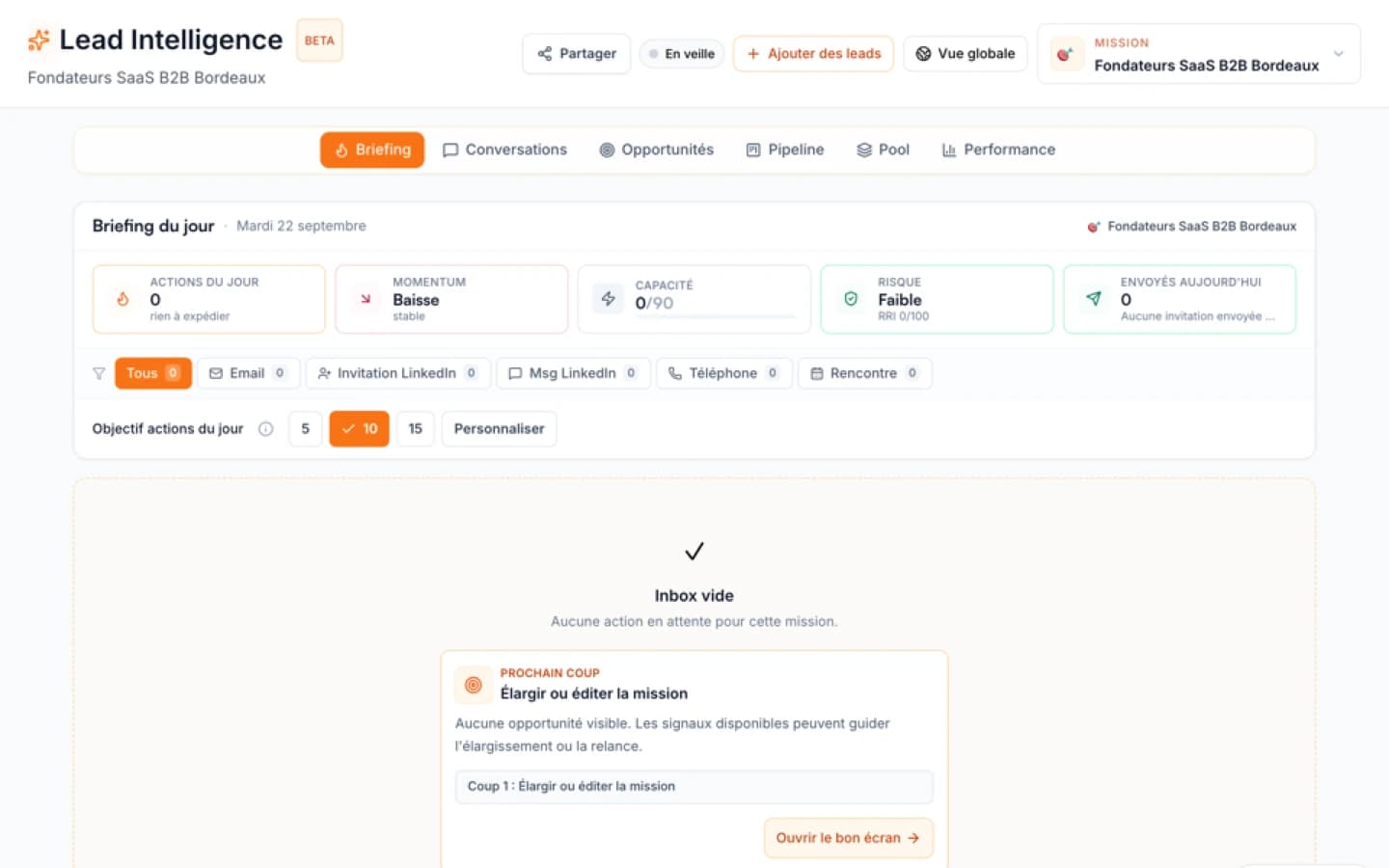
Third, commercial outreach must prioritize relevance over noise. Instead of blasting thousands of unverified contacts, the team uses Lead Intelligence to identify who to contact, why now, and with which angle. This context-grounded approach ensures that early-stage teams focus their limited energy only on the opportunities that deserve immediate action.
When these phases are connected, the start-up stops wasting resources on broad, untargeted campaigns. By using Ember's Second Brain to turn available context into clearer explanations and next actions, founders can navigate their growth with absolute clarity, building a business that is structurally ready to scale.
In practice, What problems prevent a traction-stage startup founder from knowing who to contact, why now, and with what message? completes this framework with another angle on the same topic.
Concrete examples
Among the rankings that stand out, LinkedIn published its list of 20 rising French companies for 2025. Lists such as the top 15 most innovative French startups in 2026 published by Junto also show how market observers assess innovation.
When to use this diagnosis
Early-stage founders should use this strategic diagnosis when they find themselves copying the tactics of highly publicized scale-ups instead of building their own repeatable growth engine. It is easy to look at the official list of the Next 40 and French Tech 120 on Licorne Society and assume that massive outbound campaigns are the only way forward. Similarly, founders tracking the top 15 most innovative French startups in 2026 compiled by Junto or studying the 20 rising stars from the LinkedIn Top Startups 2025 list on LinkedIn might feel pressured to scale their sales teams prematurely. This diagnosis becomes critical in three specific scenarios. First, when your outbound efforts yield high bounce rates and low engagement, indicating that your Ideal Customer Profile (ICP) is too broad. Second, when you are tempted to purchase massive databases from legacy providers like Apollo, which claims to serve millions of sellers in over 600,000 companies according to their public pricing page on Apollo, only to realize that credit-based pricing quickly drains your budget on unverified leads. Third, when you need to align your funding strategy with actual market traction before presenting to investors. Instead of relying on raw volume, early-stage ventures need a structured approach. Rather than copying the heavy infrastructure of late-stage companies, founders can use Lead Intelligence to prioritize high-intent opportunities based on real context, or leverage Fund Your Growth to map out a funding strategy that matches their actual operational runway. This ensures that every sales conversation and funding decision is backed by strategy rather than ecosystem hype.
Before deciding, Apollo vs Ember Lead Intelligence for Founder Conversion helps connect this method with adjacent priorities.
When not to use it
This context-driven strategy is not a universal fit for every business model or stage of growth. If your primary objective is to execute massive, un-targeted outbound campaigns where success is measured purely by the sheer volume of messages sent, a high-velocity outbound platform is more appropriate. For instance, legacy platforms are specifically optimized for this type of high-volume, top-of-funnel outreach. Apollo claims to support millions of sellers in more than 600,000 companies according to their pricing page, making it highly suitable for organizations that rely on broad, credit-metered scraping to fuel a large sales force. Furthermore, if your startup has already achieved clear product market fit and is scaling a large sales team with highly predictable unit economics, you might tolerate the friction of traditional lead generation tools. In these environments, teams often accept the credit-based pricing models where exporting, enriching, and verifying contacts each consume metered credits, a point Factors.ai lists among user feedback. If your business is structured to absorb these compounding costs and has the operational bandwidth to manage wasted exports and bounced emails, the raw database approach remains a viable option. Finally, if you require silent, automated database synchronization across multiple Customer Relationship Management (CRM) platforms without human review, or if you expect instant lead lists without defining a clear Ideal Customer Profile (ICP), this methodology is not appropriate. Building a sustainable business plan and finding the most promising path in the French ecosystem requires active strategic alignment. When raw volume and automated scraping are the only metrics that matter to your current playbook, sticking to traditional database providers is the more logical choice.
Next step
To join the ranks of the 20 rising French stars highlighted in the LinkedIn Top Startups 2025 list, early stage founders must move past passive observation and focus on execution. Similarly, looking at the 15 highly innovative companies selected for 2026 by Junto shows that sustainable growth requires a structured business plan and a clear commercial direction. Your next step is to transition from analyzing the success of others to building your own repeatable growth engine.
This transition begins with a clear strategy ready to be defended. By using Fund Your Growth, you can build your Business Plan, choose a funding strategy, and plan the next steps with confidence. The platform analyzes your project documents to make available proof and remaining validation gaps visible, turning those gaps into prioritized next actions so you always know what to resolve next.
Once your strategic foundation is secure, the focus shifts to market traction. Instead of generating generic outbound noise, Lead Intelligence helps you prioritize the conversations that deserve attention now. It proposes the next action and channel that fit the lead situation, giving you a clear next action on who to contact, why now, and which angle to use. This ensures your outreach aligns with your Ideal Customer Profile (ICP) without wasting resources on un-targeted campaigns.
As you navigate these decisions, Ember's Second Brain is available within your workspace to turn your available project context into clearer explanations and next actions. By anchoring your decisions in a single, shared context, you can build a venture that is not just promising on paper, but ready to scale.
To move from analysis to action, Lead Intelligence presents the corresponding Ember workflow.
Sources and methodology
To identify the most promising French startups, we examined the Junto article on the most innovative French companies in 2026. We cross-referenced it with the 20 rapidly growing businesses featured in the LinkedIn Top Startups 2025 publication, and with the list of scale-ups from the Next 40 and French Tech 120 index published by Licorne Society. Figures quoted on Apollo come from its pricing page and from its company history page. Ember is the publisher of Lead Intelligence, Creation and Fund Your Growth, which are presented in this article.
Sources
FAQ
Free diagnostic
Test your sales file
Drop an Excel or CSV and check its readiness without sending its rows to Ember.