
Symptom or signal
You are preparing to go international and you type the question that looks simplest: "which country should I target first?" Very soon you land on rankings of countries "by number of startups", published by consultancies, data platforms or media outlets. They do not always give the same podium, not all of them explain clearly what they count, and the method is not always public. That is the first warning sign: when a ranking does not say what a startup is, it cannot help you decide.
The second signal is quieter. You end up choosing a country because it is "big" or "well known" (Germany, the United Kingdom, the United States), and three months later you find that your first messages get no reply. The ranking reassured you about the size of the playing field, not about the presence of your future customers. A startup that sells software to accounting firms does not need the country with the most startups; it needs the country where accounting firms have a problem it solves and a reason to answer.
This article therefore reframes the original question, which was poorly posed, into one that open sources can answer: what do official statistics say about the countries where the most companies are created and about the exports of French start-ups, and how can you use them to choose a first country? You will find three things here: what public figures really measure, what they do not measure, and a simple method to move from a hunch about a country to a concrete test.
A word on transparency: Ember is the publisher of Lead Intelligence, the module discussed in the last part. The figures below come from public bodies (Eurostat, the Banque de France, Team France Export, the European Union's Your Europe portal), not from Ember, and each one points to its source. To put this decision in context, the Knowledge guides on sales gather the in-depth analyses of the same field.
What changed
A few years ago, choosing a country for a startup relied on impressions: a trade show, a contact met in Berlin, an anecdote about London. Today, two things have changed for a founder who wants to decide with facts.
First, public statistics are easier to consult. Eurostat publishes its business demography statistics online, page by page: number of active enterprises, enterprises born, enterprises closed, high-growth enterprises, for each Member State of the European Union. The page consulted for this article shows data dated October 2025, relating to 2023, with an update announced for 1 October 2026. The Banque de France, for its part, publishes a yearly study of the financial situation of French start-ups, including a part on their export revenue. These documents are free, dated and citable.
Second, public export support is better structured. Team France Export presents itself as the single window for export support for French companies, organised around the Regions, State services, Business France, the Chambers of Commerce and Industry and Bpifrance. It says it serves all companies, from startups to mid-sized groups. A founder no longer has to guess where to begin: part of the market analysis can be requested from advisers whose job it is.
What has not changed is the temptation to replace thinking with a ranking. A national figure gives reassurance, but it says nothing about your ideal customer. The useful change is therefore a change of method: use official figures to rule out bad leads and frame the choice, then check in the field, through real conversations, what those figures cannot tell you.
Facts and sources
Here are the verifiable facts we were able to open and read, with their source. Nothing else is presented here as a figure.
Eurostat, business demography (2023 data, page dated October 2025) (source):
- In 2023, the EU's business economy was made up of over 33 million active enterprises, of which 10.5% (3.5 million) were created that year. Those 3.5 million newly born enterprises created about 3.7 million jobs.
- The largest active enterprise population was registered in France (5.3 million) and Italy (4.6 million), followed by Spain (3.5 million) and Germany (3.2 million).
- The birth rate, meaning newly born enterprises as a proportion of active enterprises, ranged from 6.2% in Austria to 19.6% in Lithuania. It was over 16% in Portugal and Malta, and under 8% in Denmark and Italy. The chart on the same page gives about 14.1% for France, 8.4% for Germany, 9.1% for Spain, 9.4% for the Netherlands and 8.2% for Belgium.
- In most EU countries more companies were created than dissolved. The exceptions listed by Eurostat are Bulgaria, Denmark, Germany, Estonia, Ireland, Poland and Slovakia, where dissolutions exceeded creations.
- The activities contributing most to the number of newly born enterprises are wholesale and retail trade, construction, professional, scientific and technical activities, and administrative and support services: together they make up almost half of the births.
- High-growth enterprises are defined as those with at least 10 employees at the beginning of a three-year period and annual employment growth above 10% over that period. There were around 180,200 in 2023, or 10.5% of active enterprises with at least 10 employees. Their share ranged from 21.1% in Ireland to 2.8% in Cyprus.
Banque de France, "Situation financière des start-up en 2024" (September 2025) (source):
- The study covers 2,165 French start-ups, of which 2,009 have revenue above 750,000 euros and 156 raised more than 3 million euros. Their cumulative revenue is 25 billion euros in 2024, up 13%.
- According to the study, start-up export revenue represents 27.9% of total revenue, a cumulative amount of 7 billion euros. Two thirds of start-ups earn part of their revenue from exports. Tourism and leisure come first, with 55% of revenue made internationally, ahead of digital marketing (47%) and IoT and hardware (43%).
Team France Export (source): a public export support scheme, with more than 250 international advisers in the French regions and 750 advisers abroad, present in more than 50 countries. Among other things it offers export project preparation, identification of priority markets, sales prospecting, support for a trade show and the hiring of a V.I.E. (international volunteer).
The European Union's Your Europe portal (source): "Customs duties are rules that control how goods enter or leave the EU market." In other words, exporting goods outside the Union involves customs procedures, which is not the case for a sale between Member States. That page was last checked by its editors on 17 August 2026.
One fact deserves emphasis: none of these sources provides a ranking of countries by number of startups. Eurostat counts enterprises, the Banque de France counts French start-ups, and none of the pages consulted gives a common definition of a startup that would allow countries to be compared.
Why the common explanation is incomplete
The most widespread explanation fits in one line: "go where the most startups are, because that is where the ecosystem is." It is appealing, but it rests on three shortcuts that the sources above let us test.
First shortcut: confusing a new enterprise with a startup. Eurostat shows it clearly: almost half of the enterprises created in the Union are in trade, construction, specialised activities and administrative services. A high birth rate, like Lithuania's 19.6% or France's 14.1%, signals a country where many enterprises are created, not necessarily many fast-growing technology companies. Conversely, a lower rate, such as 8.4% in Germany, does not mean the country lacks customers for professional software. France also has the largest stock of active enterprises in the Union (5.3 million), yet having the biggest stock does not prevent France from being among the countries where high-growth enterprises weigh least in total employees (Cyprus 6.4%, France 6.3%, Belgium 5.4%, against more than 25% in Ireland, Greece and Finland).
Second shortcut: believing that more creations mean a better market for you. The birth rate measures turnover, not demand. A country can create many enterprises and see many disappear: Estonia shows a provisional death rate of 27.5%, Ireland 16.6% and Bulgaria 16.5%. For a founder selling to companies, a customer that closes within the year is a lost customer, and a very fluid market takes more prospecting for the same number of lasting customers.
Third shortcut: thinking that a start-up's export is decided by one country. The Banque de France data says something else. The weight of exports depends first on the sector: 55% of revenue in tourism and leisure, 47% in digital marketing, 43% in IoT and hardware, against 27.9% on average. In other words, the real variable is what you sell and to whom, more than geography taken alone. A marketing software startup is not in the same situation as a health startup subject to national approvals.
The right reading of official figures is therefore modest. They let you check that a country is not an obviously bad candidate (for instance a market where companies in your sector disappear in large numbers), not name a winner. A ranking does not replace the analysis of your target. These shortcuts are all the more tempting because some startup rankings blend them without saying which definition of a startup they apply.
The real problem
The real problem is not finding the right country in a table. It is that the question "which country?" is asked too early, before the two questions that make it useful: who is your customer, and how will you get your first conversation with them abroad?
Take an illustrative situation, invented for the example and unrelated to any real company. A French team is building a cash-tracking tool for small communication agencies. It hesitates between Germany, Spain and Belgium. It consults a ranking, picks Germany because the country is big, then buys a contact list and sends three hundred generic messages. Plausible result: few replies and no useful information about what blocked them. The team will not know whether the problem comes from the country, the message, the list or the language. The ranking created false certainty, and the failure teaches nothing.
The underlying mistake is treating a country as a single market. In practice, a country is a sum of segments: cities, sectors, company sizes, buying habits, languages. Eurostat data also reminds us that national situations are very different from one country to another: the birth rate ranges from 6.2% to 19.6% in Europe. None of these figures tells you how many communication agencies with fewer than twenty people exist in Munich and which ones already have a cash problem.
The second aspect of the problem is the cost of entry, which varies with the country targeted. Selling in another EU Member State involves no customs formalities on goods, whereas selling outside the Union does, as the Your Europe portal reminds us. For a purely software product, the customs question matters less, but other subjects take over (language of the product and support, tax rules, data protection) that you must check with official sources and specialised advisers, such as those of Team France Export. A startup ranking addresses none of these points.
Finally, there is the question of prospecting itself. When you enter a country where nobody knows you, mass sending rarely makes a good impression: it costs you reputation before you have learned anything. This approach is also worth comparing with What to Look For When Hiring a B2B Lead Generation Agency in 2026, which sheds light on the next choice.
How the mechanism works
The mechanism we recommend has five steps. It depends on no tool: you can follow it with a spreadsheet. Public data serves to frame the choice, and the bulk of the work consists in confronting two or three countries with your real criteria.
Step 1: define the target before the country. Write in a few lines the type of company you serve, the job title of the decision-maker, the problem you solve and the sign that shows it is urgent. Without this definition, any ranking of countries is off topic.
Step 2: check the size of the field with open sources. Eurostat gives you the number of active enterprises and the birth rates by EU country, and you can cross these data with the sector you target. The volume of active enterprises (5.3 million in France, 4.6 million in Italy, 3.5 million in Spain, 3.2 million in Germany) gives an order of magnitude of the number of potential customers, all sectors combined. You still have to estimate the share that matches your target, which general tables do not do.
Step 3: keep two or three candidate countries, no more. Choose them with criteria you can defend: presence of customers who look like yours, a language you can serve, no obvious regulatory barrier, existence of a relay (a partner, an adviser, a first contact). Team France Export can help you identify priority markets, and it lists that service among its missions.
Step 4: test with conversations, not with mass sending. For each country, set the same small batch of precise accounts (for example twenty companies chosen one by one), the same first-message outline adapted to the local language, and the same success criterion (a conversation obtained, not a click). Then compare the replies. This test costs little and teaches you what no ranking can.
Step 5: decide and document. For each country, keep a record of what you learned: what worked, what blocked, who answered and why. This serves to decide, and also to avoid repeating the same reasoning in six months.
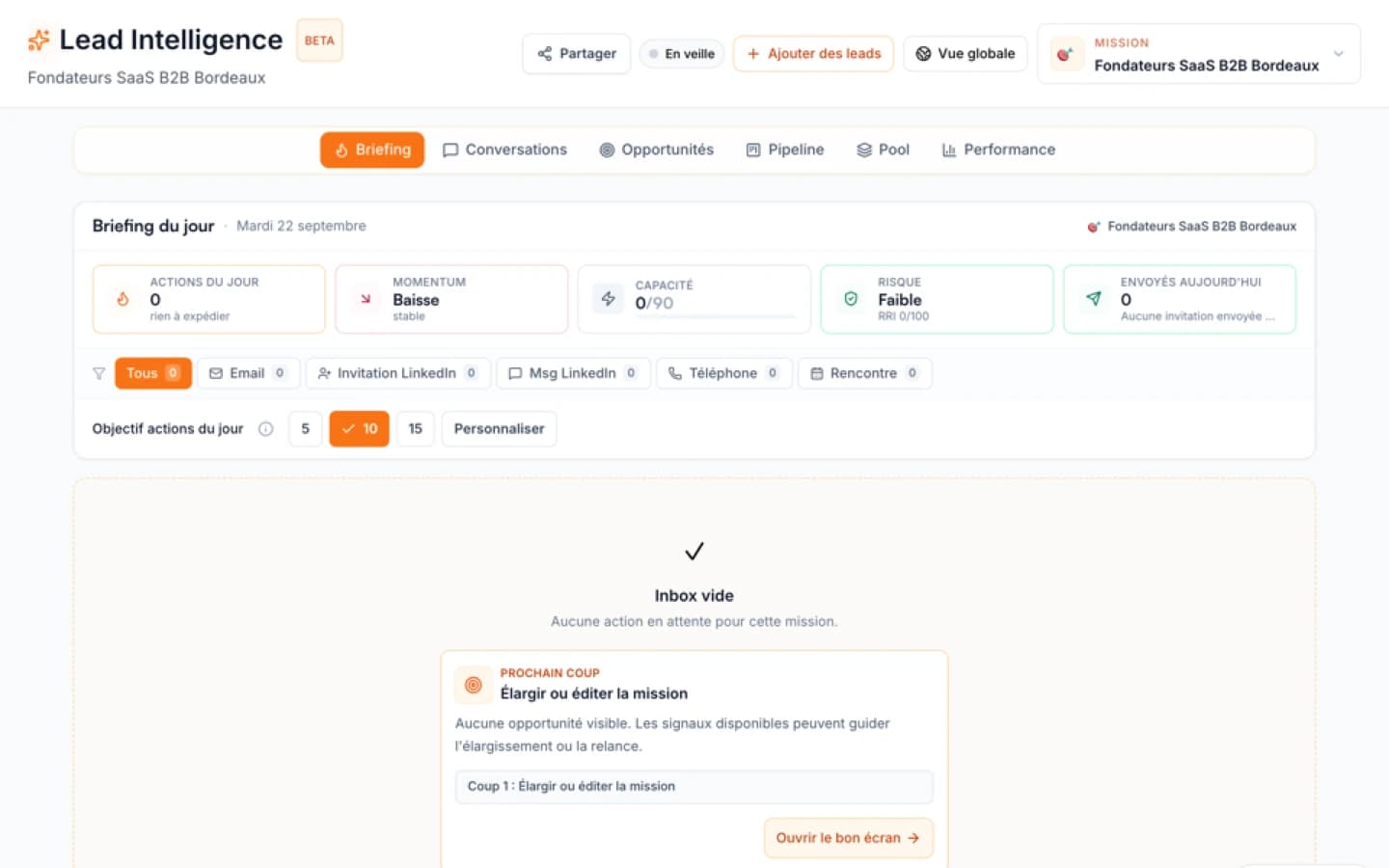
It is at step 4 that Lead Intelligence, Ember's module (of which Ember is the publisher), finds its place. It helps you know who to contact, why now, through which channel and with which angle. In practice, you describe your mission (sales prospecting or fundraising) and your target, and Lead Intelligence looks for accounts and people, checks sources, ranks the opportunities and proposes the next action. It works whether you start from 10, 100 or 1,000 contacts, with no minimum threshold, which suits a test of two or three countries on short batches. It is not meant to choose the country for you: choosing the target and the candidate countries remains your job.
Concrete examples
The three situations below are illustrative examples. They do not describe a real company and give no figures: they show how the reasoning unfolds.
Example 1, software for accounting firms. The team hesitates between Belgium, Spain and Germany. The startup ranking it consulted puts Germany first, but that ranking says nothing about accounting firms. It goes back to its target: firms of ten to fifty people, with a need to automate customer reminders. Eurostat data shows it that Spain has 3.5 million active enterprises and Germany 3.2 million: both markets are vast. It decides to test the three countries with twenty firms each, chosen one by one. If Belgium answers better, that will be a concrete result. The ranking could never have told it, since that result depends on its target, its language and its message.
Example 2, a connected hardware startup. Here the reading of the Banque de France figures is different. The IoT and hardware sector makes 43% of its revenue from exports according to the study, so going international is common for these companies. But a physical product crosses a border: if the target country is outside the Union, the customs procedures described on the Your Europe portal apply. The team therefore adds a criterion to its grid: the country must be reachable without heavy customs blockage for a first shipment. It chooses to start inside the Union, where goods circulate without customs duties, and to handle non-EU countries later, with a Team France Export adviser.
Example 3, a founder preparing a fundraise. They want to meet investors in another country and wonder which one to favour. They look at the number of startups per country, without success: no public source gives them a comparable figure. They then change the question: which investors in this country fund companies at my stage and in my sector, and who can I be introduced to? They set up a fundraising mission in Lead Intelligence with the thesis they defend, review the people proposed along with their sources, and keep for each one the reason for reaching out. This approach targets specific people, which a country ranking cannot do. To go further, Apollo vs Ember Lead Intelligence for Founder Conversion details the logic of priority over volume.
In all three cases, the country is not the starting point: it is the result of a comparison made with criteria written down in advance.
When to use this diagnosis
This reasoning is useful in several situations:
- You have a list of countries in mind and no criterion to tell them apart. Moving from "the most important country" to "the country where my target exists and answers" clarifies things immediately.
- You read a startup ranking and it seems inconsistent with your experience. Most likely its definition of a startup does not resemble yours. Check what the ranking counts before relying on it.
- You are preparing a file for a funder, a partner or a board and must justify the choice of a market. Dated public figures, like those of Eurostat or the Banque de France, hold up better than a ranking without a method.
- You hesitate between staying in France and going abroad. The Banque de France figures indicate that two thirds of the start-ups in its sample earn part of their revenue from exports. They remind you that going abroad is common among the most advanced start-ups, without saying whether it is the right time for you: that depends on your current traction.
- You are looking for a first country to test at low cost. The five-step method gives you a test that can be done in a few weeks, on short batches, before any heavy commitment (local hiring, subsidiary).
To move forward, What Evidence Should a B2B Founder Verify Before Choosing Lead Intelligence over High-Volume Prospecting? complements this approach to choosing the accounts to contact.
When not to use it
This diagnosis is not suited to several cases, and it is better to say so plainly.
- You already have customers in a country. If foreign customers found you and pay, the question is no longer choosing a country: it is understanding why they came and drawing a plan from it. Start from those customers rather than from a table of statistics.
- Your product depends on a national approval. In regulated sectors (health, finance, energy, for example), the country is imposed by the approval you can obtain. Business creation figures do not replace regulatory analysis, which belongs to official sources and specialised advice.
- You are looking for a legal or tax decision. This article gives no advice of that kind. VAT, establishment and data protection rules depend on your situation and the countries concerned; consult the competent official sites and a professional before acting.
- You expect a definitive ranking. No public source we could open ranks countries by number of startups. If such a ranking exists, it rests on a private definition of a startup, and you must read it before using it.
- You want to compare countries outside the European Union. The Eurostat figures cited here concern Member States. For the United States, the United Kingdom, Japan or the Emirates, you need other official sources, on other definitions, and you should not mix the results.
- You prefer the law of large numbers. Lead Intelligence looks for precision rather than volume: it is a poor choice for those who want to send thousands of identical messages across several countries.
Before deciding, How to Find Clients Quickly as an Early-Stage Founder? helps put these questions back into a founder's daily life.
Next step
Here is what we suggest you do this week, in order.
- Write your target in ten lines. Type of company, size, decision-maker's job title, problem, sign of urgency. If you cannot write it, that is the real task before any question of country.
- Open the Eurostat page on business demography and note, for your two or three candidate countries, the number of active enterprises, the birth rate and the death rate. Keep the date of the page (October 2025, 2023 data): it tells you when to read it again.
- Consult the Banque de France study on start-ups to place your sector: share of exports, sample size, definition used. Check that your company resembles the sample before comparing yourself.
- Contact the Team France Export office in your region to discuss the priority markets of your sector. It is a public service announced on its website, and it can save you months of exploration.
- Run a short test: twenty accounts per country, chosen one by one, same success criterion. If you use Lead Intelligence, describe the target and the candidate countries in the mission context, then review the people proposed along with their sources before any sending.
- Decide at the end of the test, not before. Write down what you learned, even if the result contradicts the ranking you read at the start.
If you want to try this approach with your own accounts, you can explore Lead Intelligence in Ember. For anything about pricing, refer to Ember's pricing page.
Sources and methodology
This article was reframed: the original question (a ranking of the countries "most taken" by French startups) had no verifiable answer. We replaced it with a question that official open sources can answer. All sources were opened and read for this version; the figures are reproduced as they are, with their year.
- Eurostat, "Business demography statistics", Statistics Explained page, data of October 2025 relating to 2023 (update announced for 1 October 2026): https://ec.europa.eu/eurostat/statistics-explained/index.php?title=Business_demography_statistics. The country rates for France, Germany, Spain, the Netherlands and Belgium come from the chart data of that page; the other figures are in its text.
- Banque de France, "Situation financière des start-up en 2024", September 2025: https://www.banque-france.fr/system/files/2025-09/Situation_financiere_start_up_2024.pdf. The sample has 2,165 start-ups, not all French start-ups.
- Team France Export, "Qui sommes-nous ?": https://www.teamfrance-export.fr/qui-sommes-nous.
- Your Europe, "Customs and excise duties in the EU", last checked 17 August 2026: https://europa.eu/youreurope/business/taxation/customs/index_en.htm.
- For Lead Intelligence: the capabilities described (mission, search for accounts and people, source checks, prioritisation, next action, start possible from 10, 100 or 1,000 contacts) are those of the Ember product. Ember is its publisher.
Limits to keep in mind. Eurostat measures enterprises, not startups: a high birth rate does not mean a richer technology ecosystem. The Banque de France study covers French start-ups, on 2024 figures, and the document consulted gives no breakdown of exports by country. None of the open sources provides a ranking of countries by number of startups. The examples on this page are illustrative. This article is not legal, tax or accounting advice.
Sources
FAQ
Free diagnostic
Test your sales file
Drop an Excel or CSV and check its readiness without sending its rows to Ember.