
Symptom or signal
Many modern sales teams experience a frustrating paradox: their Customer Relationship Management (CRM) systems are packed with thousands of contacts, yet their active pipeline remains dry. When outbound performance stalls, sales leaders naturally look for external help. They search for advice on choosing a lead generation company source or research lists of top demand generation agencies source to inject new life into their sales cycle. The immediate symptom is a perceived lack of leads, but the deeper signal is a lack of direction. Sales representatives spend hours staring at lists, unsure of who deserves their attention today, what signal matters, or how to craft a message that resonates.
To place this decision in context, the Knowledge guides for founders brings together deeper guidance on the same field.
What changed
In 2026, the B2B sales landscape has fundamentally shifted away from raw volume. The market has seen massive consolidation and growth in database providers. A large contact database can make names easy to obtain without showing which account is ready for a conversation. However, this scale has introduced new friction. Traditional credit-based pricing models turn every export, enrichment, and verification into a metered decision source, which compounds costs as sales teams grow source. On community platforms like Reddit, sales professionals are actively discussing how to look past simple list-building when hiring lead generation services source, shifting their focus toward high-intent, signal-driven outreach.
Facts and sources
Traditional sales engagement platforms are built to scale cold outreach across thousands of contacts source. They aggregate large databases and allow users to filter by firmographics or technographics source. Meanwhile, advanced data enrichment tools like Clay cater to revenue operations teams that want to combine multiple data sources and write custom enrichment logic source. While these tools are powerful, they require significant technical bandwidth to maintain. For a typical sales team, the sheer volume of uncoordinated data often results in wasted credits, bounced emails, and high noise levels source.
To explore this point further, Clay vs Ember: when each one fits details a step directly related to this decision.
Why the common explanation is incomplete
The common explanation for a dry pipeline is that the sales team simply needs a larger volume of contacts or more aggressive email sequencing. Agencies often promise a guaranteed number of booked meetings or deliver massive lists of cold prospects. However, this volume-driven outbound model assumes that success depends entirely on sending more emails. In reality, flooding prospects with generic, template-based outreach leads to diminishing returns, damaged domain reputation, and buyer fatigue. More data does not solve the fundamental challenge of relevance.
The real problem
The real problem is that sales teams lack contextual prioritization. They cannot answer the three core questions of effective prospecting: who to contact, why now, and with which message. Traditional qualification frameworks like Budget, Authority, Need, Timeline (BANT), CHaracteristics, Authority, Money, Prioritization (CHAMP), or Metrics, Economic buyer, Decision criteria, Decision process, Identify pain, Champion, Competition (MEDDICC) are difficult to apply when reps are forced to work through cold, unprioritized lists. Without a clear understanding of why an opportunity is ready for a conversation, sales teams waste valuable time on accounts that have no immediate intent or need.
This approach also connects with What Signals Actually Tell You a B2B Prospect Is Worth Contacting Now?, which clarifies the next choice.
How the mechanism works
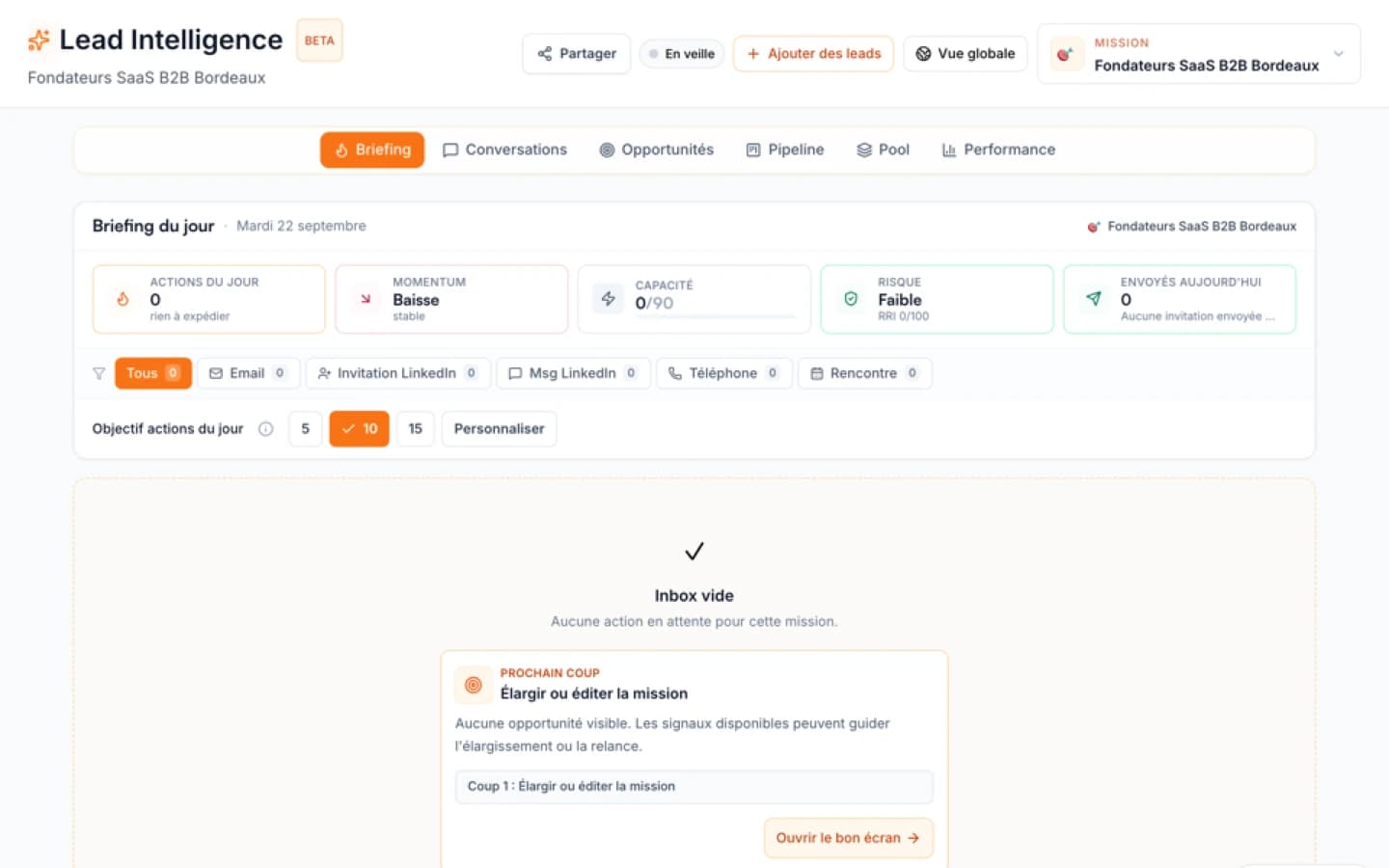
To overcome this, modern sales teams require an agentic workflow that translates business context into prioritized actions. Ember's Lead Intelligence mechanism addresses this by reusing your existing business plan, Ideal Customer Profile (ICP), and strategy to prepare a targeted sales mission source. Instead of relying on static database filters, the system finds accounts based on your specific ICP and real-time signals, then verifies useful sources source. It monitors signals about people and companies to keep your context current, classifying accounts into explained opportunities to watch, act on, or set aside source.
Concrete examples
Consider a sales team managing a list of target accounts. Under a traditional database model, reps must manually research LinkedIn profiles or use metered credits to enrich emails, hoping to find an active hook. Lead Intelligence can use account context to explain which opportunities deserve attention and suggest a next action. Check the reason, source and contact permission before outreach; the time to see useful priorities depends on the mission and available context source.
In practice, No brand or contact list: choose first B2B outreach targets completes this framework with another angle on the same topic.
When to use this diagnosis
This diagnosis is highly relevant if your sales team has plenty of names but struggles to choose the next conversation. It is the right fit when you want to reduce noise and focus attention on opportunities that deserve action now source. It is also ideal when you need your lead prioritization to be fully explainable from context, signals, and opportunity readiness source, rather than relying on an opaque, black-box lead score.
When not to use it
This approach is not suitable if your sales team is committed to high-volume, unsegmented cold outreach where success is measured solely by the quantity of emails sent. If your team does not yet have a defined ICP or a clear business strategy, a basic contact database or a generalist agency may be sufficient to run broad, initial experiments.
Before deciding, Does Real-Time Lead Qualification Replace BANT for Small Teams? helps connect this method with adjacent priorities.
Next step
Before hiring an agency or purchasing another high-volume database, define your prioritization criteria. If you want to move away from volume-based noise and focus on the conversations that deserve attention now, explore how an agentic workflow can support your team. You can learn more about prioritizing your outreach by visiting Ember's Lead Intelligence page.
Sources and methodology
This guide is compiled from industry analyses of B2B demand generation agencies source, professional guidelines on selecting lead generation companies source, and community discussions on outbound marketing strategies source. Market data regarding sales intelligence platforms is sourced from comparative reviews of credit-based prospecting tools source source. Product capabilities and workflows are verified against Ember's official Lead Intelligence specifications.
| Criteria | Agency or database | Ember |
|---|---|---|
| Dominant logic | Sells contact volume and campaign execution, and your reps still have to sort cold lists | Helps founders and sales teams prioritise opportunities with their context |
| Before choosing | Check the transparency of qualification criteria, data freshness and the billing model | Check that each priority stays explainable from your context, detected signals and opportunity readiness |
Sources
FAQ
Free diagnostic
Test your sales file
Drop an Excel or CSV and check its readiness without sending its rows to Ember.