
Symptom or signal
Early-stage founders searching for average startup revenue benchmarks are often trying to validate their business model or set realistic sales targets. They look at macro statistics source to see if their progress aligns with industry standards.
This search is a clear signal of a transition from product development to market entry. The founder realizes they need to generate predictable revenue but lacks a structured way to identify which prospects will actually convert. Often, the immediate reaction is to buy a massive contact database or start sending bulk emails, hoping that sheer volume will yield the average revenue figures they see in industry reports.
To place this decision in context, the Knowledge guides for sales brings together deeper guidance on the same field.
What changed
Startup statistics and contact platforms have become easier to find, but neither tells a founder whether their own company is selling to the right buyer. A published revenue average can combine companies of different ages and sectors. A contact database can contain thousands of names without revealing a current reason to buy. The practical change is that the founder can compare more information, but must check whether each figure and record is relevant.
Apollo now presents data, intelligence and execution capabilities, not only high-volume sequencing. A small team can compare those functions with its actual workflow. It should also define what a useful result means: a qualified conversation, a signed contract, repeat use or another observable step. More records and more messages are activities; they are not evidence of revenue on their own.
Facts and sources
The Les Makers compilation states an average annual figure for French startups, but does not give this article a defined first-year B2B sample, calculation period or distribution. Its headline cannot be used as a target for a newly formed company. A mean can also be pulled upward by a few larger firms. Without the cohort, median and age of the companies, the figure tells a founder little about their own first contracts.
Founder age is a different question from company revenue. An article about the age of successful founders cannot establish which accounts this business should contact or how many sales it will make. For a decision this quarter, use the company’s own records: signed revenue, active customers, the number of sales conversations with a verified problem, gross margin and cash runway. State the dates and definitions behind those measures so forecasts are not mistaken for actual results.
Why the common explanation is incomplete
The common advice given to early-stage founders is to build a large Ideal Customer Profile (ICP) list, load it into a Customer Relationship Management (CRM) system, and run high-volume outbound campaigns. Traditional qualification frameworks like Budget, Authority, Need, Timeline (budget authority need timeline (BANT)), Challenges, Authority, Money, Prioritization (CHAMP), or Metrics, Economic Buyer, Decision Criteria, Decision Process, Identify Pain, Champion, Competition (metrics economic buyer decision criteria decision process identify pain champion competition (MEDDICC)) are often applied blindly to these cold lists.
This explanation is incomplete because it assumes that more contacts automatically equal more revenue. In reality, volume creates noise. When founders focus purely on scaling cold outreach across thousands of contacts source, they dilute their message. They spend valuable credits on unverified leads and generic templates source. They measure success by activity metrics rather than actual conversion and revenue.
The real problem
The real problem for an early-stage founder is not a lack of contacts, but a lack of prioritization.
When you are trying to reach your first revenue milestones, you do not need an enormous list of cold leads; you need to know who to contact, why now, and with which message. Traditional databases give you lists, but they do not give you context. They do not tell you which company has a pressing need today or which relationship is ready to be activated. Without this intelligence, founders waste time and capital chasing dead ends, making their average revenue targets even harder to reach.
This approach also connects with What Is the Average Lifespan of a Startup, and How Do You Beat the Survival Odds?, which clarifies the next choice.
How the mechanism works
This is where a shift from volume to intelligence is required. Instead of treating prospecting as a database filtering exercise, founders need an agentic experience that researches, analyses, and turns available context into next sales actions.
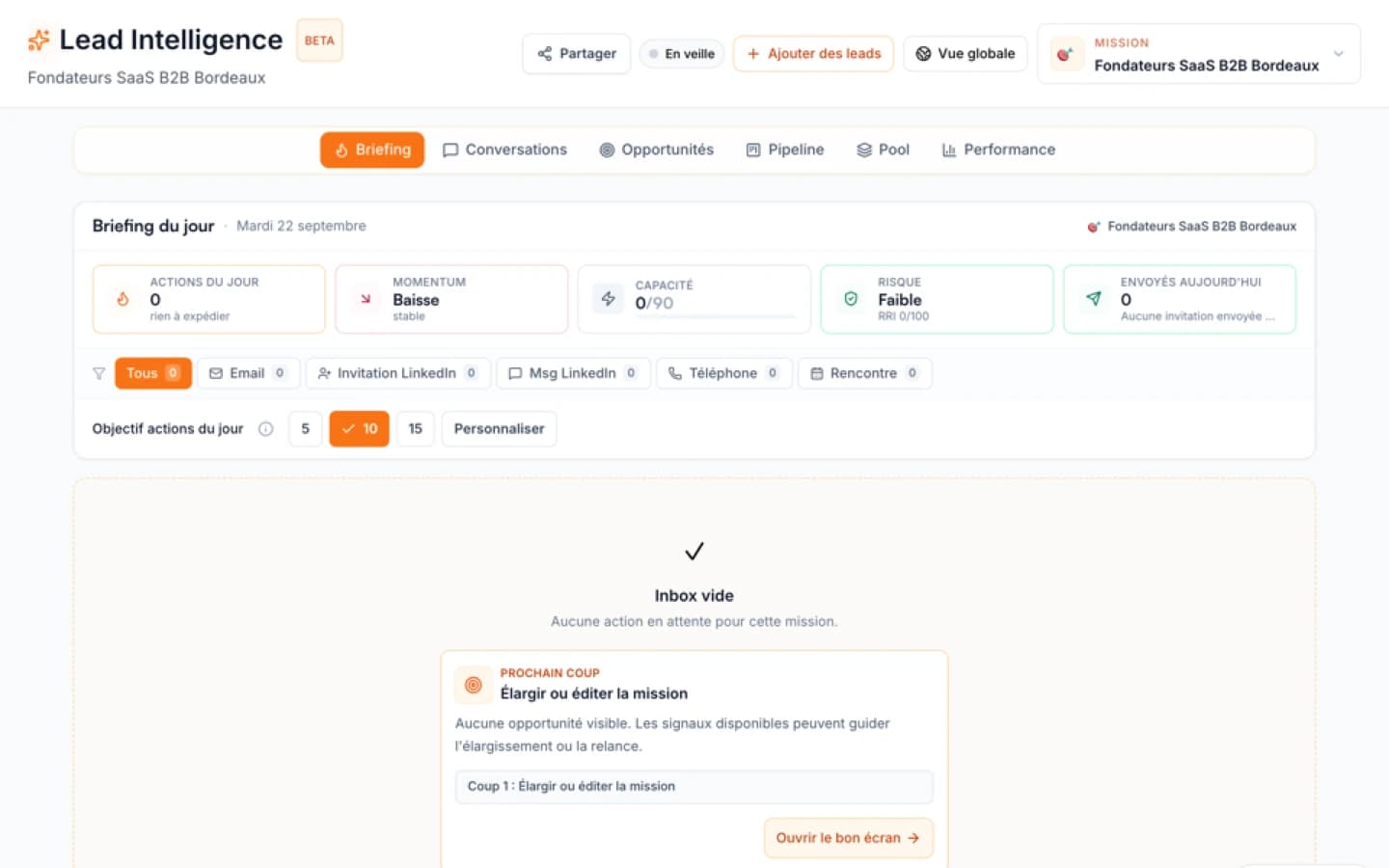
Ember's Lead Intelligence capability addresses this by understanding context and human relationships, then detecting changes across people and companies to adjust priorities. It reuses the Ember Business Plan, ICP, offer, and strategy to prepare a sales mission source. It finds accounts from the mission ICP and signals, then verifies useful sources source. This reduces noise by focusing attention on opportunities that deserve action now source.
Concrete examples
Consider a hypothetical B2B software company with an annual revenue goal. Its founder reads a headline average for startups but cannot tell whether the underlying firms are comparable in age, market or business model. Rather than copying that number into the plan, the founder starts with current signed revenue and the actual sales cycle. The forecast then states how many customers, at which price and at what conversion assumptions would be needed. Those are assumptions to test, not a market average.
For prospecting, the founder reviews a small group of accounts linked to a specific buyer problem. Each record has a source, date, relevant role, contact permission and next question. Ember Lead Intelligence may help identify and prioritise opportunities from the business context; the founder checks the suggestions and outcomes. No public Ember page establishes a fixed number of contacts, a guaranteed first-lead time or revenue uplift. A useful first result is an evidenced conversation that changes the plan, not an export count.
When to use this diagnosis
An early-stage founder should use this prioritization-first approach when they have a defined offer but limited time and budget.
If your team has plenty of names but struggles to choose the next conversation, you need to define your prioritization criteria. It is ideal when you want to avoid the compounding costs of credit-based pricing models source and instead focus on high-intent opportunities. It is also highly relevant when you have a small list of target accounts and need to make every single interaction count, as Lead Intelligence has no minimum contact threshold source.
When not to use it
This diagnosis is not suitable if your startup's go-to-market strategy relies entirely on high-volume, automated email blasts across tens of thousands of unsegmented contacts.
If your primary need is simply a massive, raw contact database to feed a large team of outbound Sales Development Representatives (SDRs) running standardized scripts, Apollo may be a candidate; compare its current data, intelligence and execution functions with your needs (Apollo). Similarly, if you already have a mature Revenue Operations (RevOps) team dedicated to building custom enrichment workflows across multiple data providers, a tool like Clay might be more appropriate source.
Before deciding, How to Qualify B2B Leads Without BANT or MEDDICC? helps connect this method with adjacent priorities.
Next step
If you are ready to move past the noise of generic lists and focus on the conversations that will actually drive your startup's revenue, the next step is to align your prospecting with your actual business context.
You can explore how to build a targeted, signal-driven sales mission that identifies high-priority opportunities. Learn more about how to structure your outreach by visiting the Lead Intelligence page on Ember.
Sources and methodology
Les Makers is a secondary compilation and does not provide a comparable first-year B2B revenue cohort for this guide. Apollo and Ember Lead Intelligence describe their own capabilities; neither proves a revenue result for the founder. The example is illustrative. Before using any benchmark in a financial plan, verify its original dataset, date, definition and distribution.
| Decision | Own baseline | Contextual opportunity review |
|---|---|---|
| What is known | Signed revenue, active customers and dated sales outcomes | Sourced account fit, current signals and remaining unknowns |
| Before changing plan | Compare actual results with forecasts for the same period | Review suggested priorities and verify contact rights |
Sources
FAQ
Free diagnostic
Test your sales file
Drop an Excel or CSV and check its readiness without sending its rows to Ember.