
Symptom or signal
A founder may be spending on product and outreach while receiving little evidence that customers need the offer. That is a warning sign to investigate, not proof of a particular cause of failure. Ask which people have the problem, what they currently do about it and whether they will commit time or money to a solution. Lead Intelligence can help research accounts that match a sales mission and explain why a conversation may be timely, but those conversations still need to test the underlying demand.
The Knowledge guides for sales place this decision in context.
What changed
A lack of demand is one possible risk, alongside execution, financing and team decisions. Tom Eisenmann's analysis in Harvard Business Review describes several patterns of failure rather than one universal cause. A founder should therefore test the assumptions specific to the venture: who has the problem, how urgent it is, what the solution costs to deliver and how much time remains to learn. Researching qualified prospects helps create conversations, but does not by itself validate a market.
Facts and sources
Startup survival figures depend on the population and definition used. For example, INSEE reports that 69% of French businesses created in the first half of 2018, excluding micro-entrepreneurs, remained active five years later. That measure is not a universal startup failure rate and does not rank causes. Harvard Business Review discusses several failure patterns. Use these sources to frame questions, then collect evidence from the venture's own customers and finances.
The Full-Cycle Sales Calendar: Serve Buyers and Refill Pipeline covers one way to review commercial evidence.
Why the common explanation is incomplete
The conventional wisdom often attributes startup failure to running out of cash or a lack of market need. Those explanations describe common symptoms, but none applies to every startup. According to research on why ventures fail by Harvard Business School Professor Tom Eisenmann, detailed in an analysis by Jean Lepage, failures follow several patterns rather than a single cause. When founders point to cash depletion, they are often pointing to a late-stage symptom rather than the origin of the problem.
The breaking point therefore varies from one project to another. Sometimes the difficulty lies in how the startup defines and pursues its first commercial traction: broad, unfocused outreach campaigns generate a lot of noise and few genuine opportunities, which dilutes limited resources. In that case, an Ideal Customer Profile (ICP) grounded in real-world signals and a clear, explainable priority for daily actions help avoid wasting runway on leads that are not ready to buy. In other cases the problem lies elsewhere: the offer, the funding or the team.
The real problem
The problem is to distinguish a weak assumption from an observed result. A team can have little revenue because the offer is unconvincing, the target is wrong, the sales cycle is long, or cash runs out before learning. These explanations require different actions. Record what customers actually said and did, compare it with the plan, and decide which assumption to test next.
The What to Look For When Hiring a B2B Lead Generation Agency in 2026? addresses a related commercial choice.
How the mechanism works
To examine the structural risks that can contribute to failure, founders must shift from static planning to an active, context-driven validation mechanism. This mechanism works by continuously linking three core pillars: validated evidence, strategic funding, and prioritized execution. Instead of treating a business plan as a static document, this approach treats it as a living graph where every assumption is mapped against real-world proof.
In Ember, Fund Your Growth can support this planning, which connects business modules to make weak points surface first. Instead of pursuing generic funding options, the system helps compare funding paths against the project context. By making the gaps in the file visible, it transforms abstract risks into a prioritized action plan, so the team can review critical assumptions before committing capital.
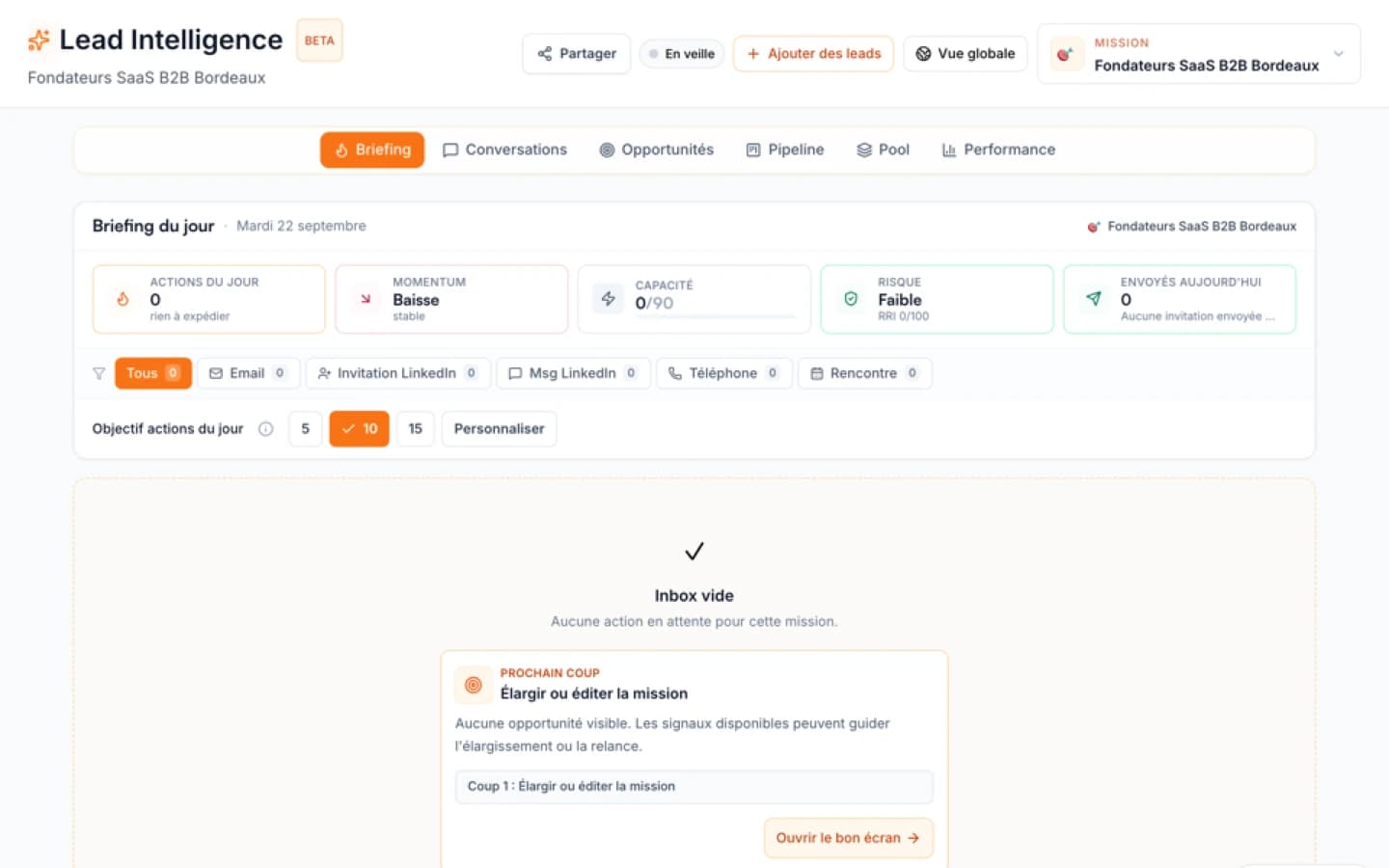
The same logic applies to market traction. Through Lead Intelligence, the mechanism reduces noise by focusing sales teams on opportunities that deserve action immediately. Rather than importing thousands of cold contacts without context, it analyzes signals from companies and people to provide a clear next action, explaining who to contact, why now, and which angle to use. This prioritization helps a team choose which conversations to review, while market validation and financial decisions remain separate work.
Concrete examples
Suppose a software founder interviews ten operations managers and hears that the problem is real, but few will pay for the proposed workflow. That evidence calls for revisiting the offer or the target, rather than buying a larger contact list. If several managers commit to a paid trial but delivery costs are too high, the next test concerns the delivery model and finances. These are hypothetical examples; neither outcome proves what happens to all startups.
Fund Your Growth can help structure the project and financing choices. Lead Intelligence can research accounts for a defined sales mission and propose a priority with sources. The founder still has to validate the customer's need and the business model.
When to use this diagnosis
Early stage founders should run this diagnosis when their market entry strategy feels like a high volume guessing game. If your team is spending valuable resources building generic lists or experiencing high email bounce rates, it is a clear signal that your ideal customer profile (ICP) lacks real-world context. This diagnostic approach is also critical when preparing for a funding round, as it helps you transition from static planning to a strategy ready to be defended. By identifying assumptions that lack evidence, you can choose a more useful next test. When you need to reduce noise and focus your limited resources on opportunities that deserve action now, evaluating your current validation and sales intelligence mechanisms becomes essential. Using Ember helps founders align their strategy with validated evidence, so each outbound effort can be checked against its context.
When not to use it
Traditional database tools are often sufficient when your target market is entirely static and your sales team relies on simple, high volume outreach without needing current context. If you do not need to continuously validate your ideal customer profile (ICP), standard credit based platforms can handle basic list generation. The tradeoff is that credit based pricing turns every action into a metered decision where exporting contacts, enriching records, and verifying emails each consume credits, which can compound costs when a sales team scales, as highlighted by Factors.ai and Coldreach.
You should not use a signal driven validation approach if your business model relies entirely on transactional, low cost consumer sales where individual relationship context does not impact the transaction. Similarly, if you prefer to execute unstructured, high volume email campaigns without filtering for readiness, generic scraping tools are a better fit.
Ember is built for teams that want to move away from this generic noise. Through Lead Intelligence, the platform helps focus attention on opportunities that deserve action now by providing a clear next action, explaining priority from real world signals, and showing the actual value produced by your sales mission. If you are not ready to connect your daily outreach to a structured strategy, traditional databases will suffice, but when you need to align your execution with a validated business plan, a context driven approach becomes essential.
Before deciding, How to Find Clients Quickly as an Early-Stage Founder? helps connect this method with adjacent priorities.
Next step
To move past the guessing game and examine the risks that matter to your startup, the immediate next step is to ground your decisions in a reviewed evidence. Instead of relying on static assumptions or generic market lists, founders must actively bridge the gap between their strategic planning and daily execution.
This is where Ember helps you transition from planning to action. Through the Fund Your Growth capability, you can build your Business Plan, choose a funding strategy, and plan the next steps. The system turns gaps in your file into prioritized next actions, making the remaining questions visible.
Once your strategy is validated, you can address market execution directly. With Lead Intelligence, you can eliminate the noise of high volume outreach and focus on the opportunities that deserve immediate attention. The system provides a clear next action, helping you know who to contact, why now, and which action to take, while proposing the next action and channel that fit the lead situation. By connecting your overall strategy to precise daily execution, you can test the market and execution assumptions that matter to your venture.
Sources and methodology
The INSEE study of businesses created in the first half of 2018 provides a clearly defined five-year survival measure for French businesses excluding micro-entrepreneurs. Tom Eisenmann's Harvard Business Review analysis describes multiple startup failure patterns. The Lead Intelligence page describes mission research and prioritization. These sources support different claims and should not be combined into a single universal failure rate or cause.
Sources
FAQ
Free diagnostic
Test your sales file
Drop an Excel or CSV and check its readiness without sending its rows to Ember.