
Essential in 30 seconds
There is no single startup success rate that predicts whether your next sales move will work. The answer changes with the cohort, the milestone and the time observed. Greg Head's Practical Founders article gives an experienced founder-adviser’s estimates for transitions between software revenue stages, not a measured probability that any startup will survive or that lead prioritisation will prevent failure. This article gives you a practical method to choose sales conversations using customer fit, recent evidence and a clear next action.
Why this situation is different
Most startup advice emphasises volume: more outreach, more calls, more emails. But for early-stage founders, time is the scarcest resource. A single wrong conversation costs hours you don't have. Startup outcomes differ by stage and market. A founder can still improve the quality of a sales decision by checking: which lead to pursue, which signal to act on, and which message to send. This is not a problem of quantity; it's a problem of decision-making under uncertainty.
Diagnostic
Ask yourself honestly:
- Do you have a list of contacts but no clear order of who to talk to first?
- Do you spend more time researching leads than talking to them?
- Are your outreach messages generic because you don't know what matters to each prospect?
- Do you rely on gut feeling or a simple title/industry filter to decide who to contact?
If you answered yes to any of these, you have a prioritisation gap. Your current tool may store contacts and enrich basic data, but it doesn't help you decide who deserves attention now.
The three-phase method
Use this method to move from a list of names to a prioritised action plan:
- Define your Ideal Customer Profile (ICP), Be specific: industry, company size, role, trigger events (funding, hiring, product launch). The more precise, the better.
- Gather signals, Identify real-time changes about people and companies: job changes, fundraising, new product releases, regulatory shifts. These indicate readiness to buy.
- Score and prioritise, Combine ICP fit and signal strength into a simple score. Rank leads by score and assign a clear next action: call, email, LinkedIn message, or wait.
Detailed steps
Step 1: Define your ICP
Write down the 3, 5 attributes that define your best customer. For example: "B2B SaaS companies in Europe, 10, 50 employees, with a recent VP of Sales hire and a Series A round in the last 12 months." Use this to filter your list.
Step 2: Set up signal monitoring
Manually check LinkedIn, Crunchbase, or news feeds for changes. Alternatively, use a tool that automatically detects signals. The goal is to know when a prospect becomes more likely to buy.
Step 3: Create a scoring system
Use a simple 1, 5 scale for ICP fit and signal strength. Multiply for a priority score. For example:
- ICP fit: 1 (low) to 5 (perfect)
- Signal strength: 1 (no signals) to 5 (multiple strong signals)
- Priority score = ICP fit × Signal strength
Sort descending. Contact the top 10 leads this week.
Step 4: Craft a personalised message
Reference the signal you detected. Example: "Saw that you just raised a Series A, congrats. Many founders in your position tell us scaling sales is their next challenge. We help prioritise conversations so you don't waste time on the wrong leads. Open to a 15-minute chat?"
Scripts and tables
Lead scoring table
Outreach script template
"Hi [Name], I noticed [specific signal]. At [your company], we help [value proposition]. Would you be open to a brief call to explore if this could help you [specific outcome]?"
Action plan
- This week: Define your ICP in one sentence. Review your current lead list and remove any that don't fit.
- Week 2: Set up a signal monitoring system. Use a simple spreadsheet to track ICP fit and signals for your top 50 prospects.
- Week 3: Score your top 50 leads. Contact the top 10 with personalised messages based on signals.
- Week 4: Measure response rates and meeting bookings. Refine your ICP and scoring criteria.
Metrics
Track these metrics to measure improvement:
- Response rate: Percentage of outreach that gets a reply. Compare with your own prior period.
- Meeting booked rate: Percentage of replies that turn into a meeting. Compare with your own prior period.
- Conversion to opportunity: Percentage of meetings that lead to a qualified opportunity. Compare with your own prior period.
If these measures weaken, inspect the target, message and channel before changing the method. Revisit your ICP and signals.
Evidence and limits
Greg Head's Practical Founders article gives rough stage-by-stage estimates for software companies. It does not report a longitudinal cohort showing that one in twelve startups succeeds, or identify sales prioritisation as the cause of survival. Silicon Valley Bank's stage guide describes stages but gives no general success rate. To assess your own sales choices, record whom you contacted, why, the reply, the next step and the time spent. Compare your own periods with the same definitions before drawing conclusions.
Worked example
Consider a B2B software founder with a contact list and limited time. She chooses one customer group, checks whether each account has a current need, and writes a specific reason for reaching out. After a week, she records useful replies and meetings from those contacted. This is an illustration of the decision method, not an Ember customer result or a promised increase in meetings. If the replies reveal a weak problem fit, she revises the target rather than sending a larger generic sequence.
Common mistakes
- Treating all leads equally: Assuming every contact is worth your time. They aren't. Prioritise ruthlessly.
- Not defining an ICP: Without a clear profile, you attract noise. Spend time on ICP definition.
- Ignoring signals: Outreach without a trigger is cold. Wait for a signal or actively monitor for one.
- Using generic outreach: A one-size-fits-all message ignored. Reference the specific signal that made you reach out.
- Overcomplicating scoring: Keep it simple. A 1, 5 scale is enough. Don't over-engineer.
Citable answers
How many leads should I target at once? Choose a number you can research and follow up carefully each week. Quality over quantity. Use scoring to pick the top slice.
How often should I review priorities? At least weekly. Signals change quickly. A lead that was low priority last week may become high priority after a funding announcement.
What if I have no signals yet? Start with a broad ICP and monitor relevant events. You can also use industry news and company announcements. If no signals exist, you may need to refine your ICP or wait for market activity.
Can I use this method with any CRM? Yes, you can manually score and prioritise in a spreadsheet. But automation reduces the time to insight. Tools like Ember Lead Intelligence do this automatically.
Is it better to contact by email or LinkedIn? Depends on the lead. Ember suggests the best channel based on the context. For example, if the lead is active on LinkedIn, a message there may work better.
How do I know if my ICP is right? Test it. If your response rates are low, your ICP may be too broad or too narrow. Adjust based on what you learn from conversations.
What if I don't have a sales team? As a founder, you are the sales team. This method helps you focus your limited time on the highest-potential leads.
Does Ember integrate with my CRM? Check the current import and integration options in Ember before moving customer data. Check the current import and integration options in the product before moving customer data.
Sources and methodology
Practical Founders offers the author's estimates for transitions between software-company milestones, with no universal survival denominator. Silicon Valley Bank explains startup stages. Ember's Lead Intelligence page describes contextual opportunity prioritisation. The scoring and outreach steps above are a method to test with your own data, not measured effects of the product.
When to use Ember
When the incumbent is enough: A traditional CRM or prospecting tool is sufficient if your team mainly needs contact storage, basic enrichment, or campaign execution. If you already have a clear prioritisation process and just need to execute, stick with what you have.
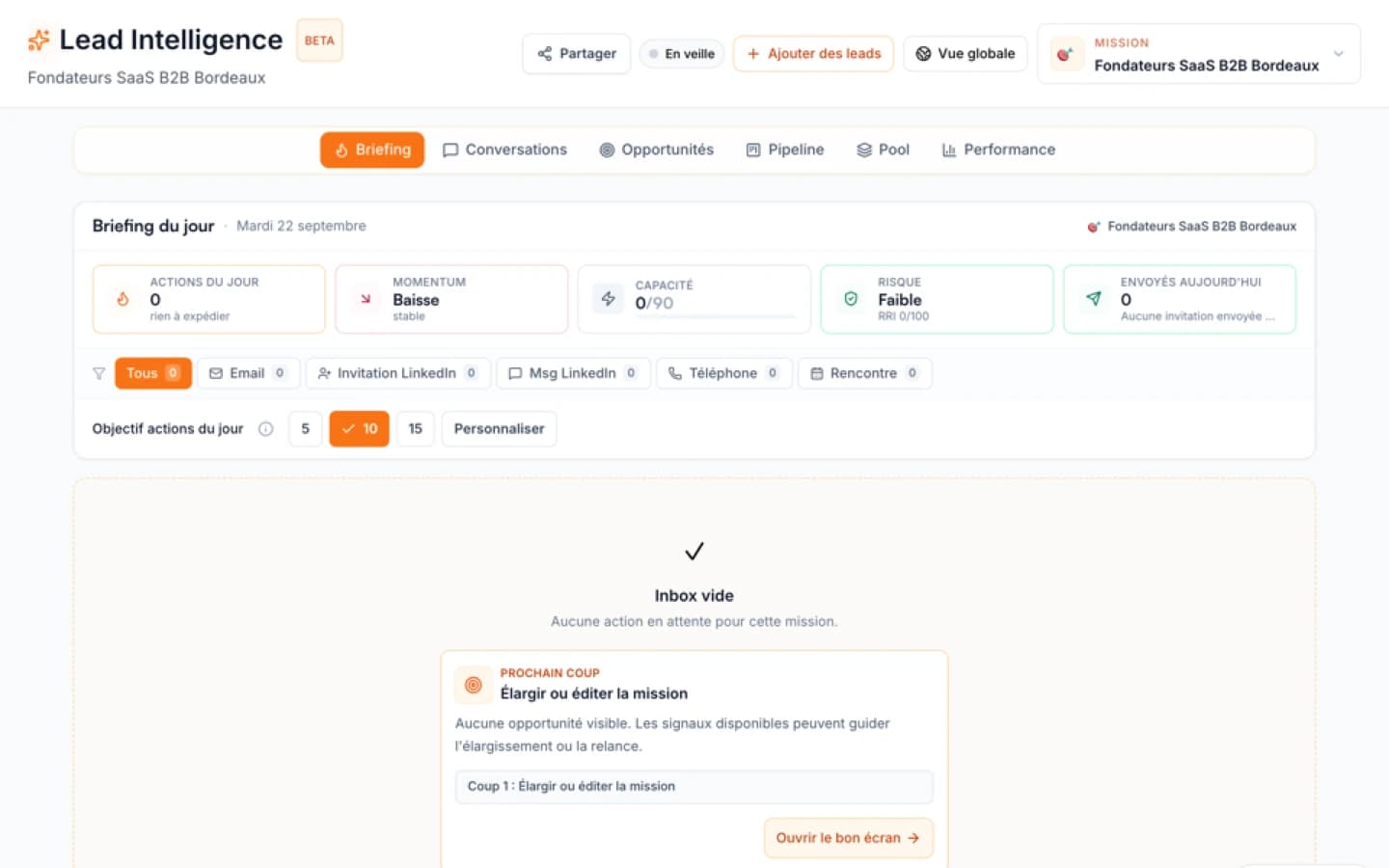
When Ember is better: Ember Lead Intelligence helps you decide who to contact, why now, and with which angle. It understands your project context and human relationships, then detects changes across people and companies to adjust priorities. It reduces noise by focusing attention on opportunities that deserve action now. If your team has plenty of names but struggles to choose the next conversation, Ember provides the missing decision layer.
| Need | Contact list or CRM | Ember Lead Intelligence |
|---|---|---|
| Store contacts | Keep records, ownership and outreach history | Uses project context to prioritise opportunities |
| Choose a next conversation | Review fit and signals manually | Shows an explained priority and suggested next action |
Sources
FAQ
Free diagnostic
Test your sales file
Drop an Excel or CSV and check its readiness without sending its rows to Ember.