
Symptom or signal
When early-stage founders search for the exact success rate of new ventures, they are often looking for a benchmark to measure their own survival odds. Industry resources, such as the startup statistics compiled by the Founders Forum Group (source), highlight the challenging landscape that new companies must navigate. However, obsessing over macro-level survival rates misses the practical reality of daily operations. The true signal of a startup's health is not a generic statistic, but how effectively the team manages its focus and avoids the trap of high-volume, low-yield activity.
For most early-stage companies, failure does not stem from a lack of effort, but from drowning in market noise. Founders and sales teams frequently burn precious runway chasing mismatched leads or executing generic outbound campaigns that fail to convert. To beat the average failure rate, a startup must transition from broad, speculative outreach to highly contextual, high-intent engagement. This means knowing exactly who to contact, why the timing is right, and which angle will resonate.
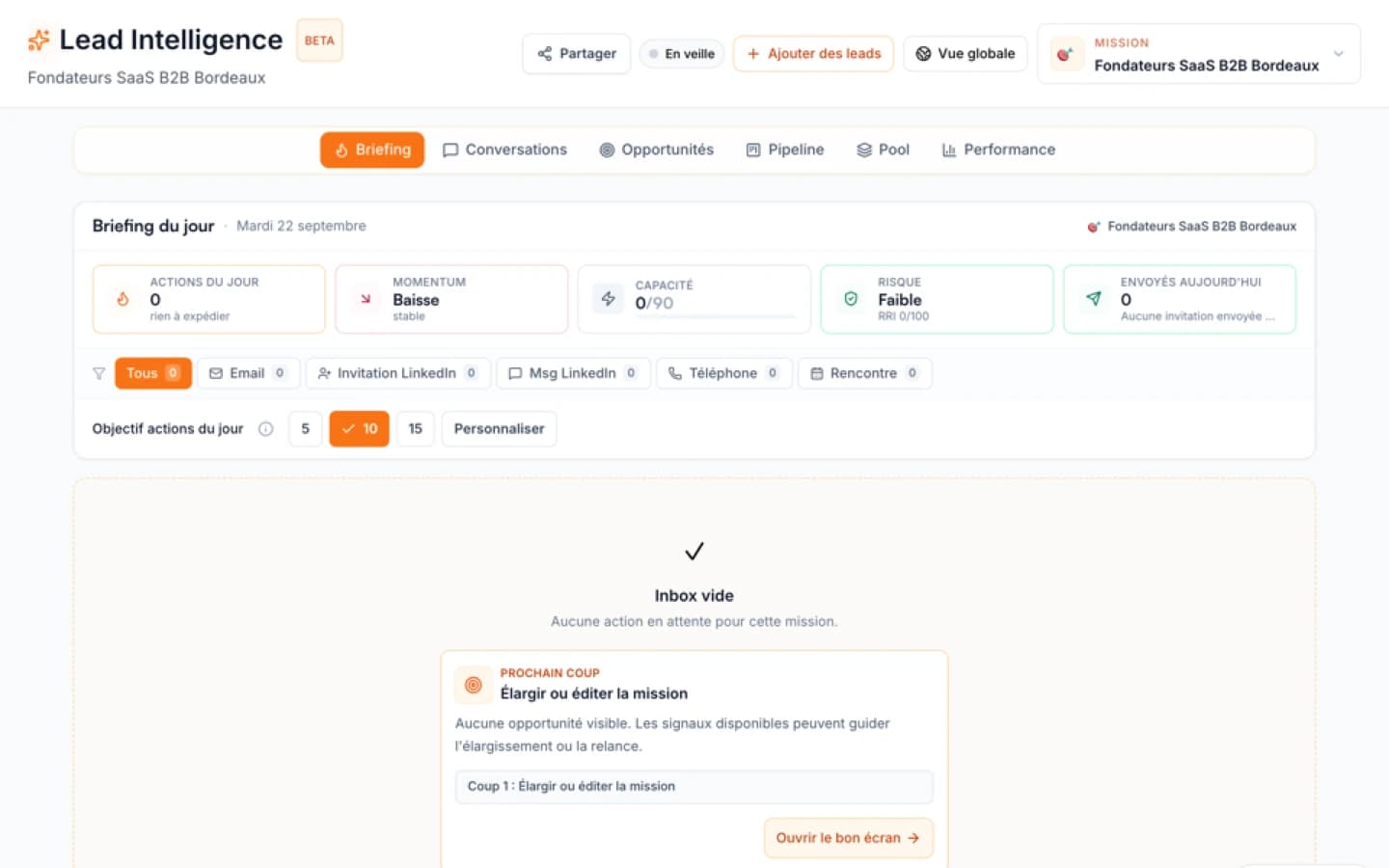
Instead of relying on massive, unverified databases that create endless noise, successful teams prioritize opportunities based on actual readiness and clear signals. By leveraging tools like Ember's Lead Intelligence, founders can reuse their existing business plan, Ideal Customer Profile (ICP), and core strategy to run highly targeted sales missions. With a usable targeting context, the first prioritized leads can appear quickly. This approach reduces market noise by focusing limited energy only on the opportunities that deserve immediate action. Because this prioritization is independent of database size, it remains highly effective whether a team starts with a small or large contact list, requiring no minimum contact threshold to begin generating value. Ultimately, surviving the early stages is about replacing guesswork with explainable, context-driven decisions.
To place this decision in context, the Knowledge guides for sales brings together deeper guidance on the same field.
What changed
What has fundamentally changed in how founders navigate these survival odds is the shift from brute-force volume to high-precision execution.
In the past, the standard playbook for improving a startup's chances of survival was to scale outbound activity as quickly as possible. This demand for immediate volume explains why platforms like Apollo.io, which advertises access to 240M contacts and 30M companies (source), became popular. However, this volume-first approach often generates more noise than actual progress, draining early-stage resources before a startup can find its footing.
Today, the founders who beat the odds are those who prioritize relevance over raw numbers. Success is no longer about emailing thousands of cold contacts; it is about knowing exactly who to contact, why now, and which angle will resonate. By focusing on opportunities that deserve action immediately, early-stage teams can drastically reduce noise and protect their limited runway.
This is why modern workflows are moving away from generic lists and toward contextual intelligence. For instance, Ember's Lead Intelligence helps founders bypass the manual grind of building complex data stacks. By reusing the startup’s existing Business Plan, Ideal Customer Profile (ICP), and core strategy, the system identifies accounts based on active signals and verifies useful sources. Instead of waiting days for a list to compile, the first prioritized leads can appear quickly. This approach provides a clear next action, detailing who to contact, why now, which channel to use, and which angle to take, making the priority entirely explainable from real-world context.
Facts and sources
Understanding the baseline survival rates of early-stage companies requires looking at aggregated market data, such as the benchmarks compiled in the startup statistics guide by Founders Forum Group. The guide states that about 90% of startups fail overall, including 10% in the first year and 70% between the second and fifth year. These benchmarks show that the path to a sustainable business model is exceptionally steep, prompting many entrepreneurs to seek structured environments or highly optimized execution strategies to tip the scale in their favor.
For founders exploring alternative structural models to beat these odds, the startup studio model has emerged as a prominent pathway, as detailed in the 2023 startup studio study by Max Pog (source). This research examines how studios attempt to institutionalize the early stages of company creation, sharing resources and validating ideas systematically to improve the traditional success rate of new ventures.
Whether operating independently or within a studio, early-stage execution inevitably relies on go-to-market efficiency. Historically, the market has favored raw volume to solve the distribution puzzle. Apollo, for its part, advertises access to 240M contacts and 30M companies on its home page (source), a positioning built on contact volume and automated outbound sequences.
However, as outbound channels become increasingly crowded, some teams have shifted toward highly customized data orchestration. Clay describes itself as infrastructure to get any data, run agentic workflows and launch go-to-market plays, with a data marketplace of more than 200 providers (source).
While these tools excel at either massive scale or complex technical workflows, early-stage founders often lack the bandwidth to manage them. This is where Ember Lead Intelligence takes a different approach. Instead of forcing teams to manage complex databases or build custom enrichment pipelines, Ember focuses on reducing noise by identifying the specific opportunities that deserve action right now. By analyzing signals and project context, it aligns outreach with the founder's Ideal Customer Profile (ICP) and provides a clear next action, explaining who to contact, why now, and which angle to use, allowing founders to prioritize high-intent conversations without requiring a massive contact threshold to see value.
To explore this point further, Average startup revenue: choose a comparable baseline before prospecting details a step directly related to this decision.
Why the common explanation is incomplete
The standard explanation for why so many early-stage companies struggle to survive is often chalked up to a lack of market need or premature scaling. When founders consult historical benchmarks, such as those compiled in the startup statistics guide by the Founders Forum Group, they often treat these failure rates as an unavoidable statistical law. The common narrative suggests that survival is simply a matter of surviving long enough to stumble into product-market fit.
However, this perspective is incomplete because it ignores how execution efficiency, specifically how a company approaches its go-to-market strategy, directly dictates runway. Startups rarely fail simply because their market does not exist; they fail because they exhaust their resources chasing the wrong buyers with generic, high-volume outreach.
In an effort to beat the odds, many teams default to brute-force outbound activity. For example, a sales leader focused entirely on speed might gravitate toward platforms like Apollo to rapidly build massive lists, a high-volume approach that Apollo promotes with its database of 240M contacts. While this volume-first playbook can work for established companies with clear market fit, it introduces immense noise for an early-stage startup. Blasting thousands of unverified contacts drains team energy, dilutes brand reputation, and burns through capital without yielding genuine market signals.
The real differentiator between survival and failure is not the volume of outreach, but the precision of the feedback loop. To protect limited runway, founders must shift from raw activity to high-intent prioritization. Instead of treating every contact in a database as equal, the goal is to identify exactly who to contact, why now, and with what specific angle.
This is where a structured, context-driven approach changes the dynamics of early-stage survival. By reusing a startup's existing Business Plan, Ideal Customer Profile (ICP), and core strategy, Ember's Lead Intelligence reduces market noise by focusing attention exclusively on opportunities that deserve immediate action. Rather than requiring massive databases to begin, this system finds and prioritizes contacts itself whether a team starts with a small or large contact list, requiring no minimum volume threshold to be effective.
By analyzing target accounts against active market signals and verifying sources, the system makes the priority behind each lead entirely explainable based on real-world context and opportunity readiness. With a usable targeting context in place, the first prioritized leads can appear quickly. This allows early-stage teams to replace speculative, high-volume campaigns with highly targeted, defensible conversations, transforming go-to-market execution from a game of chance into a disciplined process of elimination.
The real problem
When founders look at the challenging benchmarks compiled in the startup statistics guide by the Founders Forum Group, the immediate reaction is often to try and outrun the math. If the odds of building a surviving, high-growth company are notoriously low, the conventional playbook suggests that survival is simply a numbers game. Under this assumption, the solution is to generate as much noise as possible: buying massive databases, setting up complex outbound sequences, and pushing generic messages to hundreds of contacts.
But the real problem behind these survival rates is rarely a lack of activity. Instead, it is the disconnect between a startup's core strategy and its daily execution. When early-stage companies scale their outreach using brute-force volume, they end up wasting precious runway on cold leads that have no immediate need for their solution.
To move past this execution trap, founders must shift from high-volume noise to high-precision relevance. This requires grounding every sales mission in the actual context of the business, reusing the startup's Ideal Customer Profile (ICP), core offer, and strategic positioning to filter out the noise. Instead of waiting days for complex data enrichment, a more targeted approach uses real-time signals to identify exactly who to contact, why now, and which angle to take. By focusing only on opportunities that deserve action immediately, founders can generate their first prioritized leads quickly, ensuring that limited early-stage resources are spent on conversations that actually have a chance to convert.
This approach also connects with Startup survival data and a better next sales decision, which clarifies the next choice.
How the mechanism works
To break out of the low-survival statistics highlighted in the startup statistics guide by the Founders Forum Group, founders must shift from a volume-first mindset to a context-first mechanism. The traditional playbook of buying massive databases and blasting generic sequences often leads to high burn rates and wasted market attention. For instance, while massive database providers like Apollo, which advertises 240M contacts and 30M companies, offer this model at scale, early-stage startups rarely have the budget predictability or the cash reserves to sustain that level of untargeted outbound noise.
Ember operates on a fundamentally different mechanism. Instead of treating strategy and execution as disconnected silos, it binds them together.
First, the system reuses the foundational strategy, including the Ember Business Plan, Ideal Customer Profile (ICP), offer, and overall strategy, to prepare every sales mission. This ensures that outreach is never generic; it is always anchored in the core value proposition of the business.
Second, rather than generating thousands of cold, unresponsive leads, the mechanism reduces noise by focusing attention on opportunities that deserve action now. It makes the priority of each lead explainable from context, real-time signals, and opportunity readiness. Instead of guessing who to reach out to, founders and sales teams receive a clear next action: who to contact, why now, which channel to use, and which angle to take.
Finally, this strategic alignment extends to how the company presents itself to investors and partners. Through Creation, the mechanism works on reasoning, the audience journey, structure, design, and impact. This ensures that when a startup does secure a high-value conversation, the presentation is built to move decisions forward rather than just looking visually polished. By connecting strategic planning, precise lead prioritization, and high-impact communication, the mechanism helps early-stage companies execute with the efficiency required to beat the survival odds.
Concrete examples
To understand how these survival dynamics play out in the real world, consider two contrasting approaches to early-stage growth. The first approach represents the traditional volume-heavy playbook, which frequently contributes to the low survival rates documented in the startup statistics guide by the Founders Forum Group. In this scenario, a founder focuses entirely on scale, purchasing massive databases to blast generic email sequences. This high-volume strategy is the one promoted by major sales platforms such as Apollo, which advertises a database of 240M contacts, but it often backfires for early-stage startups. Blasting thousands of cold contacts without deep context burns through a limited addressable market and yields high noise with minimal conversion.
The second approach focuses on context-driven prioritization. Instead of chasing raw volume, a founder aligns their outreach directly with their core strategy. Using Ember's Lead Intelligence, the founder reuses their business plan and Ideal Customer Profile (ICP) to run highly targeted sales missions. Lead Intelligence finds and prioritizes the contacts itself, whether the team starts with a small or large contact list, with no minimum contact threshold as detailed on Ember's Lead Intelligence page. This eliminates the noise of generic lists by focusing attention strictly on opportunities that deserve immediate action. Furthermore, with usable targeting context, the first prioritized leads can appear quickly, providing a clear next action on who to contact, why now, and which angle to use. By shifting from raw volume to precise, context-grounded execution, early-stage companies can preserve their resources and significantly improve their chances of beating the typical survival odds.
In practice, Startup success rates and the next B2B sales decision completes this framework with another angle on the same topic.
When to use this diagnosis
For an early-stage founder navigating the challenging survival rates of new ventures, running a systematic data diagnosis is critical at specific inflection points. You do not need a diagnostic approach if you are still in the pure ideation phase or if you have a massive budget to burn on unverified contacts. Instead, this diagnostic evaluation becomes essential when you are preparing to transition from manual, founder-led sales to structured outbound campaigns. At this stage, blindly loading unverified lists into a sequence tool often leads to wasted capital and damaged domain reputation.
This diagnosis is also highly valuable when your current outbound setup is draining your budget without delivering qualified meetings. Many teams default to volume-heavy Business-to-Business (B2B) platforms to solve their pipeline problems. For example, Apollo advertises a database of 240M contacts and 30M companies. However, this volume-first model runs on credits: Apollo states that an export credit is consumed whenever a contact is exported outside Apollo (source), which means usage has to be tracked. If you find your team spending more time calculating credit usage than closing deals, it is time to run a diagnostic check on your data health.
Finally, you should use this diagnosis when you need to cut through the market noise and identify immediate, high-intent opportunities. Rather than treating every contact in your Comma-Separated Values (CSV) files or Customer Relationship Management (CRM) system with the same generic outreach, a diagnostic approach isolates the gaps in your lead data. With Ember's Lead Intelligence, the focus shifts from raw volume to reducing noise by directing attention to opportunities that deserve action now. This ensures that instead of managing bloated databases, you receive a clear next action detailing who to contact, why now, which channel to use, and which specific angle to take.
When not to use it
If your primary goal is to build a massive database of thousands of cold contacts to blast with generic email sequences on day one, Ember, the publisher of this article, is not the right fit. For founders who want raw database scraping and immediate outbound volume, traditional platforms are a better choice. For instance, a sales leader focused on speed and immediate outbound volume will often gravitate toward Apollo, which advertises 240M contacts and 30M companies (source), because the platform delivers immediate volume through a large contact database and sequence automation.
However, this volume-first approach comes with a practical tradeoff: Apollo states that you consume export credits whenever you export a contact outside Apollo, for example through CSV or CRM sync (source). If you are prepared to manage this credit usage in exchange for raw list size, an incumbent database is the logical choice.
Ember is also not suitable if you do not yet have a basic understanding of your target market or if you are unwilling to define your strategy. Ember’s Lead Intelligence works by reusing your Business Plan, Ideal Customer Profile (ICP), and core offer to prepare a highly targeted sales mission. It is designed to reduce noise by focusing attention on opportunities that deserve action now, providing a clear next action on who to contact, why now, which channel to use, and which angle to take. If you do not want to work from a strategic foundation and prefer to rely on random outreach, the context-driven prioritization of Ember will not align with your workflow.
Before deciding, Funding does not guarantee startup survival: review sales traction helps connect this method with adjacent priorities.
Next step
To navigate the challenging survival rates of new ventures, as documented in the startup statistics guide by the Founders Forum Group, early-stage founders must replace guesswork with structured execution. Ember helps founders understand a changing context, choose the next priority, and take action.
If your immediate priority is securing capital, the Fund Your Growth capability allows you to build the Business Plan, choose a funding strategy, and plan the next steps. Instead of letting missing details stall your progress, this agentic experience transforms gaps in the file into prioritized next actions.
If your focus is on driving early revenue, Lead Intelligence reduces noise by focusing attention on opportunities that deserve action now. Rather than blasting generic messages, it provides a clear next action: who to contact, why now, which channel, and which angle. The system analyzes your target market and proposes the next action and channel that fit the lead situation.
For ongoing strategic support, Ember's Second Brain turns available context into clearer explanations and next actions, helping you reason through complex business decisions without losing momentum.
Sources and methodology
To build a realistic picture of startup survival and the operational strategies that influence it, this analysis relies on verified market research and industry benchmarks. The baseline survival rates and operational challenges faced by early-stage companies are analyzed using the comprehensive guide published by the Founders Forum Group. To understand alternative venture-building models and their relative efficiency, we examined the startup studio ecosystem study compiled by Max Pog (source).
Additionally, to evaluate how sales execution impacts these survival rates, we looked at the tooling landscape that dictates modern outbound strategies. To understand high-volume outbound prospecting, we referred to Apollo's official pages (home and pricing), consulted on 28 September 2026. We contrasted these volume-first databases with the data orchestration platform Clay, based on its official site. Ember is the publisher of Lead Intelligence and of this article, so the comparison is not neutral.
By combining macro-level startup success data with micro-level tooling capabilities, this methodology aims to help founders move past generic growth playbooks and focus on high-intent, context-driven execution.
Sources
FAQ
Free diagnostic
Test your sales file
Drop an Excel or CSV and check its readiness without sending its rows to Ember.