
Symptom or signal
For an early-stage founder, the initial signs of trouble are rarely dramatic. They usually appear as a creeping misalignment in your daily operations. You have successfully raised capital, built a core team, and invested in a modern Customer Relationship Management (CRM) system. Your sales pipeline looks full on paper, yet your actual revenue remains flat.
Your sales reps are busy sending hundreds of automated emails every day, but your calendar is empty of high-value meetings. The burn rate is rising, while your conversion rates are dropping. You are collecting data, but you are not building relationships. This is the classic symptom of GTM noise: your team is highly active, but they are executing the wrong actions because they lack a clear way to prioritize their efforts.
To place this decision in context, the Knowledge guides for sales bring together deeper guidance on the same field.
What changed
Sales teams can now obtain company and contact data from several suppliers, including platforms that also support intelligence and execution. Apollo describes these functions on its current site. More available records do not, by themselves, reveal which buyer has a current problem, a suitable budget or permission to be contacted. The founder still has to connect the offer to a buyer situation and test a relevant message.
This creates a practical spending choice after a funding round. Buying a larger database, hiring representatives and sending more messages may be useful in some markets, but each costs money before it produces a signed customer. A small test with explicit account fit, dated evidence and a review of conversations can show what the team has learned before it expands. The result should be judged against its own baseline, not a general claim that all response rates are falling.
Facts and sources
Raising capital does not guarantee survival. Dynamique Mag describes individual funded companies that later faced insolvency or restructuring. Those stories show several different causes, including spending, operations and governance. They do not measure the proportion of funded startups that close, or prove that outbound sales was the cause. FrenchWeb discusses paths after closure; it is not a controlled study of sales strategy.
For the founder, the relevant evidence is closer to home: current cash and runway, signed revenue, dated customer feedback, conversion between clearly defined stages and the cost of acquiring a customer. If a large pipeline has not yielded signed revenue, investigate the gap. Ask whether the offer fits the buyer, whether the right person was contacted, whether the message earned a conversation and whether delivery economics work. A weak result should prompt a diagnosis, not an automatic conclusion that a prospecting tool caused it.
Why the common explanation is incomplete
Cash exhaustion or lack of product fit can describe an outcome without explaining each decision that led there. Sales execution is one place to look, alongside product, hiring, operations and financing. A funded team can spend on a database before it knows which accounts have the problem it solves. It can also underinvest in sales when there is genuine demand. Neither pattern follows automatically from a funding round.
Some prospecting tools charge by seat, credit or data action, so a team should calculate the actual cost of its intended workflow. A credit model does not inherently reward indiscriminate exports, and a small list does not inherently convert better. Compare the current plan, the allowed data uses and the outcomes of a bounded trial. Record spend and learning separately: an export is an activity, a useful conversation is evidence, and signed revenue is a different outcome.
The real problem
The real problem is not a lack of leads; it is a lack of prioritization. Early-stage founders often try to apply complex enterprise qualification frameworks like BANT (Budget, Authority, Need, Timeline), CHAMP (Challenges, Authority, Money, Prioritization), or MEDDICC (Metrics, Economic Buyer, Decision Criteria, Decision Process, Identify Pain, Champion, Competition) to completely cold databases. This requires an immense amount of manual effort and human filtering.
Without context, your sales team cannot tell the difference between a company that is actively looking for a solution and one that is completely cold. They waste hours researching accounts, writing custom emails, and chasing dead ends. A founder can test context-based prioritization against the current process, then scale only if the evidence supports it.
This approach also connects with Clay vs Ember: when each one fits, which clarifies the next choice.
How the mechanism works
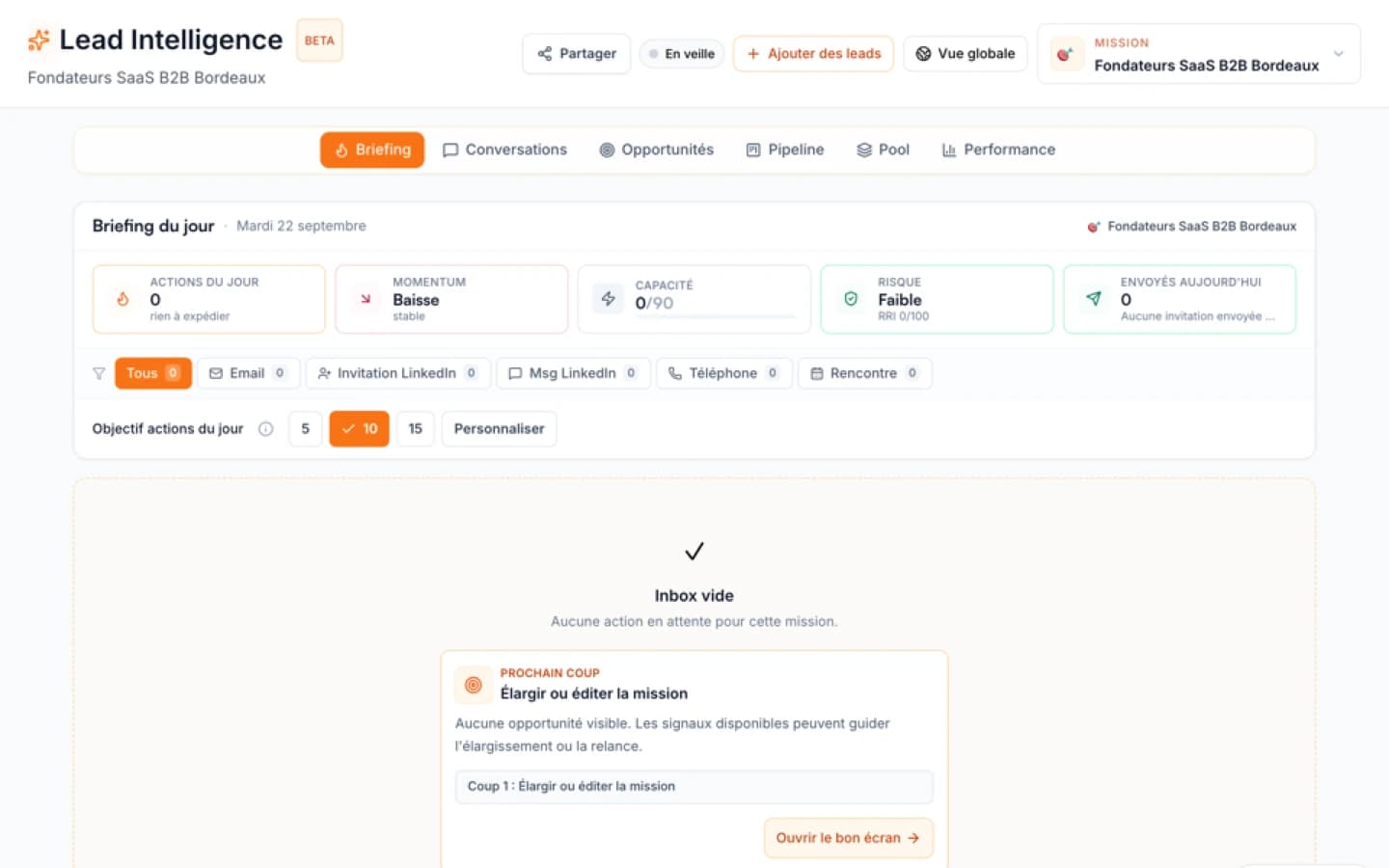
This is where an agentic approach to sales intelligence changes the dynamic. Instead of treating prospecting as a manual filtering exercise, Ember Lead Intelligence uses your existing business context to identify the best opportunities.
First, the system reuses your Ember Business Plan, Ideal Customer Profile (ICP), offer, and strategy to prepare a dedicated sales mission. It then finds accounts based on your specific ICP and real-world signals, verifying useful sources to ensure data accuracy. Rather than forcing you to build complex boolean queries, the AI understands human relationships and detects changes across people and companies to adjust your priorities automatically. It reduces noise by focusing your attention on the opportunities that deserve immediate action.
Concrete examples
Suppose a founder has a list of potential buyers after a funding round but cannot explain which conversation should happen next. Start with a small group of accounts that match the offer. For each, note the source, the date, the buyer problem, the relevant role, the contact route and what is still unknown. Do not treat a funding announcement or a job posting as proof of purchase intent.
Ember Lead Intelligence can help identify and prioritise opportunities in the business context. Review every suggestion and its evidence before outreach, and check the available import and pricing terms inside the application. The public page does not establish a universal import allowance or a time to first lead. After the first conversations, compare the reasons for replies and refusals with the targeting hypothesis. If the sample does not yet support a decision, collect better evidence rather than claiming that a fixed number of contacts guarantees traction.
In practice, Does Real-Time Lead Qualification Replace BANT for Small Teams? offers another angle on qualification.
When to use this diagnosis
This diagnosis is highly relevant if you meet the following criteria:
- You already have a list of potential customers but do not know who to contact first.
- Your sales team is spending more time researching prospects than actually speaking to them.
- You want to run highly targeted, personalized campaigns rather than mass email blasts.
- You need to validate your GTM strategy quickly without burning through your cash reserves.
When not to use it
This approach is not suitable if:
- You do not have a defined offer or any initial hypothesis of your target market.
- Your business model relies entirely on low-touch, high-volume transactional sales where personalization does not impact conversion.
- You require a platform to orchestrate complex, multi-channel automated sequences across tens of thousands of contacts without human oversight.
Before deciding, No brand or contact list: choose first B2B outreach targets helps connect this method with adjacent priorities.
Next step
If your team has plenty of names but struggles to choose the next conversation, define your prioritization criteria before comparing tools.
To see how you can turn your existing business context into actionable sales opportunities, explore Lead Intelligence and start focusing on the conversations that deserve your attention today.
Sources and methodology
The Dynamique Mag examples illustrate funded companies with different later outcomes; they are not a statistical failure rate or evidence that prospecting caused closure. FrenchWeb addresses founders and staff after closure. Apollo and Ember Lead Intelligence describe their own product functions. The spending and prioritisation framework here is an editorial method to test, not a proven way to prevent startup failure.
| Decision point | Contact data and sales platform | Contextual opportunity review |
|---|---|---|
| What to verify | Current data, intelligence and execution features; rights and cost | Why an account fits, which signal is current and what remains unknown |
| Before spending more | Measure the workflow cost and outcomes in a bounded test | Review sourced suggestions and compare with signed customer evidence |
Sources
FAQ
Free diagnostic
Test your sales file
Drop an Excel or CSV and check its readiness without sending its rows to Ember.