
Symptom or signal
For an early-stage founder, the warning signs of a shortening startup lifespan do not always appear as a sudden drop in cash. Instead, they manifest as a slow, exhausting grind. Your team might be sending thousands of automated cold emails every week using traditional databases, yet booking almost zero meaningful meetings. You watch your runway shrink while your sales representatives spend hours manually cleaning spreadsheets or arguing over which contacts to call next. This high-volume noise creates an illusion of progress, but it actually masks a critical lack of market traction.
To place this decision in context, the Knowledge guides for sales bring together deeper guidance on the same field.
What changed
Prospecting tools now make it easy to find accounts, set up sequences and record sales activity. Apollo's own page describes signal-based sequences as well as contact discovery; it is not merely a source of bulk lists. Easier outreach can still hide a weak target or offer if a team tracks messages sent but never studies replies. Silicon Valley Bank describes early, venture-funded and late startup stages. These stages are a framework for planning, not an average lifespan or proof that one outreach method prolongs a company's life.
Facts and sources
U.S. Bureau of Labor Statistics data reports five-year survival for U.S. business establishments by birth cohort: 54.3% for 1994, 49.8% for 2006 and 57.3% for 2018. These are establishments across sectors, not a measured average lifespan of venture-backed software startups. An NBER study finds a mean founder age of 45 for the fastest-growing one in 1,000 U.S. new ventures. That narrow group cannot establish why a given company survives or whether its sales method caused success. Use these figures only with their population and outcome stated.
Why the common explanation is incomplete
The standard post-mortem of a failed startup usually points to "no market need" or "running out of cash." But these explanations are incomplete. Companies can run out of cash for many reasons, including weak demand, costs, financing constraints and poor sales execution. When founders try to solve a lack of traction by simply buying more contact credits and blasting larger lists, they accelerate their burn rate without learning anything about their target market. Volume-driven outbound optimizes for the wrong metric, prioritizing emails sent over relationships built.
The real problem
The real problem is the inability to prioritize. In the early stages, your Ideal Customer Profile (ICP) is still a set of assumptions. If you load thousands of unverified contacts into a Customer Relationship Management (CRM) system and run generic sequences, you cannot tell why a campaign failed. Was the message wrong, was the timing off, or was the contact simply the wrong person? Without context, you cannot apply modern qualification frameworks like BANT (budget, authority, need, timeline), CHAMP (challenges, authority, money, prioritization) or MEDDICC (metrics, economic buyer, decision criteria, decision process, identified pain, champion, competition). You need a way to identify who deserves attention right now.
This approach also connects with What Signals Actually Tell You a B2B Prospect Is Worth Contacting Now?, which clarifies the next choice.
How the mechanism works
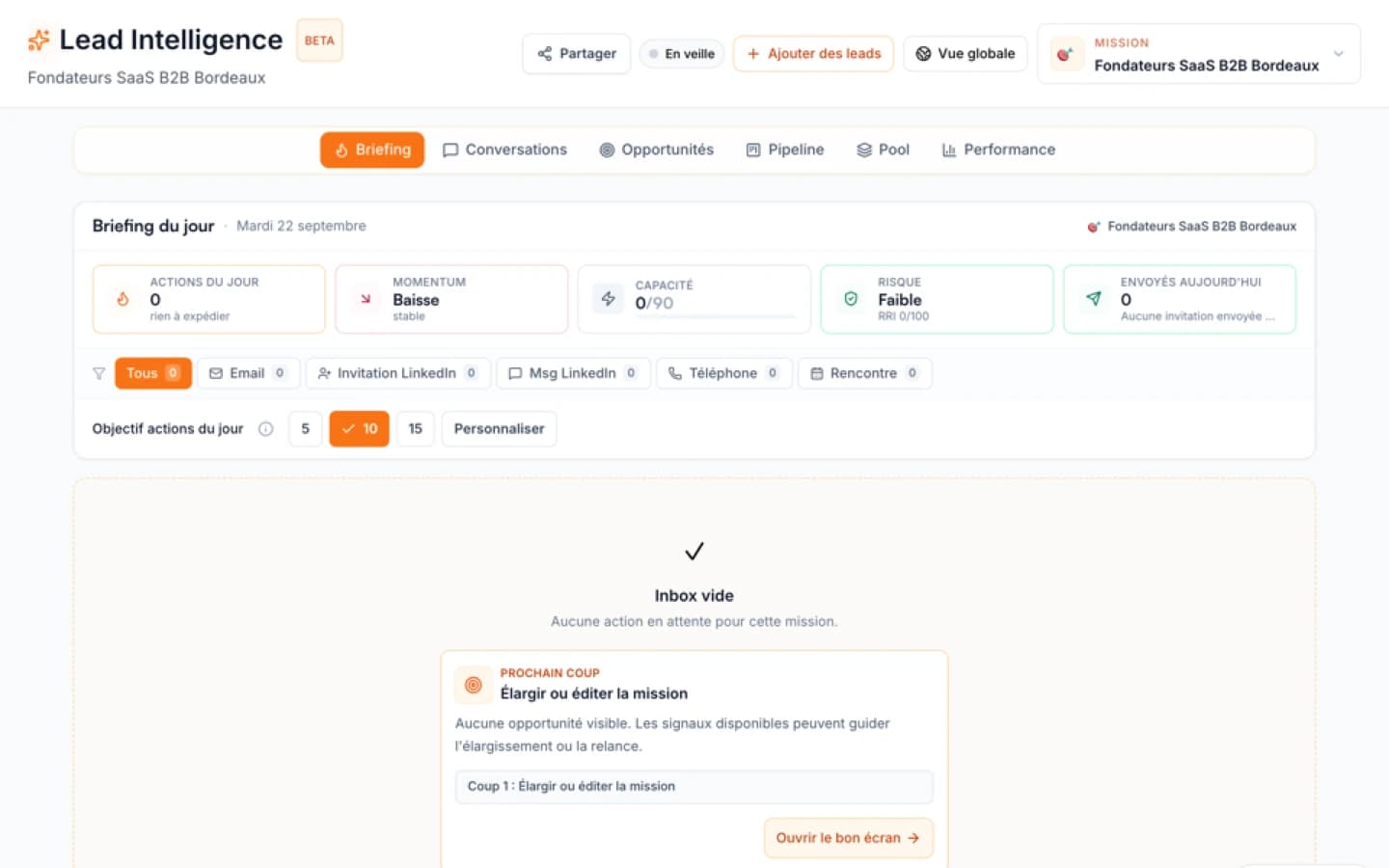
To improve the quality of a sales decision, founders can compare volume with customer intent. This is where Lead Intelligence from Ember changes the dynamic. Using available project context, Ember reuses your existing business plan, target ICP, and strategy to prepare a highly focused sales mission. The system monitors signals about people and companies to keep your context current, automatically classifying accounts into explained opportunities to watch, act on, or set aside. It reduces noise by focusing your attention on the opportunities that deserve action next, providing a clear next action, channel, and angle for each prioritized opportunity.
Concrete examples
Consider a hypothetical software founder with a shrinking cash runway and few useful replies. She checks the cash plan separately from the sales pipeline: how many months of operating costs remain, which customer problems have been confirmed, and what each outreach attempt taught her. She uses a small, verified account list and writes down why a recent signal matters to each buyer. A prospecting tool can help with discovery and follow-up; Ember can help explain priorities from project context. Neither choice guarantees meetings or extends the company's lifespan. The decision is to learn from a controlled test before scaling effort. No brand or contact list: choose first B2B outreach targets explores the first target list.
When to use this diagnosis
This shift to contextual prioritization is ideal when you already have a list of potential accounts but struggle to decide who to contact first. If your sales team is spending more time managing spreadsheets than speaking with prospects, or if your credit-based prospecting costs are compounding unpredictably, you need a system that prioritizes conversations based on real-world signals rather than raw volume.
When not to use it
A traditional, volume-oriented prospecting platform is sufficient if your business model relies on low-ticket, mass-market sales where unit economics require sending tens of thousands of automated emails weekly. If your team does not need contextual guidance and simply requires a massive, static database for bulk cold calling, standard database tools will meet your needs.
Before deciding, Does Real-Time Lead Qualification Replace BANT for Small Teams? helps connect this method with adjacent priorities.
Next step
Define the next survival-related decision precisely: cash runway, customer demand or sales execution. For the sales part, choose a small customer group, verify a reason to contact each account, and record useful replies, meetings and time spent. Compare this with the previous approach using the same definitions. If the replies reveal no problem fit, revise the offer or target. If cash is the urgent issue, work on the financing plan rather than treating a prospecting tool as a survival remedy. Lead Intelligence may help organise the prioritisation step.
Sources and methodology
BLS measures U.S. establishment survival by cohort, not the average lifespan of a software startup. NBER reports founder age for a narrowly defined high-growth group. SVB describes startup stages. Apollo and Ember describe their own current product approaches. None of these sources demonstrates that lead prioritisation prevents business closure.
| Decision point | Apollo | Ember Lead Intelligence |
|---|---|---|
| Prospecting workflow | Contact discovery, signals and multichannel engagement | Contextual opportunity priorities from project information |
| Current costs | Check the plan and usage terms for intended actions | Check the plan and usage terms for intended actions |
| Fit with the target | Use filters and signals, then verify each account | Explain why an available opportunity is prioritised |
| Next action | Set up a sequence, call or LinkedIn task | Review a proposed next action and its reason |
Sources
FAQ
Free diagnostic
Test your sales file
Drop an Excel or CSV and check its readiness without sending its rows to Ember.