
Definition
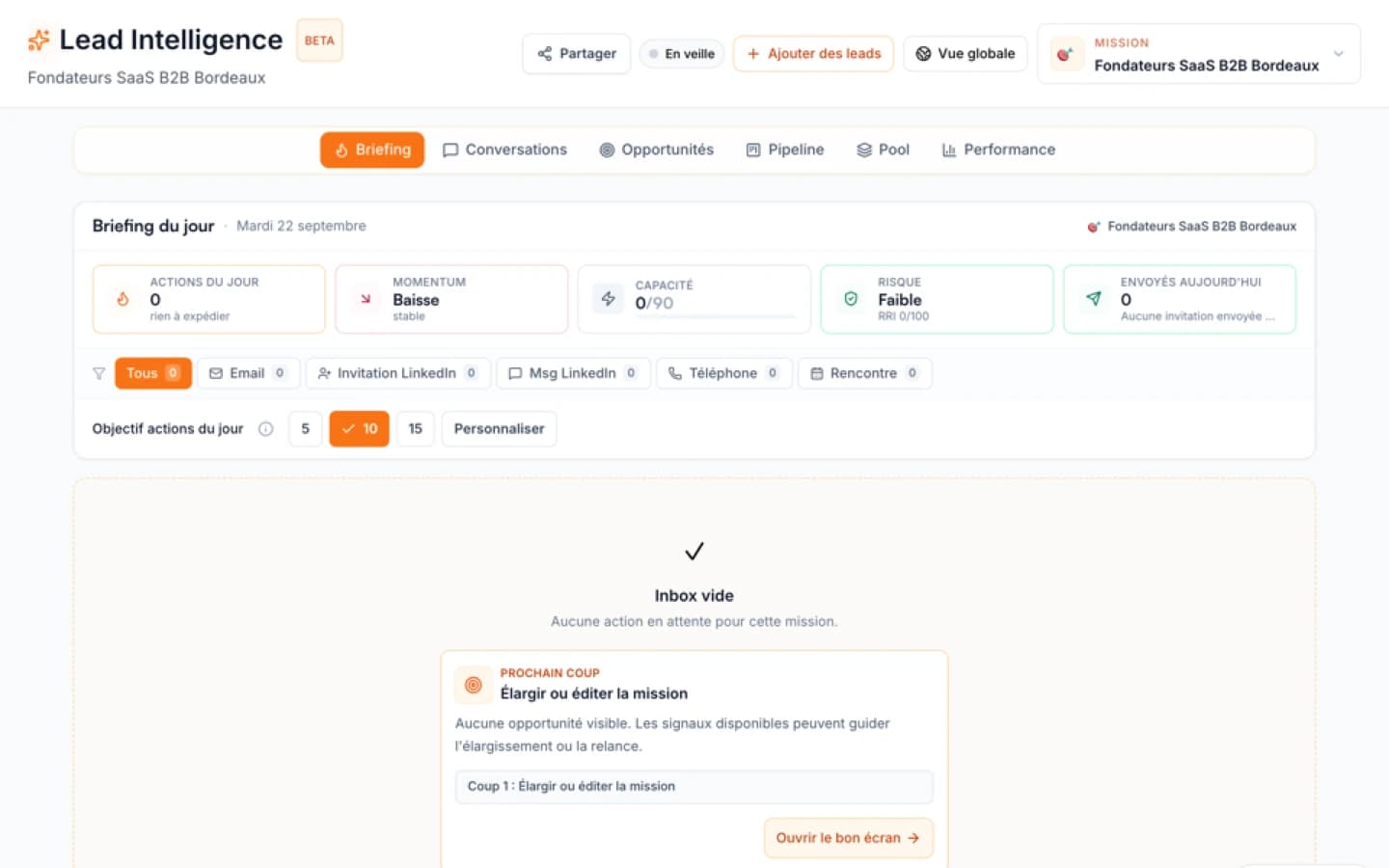
In 2026, Business-to-Business (B2B) lead qualification has shifted from manual database management to real-time signal analysis. For lean startups, establishing a reliable sales pipeline no longer requires a massive marketing department or a complex Customer Relationship Management (CRM) system. According to monday.com's guide on B2B sales lead generation, modern outbound sales for startups must focus on identifying prospects who are already showing active buying indicators. When considering how does a founder qualify B2B leads without a sales team, the answer lies in automating the evaluation of high-intent signals. Instead of hiring a dedicated Sales Development Representative (SDR), it is possible to use tools like Lead Intelligence, which researches and prioritizes contacts automatically, whether the team starts with 10, 100 or 1,000 contacts, with no minimum threshold. This approach lets you concentrate on the most promising prospects, by proposing the next action and the channel that fit their situation.
To place this decision in context, the Knowledge guides for sales brings together deeper guidance on the same field.
Prerequisites
To successfully execute outbound sales for startups, founders must first define their Ideal Customer Profile (ICP). When building a prospect list from scratch, an early stage founder should contact decision makers who have the highest immediate pain first, rather than chasing broad enterprise accounts. This targeted approach ensures that early b2b prospecting efforts are not wasted on unresponsive targets.
How does a founder qualify B2B leads without a sales team? Without a dedicated Sales Development Representative (SDR) team or a complex Customer Relationship Management (CRM) system, the process of lead qualification relies on real-time signals. According to a guide on how to qualify B2B leads, a practical qualification checklist for founders who have no marketing function focuses on 4 to 5 signals, including trigger events, role seniority, tech stack, hiring intent, and recent funding, which actually predict a reply.
While traditional platforms like Apollo are excellent for sales leaders or Revenue Operations (RevOps) managers running structured outbound, they often require dedicated management. Similarly, Clay offers a powerful infrastructure for Go-To-Market (GTM) teams to run agentic workflows and integrates with tools like LinkedIn Sales Navigator for lead discovery, but these tools demand technical setup and a steady flow of data.
For lean teams, the prerequisites are simple: a clear definition of the target buyer, a way to track these real-time signals, and a method to prioritize outreach. This is where modern AI driven solutions change the game. For instance, Lead Intelligence from Ember, an AI team for entrepreneurship, finds and prioritizes the contacts itself whether the team starts with 10, 100 or 1,000 contacts, with no minimum contact threshold, as detailed on the Ember Lead Intelligence page. It then proposes the next action and channel that fit the lead situation, allowing founders to manage b2b prospecting and build a healthy sales pipeline without administrative bloat.
Steps
To qualify a B2B lead in 2026 without a marketing team or a Customer Relationship Management (CRM) system, focus on four to five predictive signals that you can track on a simple spreadsheet. A practical guide recommends watching for a trigger event (job change, funding round), contact seniority, the technology stack in use, hiring intent, and recent funding. Combined, these signals point to immediate need and buying power. To score them, award one point per signal present: a lead that reaches three points or more deserves a priority follow up. For a founder without a sales team, the first question is who to contact first. Target a sales manager or a RevOps manager, since they are the ones who structure outbound prospecting. The typical buying committee includes a VP of Sales (focused on pipeline coverage), an SDR team lead (focused on workflow speed), and a finance contact who reviews the pricing model. Without a CRM, a spreadsheet is enough to track these profiles, provided you manually check their seniority and company on LinkedIn. If you are starting from zero to build a prospect list, a tool like Lead Intelligence finds and prioritizes the contacts itself, whether you start with 10, 100, or 1,000 contacts, with no minimum contact threshold. This saves you from having to build a large database upfront. The tool also proposes the next action and the channel that fits the lead's situation, which replaces the work of a junior Sales Development Representative (SDR). As a hypothetical example: imagine scoring a lead on your spreadsheet. They recently changed company (1 point), hold a VP Sales title (1 point), and their company just raised funding (1 point). That totals three points: you call them first. Without these signals, wait until one appears before reaching out. This method keeps you from wasting time on leads that are not ready.
To explore this point further, How to build a B2B prospect list from scratch with zero customers and no brand recognition: a practical guide details a step directly related to this decision.
Worked example
How does a founder qualify Business-to-Business (B2B) leads without a sales team? In 2026, establishing a reliable sales pipeline no longer requires a massive marketing department or a complex Customer Relationship Management (CRM) system, as outlined in the operational guide to B2B lead generation. Instead of relying on a dedicated Sales Development Representative (SDR) to manually filter databases, lean teams can qualify prospects by focusing on immediate, actionable context. According to a guide on how to qualify a lead in B2B sales, the goal is to identify the signals that actually predict a reply, such as a trigger event, role seniority, tech stack, hiring intent or recent funding.
Common mistakes
When figuring out how to qualify Business-to-Business (B2B) leads early, many lean sales teams and founders fall into predictable traps. The most common error is treating lead qualification as a static, one-time demographic exercise rather than a dynamic process driven by real-time signals. Relying on a practical checklist of 4 to 5 real-time signals, such as trigger events, role seniority, technology stack, hiring intent, and recent funding, is what actually predicts a prospect reply, as outlined in the Salesmotion B2B qualification guide. Without a dedicated marketing team to warm up prospects, relying solely on basic company size or industry filters results in a bloated, unresponsive sales pipeline. Another frequent misstep is overcomplicating the technology stack too early. Founders often rush to purchase complex infrastructure designed for larger Go-To-Market (GTM) organizations. For example, the platform Clay is built as infrastructure for GTM teams and GTM engineers to run agentic workflows, as described on the Clay homepage. Similarly, Apollo is positioned as a unified sales platform for modern sales and marketing teams, according to the Apollo platform overview. These platforms are highly effective but typically require a dedicated Sales Development Representative (SDR) team or a Revenue Operations (RevOps) manager to manage the recurring tension of credit-based pricing and structured outbound workflows, as noted in the Factors.ai analysis of Apollo alternatives. For a lean startup without these specialized roles, adopting such heavy machinery without a validated process leads to wasted budget and administrative fatigue. Furthermore, teams often delay their outbound sales for startups because they believe they need a massive database before they can begin. This volume-first mindset creates unnecessary noise and delays action. In reality, modern tools allow you to start small and scale organically. For instance, Ember Lead Intelligence finds and prioritizes the contacts itself whether the team starts with 10, 100, or 1,000 contacts, with no minimum contact threshold, as detailed on the Ember Lead Intelligence capability page. Finally, when building a prospect list from scratch, founders often struggle with the fundamental question of who should an early-stage founder contact first.
This approach also connects with Apollo pricing 2026: plans, credits, hidden costs and alternatives: a practical comparison, which clarifies the next choice.
Tools
To qualify Business-to-Business (B2B) leads effectively in 2026 without a dedicated marketing department or a complex Customer Relationship Management (CRM) system, sales teams and founders must choose tools that match their operational capacity. For organizations running highly structured outbound campaigns with dedicated Revenue Operations (RevOps) managers or Sales Development Representatives (SDRs), established platforms offer deep functionality. Apollo positions itself as a unified Artificial Intelligence (AI) sales platform for modern sales and marketing teams aiming to simplify their stack, build pipeline, and close deals, though its credit-based pricing model requires ongoing scrutiny from finance or operations teams, as detailed on the Apollo homepage. For teams that want to build custom data pipelines, Clay provides a robust infrastructure for Go-To-Market (GTM) teams and GTM engineers across RevOps, sales, and marketing to gather data, run agentic workflows, and launch GTM plays, as shown on the Clay homepage. Clay supports direct integrations with LinkedIn Sales Navigator for lead discovery and connection insights, which can be explored on the Clay Sales Navigator integration page, and connects with sales engagement tools like Salesloft, Outreach, Instantly, Smartlead.ai, and HubSpot Sequencer, as listed on the Clay integrations directory. These platforms are excellent when you have the internal resources to engineer and maintain complex workflows. However, when a founder or a lean sales team lacks a dedicated marketing function or the time to manage intricate data integrations, these enterprise-grade tools can introduce unnecessary noise and overhead. This is where Ember, an AI team for entrepreneurship, offers a streamlined alternative. Through its Lead Intelligence capability, Ember eliminates the need for complex database setups or manual lead scoring configurations. Lead Intelligence finds and prioritizes the contacts itself, whether the team starts with 10, 100, or 1,000 contacts, with no minimum contact threshold, as explained on the Ember Lead Intelligence page. Instead of requiring a GTM engineer to map out data points, the system automatically analyzes the available context and proposes the next action and channel that fit the lead situation, as detailed on the Ember Lead Intelligence page. This allows lean teams to focus entirely on starting meaningful conversations rather than managing software.
When to use this method
This lean qualification method is highly effective when a startup or a small sales team must build a pipeline without the overhead of a dedicated marketing department or a complex Customer Relationship Management (CRM) system. If you are an early-stage founder wondering how to qualify Business-to-Business (B2B) leads early, or trying to understand who to contact first as a founder, this approach prevents you from wasting time on dead-end prospects. It is best used when your sales resources are constrained and you need to prioritize immediate, high-intent opportunities over massive, unsegmented lists. Instead of relying on a large team of Sales Development Representatives (SDRs) to manually filter through databases, you can use real-time signals to identify accounts that are actively showing buying intent.
When deciding who should an early-stage founder contact first, the strategy focuses on targeting prospects who match your Ideal Customer Profile (ICP) and exhibit specific trigger events. According to a guide on B2B lead qualification by Salesmotion, a practical qualification checklist should focus on key signals such as trigger events, role seniority, technology stack, hiring intent, and recent funding to predict response rates. This method is particularly useful when building a prospect list from scratch, as it allows you to score leads on a simple spreadsheet rather than setting up enterprise-grade lead scoring workflows. For teams running highly structured outbound campaigns with a dedicated operations budget, established platforms like Apollo, which reached 150 million dollars in annual recurring revenue as reported by Apollo's company history page, provide a unified AI sales platform to manage pipeline and simplify the sales stack, as detailed on the Apollo homepage. However, when you lack a dedicated marketing team to clean data and manage credits, heavy outbound systems can become costly due to metered pricing on exports and email verification, as discussed in analyses of Apollo alternatives on Factors.ai and Coldreach.
This signal-driven approach is also ideal when your lead volume is highly variable. Traditional qualification frameworks often require a massive database to be statistically useful, but modern tools allow you to start small. For instance, Ember's Lead Intelligence finds and prioritizes contacts itself whether a sales team starts with 10, 100, or 1,000 contacts, with no minimum contact threshold, as documented on the official Ember Lead Intelligence page. By using this method, you can bypass the need for a complex CRM setup entirely. The system analyzes the available context and proposes the next action and channel that fit the lead situation, ensuring that your outreach remains highly personalized and timely even without a marketing team to orchestrate the campaigns.
In practice, HubSpot Sales Hub vs Ember: when each one fits completes this framework with another angle on the same topic.
When not to use it
This lean, no-customer relationship management (CRM) qualification method is not a universal fit for every organization. If your company has already scaled to the point of employing a dedicated Revenue Operations (RevOps) manager and a large team of Sales Development Representatives (SDRs) running highly structured, high-volume outbound campaigns, an enterprise-grade platform is often more appropriate. For instance, a unified Artificial Intelligence (AI) sales platform designed for modern sales and marketing teams is highly effective when managing complex, multi-channel pipelines at scale, as shown on Apollo. Similarly, if your organization requires a highly customizable data infrastructure to build complex Go-To-Market (GTM) plays and leverage deep data integrations, a dedicated GTM engineering platform is a better choice, as detailed on Clay. These advanced setups are particularly useful when your workflow demands official integrations to pull specific connection insights, such as those provided by the official LinkedIn Sales Navigator integration documented on Clay Integrations.
Furthermore, the lean approach is less effective when your sales operations require strict credit-based metering across multiple departments. In larger organizations, credit-based pricing models are often scrutinized by finance teams because when a sales team scales from one seat to five, the credit math does not just multiply linearly due to compounded costs from wasted exports and bounced emails, as analyzed on Factors.ai. If your business model relies on this type of highly structured, metered outbound sales environment, a lightweight, context-driven qualification workflow will not support your operational structure.
Action plan
To qualify a B2B lead in 2026 without a marketing team or a Customer Relationship Management (CRM) system, focus on four to five predictive signals: a trigger event, contact seniority, the company's tech stack, hiring intent and a recent funding round. You can score each signal in a simple spreadsheet, as recommended in the Salesmotion guide to qualifying B2B leads. As a founder, start by contacting the sales leader or the RevOps manager, the typical buyers at companies that already run structured outbound, as the analysis of Apollo's buyer profile shows on Factors.ai. If you are starting from zero, a solution like Lead Intelligence (offered by Ember) researches and prioritizes contacts automatically, even with as few as 10, 100 or 1,000 contacts, with no minimum threshold, as described on the Ember Lead Intelligence page. It reuses your business plan, your ideal customer profile (ICP), your offer and your strategy to prepare a sales mission, then proposes the next action and the channel that fit the lead situation. For those who prefer a dedicated tool, Apollo offers a free plan and paid plans with a monthly credit allowance, as listed on the Apollo pricing page. The goal is to build a prospect list from scratch while systematically checking real buying intent, so that even without a marketing team or a CRM you build an efficient sales pipeline from the first contacts.
Before deciding, How Many Cold Emails Per Day Produce Meetings in 2026? helps connect this method with adjacent priorities.
Sources and methodology
This methodology is built on a comparative analysis of modern outbound sales frameworks and real-time data orchestration practices. To understand how an early-stage founder or a lean sales team can qualify Business-to-Business (B2B) leads without a dedicated marketing function or a complex Customer Relationship Management (CRM) system, we evaluated both traditional database approaches and emerging agentic workflows. For organizations running highly structured outbound campaigns with dedicated sales leaders, established platforms like Apollo offer a unified sales and marketing platform to simplify the technology stack. This approach is highly effective for teams with dedicated Revenue Operations (RevOps) managers who require deep pipeline coverage and structured workflows, as detailed in analyses of outbound sales tooling by Factors.ai. Similarly, for Go-To-Market (GTM) teams looking to build highly customized data pipelines and run complex GTM plays, Clay provides a powerful data infrastructure, including native integrations with LinkedIn Sales Navigator Clay. These tools are excellent when a company has the internal resources to manage complex data engineering and high-volume outbound campaigns. However, when answering how a founder qualifies B2B leads without a sales team, or determining who should an early-stage founder contact first, lean operations require a different approach. Our methodology incorporates practical qualification checklists that focus on high-intent signals. According to research on B2B lead qualification by Salesmotion, the most reliable predictors of a response are real-time signals such as trigger events, role seniority, tech stack, hiring intent, and recent funding. These signals allow founders to build a prospect list from scratch and score opportunities without a massive database. This operational focus is supported by B2B lead generation strategies from Oliverlist and monday.com, which emphasize aligning outreach with immediate buyer needs rather than sheer volume. Ember, which operates as an AI team for entrepreneurship, addresses this challenge through its Lead Intelligence capability. Instead of forcing founders to manage complex databases or meet high volume requirements, Ember finds and prioritizes contacts itself, whether the team starts with 10, 100, or 1,000 contacts, with no minimum contact threshold. The system discovers accounts based on the mission Ideal Customer Profile (ICP) and real-time signals, verifies useful sources, and proposes the exact next action and channel that fit the lead situation. This shifts the focus from manual database management to executing highly contextual, timely conversations.
Sources
- A practical qualification checklist for founders who have no marketing function: which 4-5 signals (trigger event, role seniority, tech stack, hiring intent, recent funding) actually predict a reply, and how to score them on a single spread
- B2B sales lead generation: proven strategies for 2026
- Succeed in B2B lead generation in 2026
FAQ
Free diagnostic
Test your sales file
Drop an Excel or CSV and check its readiness without sending its rows to Ember.