
Definition
Building a Business-to-Business (B2B) prospect list from scratch means identifying, validating, and prioritizing high-fit target accounts and contacts when you have zero existing customer data and no brand recognition. For early-stage founders, this process is the foundation of outbound sales for startups, turning a blank slate into a functional sales pipeline. When deciding who should an early-stage founder contact first, the answer lies in finding buyers who are actively experiencing the specific pain point your product solves, rather than chasing a massive, unverified directory.
For teams that already know their Ideal Customer Profile (ICP) cold, established platforms offer a structured starting point. For example, Apollo operates as a classic B2B sales engagement platform where you define your ICP, build lists from a large contact database, apply filters, and sequence outreach (source).
To place this decision in context, the Knowledge guides for sales brings together deeper guidance on the same field.
Prerequisites
For advanced data enrichment, platforms like Clay offer a Launch plan starting at $185 per month billed monthly ($167 per month billed annually), which includes 15,000 actions per month and 3,000 data credits per month, as detailed on clay.com. Their Growth plan starts at $495 per month billed monthly ($446 per month billed annually), with 40,000 actions per month and 6,000 data credits per month, according to clay.com.
Steps
Building a B2B prospect list from scratch, with no customers and no brand recognition, is a challenge every early-stage founder knows well. The first step is to define your Ideal Customer Profile (ICP) with real precision, even before you have customer data to validate it. You need to identify the target company traits (industry, size, location) and the persona of your contact. To decide who to contact first as a founder, prioritize roles with strong decision-making power, such as sales leaders, marketing directors, or founders at small companies. From there, you can use prospecting platforms like Apollo, which operates as a classic B2B sales engagement tool: you define your ICP, build lists from its large contact database, apply filters, and sequence follow-up by email or other channels (source). This model is volume-oriented: the more credits you have, the more contacts you can export and enrich. However, this system has a downside. Credit-based pricing turns every action into a metered decision: exporting contacts, enriching records, and verifying emails all consume credits. When a sales team grows, credit costs become something to watch: one comparison describes a cheap entry point that gets more expensive as seats and credits grow. Comparisons of Apollo alternatives raise this point (Factors.ai, Coldreach). To qualify B2B leads without a sales team, founders should focus on quality over quantity. One approach is to use tools like Clay, which offers waterfall enrichment from more than 150 data providers, available on all its plans (source). Clay's Launch plan starts at $185 per month billed monthly ($167 per month billed annually), with 15,000 actions per month and 3,000 data credits per month (source). The recommended Growth plan starts at $495 per month billed monthly ($446 per month billed annually), with 40,000 actions per month and 6,000 data credits (source). Alongside this, you can rely on free resources like B2B lead-generation blogs (source) or forums like Reddit, where founders share their experience acquiring their first customers (source). These communities offer concrete feedback on what has worked. Finally, do not forget to structure your approach. A solid business plan will help you choose a financing strategy consistent with your project and plan your next development steps. You can build a business plan to fund and grow the project, replacing a generic list of options with a financing path tailored to your project's context.
To explore this point further, HubSpot Sales Hub vs Ember: when each one fits details a step directly related to this decision.
Worked example
To illustrate how this works in practice, consider an early-stage founder launching a Business-to-Business (B2B) software product with zero customers and no brand recognition. In this scenario, building a prospect list from scratch is not about collecting thousands of random email addresses. It is about identifying the exact accounts that are highly likely to buy right now, allowing you to run highly targeted cold outreach and build a predictable sales pipeline.
Who should an early-stage founder contact first? When you have no brand authority, your first outreach should target decision-makers who are actively experiencing the specific pain point your product solves. This means looking for companies undergoing specific trigger events, such as rapid hiring in a specific department, a recent technology stack change, or a public shift in corporate strategy. By focusing on these high-intent signals, you ensure your message is relevant even if they have never heard of your company.
How does a founder qualify B2B leads without a sales team? Without a dedicated Sales Development Representative (SDR) team to manually research every lead, or a complex Customer Relationship Management (CRM) system to track interactions, founders must rely on automated lead qualification and lead scoring. This involves using intelligent systems to evaluate accounts based on fit and intent signals before any outreach begins, ensuring that the founder only spends time writing messages to prospects who are ready to engage.
Common mistakes
When building a Business-to-Business (B2B) prospect list from scratch, early-stage founders often fall into predictable traps that drain their limited budgets and yield zero replies. The most common mistake is treating outbound sales for startups as a pure volume game. Founders frequently default to exporting thousands of unverified contacts from legacy databases. For example, Apollo operates as a classic B2B sales engagement platform where you define an Ideal Customer Profile (ICP), build lists from a large contact database, and sequence outreach, as shown on the Apollo pricing page. However, this volume-oriented model has significant trade-offs for a brand-new startup. Credit-based pricing turns every export, enrichment, and verification into a metered decision, and comparisons of Apollo alternatives describe the credit system as restrictive or expensive as a team grows, as highlighted on factors.ai and coldreach.ai.
Another critical error is over-engineering the data stack too early. While advanced data enrichment platforms are highly capable, they require a clear strategy to avoid runaway costs. For instance, the Growth plan on clay.com starts at $495 per month billed monthly ($446 per month billed annually), with 40,000 actions per month and 6,000 data credits per month. Spending hundreds of dollars on complex data workflows before validating your core message is a common misstep. Instead, founders must learn how to qualify B2B leads early without relying on a dedicated Sales Development Representative (SDR) or a bloated sales pipeline.
To address how a founder qualifies B2B leads without a sales team, the process must shift from quantity to context. Instead of manual, exhaustive list-building, founders should use signal-based lead qualification. This means looking for specific triggers, such as recent job changes, technology stack updates, or public hiring plans, which indicate an immediate need. This approach answers the fundamental question of who an early-stage founder should contact first. You should always contact the small group of prospects who are actively experiencing the problem you solve right now, rather than a broad list of companies that merely fit a generic industry code.
Finally, founders often rush to set up complex Customer Relationship Management (CRM) systems and automated email sequences before they have achieved any market resonance. This automation creates noise and prevents the founder from having the deep, manual conversations necessary to understand customer pain points. Focusing on high-conviction, personalized cold outreach is the only reliable way to secure the first 10 customers, a foundational milestone that many founders discuss on reddit.com. By avoiding the temptation to automate bad data, founders can build a highly targeted, high-converting prospect list from day one.
This approach also connects with Apollo pricing 2026: plans, credits, hidden costs and alternatives: a practical comparison, which clarifies the next choice.
Tools
To build a Business-to-Business (B2B) prospect list from scratch, early-stage founders must choose tools that match their operational constraints. Classic sales engagement platforms like Apollo operate as database-driven systems where you define your Ideal Customer Profile (ICP), build lists, apply filters, and sequence outreach, making them highly effective for teams that already know their target market cold, as shown on the Apollo pricing page. However, this volume-oriented model relies on credit-based pricing that turns every export, enrichment, and verification into a metered decision. This credit structure can weigh on the budget as a sales team grows and needs more credits. To qualify B2B leads without a sales team, a founder can therefore use a platform like Apollo to target their ICP precisely, while watching credit consumption closely. As a priority, contact the prospects who match your ideal customer profile first, to avoid wasting valuable resources.
When to use this method
When building a Business-to-Business (B2B) prospect list from scratch with zero brand recognition, founders must decide between a high-volume approach and a high-context approach. If you are an early-stage founder wondering who to contact first, the answer is not a broad list of thousands of cold names. Instead, you should target a highly specific subset of prospects who exhibit clear signals of opportunity readiness. For founders trying to figure out how to qualify B2B leads without a sales team, relying on manual lead scoring or hiring an expensive Sales Development Representative (SDR) is rarely feasible. This is when a context-driven method becomes essential, allowing you to prioritize prospects based on actual business signals rather than arbitrary filters.
Classic sales engagement platforms are highly effective when a company already has a validated Ideal Customer Profile (ICP) and a dedicated sales pipeline. For example, Apollo has built a highly successful business, reaching 150 million dollars in annual recurring revenue in 2025, as reported by Apollo's company history page. However, this volume-oriented model is best suited for established teams with a mature Customer Relationship Management (CRM) system. For early-stage startups, credit-based pricing models turn every single search, export, and email verification into a metered decision, and some organizations outgrow their credit limits as they scale, as highlighted by Factors.ai.
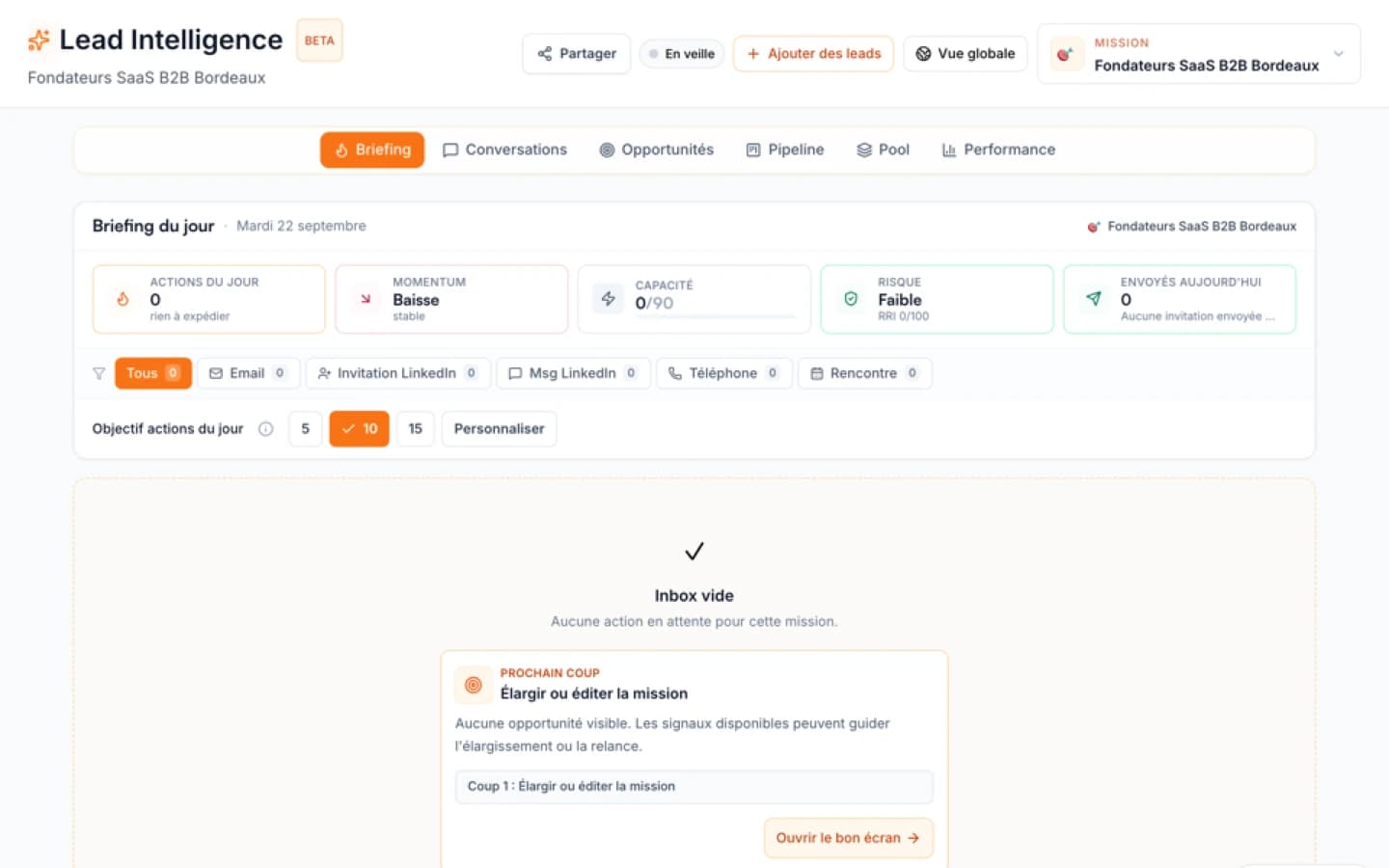
This context-driven method is ideal when your primary constraint is time and relevance, not raw volume. Instead of exporting thousands of unverified profiles, early-stage founders can use Ember Lead Intelligence to find accounts based on specific mission ICPs and verified signals, as detailed on the Ember Lead Intelligence product page. This approach is particularly valuable when you need to import up to 3,500 valid contacts from a local spreadsheet and enrich them in controlled waves of up to 200 contacts, a capability of Ember Lead Intelligence. By focusing on opportunity readiness and explainable priority, you can execute highly personalized cold outreach that builds real relationships, rather than burning through your market with generic, high-volume spam.
In practice, How Many Cold Emails Per Day Produce Meetings in 2026? completes this framework with another angle on the same topic.
When not to use it
A high-context, founder-led approach is not the right fit for every stage of a company. If you are no longer trying to figure out who to contact first as a founder and instead have a mature sales pipeline with a large team of Sales Development Representatives (SDRs), a traditional database-driven platform is often more efficient. When a company transitions from early-stage exploration to predictable, high-volume outbound sales for startups, the priority shifts from deep lead qualification to sheer scale. In these scenarios, platforms like Apollo operate as classic Business-to-Business (B2B) sales engagement platforms where you can export massive lists using credit-based systems, as shown on the Apollo pricing page.
Additionally, if your team has the technical resources to build highly customized, programmatic data enrichment pipelines, a dedicated data orchestration tool is a better fit than a context-driven assistant. For example, if you have the budget to invest in complex workflows, you might choose Clay. The Clay Launch plan starts at $185 per month billed monthly ($167 per month billed annually), which includes 15,000 actions and 3,000 data credits per month as listed on the Clay Pricing Page. For larger operations, their Growth plan starts at $495 per month billed monthly ($446 per month billed annually), providing 40,000 actions and 6,000 data credits per month according to the Clay Pricing Page.
If your Customer Relationship Management (CRM) system is already overflowing with inbound leads and your primary challenge is managing existing active deals rather than building a prospect list from scratch, you do not need to focus on early-stage lead scoring or manual prospecting missions. How does a founder qualify B2B leads without a sales team? They do so by focusing on context and signals rather than raw volume. However, once you have a dedicated sales team and a validated Ideal Customer Profile (ICP), traditional enterprise tools are better suited for managing established pipelines where the core challenge is coordination rather than discovery.
Action plan
To execute a successful outbound sales for startups strategy without a brand name, you must follow a structured action plan that prioritizes depth over raw volume. First, define who to contact first as a founder by identifying a highly specific micro segment. Instead of targeting a broad industry, look for companies experiencing a specific change, such as a recent funding round, a new executive hire, or a specific software installation. When early-stage founders discuss how they secured their first 10 customers, they consistently emphasize manual, highly targeted outreach over mass automation (Reddit B2B Marketing Discussion). This initial cohort should consist of companies where your value proposition is immediately obvious, allowing you to begin building a prospect list from scratch with clear intent. Second, establish a system for lead qualification that does not rely on a massive sales team. If you are wondering how does a founder qualify B2B leads without a sales team, the answer lies in leveraging context rather than credits. Traditional databases like Apollo allow you to export large lists (Apollo pricing page), but the credit based pricing model turns every action into a metered decision and comparisons of Apollo alternatives describe the credit system as restrictive or expensive at scale (Factors.ai Apollo Alternatives, Coldreach Apollo Alternatives). Similarly, data enrichment platforms like Clay require significant budget, with their Launch plan starting at $185 per month billed monthly ($167 per month billed annually), which includes 15,000 actions per month and 3,000 data credits per month (source).
Before deciding, How Do You Score and Prioritise B2B Leads Without a Marketing Team? helps connect this method with adjacent priorities.
Sources and methodology
To understand how early-stage founders can build a Business-to-Business (B2B) prospect list from scratch without an established brand, we analyzed real-world founder experiences, industry benchmarks, and product workflows.
First, we examined qualitative insights from active founders sharing their first-hand experiences on how they acquired their first 10 customers, as described in community discussions on Reddit. These discussions highlight that when deciding who should an early-stage founder contact first, the most effective strategy is to target highly specific micro-segments where you can offer immediate value.
Sources
FAQ
Free diagnostic
Test your sales file
Drop an Excel or CSV and check its readiness without sending its rows to Ember.