
Definition
A realistic B2B prospect list for a solo-founder with no customers and no brand is a short, curated set of accounts (10, 20) that match your ideal customer profile (ICP) and show a clear signal of interest or need. It is not a massive spreadsheet of random contacts pulled from purchased lists or LinkedIn scraping. Instead, it is a decision-focused tool: each entry should have a hypothesis about why that person might need your solution and when to reach out. The emphasis is on quality, relevance, and timing, not volume. Building a focused list from scratch helps you conserve limited time and resources.
To place this decision in context, the Knowledge guides for sales brings together deeper guidance on the same field.
Prerequisites
Before you start building your prospect list, you need three things:
- A clearly defined ideal customer profile (ICP): describe the company type, size, geography, and the persona you need to reach.
- A value hypothesis: what specific problem does your solution solve, and for whom?
- A list of signals that indicate a prospect is in-market: funding rounds, new leadership, technology stack changes, regulatory shifts, or public statements about pain points.
If you lack these, your list will be random. Common prospecting list methods assume you already have some context; without it, you must spend time researching before entering names.
Steps
- Refine your ICP. Narrow your ICP to a specific vertical, company size, and role. The more precise, the easier it is to spot relevant signals.
- Choose your signal sources. Use free tools like LinkedIn Sales Navigator trials, Crunchbase, or industry news alerts. Targeted list building recommends filtering by recent events rather than generic firmographics.
- Research 10, 20 accounts. For each account, identify the decision-maker (founder, VP, etc.) and a recent signal that creates a reason to connect.
- Prioritize based on signal strength and fit. Not all signals are equal: a job change indicating new decision authority is stronger than a generic press release. Ember Lead Intelligence can automate this step by scoring opportunities from any available context.
- Define the next action for each. Decide which channel (email, LinkedIn, cold call) and what message to use, referencing the signal. A good prospecting list ends with a clear outreach plan.
To explore this point further, Build a B2B Prospect List from Zero, Without Customers or a Brand details a step directly related to this decision.
Worked example
Imagine a solo-founder building a project management tool for boutique real estate agencies. Their ICP: independent real estate agencies with 2, 10 agents, founded within the last two years. The founder scans LinkedIn and Crunchbase and finds five recent former employees of a large agency who have opened their own shop. Each has a new role as “Founder, Agent” (signal: they are now decision-makers and likely need new software). The founder researches each: one posted about “struggling to manage transactions” on LinkedIn. That becomes the highest-priority lead because the signal is direct and recent. The action: a personalized LinkedIn message referencing the post and offering a quick demo. Within a week, two prospects respond. The founder can compare the response and learning from this small list with a broader approach; this invented example does not predict conversion.
Common mistakes
- Buying a generic list. Purchased lists often contain outdated or irrelevant contacts. Without context, you waste time on prospects with no need. Woodpecker reports 5.8% replies for campaigns under 50 recipients and 2.1% for campaigns of at least 1,000 in its platform data; these groups differ in more than list size source.
- Over-filtering by company size or revenue alone. Signals matter more than static firmographics. A small agency with a recent funding round may be more ready than a larger one with no change.
- Not aligning the outreach message to the signal. A generic “Hi, we help real estate agents” won’t stand out. Reference the specific change you observed.
- Spending too much time on list building. Limit your list to 10, 20 accounts initially. Iterate based on responses rather than trying to perfect the list upfront.
This approach also connects with Inbound or Outbound? A One-Motion Test for Small B2B Teams, which clarifies the next choice.
Tools
For a solo-founder, several tools can help:
- LinkedIn Sales Navigator, Advanced search filters to find decision-makers in target companies.
- Crunchbase, Track company funding, acquisitions, and leadership changes.
- Hunter.io, Find email addresses for prospects.
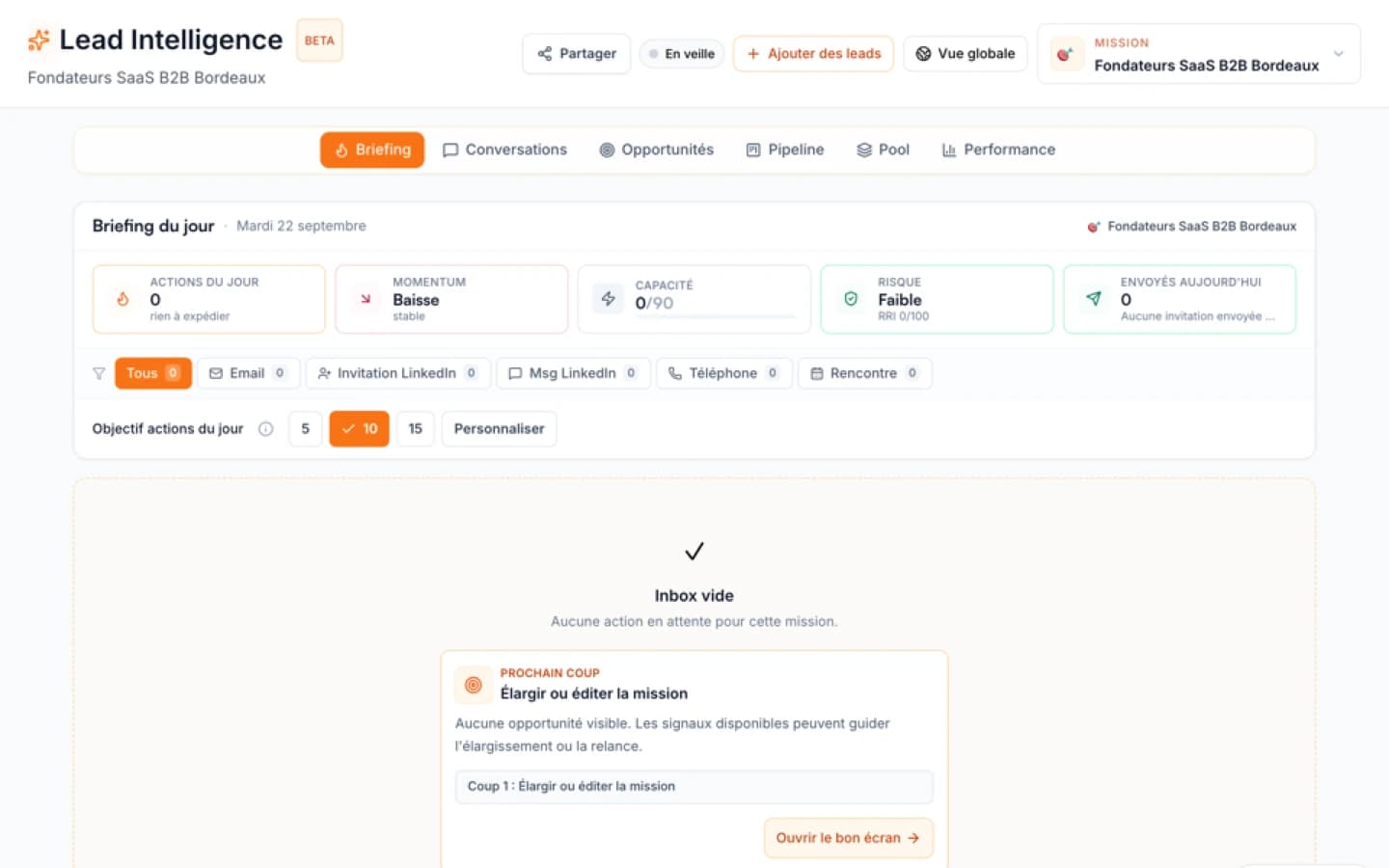
- Ember Lead Intelligence, Goes beyond list generation by analyzing your project context, detecting relevant signals, and recommending whom to contact, when, and with what message. It reduces noise and turns available information into prioritized next actions. You can try it here.
- A simple spreadsheet, Track prospects, signals, and outreach status until you scale.
When to use this method
Use this method when:
- You are a solo-founder with zero customers and no brand recognition.
- Your budget for prospecting is minimal or zero.
- You need early adopters who can provide feedback and referrals.
- You want to validate product-market fit by having real conversations, not just surface-level outreach. Proactive outreach still works when it is relevant: RAIN Group reported that 82% of buyers in its survey accept meetings at least sometimes with sellers who reach out; this is not the probability that any individual cold message succeeds source.
- You have a clear ICP but no existing contact database.
In practice, How to Prioritise Lead Conversations: A Practical Guide for Sales Teams and Founders completes this framework with another angle on the same topic.
When not to use it
This method is less suitable when:
- You have an established brand and broad appeal, allowing you to run larger-scale outbound campaigns.
- Your sales process is low-touch (e.g., self-serve) and requires high volume to generate leads.
- Your team already has a CRM like HubSpot or Salesforce and you mainly need better execution rather than prioritization.
- You have existing customers and referrals that fill your pipeline, making proactive prospecting less urgent.
In those cases, a standard CRM and list-building tool may be sufficient. Ember Lead Intelligence becomes valuable when you have names but don’t know whom to contact next.
Action plan
Today:
- Define your ICP and list three specific signals that indicate a prospect is in-market.
- Use LinkedIn or a free trial of Sales Navigator to find 10, 15 accounts matching your ICP with a recent signal.
- For each account, record the decision-maker’s name, the signal, and a potential outreach angle.
- Prioritize the top three prospects based on signal urgency and fit.
- Send a personalized message to the top prospect within 48 hours, referencing the signal.
- If you want automated prioritization and next-action suggestions, configure a mission in Ember Lead Intelligence with your ICP and signals, and let the mission research, verify and rank the accounts for you.
Before deciding, The Ember Brief #01 - Stop stacking sales frameworks. Pick the one that fits your deal size. helps connect this method with adjacent priorities.
Sources and methodology
This article synthesizes common outbound prospecting practices with an emphasis on decision-oriented prioritization. It draws on two external resources:
- Outbound Republic’s guide on building a clean prospect list (2024)
- SalesBread’s prospecting list methodology (2024)
- RAIN Group, Top Performance in Sales Prospecting
- Woodpecker, Cold Email Statistics (20M+ emails)
Both sources were used to validate the steps and common mistakes. The comparisons involving Ember Lead Intelligence are based on the current product description and publicly available information. No unverified claims are made about competitor products.
The published Woodpecker statistics compare campaigns on its platform and cannot isolate the effect of list size. RAIN Group’s buyer survey is a different sample and does not predict your reply rate. Use both as context, then measure your own small test.
| Criteria | Manual first list | Lead Intelligence |
|---|---|---|
| Source of priority | Founder records target fit, dated signals and uncertainty | Suggests opportunities from available business context |
| Before contact | Founder verifies person, relevance and contact rights | Founder reviews the suggested reason and contact rights |
Sources
FAQ
Free diagnostic
Test your sales file
Drop an Excel or CSV and check its readiness without sending its rows to Ember.