
Definition
Building a realistic Business-to-Business (B2B) prospect list from scratch means defining your target market not by the size of your database, but by the depth of your relevance. For a solo founder with 0 customers, discovering what actually works to kickstart outbound sales for startups is a matter of survival, a challenge frequently debated on Reddit. When you have no brand recognition and no historical customer data, building a prospect list from scratch requires a shift from high-volume spam to precise lead qualification.
To answer who should an early-stage founder contact first, the priority must always be companies experiencing the exact pain point your product solves today. Instead of targeting broad industries, founders must define a strict Ideal Customer Profile (ICP) based on active triggers and signals rather than static firmographics. Traditional platforms like Apollo operate as classic databases where you define your profile and export lists, but credit based pricing turns every action into a metered decision, and some organizations outgrow their credit limits as they grow, as highlighted by Factors.ai. This volume-oriented approach can quickly drain resources before you even secure your first conversation. Similarly, while advanced tools like Clay offer many data sources and advanced automation capabilities, their steep learning curve does not suit every team, as noted by Derrick App.
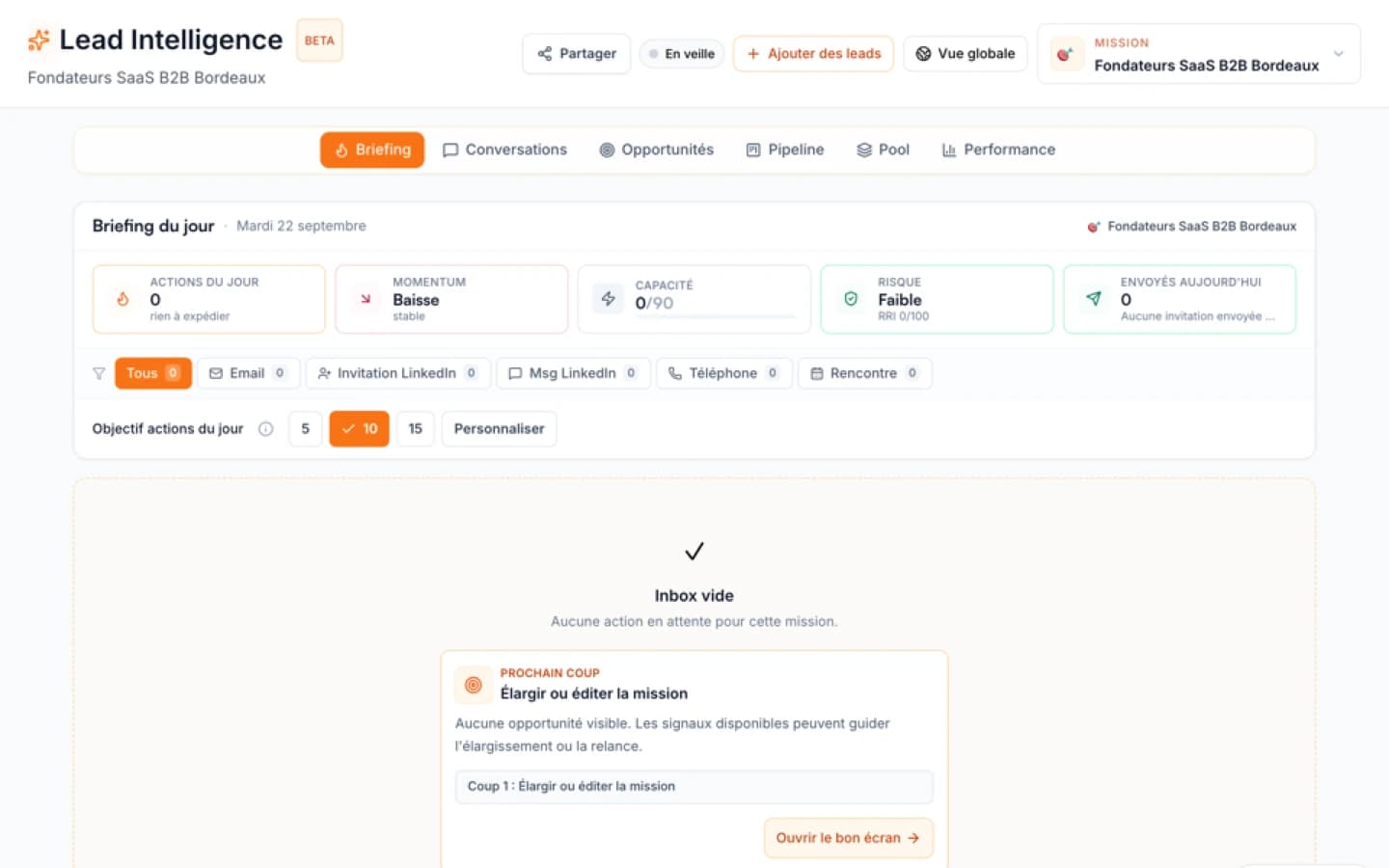
So, how does a founder qualify B2B leads without a sales team? Without a dedicated Sales Development Representative (SDR) or a complex Customer Relationship Management (CRM) setup, a solo founder must rely on context-driven lead scoring. Rather than manually parsing thousands of cold outreach targets, the goal is to identify high-intent accounts that are ready for a conversation now. This is where modern agentic workflows change the equation. By leveraging Lead Intelligence from Ember, founders can reduce the noise of raw data by focusing attention on opportunities that deserve action now. Instead of managing complex databases, this approach provides a clear next action, showing you exactly who to contact, why now, which channel to use, and which angle to take to build a healthy sales pipeline.
To place this decision in context, the Knowledge guides for sales bring together deeper guidance on the same field.
Prerequisites
Before scraping thousands of contacts, establishing a clear foundation is essential. When you have zero brand equity, you cannot rely on the volume-heavy tactics of established companies. You must instead focus on high-relevance targeting.
If you are wondering who should an early-stage founder contact first, the answer lies in finding buyers who are experiencing the exact pain point you solve right now. For a solo founder with 0 customers, finding what actually works often begins by looking at peer discussions on Reddit to see where early adopters are actively complaining about existing gaps. Instead of targeting everyone in a sector, you target those showing active signals of need.
But how does a founder qualify Business-to-Business (B2B) leads without a sales team? Without a dedicated Sales Development Representative (SDR) or a complex Customer Relationship Management (CRM) system, lead qualification must be automated yet highly contextual. You qualify leads early by looking for specific organizational changes, hiring patterns, or technology shifts that indicate a high readiness to buy. This keeps your sales pipeline clean and prevents you from wasting time on cold outreach to accounts that are not ready.
For founders who already know their Ideal Customer Profile (ICP) perfectly and want to build massive lists, classic platforms are highly effective. For instance, Apollo operates as a classic B2B sales engagement platform with a large searchable contact database and email outreach tools. However, the tradeoff is that credit-based pricing turns every action into a metered decision. As a sales team scales, some organizations outgrow their credit limits, as discussed on Factors.ai. Alternatively, platforms like Clay offer broad data coverage and advanced automation, but with a steep learning curve, as highlighted on Derrick App.
If you do not have the technical bandwidth to manage complex enrichment pipelines, you need a system that reduces noise and focuses your attention on opportunities that deserve action now. This is where Ember Lead Intelligence helps. Instead of forcing you to manage credits or build complex logic, Ember uses your validated business context to identify who to contact, why now, which channel to use, and which angle to take, making B2B prospecting manageable for a solo founder.
Steps
The first step is to start with a hyper-focused segment of high-relevance prospects who are already experiencing the exact pain point your product solves. When building a prospect list from scratch, you cannot afford to target broad industries. You must identify a micro-cohort of buyers who are actively seeking solutions.
According to real-world discussions on what actually worked for solo founders with zero customers, the most effective strategy is to find prospects who are already vocal about their problems in online communities, niche forums, or professional networks. These individuals should be your very first touchpoints because their immediate need outweighs your lack of brand recognition.
Once you have identified this initial group, the next step is to gather high-intent signals rather than chasing raw database volume. Traditional platforms like Apollo operate as classic Business-to-Business (B2B) sales engagement platforms, allowing users to search a large contact database and run email outreach. While this volume-oriented approach works for established companies, it introduces significant friction for early-stage startups. Credit-based pricing models turn every action into a metered decision. As noted on Factors AI, some organizations outgrow their credit limits as a sales team scales. This financial risk is also highlighted on Coldreach, which notes that credits can feel tight and run out faster than expected, making raw list-building a dangerous gamble for a solo founder with limited capital.
To qualify B2B leads early without a sales team, you must shift from manual data orchestration to contextual prioritization. Advanced data tools like Clay offer a comprehensive solution with many data sources and advanced automation capabilities, as discussed on Derrick App. However, their steep learning curve does not suit every team, and a solo founder acting as their own Sales Development Representative (SDR) rarely has the time to design and maintain such workflows.
Instead of building complex data pipelines, founders can leverage dedicated solutions to streamline their sales pipeline. This is where Ember's Lead Intelligence changes the dynamic. It reduces noise by focusing attention on opportunities that deserve action now, allowing you to run highly targeted outbound sales for startups without getting bogged down in manual lead scoring. By analyzing real-time signals and matching them against your Ideal Customer Profile (ICP), you can easily determine who to contact first and what message will resonate, ensuring your cold outreach is grounded in relevance rather than luck. This systematic approach allows you to build a clean, high-converting list and manage your outreach cadence without the noise of traditional databases.
To explore this point further, B2B prospecting list: target a job title, not a company size details a step directly related to this decision.
Worked example
For a solo founder with 0 customers, finding what actually works to build a sales pipeline is a common hurdle, as highlighted on Reddit. Without a dedicated Sales Development Representative (SDR) or an established brand, the challenge of building a prospect list from scratch often leads founders to traditional database tools.
A common route is using a classic Business-to-Business (B2B) sales engagement platform like Apollo, which lets you search a large contact database and run email outreach. However, the tradeoff is that credit-based pricing turns every action into a metered decision. As a sales team scales, some organizations outgrow their credit limits, as noted by Factors AI. This pricing model can force early-stage teams to treat every search as a costly experiment.
Other platforms like Clay offer many data sources and advanced automation capabilities, but with a steep learning curve, as explained by Derrick App.
Common mistakes
When building a prospect list from scratch with zero customers and zero brand equity, solo founders frequently fall into predictable traps that drain their limited time and budget. The most common mistake is treating outbound sales for startups as a pure volume game. Founders often assume that more data automatically equals more revenue, leading them to buy massive contact lists before they have clearly defined their target market.
While established platforms like Apollo serve as excellent classic Business-to-Business (B2B) sales engagement platforms for teams that already know their Ideal Customer Profile (ICP) cold, they can lead early-stage founders into a costly cycle. The primary tradeoff is that credit-based pricing turns every action into a metered decision. As a sales team scales, credit limits become a friction, as documented by Factors.ai and Coldreach. For a founder with zero customers, paying for unverified volume is a fast way to deplete capital.
Another frequent error is over-complicating the data pipeline. Highly flexible tools like Clay offer many data sources and advanced automation capabilities, but with a steep learning curve, as explained by Derrick App. However, a solo founder without a dedicated Sales Development Representative (SDR) or deep technical resources can easily get bogged down in building complex workflows instead of actually talking to prospects.
This operational complexity often leads to a fundamental question: How does a founder qualify B2B leads without a sales team? The mistake many make is relying on static lead scoring within a Customer Relationship Management (CRM) system, looking only at generic job titles or company sizes. Without a sales team, a founder must qualify B2B leads early by looking for active, real-time signals of pain, such as recent hiring changes, technology shifts, or public discussions. This prevents the sales pipeline from becoming cluttered with unresponsive accounts.
When deciding who should an early-stage founder contact first, beginners often make the mistake of targeting large, prestigious enterprises right away. This strategy usually results in long, exhausting sales cycles that lead nowhere because the founder lacks the brand authority to build trust. Instead of chasing unreachable logos, the first contacts should be agile, accessible decision-makers who are actively seeking a solution to their immediate problems, a challenge frequently discussed by early-stage builders on Reddit.
To avoid these common pitfalls, founders need to shift from volume-heavy scraping to high-relevance targeting. Rather than managing complex databases or worrying about metered credit costs, using a focused approach like Lead Intelligence by Ember allows founders to prioritize the right conversations. This method reduces noise by focusing attention on opportunities that deserve action now and provides a clear next action, identifying exactly who to contact, why now, which channel, and which angle to use for maximum impact.
This approach also connects with How Can a B2B Founder in the Founder-Led Sales Phase Decide Who to Contact, Why Now, and With What Message?, which clarifies the next choice.
Tools
Our analysis of these platforms is grounded in structured, sourced data covering Apollo and Clay. Both tools publicly document at least one integration.
When to use this method
This highly targeted method for building a Business-to-Business (B2B) prospect list from scratch is not designed for mass-market campaigns or established companies with large marketing budgets. Instead, it is specifically built for early-stage solo founders who must navigate the cold start problem with zero customers and no brand recognition.
You should use this method when you need to answer the critical question of who should an early-stage founder contact first. When you have no historical data, starting with a massive list of thousands of cold contacts is a recipe for wasted effort and high bounce rates. Instead, this approach helps you identify a highly specific micro-cohort of buyers who are experiencing immediate, addressable pain points.
This method is also essential when you need to understand how does a founder qualify B2B leads without a sales team. By focusing on a small group of prospects whose relevance you can manually validate, you build a reliable database that will feed your sales pipeline long before you need a Customer Relationship Management (CRM) system or a lead-scoring engine.
In practice, How Lead Intelligence works for a B2B founder who wants to know who to contact, why now, and with what message: a practical guide completes this framework with another angle on the same topic.
When not to use it
This hyper-targeted, manual approach to building a prospect list is not a universal solution for every stage of a company. If you already have a validated Ideal Customer Profile (ICP) and a clear understanding of your market, you do not need to spend hours manually researching individual signals. In those scenarios, established platforms are highly effective. For example, Apollo operates as a classic Business-to-Business (B2B) sales engagement platform where you can search a large contact database, apply filters, and run email outreach. This volume-oriented model has real strengths for teams that already know their target market cold.
Similarly, if your startup has grown to the point where you have the technical bandwidth to design and maintain complex data pipelines, you might outgrow simple manual lists. In those cases, platforms like Clay offer many data sources and advanced automation capabilities, as highlighted in the Derrick App guide on Clay alternatives.
However, founders must be mindful of the financial tradeoffs of scaling these tools too early. Credit-based pricing models can turn every prospecting action into a metered decision. As a sales team scales, credit limits become a friction, as discussed in the Factors.ai blog on Apollo alternatives and the Coldreach analysis of sales tools.
If you are asking how does a founder qualify B2B leads without a sales team, or who should an early-stage founder contact first, the answer depends entirely on your current stage. When you have zero customers and no brand, you should contact high-intent, highly specific industry peers first, rather than importing thousands of cold contacts. You can find real-world examples of this exact transition in the Reddit founder community discussions. Once you are ready to transition from manual spreadsheets to structured prospecting without the noise of traditional databases, Ember can help. Through Lead Intelligence, the platform reduces noise by focusing attention on opportunities that deserve action now, providing a clear next action on who to contact, why now, which channel, and which angle to use.
Action plan
To execute building a prospect list from scratch, a solo founder must adopt a highly systematic approach. When you have zero brand recognition and no historical data, the initial phase of Business-to-Business (B2B) prospecting is not about scaling volume. It is about validation. For a solo founder with 0 customers, finding what actually worked to gain initial traction requires moving away from generic automation and focusing on deep, manual relevance, as discussed by peers in the startup community on Reddit.
Who should an early-stage founder contact first? The answer lies in identifying buyers who are actively experiencing the specific pain point your product solves. Rather than chasing contact volume, focus on manually qualifying each prospect. To qualify B2B leads without a sales team, a founder can rely on their Ideal Customer Profile (ICP) and verify one by one that each prospect matches that profile, using public sources and direct conversations. This approach, while time-consuming, is one way to build a credible first sales pipeline.
Before deciding, How do you qualify a B2B lead in 2026 without a marketing team or CRM: a practical guide? helps connect this method with adjacent priorities.
Sources and methodology
To build a realistic Business-to-Business (B2B) prospect list when you have zero customers and no brand, our methodology relies on analyzing real-world founder experiences and comparing the operational workflows of leading sales platforms. For a solo founder with zero customers, understanding what actually worked in practice requires looking at peer-to-peer insights, such as those shared in community discussions on Reddit. These discussions highlight that early-stage outbound sales for startups succeed not through mass automation, but through rigorous lead qualification and highly targeted cold outreach.
When considering how a founder qualifies B2B leads without a sales team, the traditional approach often involves volume-oriented databases. For instance, Apollo operates as a classic B2B sales engagement platform with a large contact database you can search and filter, plus email outreach and other channels. However, this model is highly volume-oriented, meaning the more credits you have, the more contacts you can export and enrich. For a solo founder acting alone, credit limits are therefore a constraint to watch.
Sources
FAQ
Free diagnostic
Test your sales file
Drop an Excel or CSV and check its readiness without sending its rows to Ember.