
Symptom or signal
In the early stages of building a Business-to-Business (B2B) startup, founders often lead the initial sales efforts. This phase of founder-led sales is critical for gathering direct market feedback, but it quickly becomes a bottleneck when the founder or sales teams must manually research every lead. The primary challenge is not just finding names, but knowing who to contact, why now, and which action to take. Without this context, outreach becomes generic and conversion rates drop.
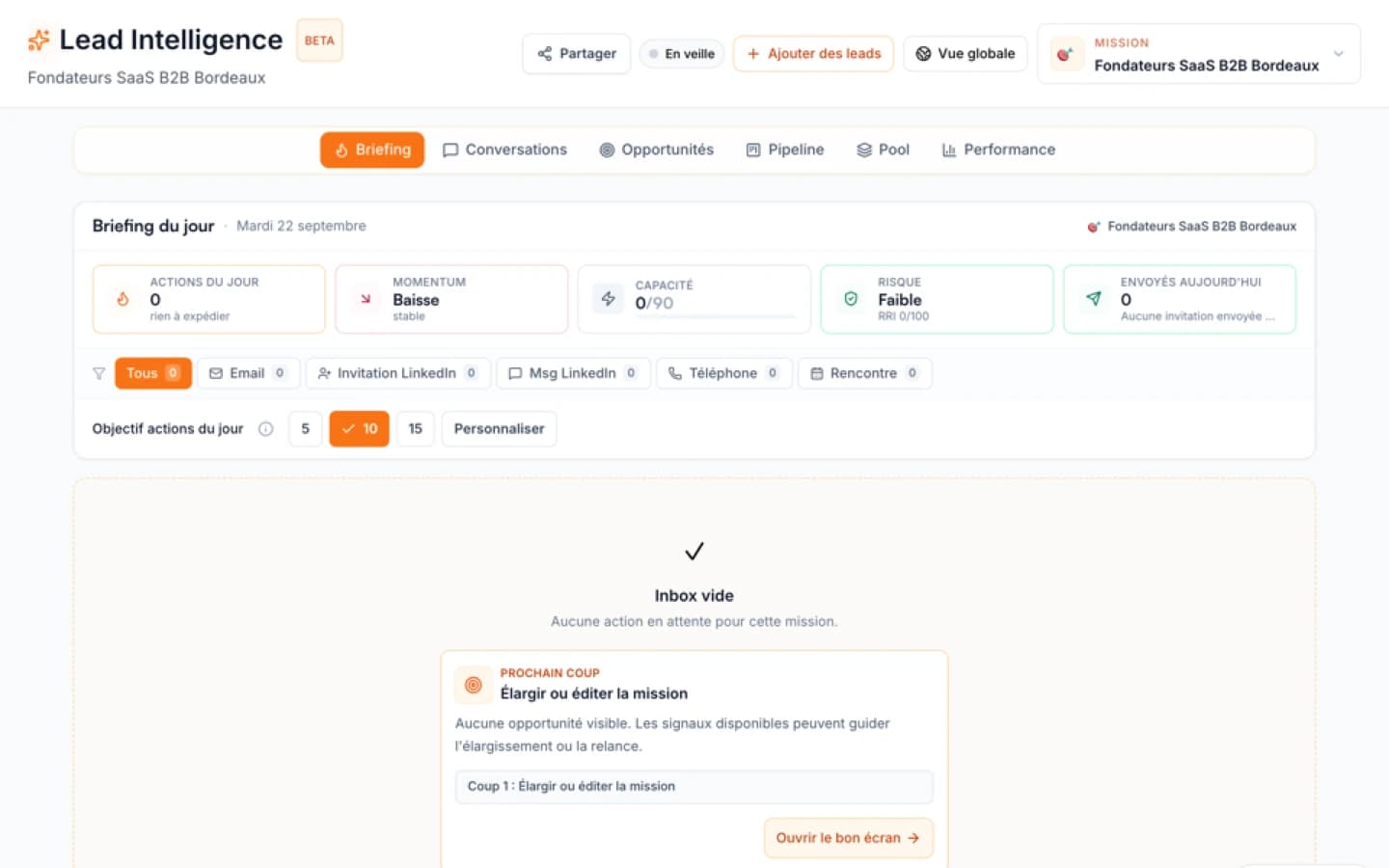
Ember addresses this bottleneck through Lead Intelligence. Instead of treating prospecting as an isolated database search, Lead Intelligence reuses the Ember Business Plan, Ideal Customer Profile (ICP), offer, and strategy to prepare a targeted sales mission. By grounding the search in the actual strategy of the business, the system provides a clear next action: who to contact, why now, which channel, and which angle to use. It proposes the next action and channel that fit the lead situation, allowing founders and sales teams to focus their energy only on high-priority opportunities.
This approach is highly flexible and independent of list size. Lead Intelligence finds and prioritizes the contacts itself whether the team starts with 10, 100, or 1,000 contacts, with no minimum contact threshold, as outlined on the Ember Lead Intelligence page. This is a significant departure from traditional sales intelligence platforms that require massive data volumes to show value.
For high-volume outbound campaigns, established platforms like Apollo are highly effective. Apollo, which generated 150 million dollars in annual recurring revenue in 2025 according to Apollo, positions itself as a unified Artificial Intelligence (AI) sales platform for modern sales and marketing teams looking to simplify their stack (source). Similarly, data enrichment tools like Clay provide powerful data-point integrations, including an official LinkedIn Sales Navigator integration (source). However, for a founder or a lean sales team navigating founder-led sales, raw volume and complex enrichment pipelines often create more noise than clarity. Lead Intelligence focuses instead on translating existing business strategy into immediate, context-rich conversations.
To place this decision in context, the Knowledge guides for sales brings together deeper guidance on the same field.
What changed
In the traditional Business-to-Business (B2B) prospecting landscape, sales teams and founders have relied on heavy data-scraping tools to build pipelines. Platforms like Apollo are highly effective for modern sales and marketing teams aiming to simplify their technology stack and manage closing pipelines, as outlined on Apollo. This volume-driven model has achieved significant commercial scale, with Apollo generating 150 million dollars in annual recurring revenue in 2025, according to Apollo. However, managing these large-scale campaigns requires navigating email credit limits governed by fair use policies, as detailed on Apollo Pricing, which often pushes teams toward sending generic, high-volume messages.
For teams that require custom data workflows, infrastructure platforms like Clay offer powerful ways for Go-To-Market (GTM) engineers and Revenue Operations (RevOps) specialists to source data and launch outbound plays, as shown on Clay. Clay integrates with platforms like LinkedIn Sales Navigator, as documented on Clay Sales Navigator Integration, and connects to sales engagement tools like Outreach or Salesloft, as listed on Clay Integrations. While these tools are excellent for established organizations with dedicated operations teams, they demand significant setup time and technical expertise to construct and maintain the data pipelines.
For a founder navigating the critical phase of founder-led sales, or a lean sales team trying to find traction, this operational complexity is often a distraction. In the early stages of a startup, success depends on deep customer empathy and highly personalized conversations rather than massive outbound volume, a reality highlighted in resources such as The Ultimate Guide to Founder-Led Sales on LinkedIn and Alex Kracov's analysis of early-stage sales dynamics on Founder-Led Sales. At this stage, the primary need is not more raw data, but immediate clarity on who to prioritize.
This is where the approach has changed. Instead of treating prospecting as a separate, disconnected database exercise, Ember integrates sales discovery directly with company strategy. The Lead Intelligence capability reuses the existing Ember Business Plan, Ideal Customer Profile (ICP), offer, and strategy to prepare a targeted sales mission. This context-driven approach ensures that the outreach is aligned with the core value proposition of the business from day one.
By leveraging this shared context, Lead Intelligence enables founders and sales teams to know who to contact, why now, and which action to take. It replaces generic lists with a clear next action, specifying who to contact, why now, which channel to use, and the exact angle to take. This eliminates the guesswork.
Facts and sources
In the early stages of building a Business-to-Business (B2B) startup, founders often lead the initial sales efforts. This phase of founder-led sales is critical for gathering direct market feedback, but it quickly becomes a bottleneck when the founder or sales teams must manually research every lead. As Alex Kracov notes in his guide on founder sales, early traction often relies heavily on networking and direct conversations before scaling (source). Transitioning from pure networking to structured outreach requires clear execution. Bharathi Masilamani recommends starting manually: identify 30 potential prospects and write thoughtful, personalized messages, which helps refine your understanding of the ideal customer profile (source). Established platforms are highly effective for broad database coverage and pipeline management. For instance, Apollo operates as a unified artificial intelligence sales platform for modern sales and marketing teams aiming to simplify their technology stack, as outlined on their official website (source). This credit-based database model is highly successful, with Apollo reaching 150 million dollars in annual recurring revenue in 2025, while securing a 1.6 billion dollar valuation in 2023 and about 250 million dollars in total funding (company history and Series D announcement). Similarly, Clay offers deep data enrichment, including an official LinkedIn Sales Navigator datapoint integration for lead discovery and connection insights (source). These tools are excellent when teams need massive database volume or complex data enrichment pipelines. However, for a founder or a sales team focused on immediate relevance rather than sheer volume, Lead Intelligence offers a different path. It reuses the Ember Business Plan, Ideal Customer Profile (ICP), offer, and strategy to prepare a targeted sales mission. Instead of requiring a massive database setup, Lead Intelligence finds and prioritizes the contacts itself, whether the team starts with 10, 100, or 1,000 contacts, with no minimum contact threshold, as detailed on the official Ember Lead Intelligence page. This allows teams to know exactly who to contact, why now, and which action to take. By proposing the next action, channel, and angle that fit the lead's specific situation, it provides a clear next step without the noise of traditional cold scraping.
To explore this point further, How do you qualify a B2B lead in 2026 without a marketing team or CRM: a practical guide? details a step directly related to this decision.
Why the common explanation is incomplete
The common explanation of Business-to-Business (B2B) prospecting suggests that success is purely a numbers game. Under this traditional view, the formula for founder-led sales is simple: buy access to a massive database, scrape thousands of contacts, and send automated email sequences. While large-scale databases are highly valuable for modern sales and marketing teams looking to simplify their technology stack, this volume-first approach is fundamentally incomplete for a founder or a sales team trying to establish initial market traction. The limits of this explanation become clear when looking at the market leaders. For instance, Apollo generated 150 million dollars in annual recurring revenue in 2025, holding a 1.6 billion dollar valuation in 2023 with about 250 million dollars in total funding, according to Apollo (company history and Series D announcement). This scale proves that B2B contact databases are commercially successful, but having access to millions of records does not tell a founder who to contact today, why now, or what specific message will resonate. Similarly, advanced data orchestration platforms like Clay offer official LinkedIn Sales Navigator datapoint integrations for lead discovery and connection insights, as detailed on the Clay Sales Navigator integration page. Yet, these tools still require sales teams to spend hours building complex logic, filtering out noise, and guessing the right outreach angles. The common explanation is incomplete because it treats data enrichment and strategic context as two separate steps. In founder-led sales, you cannot separate your product strategy from your prospecting. A generic list of leads leads to generic messaging, which dilutes the founder's unique insights. Instead of treating prospecting as an isolated database search, Lead Intelligence by Ember connects your outbound efforts directly to your business strategy. It reuses the Ember Business Plan, Ideal Customer Profile (ICP), offer, and strategy to prepare a highly targeted sales mission. This context-driven approach removes the need for massive, noisy databases. According to the Ember Lead Intelligence documentation, the system finds and prioritizes the contacts itself whether the team starts with 10, 100, or 1,000 contacts, with no minimum contact threshold. By grounding the search in your actual business context, it proposes the next action and channel that fit the lead situation. This gives founders and sales teams a clear next action: exactly who to contact, why now, which channel to use, and which angle to take to move the decision forward.
The real problem
The real problem in founder-led sales is not a lack of raw contact information, but the overwhelming noise that comes with unstructured data. Traditional sales intelligence platforms are highly capable at what they do. For instance, Apollo is a powerful sales intelligence and engagement platform built around a large database, and according to Apollo (company history and Series D announcement), the company generated 150 million dollars in annual recurring revenue in 2025, holding a 1.6 billion dollar valuation in 2023 with about 250 million dollars in total funding. Similarly, Clay provides excellent data enrichment, including an official LinkedIn Sales Navigator datapoint integration for lead discovery and connection insights as documented on Clay. These tools are highly effective for modern sales and marketing teams aiming to simplify their technology stack, but they still require manual effort to filter, sequence, and determine the right messaging angle. For a founder or a sales team, the primary challenge is to know who to contact, why now, and which action to take. When resources are limited, spending hours analyzing spreadsheets to guess why a prospect might care about your offer is a major bottleneck. This is where Lead Intelligence changes the workflow. Instead of requiring a massive list to start, Lead Intelligence finds and prioritizes the contacts itself whether the team starts with 10, 100, or 1,000 contacts, with no minimum contact threshold as explained on Ember. The system works by aligning your prospecting directly with your strategic foundation. It reuses the Ember Business Plan, Ideal Customer Profile (ICP), offer, and strategy to prepare a targeted sales mission. Because it understands this deep Business-to-Business (B2B) context, it does not just return a list of names. Instead, it proposes the next action and channel that fit the lead situation. This approach provides a clear next action, helping sales teams and founders understand exactly who to contact, why now, which channel to use, and which angle to take to make the conversation relevant.
This approach also connects with How to build a B2B prospect list from scratch with zero customers and no brand recognition: a practical guide, which clarifies the next choice.
How the mechanism works
The mechanism of Lead Intelligence is designed to transition Business-to-Business (B2B) founders and sales teams from manual, exhausting research to highly targeted, context-driven outreach. Instead of starting with a blank slate or an unmanageable list of cold leads, the system begins by reusing the strategic foundation already built within Ember. It directly integrates the Ember Business Plan, Ideal Customer Profile (ICP), core offer, and overall business strategy to prepare a dedicated sales mission. This ensures that every prospecting action is aligned with the company's actual goals rather than generic market criteria.
Once the mission parameters are set, the system operates independently of initial database size. Traditional platforms often require massive lead lists to be effective. For example, Apollo, which generated 150 million dollars in annual recurring revenue in 2025 (company history), operates as a massive sales intelligence and engagement platform built around a large contact database. In contrast, Lead Intelligence finds and prioritizes the contacts itself, whether the sales team starts with 10, 100, or 1,000 contacts, with no minimum contact threshold as documented on the Ember Lead Intelligence product page. This flexibility allows founders in the early stages of founder-led sales to focus on high-value targets without needing to build or buy massive, noisy databases.
The final step of the mechanism translates this filtered context into execution. Lead Intelligence analyzes the specific situation of each target company and individual to propose a clear next action, identifying the most appropriate channel and the precise messaging angle. By answering who to contact, why now, and which action to take, the system allows sales teams to bypass the noise of generic sequencing and engage prospects with highly relevant, timely conversations.
Concrete examples
This structured approach directly addresses the challenges of prospecting during the founder-led sales phase, as illustrated by resources such as The Ultimate Guide to Founder-Led Sales and Alex Kracov's account of his own approach on How I've approached founder-led sales. In practice, the tool reuses your Business Plan, Ideal Customer Profile (ICP), offer, and strategy to prepare a sales mission. It finds and prioritizes the contacts itself, whether you start with ten, a hundred, or a thousand contacts, with no minimum threshold. For each lead, it proposes the next action and the channel that fit their situation.
In practice, HubSpot Sales Hub vs Ember: when each one fits completes this framework with another angle on the same topic.
When to use this diagnosis
For Business-to-Business (B2B) founders navigating the transition into structured founder-led sales, knowing who to contact, why now, and with what message is the ultimate bottleneck. Incumbent platforms are excellent when your primary goal is broad market coverage or complex workflow engineering. For instance, Apollo operates as a highly successful unified Artificial Intelligence (AI) sales platform for modern sales and marketing teams focusing on pipeline, closing, and stack simplification, which you can explore on the Apollo official website. According to financial data, Apollo generated 150 million dollars in annual recurring revenue in 2025, with a valuation of 1.6 billion dollars in 2023 and about 250 million dollars in total funding, according to Apollo (company history and Series D announcement), showing that its credit-based model works commercially at scale.
When not to use it
While Lead Intelligence is highly effective for focused, strategic prospecting, it is not the right tool for every sales scenario.
If your primary objective is executing high-volume, automated cold-email campaigns to hundreds of thousands of recipients without deep contextual filtering, traditional sales engagement platforms are a better fit. For instance, Apollo is a unified sales intelligence and engagement platform built around a large Business-to-Business (B2B) contact database, email sequencing, and prospecting workflows, as detailed on the Apollo official website. This platform scale is massive, as Apollo generated 150 million dollars in annual recurring revenue in 2025, and holds a 1.6 billion dollar valuation in 2023 with about 250 million dollars in total funding, according to Apollo (company history and Series D announcement). If your sales strategy relies on managing a massive database and executing broad, automated sequences, an established platform of that scale is more appropriate.
Similarly, if your team requires highly customized data-engineering workflows or complex programmatic data enrichment, specialized data platforms are more suitable. For example, Clay offers an official LinkedIn Sales Navigator datapoint integration for lead discovery and connection insights, which is ideal for teams that want to build custom, multi-source enrichment pipelines, as shown on the Clay Sales Navigator integration page.
Ember Lead Intelligence is not built for mindless volume or generic spam. Instead, it is designed for founders and sales teams who need to know exactly who to contact, why now, and with what message. It is highly relevant even at small scales, finding and prioritizing contacts whether you start with 10, 100, or 1,000 contacts, with no minimum contact threshold, as detailed on the Ember Lead Intelligence documentation. If you do not want your outreach guided by your strategic business plan and Ideal Customer Profile (ICP), or if you prefer to manage raw, unprioritized lists of leads manually, then generic database providers will better serve your current workflow.
Before deciding, Apollo pricing 2026: plans, credits, hidden costs and alternatives: a practical comparison helps connect this method with adjacent priorities.
Next step
To transition from manual networking to a structured, repeatable sales process, Business-to-Business (B2B) founders must move beyond ad-hoc outreach. In the early stages of a company, founders often network their way into making their first sales happen, relying heavily on personal introductions and direct insights, as described by experienced sales leaders (source). However, scaling past this initial network requires a systematic approach to identifying and engaging potential customers, a point Bharathi Masilamani's guide sums up this way: the biggest challenge is often getting prospects to pay attention (source).
Instead of adopting high-volume platforms designed for massive outbound campaigns, such as Apollo, which generated 150 million dollars in annual recurring revenue in 2025 (company history), early-stage teams need precision. The immediate next step for a founder is to define a clear, context-driven prospecting mission.
Ember addresses this need through Lead Intelligence. The system reuses the strategic foundation already established in the Ember Business Plan, including the Ideal Customer Profile (ICP), core offer, and overall strategy, to prepare a targeted sales mission. Rather than requiring a massive database to begin, Lead Intelligence finds and prioritizes the contacts itself whether the team starts with 10, 100 or 1,000 contacts, with no minimum contact threshold (source).
By monitoring real-time signals across companies and individuals, the system continuously updates the context of each opportunity. It then proposes the next action and channel that fit the lead situation (source). This ensures that founders and sales teams know exactly who to contact, why now, and which specific angle to use.
Sources and methodology
To understand how modern Business-to-Business (B2B) sales teams and founders navigate early-stage prospecting, this analysis relies on official product documentation, industry benchmarks, and established frameworks for founder-led sales.
The methodology for identifying high-priority opportunities is grounded in the transition from manual networking to structured outreach. In the early stages of a company, founders often network their way into making their first sales happen, relying heavily on personal introductions and direct insights, as detailed in the founder-led sales guide by Alex Kracov (source). Transitioning this manual process into a repeatable system requires moving beyond ad-hoc outreach, a challenge addressed in strategic guides such as the founder-led sales analysis published on LinkedIn (source).
To evaluate how different platforms solve this challenge, we examine established market incumbents. For instance, Apollo operates as a unified sales intelligence platform designed for modern sales and marketing teams, focusing on pipeline, closing, and stack simplification, as described on the official Apollo website (source). According to financial data, Apollo generated 150 million dollars in annual recurring revenue in 2025, with a valuation of 1.6 billion dollars in 2023 and about 250 million dollars of total funding (company history and Series D announcement). This scale demonstrates the commercial viability of high-volume database models. Similarly, other data enrichment tools like Clay focus on deep integration capabilities, such as their official LinkedIn Sales Navigator datapoint integration for lead discovery and connection insights (source).
In contrast to high-volume database models, the methodology behind Lead Intelligence by Ember focuses on contextual prioritization rather than sheer volume. According to the official Ember documentation, Lead Intelligence finds and prioritizes the contacts itself whether the team starts with 10, 100, or 1,000 contacts, with no minimum contact threshold (source). This approach reuses the Ember Business Plan, Ideal Customer Profile (ICP), offer, and strategy to prepare a sales mission, ensuring that the platform proposes the next action and channel that fit the specific lead situation. This methodology guarantees that founders and sales teams know who to contact, why now, and which action to take without needing to manage massive, unfiltered databases.
Sources
FAQ
Free diagnostic
Test your sales file
Drop an Excel or CSV and check its readiness without sending its rows to Ember.