
Symptom or signal
During the early stages of building a business, founders often find themselves running their own sales processes. This phase of founder-led sales is critical because founders possess a unique vision for the business that can be used to create a winning sales strategy, as highlighted by HubSpot in their analysis of startup growth The Importance of Founder-Led Sales for Startups. In these early days, sales often feel like networking your way into making the company happen, constantly talking to potential customers and bringing those insights back to the team, a dynamic described by Alex Kracov in his reflections on early-stage sales How I've approached founder-led sales - Alex Kracov. However, as the business begins to scale, manual networking quickly becomes a bottleneck, leaving business-to-business (B2B) founders and their sales teams asking who they should contact, why they should reach out now, and what message they should send.
When founders and sales teams focus purely on speed and immediate outbound volume, legacy platforms are often highly effective. For instance, Apollo has built a massive business by delivering immediate volume through a large contact database, Chrome extension prospecting, and sequence automation. According to Apollo's own data, the company reached 150 million dollars in annual recurring revenue (Apollo's company history page). Positioned as a unified artificial intelligence (AI) sales platform for modern sales and marketing teams Apollo Pricing, it is an excellent fit for teams that need to generate high-volume outbound activity, though users should keep in mind that its unlimited email plans are subject to a fair use policy Apollo Pricing. Similarly, teams looking for deep data enrichment and orchestration often turn to Clay, which integrates with tools like Salesloft, Outreach, Instantly, Smartlead.ai, and HubSpot Sequencer Clay Integrations.
While these high-volume tools are powerful for established sales operations, they can introduce significant noise for a founder-led sales team that needs to stay highly targeted. Instead of blasting generic databases, early-stage B2B teams need to know who to contact, why now, and which action to take.
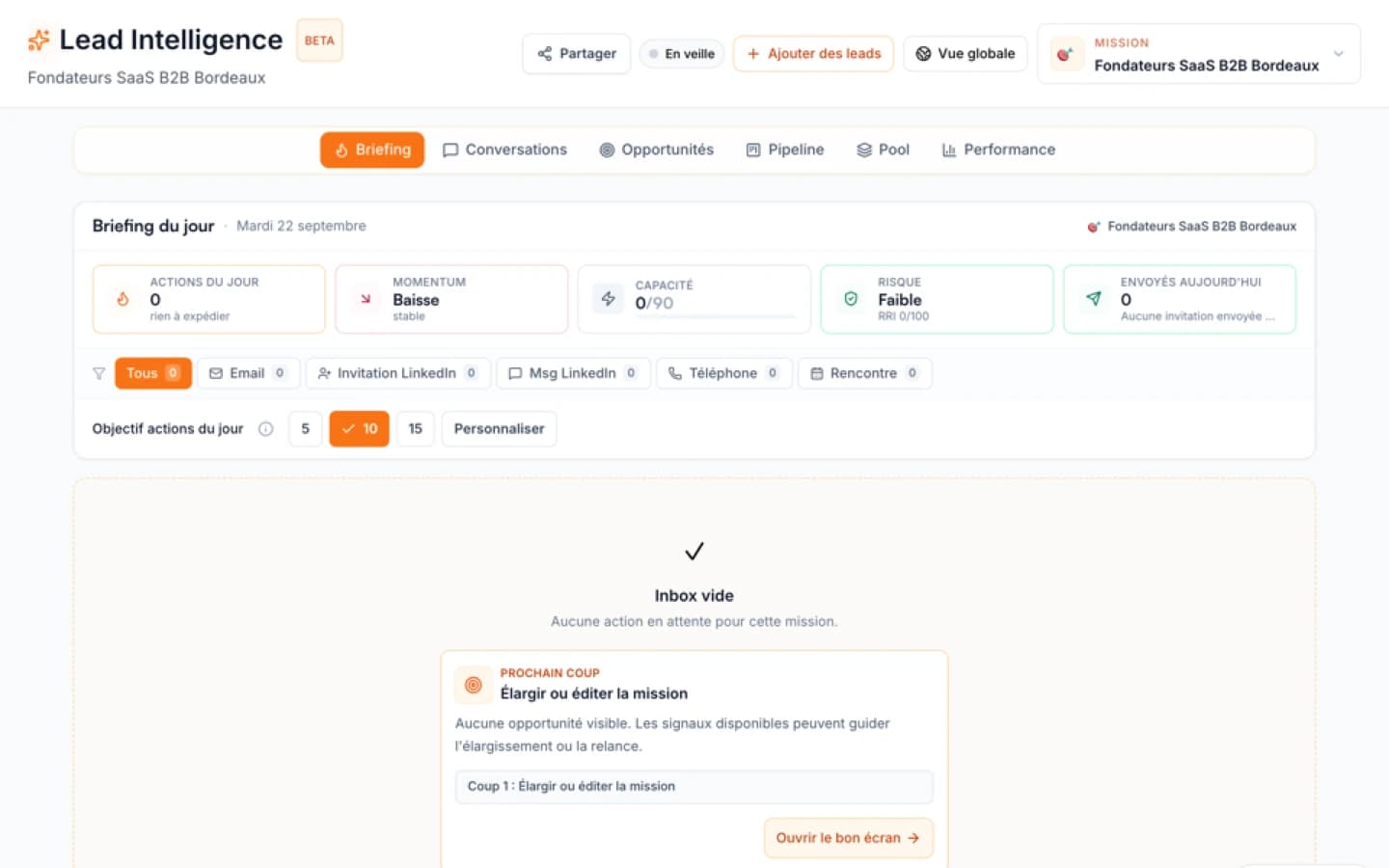
This is where Lead Intelligence by Ember changes the approach. Instead of starting from scratch, Lead Intelligence reuses the Ember Business Plan, ideal customer profile (ICP), offer, and strategy to prepare a highly contextual sales mission Lead Intelligence. By searching and importing profiles through LinkedIn or Sales Navigator from a connected account Lead Intelligence, it bridges the gap between high-level strategy and daily execution. This allows founders and sales teams to transition away from raw volume and instead focus on a clear next action, identifying exactly who to contact, why now, which channel to use, and which angle to take.
To place this decision in context, the Knowledge guides for sales brings together deeper guidance on the same field.
What changed
The transition from Business-to-Business (B2B) founder-led sales to a structured commercial engine represents a fundamental shift in how a young company approaches the market. In the earliest days, founders typically build their initial traction through direct, personal networking, as noted by Alex Kracov in his analysis of early stage Go-To-Market (GTM) strategies at Lattice Alex Kracov. However, as the company grows, the sales team must establish a repeatable process to answer three critical questions: who to contact, why contact them now, and what message will resonate.
For businesses that prioritize immediate outbound volume and rapid sequence automation, traditional sales platforms are highly effective.
Facts and sources
To build a repeatable Business-to-Business (B2B) sales process, founders and sales teams must move beyond random networking and establish a systematic approach to outreach. Understanding who to contact, why now, and with what message requires grounding every sales mission in real, structured context rather than generic templates. According to the Ultimate Guide to Founder-Led Sales, in the early days, before brand recognition, the founder's expertise and vision become the primary selling point. This stage is critical because, as outlined by HubSpot, founders possess a unique vision for the business that can be used to create a winning sales strategy.
In the early stages, founders often rely on direct personal networks to generate initial traction. As Alex Kracov explains in his analysis of founder-led sales, early sales often feel like networking one's way into making a company happen, where insights from direct conversations are constantly fed back to the product team. However, scaling this effort requires moving from manual networking to data-driven prioritization. Sales teams can leverage dedicated platforms to accelerate this transition. For instance, some platforms focus on immediate volume. A speed-oriented founder or sales leader might gravitate toward Apollo, which has positioned itself as a unified AI sales platform for modern sales and marketing teams. According to data from Apollo's company history page, Apollo reached 150 million dollars in annual recurring revenue by offering large contact databases and sequence automation. However, sales teams using such platforms must navigate specific constraints, such as unlimited email plans that remain subject to a fair use policy with credit limits, as detailed on the Apollo pricing page.
Rather than relying solely on volume, modern sales teams require precise intelligence that connects outreach to strategic goals. This is where Ember Lead Intelligence helps teams prioritize conversations that deserve attention. The platform reuses the Ember Business Plan, Ideal Customer Profile (ICP), offer, and strategy to prepare a highly targeted sales mission. Instead of manually guessing who to target, the system finds accounts from the mission ICP and signals, then verifies useful sources. To streamline execution, sales teams can search and import profiles through LinkedIn or Sales Navigator from a connected account. This structured approach ensures that founders and sales teams always know who to contact, why now, and which action to take, providing a clear next action that defines the exact channel and angle for outreach.
To explore this point further, How Lead Intelligence works for a B2B founder who wants to know who to contact, why now, and with what message: a practical guide details a step directly related to this decision.
Why the common explanation is incomplete
The traditional playbook for Business-to-Business (B2B) prospecting often tells founders and sales teams that success is purely a numbers game. This explanation is incomplete because it mistakes raw activity for strategic alignment.
For founders or sales leaders who prioritize immediate volume and speed, established database platforms are often highly effective. For instance, Apollo, which reached 150 million dollars in annual recurring revenue, according to data from Apollo's company history page, serves as a unified Artificial Intelligence (AI) sales platform for modern sales and marketing teams to manage pipeline, closing, and stack simplification, as stated on the Apollo Pricing. It delivers immediate volume with a large contact database, Chrome extension prospecting, and sequence automation that can start producing outbound activity the same day. Yet, even these unlimited plans remain subject to a Fair Use Policy with specific credit limits, as outlined on the Apollo Pricing Page.
While these tools are excellent for generating a high volume of outbound activity, they often leave sales teams with the burden of figuring out the actual relevance of each contact. Similarly, advanced data enrichment platforms like Clay allow teams to build complex workflows and connect to sales engagement tools like Salesloft, Outreach, Instantly, Smartlead.ai, or HubSpot Sequencer, as listed on the Clay Integrations Page. However, these setups still require the user to manually orchestrate the logic of who to target, why the timing is right, and what specific angle to use.
When sales teams rely solely on volume or disconnected enrichment workflows, they miss the strategic grounding required for high-conviction outreach. A successful sales mission cannot be built in a vacuum. It must directly reuse the core business plan, Ideal Customer Profile (ICP), offer, and strategy to determine the next action. Without this deep connection, prospecting becomes a noisy exercise of sending generic messages to cold lists, rather than initiating meaningful, context-driven conversations.
The real problem
For founders or sales leaders who prioritize immediate volume and speed, established platforms like Apollo are highly effective. Apollo operates as a unified Artificial Intelligence (AI) sales platform for modern sales and marketing teams to build pipelines and simplify their technology stack, as detailed on the Apollo Pricing. It provides a massive contact database and automated sequences that can start producing outbound activity the same day, helping the company reach 150 million dollars in annual recurring revenue, as reported by Apollo's company history page. However, even these unlimited plans are subject to a Fair Use Policy with credit limits, as shown on the Apollo Pricing Page.
The real problem for a founder or a sales team in the founder-led sales phase is that raw volume often creates noise rather than clarity. The real challenge is not just sending more emails, but knowing exactly who to contact, why now, and with what message. When a startup scales, relying purely on broad outreach dilutes the unique vision that founders possess to build a winning sales strategy, which is a core advantage highlighted by Paige Bennett in her analysis of founder-led sales on HubSpot.
Without deep context, sales teams waste time chasing cold contacts. They lack a clear next action that tells them who to contact, why now, which channel to use, and which angle to take. This is where the transition from manual networking, which Alex Kracov describes as how early traction is often built on Kracov.co, to a structured, intelligent system becomes critical.
Instead of blasting a massive list, sales teams need to reuse their core business plan, Ideal Customer Profile (ICP), and strategy to prepare highly targeted sales missions. This is the exact mechanism behind Ember and its Lead Intelligence capability. By leveraging the existing business context, Lead Intelligence helps founders and sales teams prioritize the conversations that deserve attention now, transforming raw data into explainable, high-conviction opportunities.
This approach also connects with How do you qualify a B2B lead in 2026 without a marketing team or CRM: a practical guide?, which clarifies the next choice.
How the mechanism works
For sales teams executing founder-led sales, the transition from manual networking to structured outreach requires a mechanism that connects strategy directly to execution. Established platforms are highly effective when the primary goal is rapid scale. For example, Apollo provides immediate volume and sequence automation, which helped it reach 150 million dollars in annual recurring revenue, according to Apollo's company history page. Similarly, Clay excels at data enrichment and connects directly with sales engagement tools like Salesloft, Outreach, Instantly, Smartlead.ai, and HubSpot Sequencer, as detailed on the Clay Integrations page. These tools are ideal when a sales team already has a validated playbook and needs to maximize outbound volume.
However, when a founder or sales team is still defining the market, raw volume can create noise. The mechanism in Ember works by aligning prospecting directly with the core business strategy. First, Lead Intelligence reuses the Ember Business Plan, Ideal Customer Profile (ICP), offer, and strategy to prepare a sales mission. This step ensures that every search is anchored in validated business assumptions rather than generic industry filters.
Next, the system searches and imports profiles through LinkedIn or Sales Navigator from a connected account. Instead of leaving the sales team with a flat list of names, Lead Intelligence analyzes these profiles against the active strategic context. The mechanism then provides a clear next action, showing the team who to contact, why now, which channel to use, and which angle to take. By linking strategic context to individual prospect signals, the mechanism helps founders and sales teams focus their energy on the conversations most likely to convert.
Concrete examples
In the early stages of building a company, founders often drive initial traction through direct networking and personal relationships. As highlighted in The Ultimate Guide to Founder-Led Sales, this phase relies heavily on the founder's expertise and vision, the primary selling point before brand recognition. However, scaling this effort requires transitioning from informal conversations to a structured system where sales teams can identify precise opportunities. According to The Importance of Founder-Led Sales for Startups, founders have a unique vision for the business that can be used to create a winning sales strategy.
When transitioning to structured outreach, sales teams face the challenge of determining who to contact, why now, and what message will resonate. In some scenarios, high volume platforms are the logical choice. For instance, Apollo has built a massive business by offering immediate database access and automated sequencing, reaching 150 million dollars in annual recurring revenue, as reported by Apollo's company history page. While Apollo provides rapid outbound capabilities, its unlimited email plans remain subject to a Fair Use Policy with specific credit limits, as outlined on the Apollo Pricing Page. Other teams might opt for data enrichment platforms like Clay, which connects to various sales engagement tools such as Salesloft, Outreach, Instantly, Smartlead.ai, and HubSpot Sequencer, as shown on the Clay Integrations Page. These tools are highly effective when the primary goal is to enrich large lists and push them into automated sequences.
For sales teams that need to preserve the strategic depth of founder-led sales, Ember offers a different approach through Lead Intelligence. Instead of starting with generic lists, Lead Intelligence reuses the Ember Business Plan, Ideal Customer Profile (ICP), offer, and strategy to prepare a highly targeted sales mission. This ensures that every outreach effort is grounded in the core value proposition of the company. The platform searches and imports profiles through LinkedIn or Sales Navigator from a connected account, allowing sales teams to leverage existing professional networks. By aligning the outreach with the strategic context of the business, Lead Intelligence provides a clear next action, helping teams know exactly who to contact, why now, which channel to use, and which angle to take. This systematic alignment allows the sales team to scale the founder's original momentum without losing the personalization and relevance that made the early deals successful.
In practice, How to build a B2B prospect list from scratch with zero customers and no brand recognition: a practical guide completes this framework with another angle on the same topic.
When to use this diagnosis
This diagnostic approach is particularly valuable when a Business-to-Business (B2B) startup transitions from early networking to a structured, repeatable sales process. In the initial stages of founder-led sales, founders often drive traction through direct networking and personal relationships, as detailed by Alex Kracov in his guide on founder-led sales. However, scaling this effort requires moving beyond manual outreach without falling into the trap of untargeted volume.
For sales teams and founders who prioritize immediate volume and speed, established platforms like Apollo are highly effective. Apollo provides a large contact database and sequence automation that can start producing outbound activity the same day. This volume-oriented model has clear strengths, and Apollo reached 150 million dollars in annual recurring revenue, according to Apollo's company history page. Yet, this approach introduces specific tradeoffs. Credit-based pricing can hold back scaling: credit and pricing constraints are among the pain points teams frequently cite when looking for alternatives to Apollo, according to Factors.ai and Coldreach.
This diagnosis is best used when your goal is to transition from raw volume to high-conviction outreach. Founders possess a unique vision for the business that can be used to create a winning sales strategy, as noted by HubSpot. To leverage this vision, sales teams must know exactly who to contact, why now, and which action to take.
Ember addresses this need directly through Lead Intelligence. Instead of forcing you to manage complex credit math or run generic campaigns, Lead Intelligence reuses your Ember Business Plan, Ideal Customer Profile (ICP), offer, and strategy to prepare a highly targeted sales mission. The system searches and imports profiles through LinkedIn or Sales Navigator from a connected account, ensuring your data is grounded in active professional contexts. By analyzing these signals, Ember provides a clear next action, helping you determine who to contact, why now, which channel to use, and which angle to take to move the decision forward.
When not to use it
A context-driven approach to prospecting is not suitable for every sales team or business stage. If your primary objective is raw, unguided outbound volume or immediate, massive database scraping without strategic alignment, traditional database platforms are a more appropriate choice. For example, founders or sales leaders focused strictly on speed and immediate volume often gravitate toward platforms like Apollo, which provides a massive database and immediate sequence automation. This high-volume model is highly popular, as Apollo reached 150 million dollars in annual recurring revenue, as reported by Apollo's company history page. If your goal is to launch broad, unsegmented cold email campaigns immediately, a volume-first database is the correct path.
However, this high-volume approach comes with specific operational tradeoffs. Traditional platforms rely heavily on credit-based pricing, whose limits are a common frustration noted in analyses of Apollo alternatives by Factors.ai and Coldreach. Additionally, even unlimited plans are typically bound by fair use policies, as seen in the pricing terms on Apollo. If your team is prepared to manage these metered credit calculations and prefers to filter through large volumes of raw data manually, a contextual prioritization tool is unnecessary.
Furthermore, a contextual solution like Lead Intelligence is not designed for teams that lack a foundational strategy. Lead Intelligence operates by reusing the Business Plan, Ideal Customer Profile (ICP), offer, and strategy to prepare a sales mission. If a Business-to-Business (B2B) startup has not yet defined its target market, value proposition, or basic commercial direction, it cannot leverage this context. Without these strategic inputs, the system cannot effectively determine who to contact, why now, and which channel or angle to use. For teams in this pre-strategy phase, focusing first on defining the core business model is the necessary next step before attempting to prioritize sales opportunities.
Before deciding, HubSpot Sales Hub vs Ember: when each one fits helps connect this method with adjacent priorities.
Next step
To transition from founder-led sales to a scalable process, sales teams and founders must move beyond manual, gut-driven outreach. In the early stages, founders rely heavily on personal networks, but sustaining growth requires a systematic approach to identifying opportunities. According to The Importance of Founder-Led Sales for Startups, founders possess a unique vision that is essential for shaping a winning sales strategy, yet translating this vision into daily execution can be a bottleneck.
The next logical step is to ground your prospecting in the strategic context of your business. Instead of scraping generic lists, you can leverage Lead Intelligence to align your outreach directly with your strategic foundations. The system reuses your existing Business Plan, Ideal Customer Profile (ICP), offer, and strategy to prepare a targeted sales mission. This ensures that every prospecting effort is rooted in your actual business goals rather than disconnected data points.
To execute this mission, the platform searches and imports profiles through LinkedIn or Sales Navigator from a connected account. Rather than leaving sales teams to guess who to prioritize, it analyzes signals to provide a clear next action, helping you know exactly who to contact, why now, and which action to take. By proposing the next action and channel that fit the lead situation, Lead Intelligence transforms raw prospecting into a series of high-conviction conversations, allowing founders to scale their unique vision without losing the personal touch that made their early sales successful.
Sources and methodology
The methodology of this analysis combines real-world operator benchmarks with official product specifications to help Business-to-Business (B2B) founders navigate the transition to structured sales.
To understand the strategic foundations of early-stage outreach, we examined industry frameworks including The Ultimate Guide to Founder-Led Sales alongside practical case studies, such as the operational approach outlined by Alex Kracov in his review of founder-led sales. The broader organizational impact of this transition is further supported by research from HubSpot for Startups.
For technology and platform comparisons, we analyzed market-leading database solutions. Apollo reached 150 million dollars in annual recurring revenue, according to Apollo's company history page. We also reviewed their declared positioning as a unified artificial intelligence sales platform on the Apollo pricing page and verified their pricing terms, which state that unlimited email plans are subject to a Fair Use Policy with specific credit limits, as detailed on the Apollo pricing page.
Finally, the capabilities of Ember were evaluated using the public product presentation. Lead Intelligence is presented on the Ember Lead Intelligence page. The system reuses the Business Plan, Ideal Customer Profile (ICP), offer, and strategy to prepare a sales mission. The technical analysis also verified how the platform finds accounts from mission ICP and signals, verifies useful sources, and searches and imports profiles through LinkedIn or Sales Navigator from a connected account, as presented on the Ember product page.
Sources
FAQ
Free diagnostic
Test your sales file
Drop an Excel or CSV and check its readiness without sending its rows to Ember.