
Essential in 30 seconds
Volume-focused platforms have seen massive adoption, with Apollo reaching 150 million dollars in annual recurring revenue in May 2025, according to Apollo’s history page. However, relying solely on massive databases can lead to high noise and low conversion for lean teams. However, for early-stage teams, the primary challenge is not just finding contacts, but identifying exactly who to contact, why now, and which action to take, a distinction to make from the start. Bharathi Masilamani's Ultimate Guide to Founder-Led Sales on LinkedIn recommends starting with manual outreach and personalised messages before investing in automation.
To solve this, founders need baseline data that connects their strategic positioning directly to their prospecting efforts. According to the Pipedrive Founder-Led Sales Guide, everything the founder knows stays in their head until it is shared, and scaling requires documented processes.
This approach ensures that sales teams do not just collect names, but instead receive a clear next action that outlines who to contact, why now, which channel, and which angle to use. This contextual baseline transforms founder-led sales from a numbers game into a series of high-conviction, timely conversations.
To place this decision in context, the Knowledge guides for sales brings together deeper guidance on the same field.
Why this situation is different
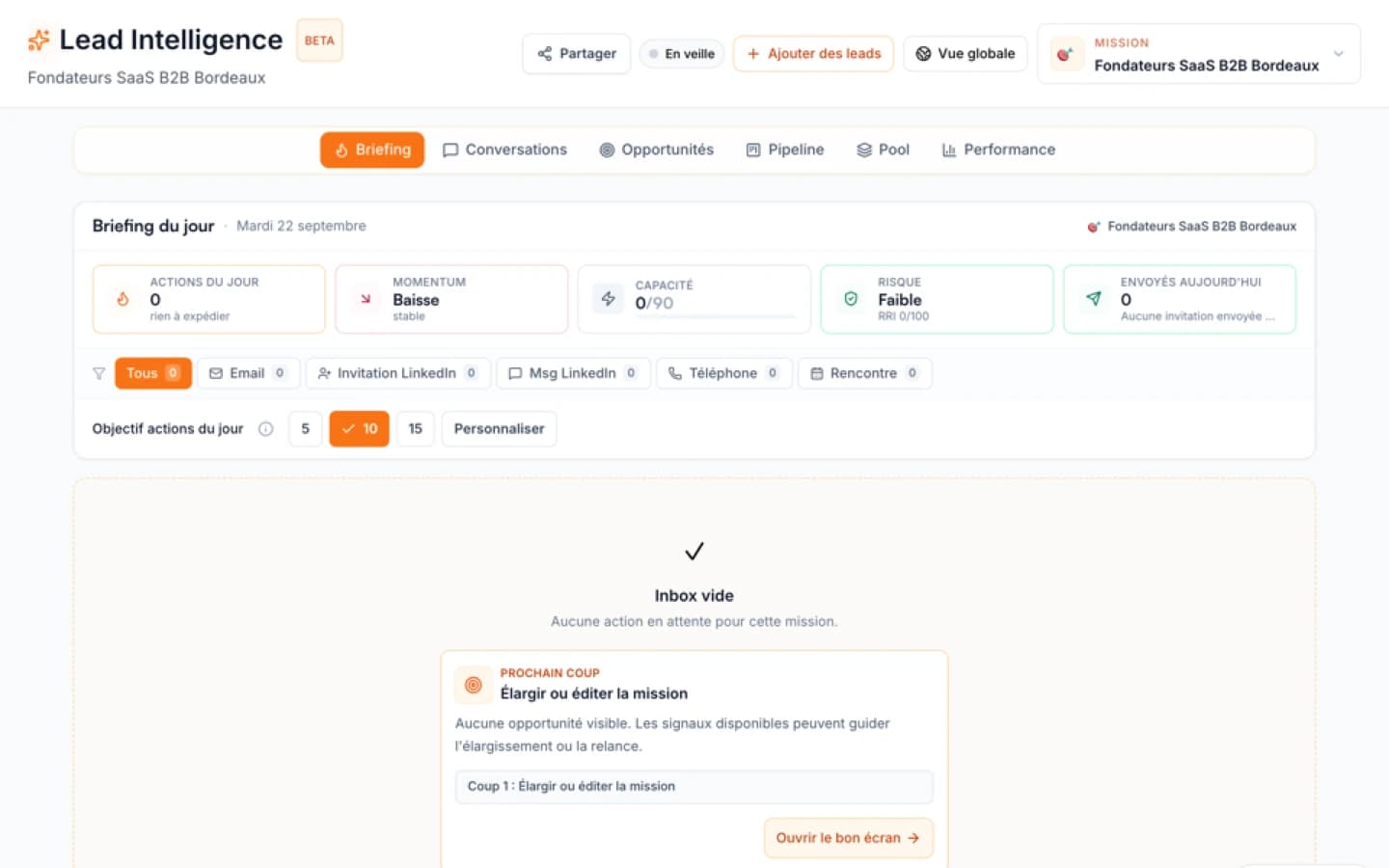
In the early stages of scaling a startup, founders and sales teams often face a choice between raw volume and precise relevance. Traditional sales intelligence platforms have focused heavily on database size. However, relying solely on massive databases presents clear operational challenges for lean sales teams. While these orchestration tools are highly effective for dedicated GTM engineers, they require significant technical setup and constant maintenance. Sales teams do not need more complex databases to manage; they need to know who to contact, why now, and which action to take. This is where the paradigm is changing. Instead of spending hours configuring data pipelines or running generic email sequences that burn domain reputation, modern sales teams require contextual intelligence. This approach shifts the focus from database size to actionable relevance. Ember addresses this need directly through Lead Intelligence, which replaces the noise of raw data with a clear next action: who to contact, why now, which channel, and which angle. By focusing on the underlying context of each opportunity rather than just the contact details, sales teams can execute highly targeted outreach that respects the buyer's current situation and maximizes conversion.
Diagnostic
To successfully transition from founder-led sales to a scalable outbound process, founders and sales teams require reference data that goes beyond basic contact lists. According to the Pipedrive Founder-Led Sales Guide, the challenge in this phase is turning what the founder keeps in their head into shared knowledge and documented processes that the team can repeat. This transition requires a shift from manual, ad hoc prospecting to structured data orchestration. Traditional sales intelligence platforms solve the data access problem by aggregating massive databases. While these massive databases are highly effective for sales teams that require immediate volume and automated email sequences, they often introduce significant noise for early stage startups. A high volume of generic outreach can dilute a company's brand and lead to low conversion rates if the messaging is not highly contextualized. For sales teams focused on precision, the critical requirement is knowing who to contact, why now, and which action to take. The LinkedIn Ultimate Guide to Founder-Led Sales recommends starting with manual outreach and personalised messages, with a narrow Ideal Customer Profile, rather than with volume. Sales teams need reference data that connects signals about companies and people and specific pain points to the startup's unique value proposition. Ember addresses this need through Lead Intelligence, which reuses the Ember Business Plan, Ideal Customer Profile (ICP), offer, and strategy to prepare a sales mission. By grounding the prospecting process in the validated business context of the company, Lead Intelligence provides a clear next action, indicating who to contact, why now, which channel to use, and which angle to take.
Why volume alone is not enough
In the common approach, founders and sales teams are encouraged to buy access to massive contact databases and launch automated email sequences to generate immediate activity. This volume-focused approach has fueled the rapid growth of traditional sales intelligence platforms. While this scale is highly attractive to buyers who prioritize immediate outbound volume, it often fails to address the strategic needs of founder-led sales. This volume-first methodology is incomplete because it mistakes activity for progress. Simply acquiring thousands of cold contacts does not help a founder understand who to contact, why now, and with what message. As The Ultimate Guide to Founder-Led Sales on LinkedIn puts it, early-stage sales call for personalised, tailored conversations rather than generic, automated outreach. When sales teams rely solely on static lists, they lack the context needed to craft a compelling narrative. To move beyond this limitation, founders need reference data that is directly connected to their strategic goals. Instead of treating prospecting as an isolated database search, effective founder-led sales processes reuse the core business plan, Ideal Customer Profile (ICP), offer, and strategy to prepare a highly targeted sales mission. By anchoring the search in the actual strategy of the business, founders and sales teams can identify a clear next action, ensuring they know exactly who to contact, why now, which channel to use, and which angle will resonate most.
What contact databases do not tell you
Standard contact databases provide raw lists, but they fail to answer the critical questions of who to contact, why now, and with what message. Without these answers, sales teams waste time on generic outreach that fails to convert.
The Ultimate Guide to Founder-Led Sales on LinkedIn recommends starting with manual, personalised outreach rather than automated volume. Sales teams need reference data that connects the company's core strategy, Ideal Customer Profile (ICP), and real-time signals.
To bridge this gap, teams require reference data that aligns their strategic foundations with daily execution. This involves utilizing the initial business strategy and offer details to guide prospecting missions.
How the sales mission is prepared
Traditional sales intelligence platforms are highly effective when the primary objective is raw volume. This scale makes such platforms excellent for speed-focused sales leaders who require an immediate database of contacts to kickstart outbound sequences on the same day. The mechanism to solve this relies on aligning strategic context with daily execution. Instead of starting with a cold list of random leads, the process begins by reusing the Ember Business Plan, Ideal Customer Profile (ICP), offer, and strategy to prepare a highly targeted sales mission. To execute this mission, the system searches and imports profiles through LinkedIn or Sales Navigator from a connected account. By analyzing these profiles against the established business context, the mechanism identifies the exact signals that indicate a prospect is ready for a conversation. This context-driven approach allows sales teams to know who to contact, why now, and which action to take. Ultimately, this mechanism provides a clear next action by defining who to contact, why now, which channel, and which angle to use.
Three layers of reference data
In the transition from founder-led sales to scalable outbound operations, sales teams must move away from raw, unsegmented contact lists. Instead, they require reference data that is grounded in the strategic foundation of the company. For instance, the Pipedrive Founder-Led Sales Guide reminds readers that founders know their product and Ideal Customer Profile better than anyone, but that this knowledge must be shared so the wider sales team can act on it.
The second layer of reference data involves real-time professional context. Static databases quickly become obsolete, leading to wasted effort and damaged domain reputation. Sales teams need to capture live signals directly from where professional conversations happen. This live data capture ensures that the team is targeting individuals who are currently active and relevant to the defined mission. The Kixie Founder-Led Sales Strategy Guide points out that a sales campaign is neither sustainable nor reliable without a guiding strategy: an outdated contact list does not replace one.
Finally, the most critical reference data points are those that define the immediate next action. Knowing who to contact is useless without understanding why now, which channel to use, and which angle to take. For example, in a hypothetical scenario, a sales team targeting chief technology officers might receive a signal that a target company has recently launched a new product initiative. This trigger event transforms a cold outreach into a highly contextual conversation. Rather than sending a generic pitch, the sales team can reference this specific change. By structuring these decisions, sales teams can replicate the intuitive, relationship-driven approach of founder-led sales at a much larger scale.
From a personal network to a repeatable system
In the early stages, founders rely on personal networks and manual outreach, but scaling requires a repeatable system. As the guides from Pipedrive and Kixie point out, scaling requires documented processes and a guiding strategy; without them, sales representatives risk wasting time on cold, unverified leads. Without this foundation, teams often default to buying massive contact lists, which quickly leads to operational friction.
Many scaling teams turn to volume-oriented platforms, but this has a cost: unnecessary noise and budget drained by unaligned exports. This diagnosis is highly useful when a team wants to assess whether their current data provider produces that noise.
Instead of relying on raw, unsegmented databases, founders and sales teams need reference data that answers three core questions: who to contact, why now, and with what message. According to the LinkedIn guide, the founder is the product in the early stages, so the founder's unique context is what must be passed on to the sales team. Ember Lead Intelligence addresses this gap by reusing the company's validated Business Plan, Ideal Customer Profile (ICP), and core strategy to prepare sales missions. By aligning outbound efforts with strategic reference data, Lead Intelligence provides a clear next action, defining who to contact, why now, which channel to use, and which angle to take to maximize conversion.
When this approach is not the right fit
If your primary objective is to execute high-volume, unsegmented email blasts where personalized context and precise timing are secondary to sheer outreach numbers, traditional database platforms are more suitable. For example, platforms designed for rapid, mass-scale outbound prospecting are highly effective when volume is the only metric that matters. If your sales strategy relies entirely on saturating a broad market with generic messaging, a specialized tool focused on deep context is unnecessary.
Additionally, this structured, context-grounded methodology is not ideal for teams that prefer a credit-metered operational model. If your team is comfortable navigating these metered credit calculations and the associated risk of bounced emails or wasted exports, then a system that prioritizes pre-validated, context-rich opportunities may not be required.
Finally, founders who are in the absolute infancy of their founder-led sales journey, perhaps contacting only a handful of warm personal connections or design partners within their immediate professional network, do not yet need a structured intelligence system. At this micro-stage, manual tracking and direct, personal emails are entirely sufficient. As the Pipedrive guide on founder-led sales notes, this kind of selling works first because the founder knows their product and Ideal Customer Profile better than anyone. Implementing a dedicated context-driven system like Lead Intelligence only becomes necessary when you need to transition from these initial warm relationships to a repeatable, scalable outbound process where you must know exactly who to contact, why now, and which action to take.
From founder intuition to a repeatable process
To successfully scale beyond early founder-led sales, sales teams must transition from relying on raw contact lists to leveraging structured reference data. According to The Ultimate Guide to Founder-Led Sales, where the founder is described as the product, the initial phase of sales relies heavily on the founder's personal context and deep understanding of the product's value proposition. As teams scale, maintaining this level of personalization requires reference data that directly connects the company's strategic foundation to daily outreach.
While high-volume database tools are useful for pure outreach capacity, they often lack the strategic alignment needed for high-conversion sales. For scaling teams, the next step is not simply acquiring more contacts, but structuring their Ideal Customer Profile (ICP) and strategic goals into actionable insights, a need that Pipedrive's founder-led sales guide describes as moving the founder's knowledge into shared processes.
This is where integrating strategic context becomes the primary lever for growth. By aligning your business plan and target signals, sales teams can determine exactly who to contact, why now, and which action to take. For teams looking to operationalize this strategy, Ember's Lead Intelligence bridges the gap between high-level strategy and daily execution. This systematic approach transforms founder-led intuition into a repeatable, context-driven sales engine that empowers your entire sales team.
The sources behind the method
Understanding who to contact, why now, and with what message requires aligning strategic company data with real-time market signals. The foundational methodology for scaling founder-led sales is drawn from comprehensive industry guides. Insights on structuring early-stage sales pipelines and transitioning to repeatable systems are sourced from The Ultimate Guide to Founder-Led Sales and the tactical frameworks outlined in the Pipedrive Founder-Led Sales Guide. Additionally, the operational challenges of scaling outreach without losing the founder's personal touch are analyzed through the strategic recommendations found in the Kixie Sales Blog. To contrast context-driven sales intelligence with traditional high-volume database approaches, we examine market data from established providers. In contrast to unsegmented volume, Ember uses a context-grounded methodology. This integration ensures that sales teams can identify exactly who to contact, why now, and which action to take, translating raw market signals into a clear next action with a specific channel and angle.
Sources
FAQ
Free diagnostic
Test your sales file
Drop an Excel or CSV and check its readiness without sending its rows to Ember.