
Definition
Lead scoring is a method used by sales teams to rank prospects based on their likelihood to convert. In a traditional setup, marketing teams assign points for behaviours like visiting a pricing page or downloading an ebook, then pass the highest-scoring leads to sales as "marketing qualified leads" (MQLs). When you have no marketing team, you have to build your own scoring system, often manually in a CRM or spreadsheet, using whatever data you can find about a company and its people.
This article covers how to prioritise B2B leads when you don't have a marketing team generating MQLs, and compares the classic point-based approach with a newer context-based method that focuses on the next action rather than a numerical score.
To place this decision in context, the Knowledge guides for sales brings together deeper guidance on the same field.
Why this category exists
Sales teams with an existing contact list often face the same problem: they have too many names and not enough clarity on which one to call today. A CRM stores contacts, but it doesn't tell you why a specific person became a better opportunity this week. Without a marketing team to filter and score, salespeople end up hunting manually, checking LinkedIn, news, and email opens, and still risk missing the best conversations.
The need for lead scoring exists because attention is the scarcest resource in B2B sales. A prioritisation system that fits a team without marketing should answer three questions: who to contact, why now, and with which message. Classic point-based scoring often fails on the "why now" part because it's static and doesn't incorporate recent signals source. The stakes are measurable: in RAIN Group's Top Performance in Sales Prospecting study, top-performing sellers achieve 2.7x more conversions than the rest, mostly through better targeting and preparation before outreach source.
How it works
In a traditional lead-scoring model, you assign fixed points to attributes (job title, company size, industry) and behaviours (website visits, email clicks). The sum gives a score, and you follow up on leads above a threshold. This works when marketing can feed consistent data, but it's time-consuming to set up and maintain source.
In a context-based approach, the system doesn't just calculate a score, it reasons about the person's situation. You start with your ideal customer profile and your offer. Then the system finds accounts that match, monitors signals (job changes, funding rounds, new product launches), and prioritises the ones where a conversation is timely. The output is not a number but a specific next action: "Contact Jane Smith at Acme Corp via LinkedIn; she just became VP of Sales and your solution matches her new mandate."
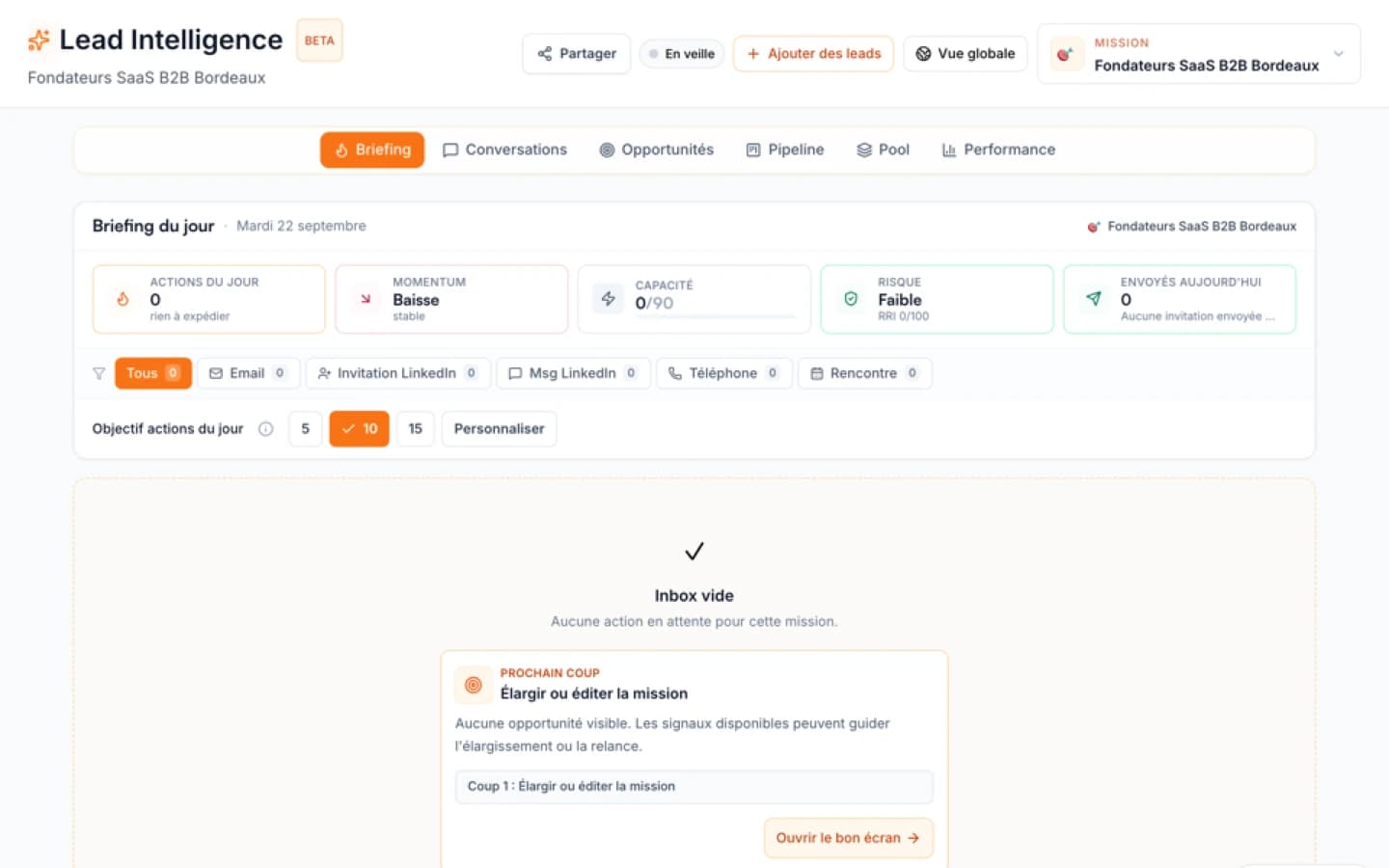
Ember's Lead Intelligence follows this context-based model. It reuses your Business Plan, ICP, and strategy to define a sales mission, then discovers and prioritises leads automatically. The first prioritised leads arrive from that first mission, once the research and analysis complete.
To explore this point further, Build a B2B Prospect List from Zero, Without Customers or a Brand details a step directly related to this decision.
Difference from the classic approach
Classic lead scoring is typically static, point-based, and relies on past behaviour and explicit demographic data. It assumes that a high score today means a high priority tomorrow, but it doesn't adapt to changes unless you manually update the rules. MQLs themselves have been criticised for being a flawed metric because they often measure engagement rather than buying intent source.
Context-based prioritisation, by contrast, is dynamic. It factors in new signals continuously, considers the relationship between the company and your offer, and produces a clear next action. It doesn't require a marketing team to maintain it, the system does the research and analysis. The tradeoff is that you need to invest time upfront to define your ICP and strategy, and you must be comfortable with a system that prioritises rather than just stores contacts.
Concrete example
Imagine you run a small SaaS company selling compliance software to fintech startups. You have 500 contacts in a spreadsheet, names from LinkedIn, conference badges, and old trial signups. You have no marketing team to score them.
With classic lead scoring, you might give +10 points for "CTO" title, +5 for "company size › 50", and +3 for "opened email last month". You sort by score and start calling the top names. But you might miss the real opportunity: a VP of Engineering at a 40-person startup who just got promoted to CTO, posted about PCI compliance, and whose company just raised a Series A. That person has a high contextual priority but a low classic score because the company size is below 50.
With context-based prioritisation, the system would catch the promotion, the funding round, and the public interest in compliance. It would surface that VP as a high-priority lead and suggest contacting them via LinkedIn with a message about your solution's compliance automation. The classic approach would leave that lead buried.
This approach also connects with Inbound or Outbound? A One-Motion Test for Small B2B Teams, which clarifies the next choice.
Limits
Context-based prioritisation is not a silver bullet. It requires a well-defined ICP and a clear offer to work well. If your targeting is vague, the system will produce vague priorities. It also depends on the quality of signals available, if your industry is private or your ideal customer doesn't generate much public activity, the system will have less data to work with.
For teams that need simple contact storage, basic enrichment, or bulk campaign execution, a CRM or prospecting tool is often enough. Context-based prioritisation adds value when you have more contacts than you can follow up and you need to decide who to contact now, not just store and filter.
When to use it
Use context-based lead prioritisation when:
- You have more contacts in your pipeline than you can realistically follow up with.
- You lack a marketing team to generate MQLs or manage a lead scoring system.
- Your sales team spends noticeable time deciding who to call instead of actually calling.
- You need to adapt quickly to market changes, new fundings, job moves, product launches at your target accounts.
A team that operates with a defined ICP and a clear sales process will benefit most. The system acts as a decision support layer, saving time and increasing the likelihood of landing the right conversation.
In practice, How to Prioritise Lead Conversations: A Practical Guide for Sales Teams and Founders completes this framework with another angle on the same topic.
When not to use it
Context-based prioritisation is not a replacement for a CRM. You still need a place to store contact history, manage deals, and track relationships. If your team only has a handful of leads and can easily manage them manually, adding a prioritisation layer may be overkill.
Also, if your sales process relies on high-volume outreach with minimal personalisation (e.g., cold email blasts to thousands), then speed and list size matter more than signal-based prioritisation. In that case, a classic prospecting tool with bulk enrichment may be a better fit.
Honest relationship to Ember
Ember offers a product called Lead Intelligence that implements context-based lead prioritisation as described in this article. It uses the project context from your Business Plan, ICP, and strategy to define a sales mission, then automatically discovers and prioritises leads. It provides a clear next action for each prioritised lead: who to contact, why now, which channel, and which angle.
Lead Intelligence is designed for founders and sales teams who have enough contacts but need help choosing the priority. It doesn't require a marketing team, and it starts producing prioritised leads from the very first mission with usable targeting context. It is not a CRM, it's a prioritisation layer that works alongside your existing tools.
If your team has plenty of names but struggles to choose the next conversation, Ember's approach may be worth evaluating. Define your ICP and prioritisation criteria first, then compare tools that fit that model.
Before deciding, The Ember Brief #01 - Stop stacking sales frameworks. Pick the one that fits your deal size. helps connect this method with adjacent priorities.
Sources and methodology
- 7 Effective Tips For B2B Lead Scoring Examples, used for classic lead scoring mechanics.
- Why the MQL is still flawed in B2B marketing, used for critique of MQLs.
- How to score & prioritize accounts & leads in B2B, used for difference between static and dynamic scoring.
| Criteria | A fixed point score | Ember |
|---|---|---|
| Current information | Ranks by a chosen set of points for attributes or actions | Helps founders and sales teams prioritise opportunities with their context. |
| Before choosing | Check whether the weights still reflect buyer behaviour | Review the reason attached to each suggested opportunity |
Sources
FAQ
Free diagnostic
Test your sales file
Drop an Excel or CSV and check its readiness without sending its rows to Ember.