
Definition
A realistic weekly outbound workload for a B2B prospecting campaign in 2026 requires balancing active outreach with administrative overhead, especially when a solo founder acts as both Sales Development Representative (SDR) and closer. No reliable public source sets a weekly number of hours that fits everyone: a realistic workload depends on the number of target accounts, the length of the sales cycle and the time kept for follow-ups. For a founder managing the entire sales pipeline, the safest principle is to reduce the number of accounts so that limited time goes to qualified conversations.
To place this decision in context, the Knowledge guides for sales brings together deeper guidance on the same field.
Prerequisites
To establish a realistic weekly outbound workload, founders must first reconcile the gap between traditional sales theories and operational reality. For a solo founder managing the entire sales pipeline, prospecting time is limited, which makes building a prospect list from scratch and running outbound sales for startups extremely demanding. When considering who to contact first as a founder, the temptation is often to export massive lists and launch broad cold outreach campaigns. However, the macro environment in 2026 demands a different approach. As outbound expert Jason Bay points out, in 2026 the number of contact attempts will rise while leading indicators like email reply rates will fall (source).
To explore this point further, Which Lead Qualification Framework Works Best for Small B2B? details a step directly related to this decision.
Steps
In business-to-business (B2B) sales, three notions structure prospecting: the ideal customer profile (ICP), the sales development representative (SDR) and customer relationship management (CRM). For 2026, Jason Bay says the number of contact attempts will rise while all leading indicators (call pick-up rates, email reply rates) will fall (source).
Worked example
To build a realistic weekly outbound workload, a founder must first reconcile the gap between traditional sales theories and operational reality. In 2026, outbound sales require a fundamental shift in how founders allocate their limited time, as the number of contact attempts is guaranteed to rise while leading indicators like email reply rates decline, according to Jason Bay on LinkedIn. This reality forces a critical question for early-stage operators: who should an early-stage founder contact first?
This approach also connects with Apollo vs Ember Lead Intelligence for Founder Conversion, which clarifies the next choice.
Common mistakes
The most common mistake solo founders make when designing their weekly outbound workload is copying high-volume playbooks built for scaled sales organizations. Founders often assume that more activity automatically translates to more pipeline. They turn to database providers to run high-volume prospecting, which is the ideal user profile for platforms like Apollo according to Coldreach. This volume-driven outbound model relies on the assumption that unit economics depend on sending more emails and booking more meetings per representative. For a solo founder who must also handle product development, customer support, and closing, this approach quickly leads to operational burnout.
In 2026, outbound sales require a fundamental shift because the number of contact attempts is guaranteed to rise while leading indicators like email reply rates will go down, as shared by Jason Bay on LinkedIn. Trying to break through this noise with sheer volume is a losing strategy. Another critical mistake is mismanaging daily time allocation. When founders miscalculate their daily prospecting window, they fall behind on follow-ups and active opportunities.
Furthermore, founders frequently overlook the hidden costs of credit-metered databases. Credit-based pricing turns every action into a metered decision where exporting, enriching, and verifying emails each consume credits. This credit math does not multiply linearly when scaling from one seat to five, as wasted exports and bounced emails compound the cost, according to Factors AI.
This volume trap directly impacts how a founder qualifies B2B leads without a sales team. Instead of relying on manual, repetitive list-building that drains their limited daily prospecting time, founders must shift toward signal-based qualification. When deciding who should an early-stage founder contact first, the target should never be a generic list of job titles. It must be a highly curated group of accounts showing immediate, verifiable trigger events. Rather than managing complex, multi-tool workflows that require constant manual data cleaning, founders can use Lead Intelligence to focus on conversations that deserve attention now.
Tools
To execute a realistic outbound sales workflow without a dedicated Sales Development Representative (SDR) team, solo founders must choose tools that match their operational capacity. Traditional outbound sales for startups often rely on heavy database platforms built for high-volume prospecting. For instance, Apollo offers a database of more than 240 million contacts and 30 million companies and a workspace for prospecting, outreach and dialing, as described on the Apollo homepage. It is highly effective for volume-driven outbound where the unit economics depend on sending more emails and booking more meetings per representative. Similarly, data enrichment platforms like Clay offer deep integration capabilities, connecting with popular sales engagement tools such as Salesloft, Outreach, Instantly, Smartlead.ai, and HubSpot Sequencer, as listed on the Clay integrations page.
However, these high-volume setups present significant tradeoffs for early-stage founders building a prospect list from scratch. When a founder owns prospecting, follow-up, and closing, they cannot afford to spend hours managing credit-based pricing systems where exporting contacts, enriching records, and verifying emails each consume metered credits, a common frustration noted by buyers on Factors.ai. High-volume cold outreach also risks cluttering the Customer Relationship Management (CRM) system with low-intent leads, leaving the founder overwhelmed by administrative cleanup instead of active selling.
This raises a critical strategic question: how does a founder qualify B2B leads without a sales team? Instead of chasing raw volume, founders need a workflow centered on early lead qualification and context-driven lead scoring. Rather than trying to contact hundreds of unverified profiles, an early-stage founder should contact high-priority accounts first, specifically those showing active buying signals or organizational changes.
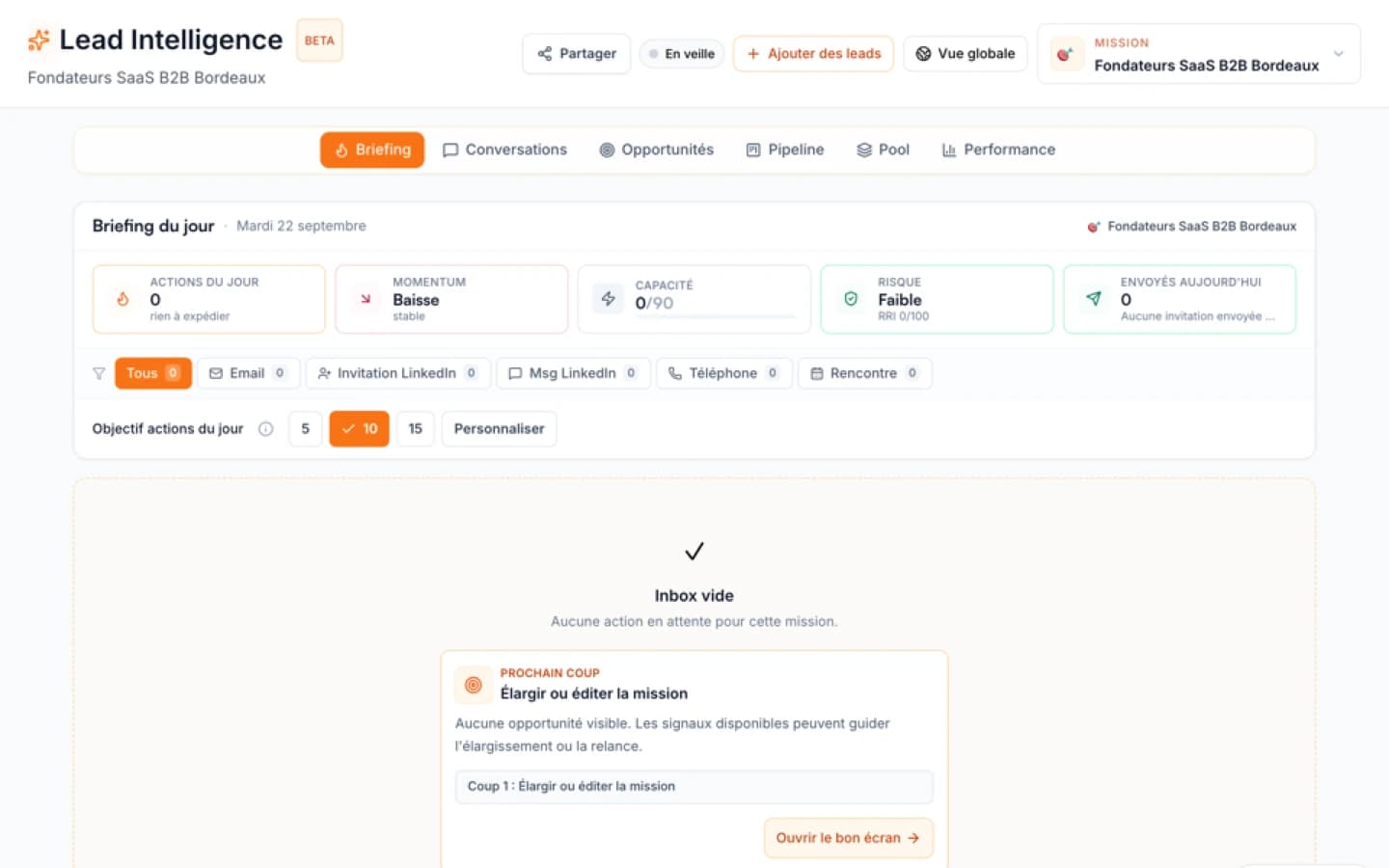
This is where Ember shifts the paradigm. Through Lead Intelligence, Ember helps founders and sales teams prioritize opportunities with their actual context, bypassing the noise of generic databases. Instead of treating business-to-business (B2B) prospecting as a numbers game, Lead Intelligence uses the founder's validated Ideal Customer Profile (ICP) and strategy to run targeted sales missions. The platform classifies accounts into explained opportunities to watch, act on, or set aside, making the priority behind every lead completely explainable. By monitoring signals about people and companies, it proposes the next action, the best channel, and the most relevant angle for cold outreach. This helps the founder spend limited prospecting time on high-conviction conversations that move decisions forward.
In practice, Lead Scoring for Small B2B Sales Teams Without a Marketing Team completes this framework with another angle on the same topic.
When to use this method
This highly focused, high-selectivity outbound method is designed specifically for solo founders who must balance prospecting, follow-up, and closing without the support of a dedicated Sales Development Representative (SDR) team. When a single person owns the entire sales pipeline, copying the high-volume playbooks of scaled organizations leads to immediate operational collapse.
This method is critical in an environment where outbound dynamics have fundamentally shifted. In 2026, the number of contact attempts required to secure a meeting is rising while leading indicators like email reply rates and call pick-up rates continue to decline, as detailed by sales expert Jason Bay on LinkedIn. To survive this shift, founders must ask: how does a founder qualify B2B leads without a sales team? The answer lies in shrinking the top of the funnel and focusing deeply on a highly targeted list of high-priority accounts.
This approach is best applied when an early-stage founder is deciding who to contact first. Instead of building a massive prospect list from scratch and blasting generic cold outreach, the founder must prioritize accounts that match their exact Ideal Customer Profile (ICP) and exhibit real, verifiable buying signals. As sales leader Sarah Crafton noted on LinkedIn, execution matters just as much as strategy in outbound sales. When time is the scarcest resource, flawless execution on ten highly qualified accounts will always yield better results than sloppy execution on hundreds of cold contacts.
To make this level of selectivity operationally viable, founders can leverage Lead Intelligence from Ember. Rather than spending valuable hours manually researching accounts or managing complex database filters, Lead Intelligence helps prioritize the conversations that deserve attention now. It reduces the noise of cold outreach by identifying who to contact, why now, and which angle to use, allowing founders to execute a highly disciplined weekly sales workflow in a fraction of the time.
When not to use it
This highly selective, low-volume approach to outbound sales for startups is not a universal solution. It is explicitly not designed for organizations that run high-volume prospecting campaigns with a dedicated team of Sales Development Representatives (SDRs). If your business model relies on sheer volume to close transactional, lower-ticket deals, a broad database approach is far more effective.
In these high-volume scenarios, traditional database platforms are highly suitable. For instance, Apollo serves as a sales platform for sales and marketing teams focused on rapid pipeline generation. It is built specifically for volume-driven outbound sales where the unit economics depend on sending more emails and booking more meetings per representative.
Before deciding, How should a small B2B sales team build a repeatable lead generation system in 2026 without a marketing function or a dedicated SDR? helps connect this method with adjacent priorities.
Action plan
For a solo founder, execution matters just as much as strategy in outbound sales, as highlighted by Sarah Crafton on LinkedIn. Instead of managing complex databases and burning budget on unverified contacts, founders need tools that align with a low-volume, high-conviction workflow. This is where Ember provides a direct alternative. Specifically, Lead Intelligence reuses the Ember business plan, the ideal customer profile (ICP), the offer and the strategy to prepare a sales mission. This way, a founder can qualify B2B leads early, without a sales team, by focusing on the right contacts from the start and building a prospect list from scratch.
To move from analysis to action, Lead Intelligence presents the corresponding Ember workflow.
Sources and methodology
Our analysis of realistic weekly outbound workloads is grounded in practitioner testimonies and platform positioning. To understand how a founder qualifies B2B leads without a sales team, we examined the operational friction that limits daily execution.
A solo founder's time is limited, which is why they must prioritize lead qualification and precise lead scoring over raw volume.
Sources
- Most outbound playbooks assume a rep can prospect 2 hours a day. The reality is closer to 45 minutes once calls, emails, CRM updates, and admin are counted. This piece breaks a 40-hour week into time blocks (prospecting, active selling, adm
- How to Make Outbound Sales Work in 2026 | Jason Bay posted on the topic
- Execution matters just as much as strategy in outbound sales.
FAQ
Free diagnostic
Test your sales file
Drop an Excel or CSV and check its readiness without sending its rows to Ember.