
Symptom or signal
Symptom or signal
A prospect visits the pricing page, downloads a guide or likes a post. The activity is visible, but it does not yet prove a buying project. A useful buying signal changes the probability of a real sales conversation because it connects an observable event to the account's fit, a current problem and a plausible decision path.
A vanity signal records attention without enough context to support action. The event may be real, but the commercial interpretation is weak. A page view can come from a student, competitor, existing customer or employee. A new executive can have no mandate related to your offer. The distinction therefore lies in the evidence around the event, not in the event label.
What changed
What changed
Sales teams can now observe more digital activity than they can responsibly interpret. The operational problem is no longer simply finding events. It is deciding which events matter for a particular account.
INFUSE describes B2B qualification as a combination of genuine interest and fit with the ideal customer profile. Its guide also recommends looking across the buying group instead of reducing the account to one contact. Highspot lists several useful categories, including comparison research, engagement spikes, new stakeholders, pricing questions, product usage and organisational change.
These categories are starting points, not automatic verdicts. A label such as "pricing visit" or "new executive" still needs account context and verification.
Facts and sources
Separate published facts, internal observations and assumptions. Keep a link for every external fact and a defined scope for every internal observation. An assumption remains explicitly revisable and never becomes a general promise.
Why the common explanation is incomplete
The common shortcut says that visible engagement equals intent. That confuses observation with interpretation.
An explicit request can be strong because the buyer states a need. An implicit event is more ambiguous. A pricing visit may support a buying hypothesis, but only if the account fits, the visit is recent and other evidence points toward evaluation. Without that context, the salesperson knows that something happened, not why it happened.
The reverse mistake is also possible. A quiet account can still be important when an executive change, a public initiative and a relevant hiring pattern converge. Low digital engagement does not prove low need when the buying process happens through other channels.
The real problem
Decision criteria
Test every signal with four questions:
- Fit: Is the account inside the ideal customer profile, and is the person connected to the problem?
- Specificity: Does the event reveal a problem, project, constraint or evaluation step relevant to the offer?
- Recency: Is the information fresh enough to justify action now?
- Corroboration: Is there a second independent fact, another stakeholder or a direct statement that supports the same interpretation?
One weak answer does not automatically disqualify the account. It lowers confidence and changes the next action. A low-confidence signal calls for research or a neutral question. A high-confidence signal can justify timely, specific outreach.
How the mechanism works
How the mechanism works
Use a five-step evidence loop.
- Record the observation without interpretation. Write "two people from the account viewed the implementation guide this week," not "the account is ready to buy."
- Map it to the commercial hypothesis. Name the problem your offer solves and the role likely to own it.
- Check fit and freshness. Confirm company profile, responsibility and event date.
- Seek corroboration. Look for a second stakeholder, a public project, a relevant change or a direct question.
- Choose a proportionate next action. Research when confidence is low, ask a neutral question when it is medium, and propose a concrete next step when it is high.
After contact, record the outcome. A reply that confirms the problem strengthens the pattern. A correction or rejection should change future scoring. This feedback matters more than adding another untested signal source.
Concrete examples
Concrete examples
Pricing page visit: One anonymous visit is weak. Repeated visits from a fitting account, followed by a question about security or implementation from a relevant role, form a stronger buying hypothesis.
Leadership change: A new sales leader is only context. Confidence rises when the company also publishes a related mandate, recruits for the affected team or evaluates tools connected to that mandate.
Content download: One download can be educational curiosity. Several stakeholders consuming comparison and implementation material in a short period suggests an account-level evaluation, but still requires a respectful verification question.
Product trial: Registration alone is weak. Repeated use of a capability tied to the account's stated problem, combined with an invitation to colleagues or a question about rollout, is more actionable.
None of these examples guarantees a purchase. They determine the quality and urgency of the next test.
When to use this diagnosis
When to use this diagnosis
Use the framework when the team has more possible accounts than it can investigate well, when alerts create frequent false positives or when representatives disagree about what deserves immediate attention. It is also useful before building a scoring model because it forces each signal to have an owner, an interpretation rule and a next action.
The framework does not remove human judgment. Review the evidence attached to an opportunity and keep an absence of signal visible.
When not to use it
When not to use it
Do not delay an explicit request while waiting for more signals. A prospect who asks for pricing, security documentation or a meeting has already supplied direct evidence. Respond to the request and use the framework to prepare the conversation.
Do not use hidden or unlawfully obtained personal data. A commercially useful signal must still respect consent, contractual permissions and applicable privacy rules. Do not turn a weak observation into invasive personalisation.
Finally, do not add complexity when the team cannot act on the result. If every account receives the same generic sequence, a sophisticated score will not improve the conversation. Fix the response playbook first.
Limits
The cited guides are written by commercial vendors. They provide useful categories and operating methods, but they do not establish a universal conversion rate for every market.
Signal visibility is always incomplete. Private conversations, procurement constraints and internal politics may be invisible. Data can also be stale or attached to the wrong person. Treat every score as a prioritisation hypothesis, not a fact about the buyer's intent.
Next step
Next step
Take ten recent opportunities and rewrite each signal as a neutral observation. Score the four criteria as strong, uncertain or weak. For every account, choose one action: research, verify, contact or wait. Then compare the decision with the actual reply or outcome one week later.
For a reusable review, apply the Defensible B2B Lead Qualification Framework for Small Sales. To make the decisions visible over time, add them to the Structure a Weekly Outbound Review for Small B2B Sales Teams.
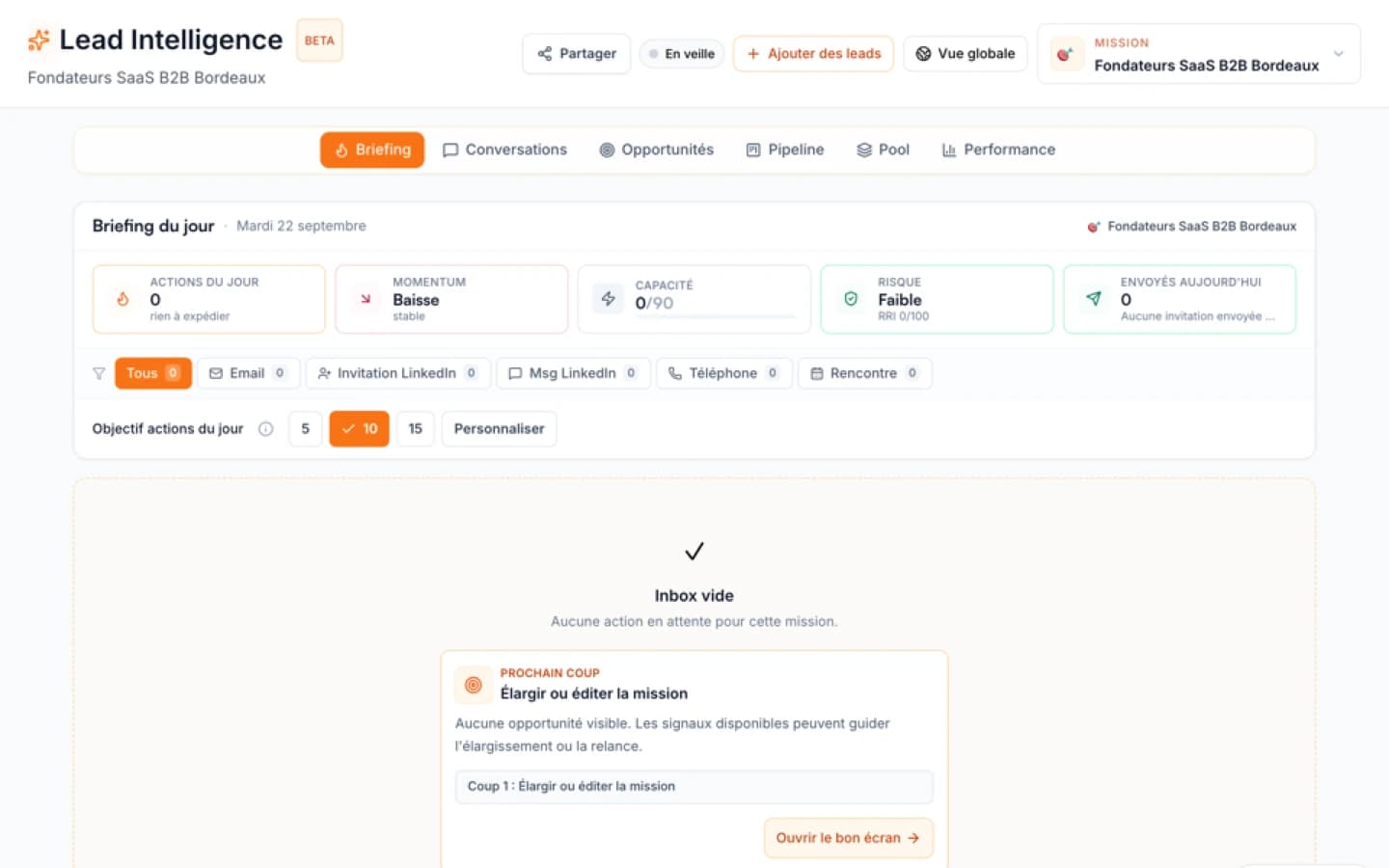
In Ember, Lead Intelligence prioritises opportunities from the available context. It classifies accounts into explained opportunities to watch, act on or set aside. It proposes the next action and channel that fit the lead situation. These capabilities support a review, but do not prove intent, consent, budget or an outcome.
Sources and methodology
External sources frame facts and limitations rather than promise a universal result. Recommendations are editorial analysis. Assumptions, unknowns and revision conditions remain visible throughout the article.
- INFUSE guide to generating qualified B2B leads
- Highspot guide to B2B buying signals
- Salesmotion buying signals guide
| Criterion | Stronger buying signal | Vanity or weak signal |
|---|---|---|
| Account fit | Account and role match the defined problem | Activity comes from an unknown or irrelevant profile |
| Specificity | Event points to a project, constraint or evaluation | Event only records generic attention |
| Recency | Information is current enough to affect timing | Event is stale or undated |
| Corroboration | A second fact or stakeholder supports the hypothesis | One isolated event carries the whole conclusion |
| Next action | Specific research, verification or outreach | Generic sequence sent without checking context |
| Learning | Outcome updates future interpretation | Score remains unchanged after rejection or correction |
Sources
FAQ
Free diagnostic
Test your sales file
Drop an Excel or CSV and check its readiness without sending its rows to Ember.