
Symptom or signal
Early stage founders often find themselves staring at massive databases of cold contacts without a clear starting point. They waste critical hours trying to figure out who to contact, why they should reach out now, and which message will actually resonate. Traditional platforms focus heavily on database volume. For instance, Apollo promotes “one connected GTM system” on its homepage. Apollo reported 150 million dollars in annual recurring revenue in 2025, with a valuation of 1.6 billion dollars and about 250 million dollars of total funding, as documented by Apollo (company history and Series D announcement). Their unlimited email plans remain subject to a Fair Use Policy according to Apollo pricing, and they often leave small teams drowning in data noise rather than finding high-intent opportunities. For a founder seeking qualified introductions, the real signal is not the size of the database, but the relevance of the connection. This is where Lead Intelligence changes the approach. The system reduces the noise of outbound prospecting by transforming raw data into a clear next action. It helps founders know exactly who to contact, why now, and which action to take. Rather than sending generic sequences, the platform proposes the next action and channel that fit the lead situation, giving founders a precise angle for every single conversation. This allows early stage founders to focus on high-value relationships, as highlighted in the Lead Intelligence use cases for bootstrapped founders.
To place this decision in context, the Knowledge guides for sales brings together deeper guidance on the same field.
What changed
For early stage founders, the traditional approach to outbound sales often feels like a brute force exercise in database filtering. Established platforms are highly effective when you have dedicated sales operations teams to manage complex workflows and clean raw data. For example, Apollo promotes “one connected GTM system”, as shown on the Apollo homepage. According to Apollo (company history and Series D announcement), Apollo generated $150M in annual recurring revenue in 2025, reached a $1.6B valuation in 2023 and has raised about $250M in total funding.
Facts and sources
To understand how Lead Intelligence operates, it is helpful to look at the broader market context of business data. Traditional sales platforms focus heavily on database volume and stack consolidation. For example, Apollo promotes “one connected GTM system”, as shown on the Apollo Homepage. According to Apollo, it declared 150 million dollars in annual recurring revenue in 2025, with a valuation of 1.6 billion dollars and about 250 million dollars of total funding (company history and Series D announcement). However, navigating these massive databases often requires dedicated sales operations, and even unlimited plans remain subject to a Fair Use Policy where unlimited email credits are framed by credit limits, as detailed on the Apollo Pricing Page. For early stage founders, especially those exploring bootstrapped use cases as discussed in the Lead Intelligence use cases for bootstrapped founders, the priority is not scraping thousands of cold profiles but securing qualified introductions. Lead Intelligence addresses this by shifting the focus from volume to context. The system finds accounts from the mission Ideal Customer Profile (ICP) and signals, then verifies useful sources. This approach ensures that founders know exactly who to contact, why now, and which action to take. By analyzing these signals, the platform proposes the next action and channel that fit the lead situation, giving founders a clear next action that outlines who to contact, why now, which channel to use, and which angle to take.
To explore this point further, Clay vs Ember: Which GTM Tool Wins for Your Team? 2026 details a step directly related to this decision.
Why the common explanation is incomplete
The common explanation of outbound sales suggests that success is purely a numbers game. This perspective argues that if you load enough contacts into an automated sequence, you will eventually secure qualified introductions. However, this explanation is incomplete because it mistakes data volume for actual market readiness. For early stage founders, relying solely on massive databases often leads to high noise and low conversion rates. Large scale platforms are built to support this high volume approach. According to data from Apollo (company history and Series D announcement), Apollo declared 150 million dollars in annual recurring revenue in 2025, with a valuation of 1.6 billion dollars and about 250 million dollars of total funding. This volume based credit model often forces founders into a cycle of bulk emailing where unlimited plans remain subject to a fair use policy, as outlined on the Apollo pricing page. Similarly, advanced data enrichment tools allow teams to build highly customized workflows. For example, Clay provides an official LinkedIn Sales Navigator data point integration for lead discovery and connection insights, as detailed on the Clay integrations page. While these integrations are excellent for dedicated sales operations teams who have the time to orchestrate complex setups, they require significant manual effort to keep the data useful. The real challenge for a founder is not finding more names, but knowing who to contact, why now, and which action to take. When you lack a dedicated sales team, you cannot afford to spend hours filtering raw lists. This is why the traditional explanation falls short: it focuses on the pipeline infrastructure rather than the immediate context of the conversation. Ember changes this dynamic by focusing on relevance over raw volume. Instead of leaving you to decipher which leads are warm, it proposes the next action and channel that fit the lead situation. This approach provides a clear next action, helping you understand who to contact, why now, which channel to use, and which angle to take to secure meaningful introductions. More insights on how this helps lean teams can be found in the guide on Lead Intelligence use cases for bootstrapped founders.
The real problem
For early stage founders, the fundamental challenge of outbound sales is not a lack of data, but a lack of time. When you are trying to secure your first qualified introductions, spending hours filtering through massive databases is a costly distraction from refining your product and speaking with active prospects. Established database platforms are highly effective when you have dedicated sales operations teams to manage complex workflows and clean raw data. For instance, Apollo, which declared 150 million dollars in annual recurring revenue in 2025 according to Apollo, promotes “one connected GTM system”. However, managing these massive volumes requires significant effort, and even their unlimited plans remain subject to a fair use policy with specific credit limits, as outlined on the Apollo pricing page. Similarly, highly customizable tools like Clay offer deep technical integrations, such as their official LinkedIn Sales Navigator data point integration detailed on the Clay Sales Navigator integration page, but these require founders to build their own data enrichment recipes from scratch. As a founder, you do not need more raw data. You need to know who to contact, why they should care right now, and what specific message will resonate. This is where Lead Intelligence by Ember changes the approach. By focusing on relevance over raw volume, the platform proposes the next action and channel that fit the lead situation. This gives you a clear next action: who to contact, why now, which channel, and which angle to use, allowing you to secure qualified introductions without the operational overhead. Founders can explore real world applications of this approach in the Lead Intelligence use cases for bootstrapped founders.
This approach also connects with Apollo vs Ember Lead Intelligence for Founder Conversion, which clarifies the next choice.
How the mechanism works
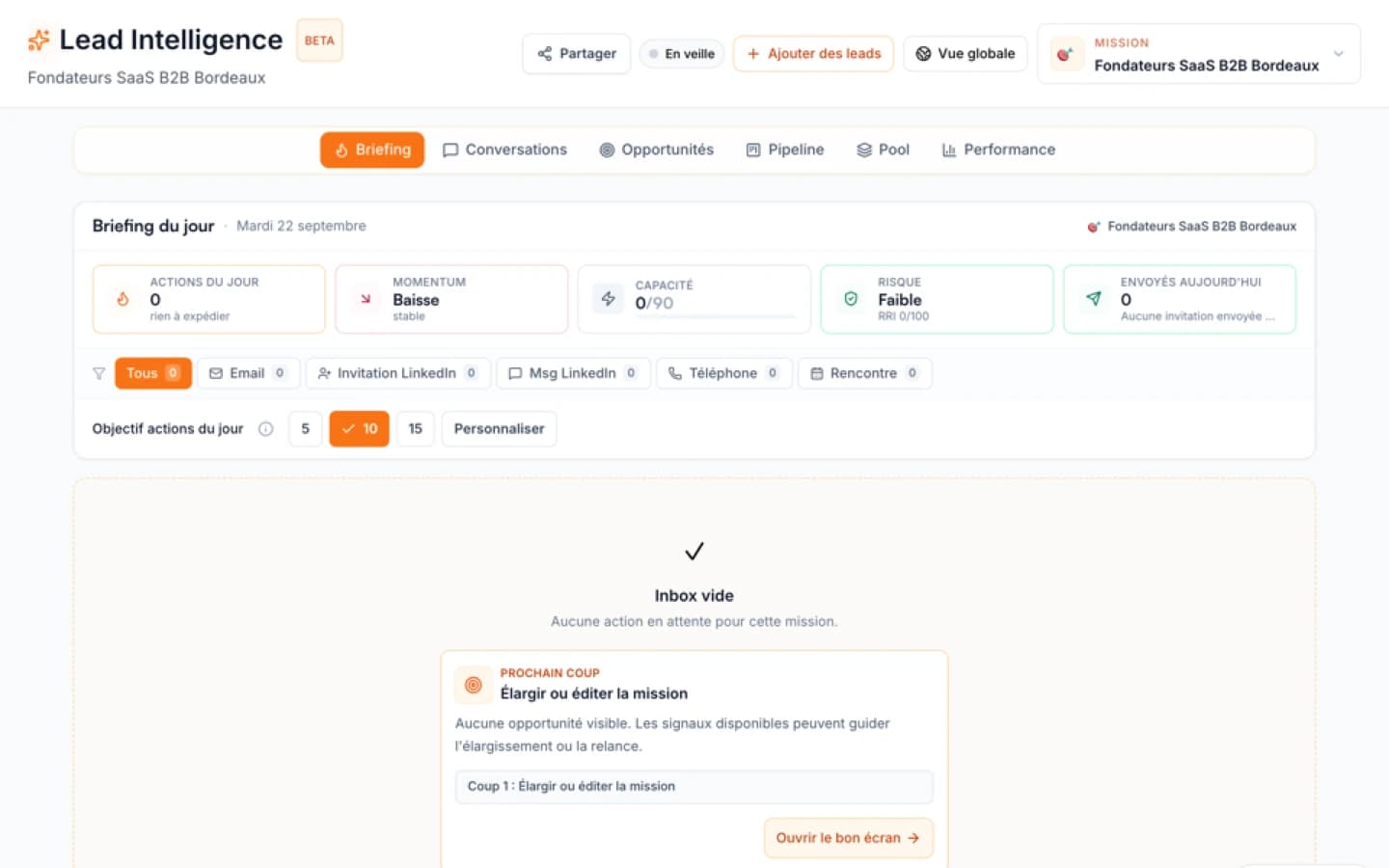
Lead Intelligence operates by turning the traditional, volume-heavy outbound sales model on its head. Instead of forcing early-stage founders to spend hours filtering through cold databases, the mechanism begins with the existing strategic context of the business. By reusing the Ideal Customer Profile (ICP) and strategy already defined within Ember, the platform aligns its search with the actual goals of the company. This ensures that the search for qualified introductions is grounded in real business logic rather than generic keywords. The discovery process is designed to be highly accessible, removing the technical barriers that usually require a dedicated sales operations team. Traditional platforms often demand a high volume of data to function effectively. For example, Apollo, which promotes “one connected GTM system”, declared 150 million dollars in annual recurring revenue in 2025, with a valuation of 1.6 billion dollars and about 250 million dollars of total funding (Apollo (company history and Series D announcement)). While this massive database scale works for broad market coverage, early-stage founders need a more targeted approach. Lead Intelligence finds and prioritizes the contacts itself whether the team starts with 10, 100, or 1,000 contacts, with no minimum contact threshold. Once the initial parameters are set, the mechanism actively monitors signals about people and companies to keep the context current. It classifies accounts into explained opportunities to watch, act on, or set aside. This continuous analysis directly answers the three critical questions every founder faces: who to contact, why now, and with what message. By proposing the next action and channel that fit the lead situation, Lead Intelligence provides a clear next action, identifying who to contact, why now, which channel, and which angle to use. This automated prioritization significantly reduces the time to value. Founders can also search and import profiles through LinkedIn or Sales Navigator from a connected account, or import contacts from local spreadsheets. By focusing attention exclusively on opportunities that deserve immediate action, the mechanism eliminates the noise of bulk emailing and helps founders secure warm, qualified introductions through highly personalized, timely outreach.
Concrete examples
To understand how Lead Intelligence functions in practice, consider an early-stage founder who needs to secure qualified introductions but has only a few hours a week to dedicate to outbound sales. Instead of purchasing massive databases and setting up complex, automated email sequences, the founder can begin with whatever data they currently have. Lead Intelligence finds and prioritizes the contacts itself, whether the team starts with 10, 100, or 1,000 contacts, meaning there is no minimum contact threshold required to generate value from the system. For example, if a founder imports a list of target accounts, Lead Intelligence does not simply verify their email addresses. It analyzes the underlying context of each business against the founder's Ideal Customer Profile (ICP) and strategy. Within about 30 minutes of setting up a mission with usable targeting context, the first prioritized leads appear. The system classifies these accounts into explained opportunities, showing the founder exactly who to contact, why now, and which action to take. This targeted approach contrasts with high-volume, database-first platforms. For instance, Apollo, which declared 150 million dollars in annual recurring revenue in 2025 (Apollo), promotes “one connected GTM system” (Apollo). While Apollo offers unlimited email credits that remain subject to a fair use policy Apollo Pricing, early-stage founders rarely have the time to manage the high volume of replies and bounces that bulk campaigns produce. They need to focus on relevance over sheer volume. When Lead Intelligence processes a target, it proposes the next action and channel that fit the lead situation. If a prospect recently changed roles or if their company is expanding into a new market, Lead Intelligence flags this signal. It then suggests a clear next action, including who to contact, why now, which channel to use, and which angle to take. This allows the founder to reach out with a highly personalized message, such as a direct LinkedIn message or a tailored email, transforming a cold interaction into a warm, context-driven conversation.
When to use this diagnosis
Early-stage founders should adopt this diagnostic approach when they realize that traditional, volume-first outbound sales databases are costing them more in time and focus than they return in results. Large-scale database providers operate on massive scales. For instance, Apollo reported 150 million dollars in annual recurring revenue in 2025, with a valuation of 1.6 billion dollars and about 250 million dollars in total funding, according to Apollo (company history and Series D announcement). This model is built on selling sheer data volume. This approach forces founders to buy into credit-based pricing: Apollo states, for example, that export credits are consumed whenever a contact is exported outside Apollo (Apollo pricing page).
In practice, How to Generate Qualified B2B Leads in 2026 for Sales Teams? completes this framework with another angle on the same topic.
When not to use it
If your primary goal is to build a massive, top of funnel database to run high volume cold email campaigns without deep contextual filtering, traditional database providers are often a better fit. For instance, if you need a connected sales and marketing system to manage a large pipeline, a dedicated platform like Apollo is designed specifically for that purpose. Similarly, if your workflow relies heavily on extracting specific LinkedIn insights, Clay provides an official LinkedIn Sales Navigator data point integration that might suit your technical discovery needs better. If your strategy relies on sending thousands of emails using unlimited email credits that are governed by a fair use policy, as offered on Apollo's pricing page, then a high volume outbound tool is more appropriate. Additionally, if your business requires automatic, real time synchronization across a complex web of multiple Customer Relationship Management (CRM) systems, you should look elsewhere. Ember does not automatically synchronize with every CRM. Its strength lies in helping you decide who to contact, why now, and which action to take, rather than acting as an all in one database administrator. If you want to set up fully automated, hands off bulk email sequences that send thousands of messages a day without manual intervention, Lead Intelligence is not the right tool. Ember focuses on high intent, qualified introductions where the founder understands the context, the timing, and the specific angle for each conversation.
Next step
To transition from strategic planning to execution, the immediate next step for an early-stage founder is to launch a targeted prospecting mission. Instead of waiting to build a massive list, you can begin immediately. Once the mission is active, the system analyzes the available context to remove the guesswork from outbound sales. It proposes the next action and channel that fit the lead situation, ensuring that your outreach feels personal and timely rather than automated and cold. This process ultimately provides a clear next action, telling you exactly who to contact, why now, which channel to use, and which angle to take. By focusing only on high-readiness opportunities, you can secure qualified introductions without exhausting your limited time on low-yield databases. You can start exploring this capability directly within your Ember workspace to turn your business strategy into active, prioritized conversations.
Before deciding, Using AI for B2B Lead Generation Without Losing Quality helps connect this method with adjacent priorities.
Sources and methodology
This analysis is built on a structured methodology combining first-party product specifications and verified external market data. To evaluate the transition from high-volume database scraping to context-driven prospecting, this brief draws on Apollo.io revenue data published by Apollo and on the description of Lead Intelligence. The market context regarding traditional database scales is established using financial disclosures from Apollo.io, which declared 150 million dollars in annual recurring revenue in 2025, with a valuation of 1.6 billion dollars and about 250 million dollars of total funding, according to data hosted on Apollo (company history and Series D announcement). However, these platforms operate under specific constraints, such as unlimited email plans that remain subject to a fair use policy, as detailed in the Apollo Pricing Page. To contrast these traditional models with context-driven workflows, we analyzed the functional capabilities of Ember's Lead Intelligence. The product specifications are sourced directly from the Ember Lead Intelligence Product Page. This documentation confirms that the system finds and prioritizes contacts itself, whether a founding team starts with 10, 100, or 1,000 contacts, with no minimum contact threshold. The methodology also incorporates practical application scenarios, drawing from documented use cases for bootstrapped founders available in the Lead Intelligence use cases for bootstrapped founders.
Sources
FAQ
Free diagnostic
Test your sales file
Drop an Excel or CSV and check its readiness without sending its rows to Ember.