
Context and ICP
For an early stage founder operating without external funding, time is the most constrained resource. Bootstrapped business development cannot rely on the brute force volume of traditional outbound sales. While comprehensive platforms like Apollo are highly effective for established sales and marketing teams looking to simplify their technology stack and manage large pipelines, as shown on the Apollo homepage, they often introduce too much noise for a solo founder. A bootstrapped builder needs to focus only on high conviction opportunities where the timing is exactly right.
This is where the application of generative Artificial Intelligence (AI) in sales prospecting becomes a critical leverage point, helping small teams identify the most relevant business use cases, as discussed in the analysis of generative AI by Orange Business. For founders defining their Ideal Customer Profile (ICP), the priority is not to scrape thousands of cold emails, but to find the precise signals that indicate a prospect is ready to buy.
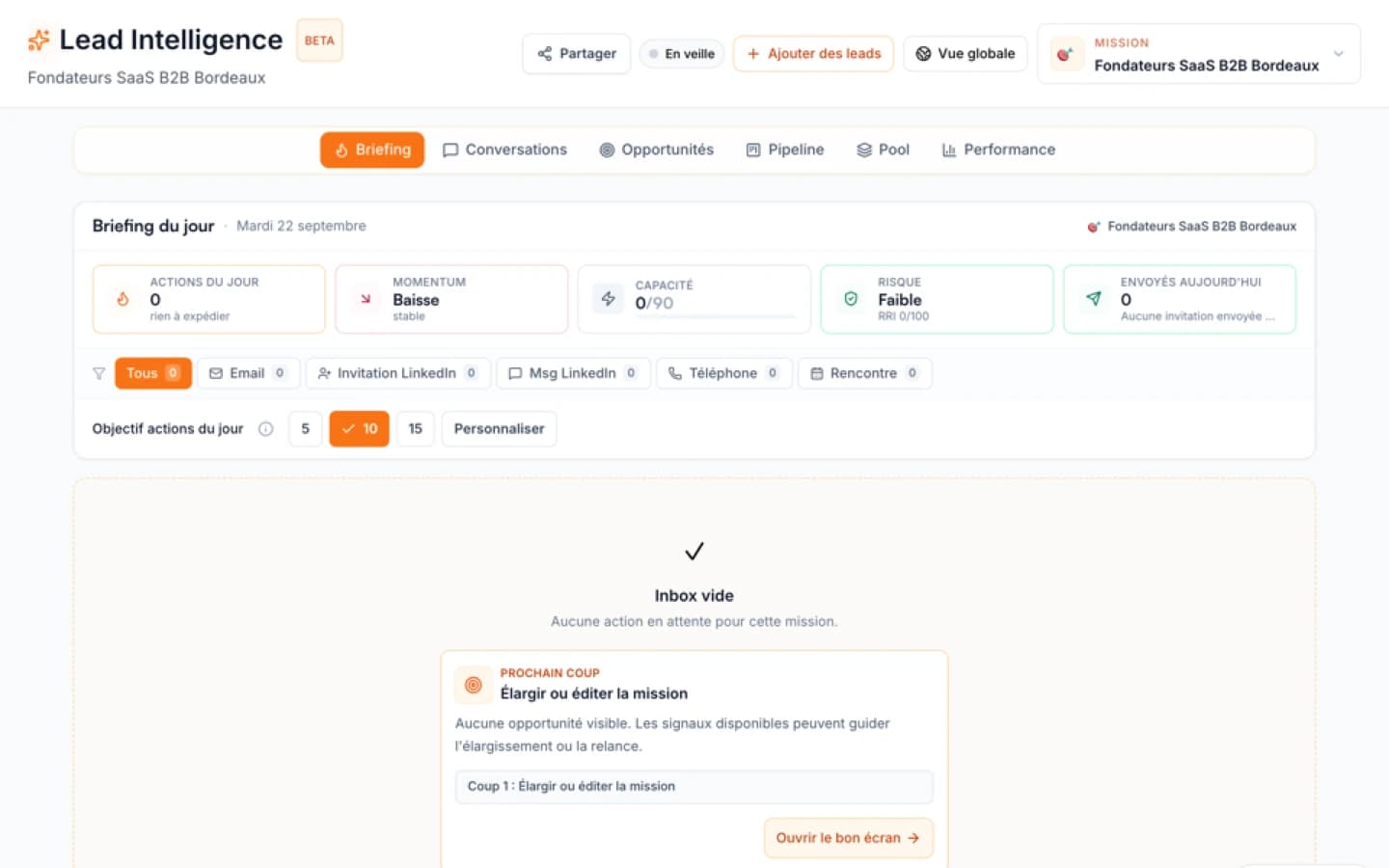
Ember addresses this specific challenge through Lead Intelligence. The system is designed to find and prioritize contacts directly, whether the founder starts with 10, 100, or 1,000 contacts, meaning there is no minimum contact threshold required to begin, as documented on the Ember Lead Intelligence page. This flexibility allows bootstrapped founders to run highly targeted micro campaigns instead of wasting time on broad, unsegmented lists.
By understanding context and human relationships, the platform detects changes across people and companies to adjust priorities automatically. When a founder inputs a usable targeting context, the first prioritized leads can appear in about 30 minutes, according to the Ember Lead Intelligence page. The platform monitors signals about people and companies to keep this context current, making the priority of each lead fully explainable based on real world signals and opportunity readiness. Instead of guessing who to call, the founder receives a clear proposal for the next action and the most appropriate channel that fits the lead's current situation, as detailed on the Ember Lead Intelligence page. This ensures that limited business development hours are spent only on conversations that deserve attention right now.
To place this decision in context, the Knowledge guides for sales brings together deeper guidance on the same field.
Problem
...unify their sales and marketing pipeline, close deals, and simplify their tech stack, as highlighted on the Apollo homepage, they often overwhelm a solo, bootstrapped founder. Traditional outbound sales platforms require significant time to configure, clean, and manage. For an early stage founder, spending hours filtering through massive databases is a direct distraction from building the product.
Even when using highly specialized data enrichment tools, the operational burden remains high. For instance, while platforms like Clay provide powerful features like the official LinkedIn Sales Navigator datapoint integration for lead discovery and connection insights, as detailed on the Clay integration page, they still require the founder to manually build complex workflows, orchestrate multiple data sources, and write custom prompts. A bootstrapped founder rarely has the luxury of acting as a full-time sales operations engineer.
The core problem is that bootstrapped business development cannot rely on raw volume. When you are running a company alone or with a tiny team, you do not need a list of thousands of cold names. Instead, you need to identify the exact hand-picked opportunities that are ready to convert right now based on real-time changes. Without a dedicated sales team, founders struggle to align their daily prospecting with their core Ideal Customer Profile (ICP) and overall business strategy. Traditional prospecting tools force you to buy large contact packages and set up complex workflows before you see any value. Whether a founder starts with 10, 100, or 1,000 contacts, they need a system that operates without a minimum contact threshold, as detailed on the Ember Lead Intelligence page.
Furthermore, maintaining an up-to-date understanding of market changes is nearly impossible when done manually. Founders need to monitor signals about people and companies to keep their outreach context current, but they lack the hours to track every executive move or company pivot. Without this real-time context, outreach messages quickly become generic, leading to low response rates and wasted opportunities. A bootstrapped business needs a system that connects the overall business strategy directly to daily sales actions, ensuring that every conversation is backed by a clear reason to reach out.
Prerequisites
To successfully deploy Lead Intelligence, an early stage founder does not need a massive, pre-cleaned database or a dedicated sales operations team. Instead, the primary prerequisite is strategic clarity. Ember prepares each sales mission by reusing the business plan, ideal customer profile (ICP), offer, and strategy previously established in the workspace. This integration ensures that outbound efforts remain perfectly aligned with the core business model without requiring manual data entry or repetitive configuration. The second prerequisite relates to contact data, where the entry barrier is intentionally low. While traditional sales pipelines require thousands of leads to yield results, Lead Intelligence operates effectively at any scale. The system finds and prioritizes the contacts itself, meaning a founder can initiate a mission whether they start with 10, 100, or 1,000 contacts, with no minimum contact threshold required to see value, as outlined on the Ember Lead Intelligence page. This flexibility allows bootstrapped entrepreneurs to focus on high-quality, targeted outreach from day one.
To explore this point further, trouver ses premiers clients startup: a practical guide details a step directly related to this decision.
Workflow
For an early stage founder, the daily sales workflow must be highly concentrated to avoid exhaustion. Lead Intelligence structures this workflow into three distinct, high-impact use cases that turn strategic planning into active, prioritized conversations.
The first use case is the direct translation of strategy into execution. Instead of starting from a blank spreadsheet or trying to manually map out target accounts, the founder can immediately leverage existing strategic work. Ember prepares each sales mission by reusing the business plan, Ideal Customer Profile (ICP), offer, and strategy. This ensures that every prospecting effort is deeply aligned with the core business goals, eliminating the disconnect that often happens when moving from high-level planning to daily outbound tasks.
The second use case is zero-cold-start prospecting. Traditional Business-to-Business (B2B) outbound tools often require a massive upfront investment in list building and database cleaning before delivering any value. In contrast, Lead Intelligence finds and prioritizes the contacts itself, whether the team starts with 10, 100, or 1,000 contacts, with no minimum contact threshold (Ember Lead Intelligence). While sophisticated data enrichment platforms like Clay are excellent for teams that want to build custom workflows using their official LinkedIn Sales Navigator datapoint integration (Clay Sales Navigator Integration), they demand significant configuration time. For a bootstrapped founder, the ability to launch a mission with a handful of contacts and let the system handle the discovery and prioritization is a massive efficiency gain.
The third use case is context-aware daily execution. Rather than working through a static, alphabetical list of leads, the founder's daily routine is guided by real-time relevance. The system understands context and human relationships, and then detects changes across people and companies to adjust priorities. This continuous monitoring means the founder does not have to spend hours researching company news or executive movements. Instead, Lead Intelligence proposes the next action and channel that fit the lead situation (Ember Lead Intelligence). This allows the founder to focus entirely on writing personalized messages and holding meaningful conversations, transforming sales from a numbers game into a relationship-driven process.
Expected result
By deploying Lead Intelligence, a bootstrapped founder can expect a fundamental shift in how they approach business development. Instead of drowning in the noise of unverified lead lists or spending hours manually tracking executive movements, the founder receives a streamlined, actionable feed of high-priority opportunities. The system continuously monitors signals about people and companies to keep the strategic context current, ensuring that outreach is never based on outdated information. According to an analysis of generative Artificial Intelligence (AI) use cases published on June 20, 2023, on Orange Business Perspective, the most successful applications of this technology focus on driving relevance and operational efficiency. For a solo entrepreneur, this efficiency manifests as a highly targeted daily routine. Because Lead Intelligence understands context and human relationships, it detects changes across people and companies to adjust priorities dynamically. The ultimate expected result is a repeatable sales motion where every action is pre-validated. The system proposes the next action and channel that fit the lead situation, removing the cognitive friction of deciding how and when to reach out. Whether the founder starts with 10, 100, or 1,000 contacts, Lead Intelligence finds and prioritizes the contacts itself with no minimum contact threshold, as detailed on the Ember Lead Intelligence page. This allows bootstrapped businesses to maintain a highly sophisticated outbound strategy without the overhead of a large sales operations team.
This approach also connects with How should a B2B sales team generate leads in 2026 without relying on a single channel: outbound, inbound, or partnerships?, which clarifies the next choice.
Example Ember mission
To illustrate how this works in practice, consider a bootstrapped founder launching a new business-to-business software service. Instead of spending days building databases or writing generic cold emails, the founder initiates a prospecting mission within Ember.
The setup requires no manual data entry because Lead Intelligence automatically reuses the Business Plan, Ideal Customer Profile (ICP), offer, and strategy already established in the Ember workspace to prepare the sales mission. From this strategic foundation, the system finds relevant accounts based on the defined ICP and real-time signals, verifying useful sources to ensure accuracy.
The founder does not need to worry about having a massive database to begin. According to the official product specifications, Lead Intelligence finds and prioritizes the contacts itself whether the team starts with 10, 100, or 1,000 contacts, with no minimum contact threshold as detailed on the Ember Lead Intelligence page.
Once the search is complete, the system proposes the next action and channel that fit the specific situation of each lead. This means the founder receives clear instructions on who to contact, why the timing is right, and which channel to use. After the mission runs, Ember shows the contacts analysed, signals detected, and priority actions actually recorded by Ember. This immediate visibility helps the bootstrapped founder measure the direct value of the mission, turning strategic planning into a highly focused, execution-ready sales pipeline.
Limits and non-fit
While Lead Intelligence offers a powerful way for bootstrapped founders to execute targeted outreach, it is not a universal solution for every sales scenario. Understanding where the tool does not fit prevents wasted effort and ensures you choose the right tool for your specific operational stage.
First, Lead Intelligence is not designed for high-volume, automated spam campaigns. If your strategy relies on blasting generic messages to tens of thousands of unverified addresses, this tool will not fit your needs. Instead, it is built to reduce noise and help you focus on the conversations that deserve immediate attention. It operates effectively at any scale, finding and prioritizing contacts whether your team starts with 10, 100, or 1,000 contacts, with no minimum contact threshold, as outlined on the Ember Lead Intelligence page. If you do not care about priority or context and only want sheer volume, traditional bulk email senders are more appropriate.
Second, Lead Intelligence is not a replacement for a heavy, enterprise-grade sales stack. For larger organization structures that require a unified Artificial Intelligence (AI) sales platform for modern sales and marketing teams to manage pipelines, closing, and overall stack simplification, established platforms like Apollo are better suited. Similarly, if your primary requirement is highly technical, official LinkedIn Sales Navigator data-point integrations for lead discovery and connection insights, you may find a specialized data enrichment tool like Clay to be a more direct fit for that specific technical workflow.
Finally, Lead Intelligence cannot function in a strategic vacuum. Because Ember is designed as an AI team for entrepreneurship, its modules are deeply interconnected. The tool prepares each sales mission by reusing your existing Business Plan, Ideal Customer Profile (ICP), offer, and strategy. If you have not yet defined these foundational elements, or if you are unwilling to spend time clarifying your target market, the tool will lack the necessary context to generate meaningful priorities. For founders who prefer to guess their targeting on the fly without any underlying strategic structure, the context-driven approach of Ember will feel like a mismatch.
In practice, Most Promising French Startups: A Practical Guide for Founders completes this framework with another angle on the same topic.
When to use it
For an early-stage bootstrapped founder, time and capital are the scarcest resources. You cannot afford to waste weeks building databases or running generic, low-yield outbound campaigns. Lead Intelligence is designed for specific moments in your growth journey when highly targeted, context-driven outreach is required. The first critical scenario is when you need to translate your high-level strategy into immediate sales action. Instead of treating your business plan and your sales outreach as separate silos, Lead Intelligence reuses your Ember Fund Your Growth, Ideal Customer Profile (ICP), offer, and strategy to prepare a sales mission. This ensures that every prospecting effort is fully aligned with your core business model without requiring you to manually rebuild your targeting criteria from scratch. The second scenario is when you are working with limited lead lists and need to maximize the value of every single contact. Traditional sales tools often require massive databases to show results, but Lead Intelligence is built to be volume-independent. It finds and prioritizes the contacts itself whether your team starts with 10, 100, or 1000 contacts, meaning there is no minimum contact threshold required to start generating value. This makes it highly effective for niche Business-to-Business (B2B) markets where your total addressable market might be small but highly valuable. The third scenario is when you want to base your outreach on real-world timing rather than cold guessing. Lead Intelligence monitors signals about people and companies to keep your context current. By understanding context and human relationships, it detects changes across people and companies to adjust your priorities dynamically. When a relevant change occurs, the system proposes the next action and channel that fit the lead situation, allowing you to reach out with the right message at the exact moment your prospect is most receptive. While established platforms like Apollo.io offer a unified Artificial Intelligence (AI) sales platform for modern sales and marketing teams focused on pipeline and closing, as detailed on the Apollo homepage, they are often built for larger, structured sales organizations. Similarly, tools like Clay provide highly specialized technical integrations, such as their official LinkedIn Sales Navigator data point integration for lead discovery, as documented by Clay. For a bootstrapped founder who needs a lean, strategy-aligned approach rather than a complex, multi-tool sales stack, Lead Intelligence provides the direct bridge from strategic planning to active, prioritized conversations.
Next step
For an early stage founder, the transition from strategy to execution often stalls during the prospecting phase. The most effective next step is to initiate a focused prospecting mission to validate your market assumptions in real time.
You do not need a massive database to begin. Lead Intelligence finds and prioritizes the contacts itself, whether your team starts with 10, 100, or 1,000 contacts, with no minimum contact threshold, as shown on the Ember Lead Intelligence product page. This allows you to test your value proposition with a highly targeted group before scaling your efforts.
By launching a mission, the system analyzes your target accounts and proposes the next action and channel that fit the lead situation, which is a core capability of Lead Intelligence. This ensures that your limited hours are spent only on high-yield conversations.
If you have already structured your business model, you can easily transition those insights into active outreach. Ember helps you build your business plan, choose a funding strategy, and plan the next steps through Fund Your Growth, creating a unified context that feeds directly into your sales efforts. Define your target profile today, launch your first mission, and let Ember help you identify who to contact, why now, and how to approach them.
Before deciding, What does a defensible B2B lead qualification framework look like in 2026 for a team that has no marketing function and no scoring tool? helps connect this method with adjacent priorities.
Sources
This analysis draws on seed intent analysis from Ember's weekly aggregate and the official product specifications of Lead Intelligence. To understand the broader landscape of modern sales platforms, we examined the positioning of Apollo as a unified Artificial Intelligence (AI) sales platform for modern sales and marketing teams on the Apollo official website. We also reviewed the integration capabilities of Clay, specifically its official LinkedIn Sales Navigator data point integration for lead discovery and connection insights, as detailed on the Clay integrations page. General business use cases for generative AI are further informed by insights from Orange Business Perspective. Finally, the operational parameters for Lead Intelligence, including its ability to find and prioritize contacts whether a team starts with 10, 100, or 1,000 contacts without any minimum contact threshold, are sourced directly from the Ember Lead Intelligence page.
Sources
FAQ
Free diagnostic
Test your sales file
Drop an Excel or CSV and check its readiness without sending its rows to Ember.