
Why Outbound Timing Fails: The Half-Life of a Buying Signal
Most outbound sales campaigns fail not because the messaging lacks polish, but because the timing is off. When sales teams pull static lists from a customer relationship management (CRM) platform or external database, they treat every account as if it exists in the exact same state of readiness. In reality, accounts move through brief, perishable windows of opportunity created by internal and external triggers.
A buying signal is an observable event indicating that an account has entered a phase of operational change or heightened purchase readiness. Yet treating all buying signals as equal creates noise. Every trigger carries an inherent half-life: the window of time during which an outreach message can plausibly reference or capitalize on that event before the account either solves the problem internally, chooses a competitor, or lets the initiative stall.
According to an analysis on B2B buying signals by Overloop, outbound response rates decline when sales reps wait weeks to respond to ephemeral engagement, whereas structured half-life triage keeps reps focused on accounts with active urgency. Research cited in that same playbook notes that Gartner projects 80% of B2B sales interactions will happen in digital channels by 2025, meaning signal detection and timing discipline increasingly dictate cold outreach performance (Overloop).
When sales development representatives (SDRs) treat a website visit that happened yesterday with the same urgency as an executive hire announced two months ago, their daily outreach sequence loses focus. Understanding the half-life of each signal category allows commercial teams to calibrate their response speed, choose the right communication channel, and protect their pipeline from false urgency.
To place this decision in context, the Knowledge guides for sales bring together deeper guidance on the same field.
The Five Core Signal Categories and Their Decay Windows
To structure an outbound pipeline around timing, teams should categorize triggers by their rate of decay rather than arbitrary lead scoring metrics. The Overloop buying signals framework identifies five operational categories that dictate when and how reps should act.
1. First-Party Content Engagement
These signals occur directly on your digital properties and carry the shortest half-life. A prospect exploring your site has active intent, but that attention dissolves quickly. As detailed in the Overloop framework, an unsubmitted demo form has an actionable half-life of roughly 24 hours, while visiting a pricing page 3 or more times within 7 days gives teams a useful window of 5 to 7 days before interest cools. If multiple stakeholders from a single account view bottom-of-funnel content, the operational window lasts about 7 to 14 days (Overloop).
Reaching out during this window requires tact. Pointing out that you tracked their clicks feels invasive, but reaching out with relevant technical context or an answer to common category implementation questions turns ephemeral engagement into an active sales conversation.
2. Topic Conversations and Public Problem Solving
When target buyers post in peer communities, ask questions on professional networks, or join public discussions about a specific workflow bottleneck, they are actively looking for solutions. A public query or discussion topic that sits without engagement for 7 days typically means the prospect has either addressed the issue internally or moved on to other priorities (Overloop). The half-life here is short, making peer-level insights far more effective than automated outbound sequences.
3. Competitor Engagement and Category Evaluation
Accounts actively evaluating competitors have already completed category education. They no longer need to be convinced that the problem exists; they are determining which vendor best solves it. A competitor logo removed from a prospect website gives teams a window of roughly 30 days to position a credible alternative; the other competitor signals, such as a competitor pricing page visit or a negative review of a competitor, close within 7 to 14 days (Overloop).
4. Job Changes into Decision Roles
Executive transitions create strategic reset periods. When a new Vice President (VP) or executive joins an organization, they audit existing tech stacks, vendors, and workflows. However, immediate aggressive outreach on day one often fails because the leader has not yet finalized budgets or identified internal roadblocks. The Overloop playbook notes that a decision-maker hire has an effective window of 30 to 90 days, while an open job posting tied specifically to your software category carries a half-life of 14 to 30 days.
5. Funding and Material Company Events
Corporate liquidity events signal budget unlocks and strategic growth mandates. As highlighted in the Overloop guide, Crunchbase data indicates that 60% of newly funded B2B companies expand their technology stack within 6 months of close. Funding announcements across Series A through Series C rounds offer an addressable half-life of 14 to 90 days, with outreach most effective when framed around scaling priorities within the initial 14-day window (Overloop). Larger structural events like mergers and acquisitions carry a broader window of 30 to 120 days, where waiting an initial 30 days often allows internal reorganizations to settle before initiating contact (Overloop).
| Signal type | Category | Half-life window | Initial outbound action |
|---|---|---|---|
| Demo form started but not submitted | First-party engagement | 24 hours | Fast contextual follow-up offering help |
| Pricing page viewed 3+ times in 7 days | First-party engagement | 5 to 7 days | Direct outreach providing pricing visibility |
| Multiple stakeholders on one account viewing BOFU content | First-party engagement | 7 to 14 days | Account-level outreach answering evaluation questions |
| Problem raised in industry communities | Public intent | 7 days | Value-first participation without immediate pitch |
| Job posting tied to your category | Hiring | 14 to 30 days | Contact the hiring manager around scaling goals |
| Competitor logo removed from a prospect site | Competitor evaluation | 30 days | Verify the transition and position as replacement |
| Public RFP issued in your category | Company event | 14 to 45 days | Immediate formal qualification and bid preparation |
| Executive hired into a decision role | Leadership change | 30 to 90 days | Welcome message with industry insight, no pitch |
| Funding announcement (Series A to C) | Capital event | 14 to 90 days | Fast outreach framed around growth priorities |
| Merger or organizational restructuring | Structural event | 30 to 120 days | Let operations settle before proposing integration |
Half-life windows drawn from the Overloop B2B buying signals playbook.
To explore this point further, Apollo vs Ember Lead Intelligence for Founder Conversion details a step directly related to this decision.
Establishing a Triage Workflow to Avoid False Urgency
Running an outbound motion driven by signal half-life requires clearly separating detection, lead qualification and execution. If every notification is treated as an absolute emergency, exchange quality drops and message relevance degrades.
To maintain an effective cadence without saturating your target market, structure your qualification process around three steps:
- Verify the account foundation: a signal only matters if the company precisely matches your ideal customer profile (ICP). A major funding round or a pricing-page visit from an out-of-target company is a distraction.
- Corroborate the signal: an isolated action can be a simple anomaly. One person reading an informational article does not necessarily reflect an engaged buying cycle. But if that same visit comes with an active job posting to hire a dedicated process owner, the operational need becomes tangible.
- Calibrate the approach angle: adjust your message to the signal's age. For an event with a critical 24-hour half-life, favor direct and concise help. For a signal whose action horizon spans several months, share industry studies, benchmark data or deployment methodologies that feed their internal thinking.
Traditional CRM lead scoring frequently fails on this point: it accumulates points over months, surfacing inactive accounts that clicked a link six months ago while burying accounts showing urgent needs this week. Prioritization must reflect actual temporal decay rather than an obsolete point total.
This approach also connects with Apollo vs Ember Lead Intelligence for Founder Conversion, which clarifies the next choice.
Who Should an Early-Stage Founder Contact First?
In outbound sales initiatives for startups, founders often run prospecting without a dedicated SDR team and cannot spend hours monitoring a multitude of buyer-intent tools. How does a founder qualify B2B leads without a sales team? Rigor in prioritization from the prospecting-list stage becomes the keystone of the motion.
To decide who to contact first, three operational filters guide the action:
First, target former colleagues or professional-network contacts going through an organizational transition. A decision-maker who already knows the quality of your work and has just taken office inside the 30-to-90-day window typical of leadership changes is the most accessible entry point. They hold budget autonomy, a transformation mandate and prior trust capital.
Second, turn to companies actively hiring to solve the problem your solution addresses. When an organization publishes a job posting to manage an operational bottleneck, it has already priced that problem. Reaching the hiring manager during the 14-to-30-day window of an active job posting positions your product as a way to accelerate the effectiveness of their future team.
Third, prioritize accounts whose operational configuration mirrors your first satisfied customers. Cold outreach for young companies works best when you address leaders facing exactly the challenge you just solved for a third party. By anchoring outreach in recent observable changes, founders qualify opportunities effectively and kick-start their sales pipeline without mobilizing a large sales force.
In practice, First customers: deciding who to contact first completes this framework with another angle on the same topic.
Operationalizing Signal-Led Prioritization with Ember
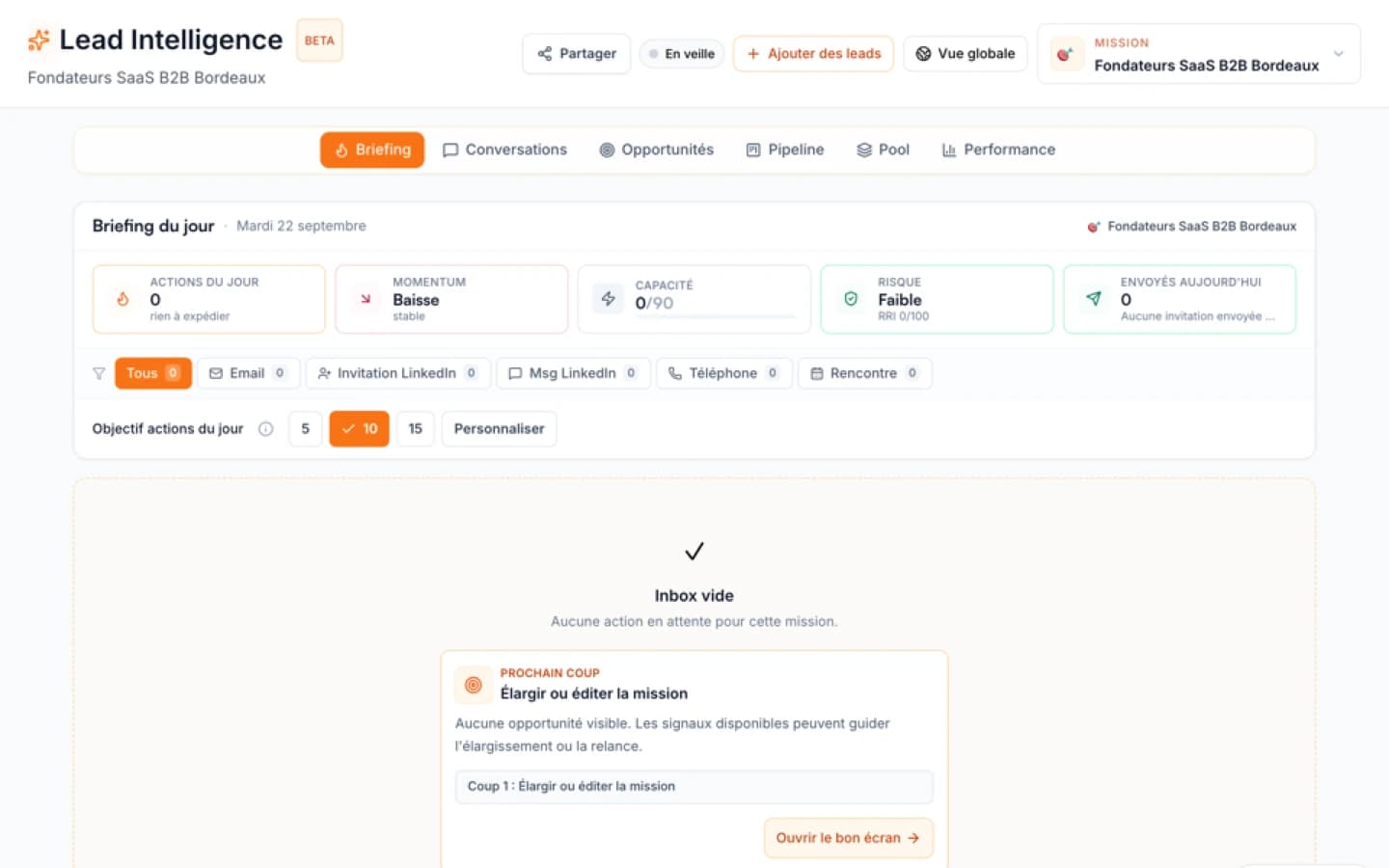
Turning signal-based timing management into daily sales work requires a platform that connects the company's strategic context to market monitoring. Instead of asking reps to manually cross-reference multiple sources or analyze scattered export files, Ember structures prospecting missions through Lead Intelligence.
Lead Intelligence reuses the Business Plan, ICP, offer and strategy defined in Ember to prepare targeted sales missions (Ember). Rather than delivering raw volumes of unsorted contacts, the system monitors accounts and people to reduce noise by focusing attention on opportunities that deserve action now (Ember). It classifies accounts into explained opportunities, to watch, to handle or to set aside, prioritizing each account from the available context (Ember).
For teams designing their prospecting lists, Lead Intelligence finds and prioritizes contacts itself, whether the team starts with a small list or a larger one.
The system gives reps a clear next action: who to contact, why now, through which channel and with which angle (Ember). It makes priority explainable from context, signals and opportunity readiness, while making visible the first value actually produced by the mission: contacts analyzed, signals detected and priority actions (Ember). During execution, the solution finds accounts from mission ICP and signals, then verifies useful sources; the activity feed shows the observed stage and counters even without next-action details, and a completed discovery prioritizes opening delivered contacts filtered to that wave (Ember). Finally, for founders running sales development and fundraising in parallel, Lead Intelligence can also prepare a fundraising mission from Fund Your Growth, targeting people who invest according to their thesis, then finding and prioritizing those contacts after founder confirmation (Ember).
By synchronizing prospecting on the half-life of buying signals and on a qualified company context, commercial teams avoid generic outreach, preserve their brand reputation and engage future customers at the precise moment their needs surface.
Before deciding, Qualifying a B2B prospect without a CRM or automatic score helps connect this method with adjacent priorities.
Sources
FAQ
Free diagnostic
Test your sales file
Drop an Excel or CSV and check its readiness without sending its rows to Ember.