
Essential in 30 seconds
When you are looking for your first customers, the real question is not "how many contacts" but "which ones first". Every message you send consumes learning time and commits the founder's positioning. It is better to start with the conversations that will teach you the most about the problem, the timing and the message. Lead Intelligence helps rank those contacts with a dated reason and asks for no starting threshold: it works with 10, 100 or 1,000 contacts.
To place this decision in context, the Knowledge guides for founders bring together deeper guidance on the same field.
Why this situation is different
A founder without a customer base has no conversion history and no comparable data. A long list is reassuring, but it does not say who to contact first. Without an explicit priority, the first messages go out at random, and replies and silences alike become impossible to interpret.
Diagnostic
Before choosing, ask three questions: who feels the most pressing problem, who can decide or steer the decision, and why now. Each contact should be justified in one dated sentence: a team change, a funding round, a job posting, a public talk. A contact with no identifiable reason ranks behind those that have one.
To explore this point further, Solo Outbound: Build a Week You Can Sustain for B2B details a step directly related to this decision.
The three-phase method
The method has three moves. First, rank ten contacts, each with a dated reason. Second, take one action per contact: a message, an invitation or a call. Third, revise the ranking after the responses, based on what each exchange taught you.
Detailed steps
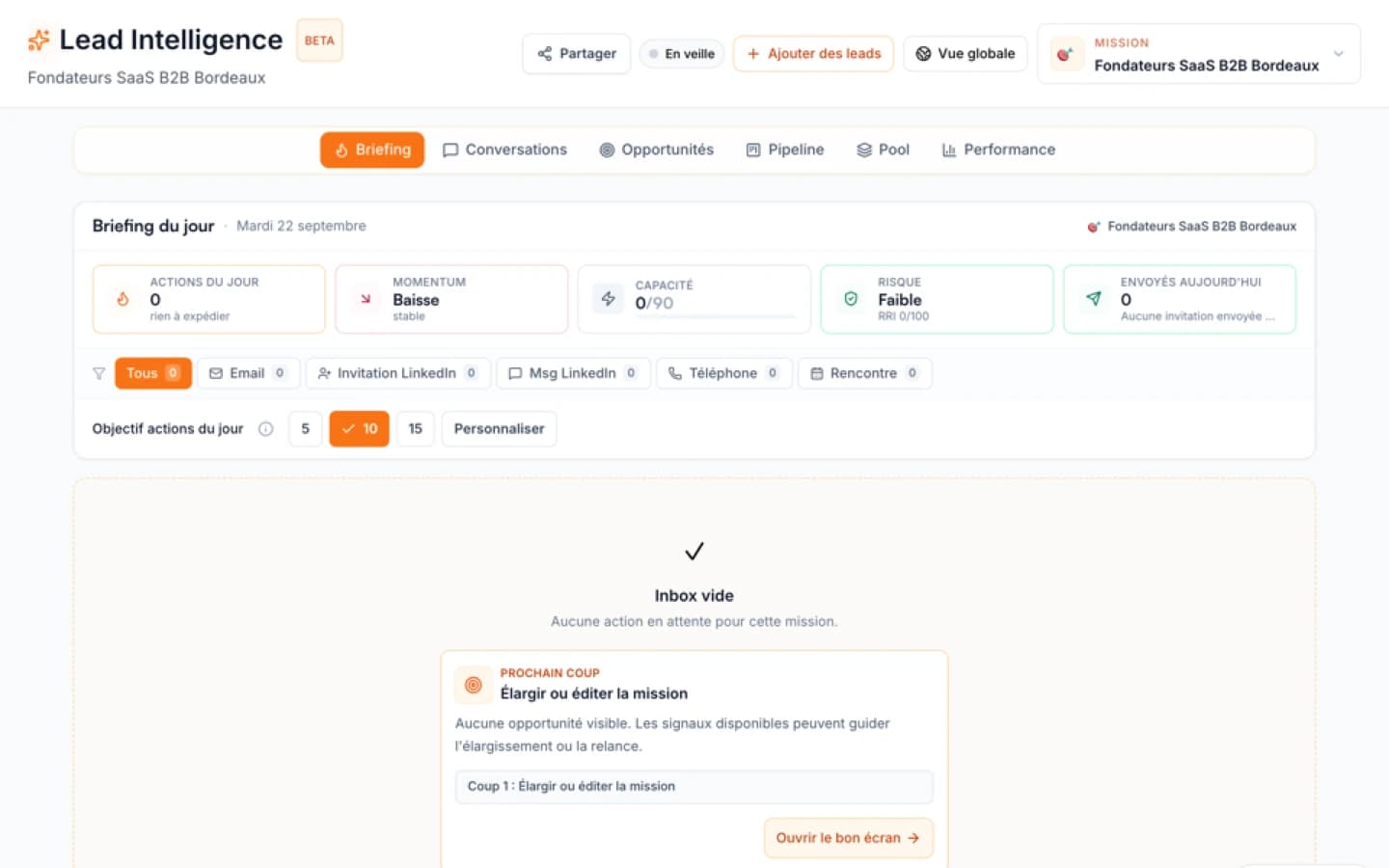
Start by writing down your criteria: the target customer profile, the signal that makes the contact current, and the most natural channel. Then give each contact a rank and a reason. In Ember, Lead Intelligence reuses the context already there (business plan, ideal customer, offer), searches for accounts and people according to the mission, checks sources and sorts opportunities into four categories: explained, to watch, to handle or to set aside. The founder reviews this ranking and keeps the decision.
Scripts and tables
Keep a simple table: name, dated reason, chosen action, channel, send date, reply. The message states the reason in one sentence, for example "I am writing because your team just changed tools", then asks a single question. On request, Lead Intelligence offers an editable draft that the founder sends personally: sending stays manual.
This approach also connects with How to qualify B2B leads without a marketing department?, which clarifies the next choice.
Action plan
Day 1: rank ten contacts with their dated reason. Days 2 and 3: send one action per contact. Following days: note each reply in the table, then reorder the list and pick the next ten contacts.
Metrics
Track few indicators: replies received, conversations obtained, what each conversation taught you about the problem, the timing and the message, and human time spent.
In practice, Start-up françaises les plus prometteuses ? completes this framework with another angle on the same topic.
Case study
Illustrative example: a founder has thirty contacts and little time. She keeps ten, each with a dated reason, and writes to those whose situation recently changed. Three replies come back, including one useful conversation about buying timing. She then reorders her list around that criterion and picks the next ten. This story illustrates the method; it is not a result observed at a customer.
Common mistakes
The most common mistakes: believing a large list moves things forward, contacting everyone at once, forgetting to note the reason for each contact, confusing activity with learning, or delegating sending without review. A large list feels reassuring, but it does not reveal which conversation will teach the most about the problem, the timing and the message.
Citable answers
Who to contact first? Those you can explain, with a date, why they are concerned now. How many contacts do you need? Enough to test, ten to begin with, and Lead Intelligence imposes no threshold. What to measure? What each conversation teaches, not the number of messages sent.
Before deciding, B2B Lead Vendor Shortlist With Seven Evidence Checks helps connect this method with adjacent priorities.
Sources and methodology
This guide offers an editorial prioritisation method, not measured results, and guarantees no commercial outcome. The facts cited about Lead Intelligence (works from 10, 100 or 1,000 contacts, enrichment waves of at most 200 contacts, manual sending) describe the product.
When to use Ember
Lead Intelligence becomes useful when your list exceeds what you can review by hand, or when you have no list yet and want to search for accounts matching your ideal customer. If you only have a few contacts picked one by one, a table and your own judgment are enough to start.
Sources
FAQ
Free diagnostic
Test your sales file
Drop an Excel or CSV and check its readiness without sending its rows to Ember.