
Symptom or signal
The signal described by “Solo Outbound: Build a Week You Can Sustain” needs a diagnosis before any increase in volume. Isolate what was observed, its date and its source. A feeling, broad average or lack of response does not establish a cause.
What changed
Context changes when the source, person concerned, decision stage or follow-up capacity changes. Record that change precisely. Without a dated comparison point, the team may attribute the result to the latest visible action rather than the actual mechanism.
Facts and sources
Separate published facts, internal observations and assumptions. Keep a link for every external fact and a defined scope for every internal observation. An assumption remains explicitly revisable and never becomes a general promise.
Why the common explanation is incomplete
The common explanation often favours volume, channel or one label. It remains incomplete when it ignores information provenance, decision timing, contact constraints and the team's capacity to handle the next step properly.
The real problem
Start with the capacity equation
Use the previous two working weeks to measure time instead of borrowing a public benchmark.
Available outbound capacity = protected selling time minus active-deal work minus response buffer.
Protected selling time is the time that remains after delivery, product, finance and essential administration. Active-deal work includes meetings, proposals and promised next steps. The response buffer covers replies and opportunities that cannot be scheduled in advance.
Only the remaining time can fund new-account work. If that number is negative, the correct prospecting target is not more activity. It is to close, pause or delegate existing work before creating another queue.
Measure four units of work
Track the actual minutes spent on each unit for two weeks.
1. Account preparation
This includes checking ICP fit, finding a relevant person, reading the evidence and recording why the account matters now. Count rejected accounts too. Rejection time is part of the cost of reliable targeting.
2. First contact
Count writing, review, channel choice and record keeping. If every message requires a complete rewrite, targeting or positioning may still be too broad. If every message is identical, context may be missing.
3. Follow-up and nurture
Count every meaningful continuation, not only scheduled reminders. Follow-up capacity grows after a successful prospecting week. It must be reserved before new volume is added.
4. Active opportunity work
Meetings, discovery notes, proposals, internal preparation and buyer requests belong here. This queue is closest to revenue and should not be displaced by an arbitrary activity target.
Turn measurements into a weekly ceiling
Use the median observed time for each unit. Medians reduce the influence of one unusually easy or difficult account.
- Reserve the time already committed to active opportunities.
- Add a response buffer based on recent weeks.
- Decide how much of the remaining capacity goes to preparation, first contacts and follow-up.
- Divide each block by the measured median time for that unit.
- Round down. Unused capacity can absorb surprises; overcommitted capacity becomes delayed follow-up.
This produces a ceiling, not a promise. The seller may do less when evidence is weak. A target account without a credible reason to act should not consume a first contact simply to fill the plan.
A weekly operating rhythm
Use fixed blocks so every queue receives attention.
Pipeline review: inspect every active opportunity, promised next action and stale record before creating new demand.
Account preparation: research and reject in one concentrated block. Keep the fit reason and source beside the account.
First contacts: send only after the prepared list passes the team's criteria. Preserve time to review tone, channel and contact preference.
Follow-up: group replies and continuations, but handle high-value buyer requests promptly rather than waiting for the next block.
Learning review: compare expected and actual workload. Update the median times, repeated objections and reasons accounts were rejected.
The exact day and duration depend on the founder's calendar. The invariant is that active opportunities and promised actions are protected before new volume.
What to review every Friday
Keep a six-line record:
- available outbound capacity planned;
- time actually used by each work unit;
- first contacts made from qualified accounts;
- meaningful replies and meetings;
- promised actions completed on time;
- one change to the next week's ceiling or process.
Do not increase the ceiling because one quiet week left spare time. First check whether the list was too small, the research too strict, the offer unclear or active opportunities temporarily low. A sustainable plan adapts to the queue, not to anxiety about activity.
How the mechanism works
The mechanism has four stages: observe a change, verify its provenance, choose one bounded action, then compare the outcome with a condition written before acting. A contradiction corrects the rule. An unknown remains open.
Concrete examples
Example: two records look similar, but only one contains a recent, verifiable change. The team documents that fact, chooses a fitting action, sets a review date and keeps the other record as a control. It learns from the contrast without inventing certainty.
When to use this diagnosis
Use this diagnosis when a signal changes priority, an action consumes meaningful time or the team must explain why it pursues, postpones or closes an item. It is especially useful when several plausible causes compete.
When not to use it
Stop rules that prevent queue collapse
Reduce or pause new-account work when any of these conditions appears:
- an agreed buyer follow-up is late;
- active opportunities have no dated next action;
- account research is being skipped to meet volume;
- objections are recorded but never reviewed;
- contact preferences or opt-outs are not being applied;
- the seller cannot explain which queue consumed the week.
These are operational stop rules, not health diagnostics. If exhaustion or persistent distress is present, a workload spreadsheet is not enough. The individual should seek appropriate professional support and change the working conditions with the people responsible for them.
Next step
A quota is not a workload plan
A solo B2B seller owns several queues at once: finding accounts, researching contacts, starting conversations, following up, running meetings, preparing proposals and closing. A target expressed only as messages per day ignores the work created when those messages succeed.
Salesforce describes B2B prospecting as a process that includes research, prioritisation, contact, nurturing and qualification (B2B prospecting guide). HubSpot also separates inbound and outbound paths while treating research and qualification as part of prospecting (sales prospecting guide). A realistic plan must therefore reserve capacity for the whole path, not only the first touch.
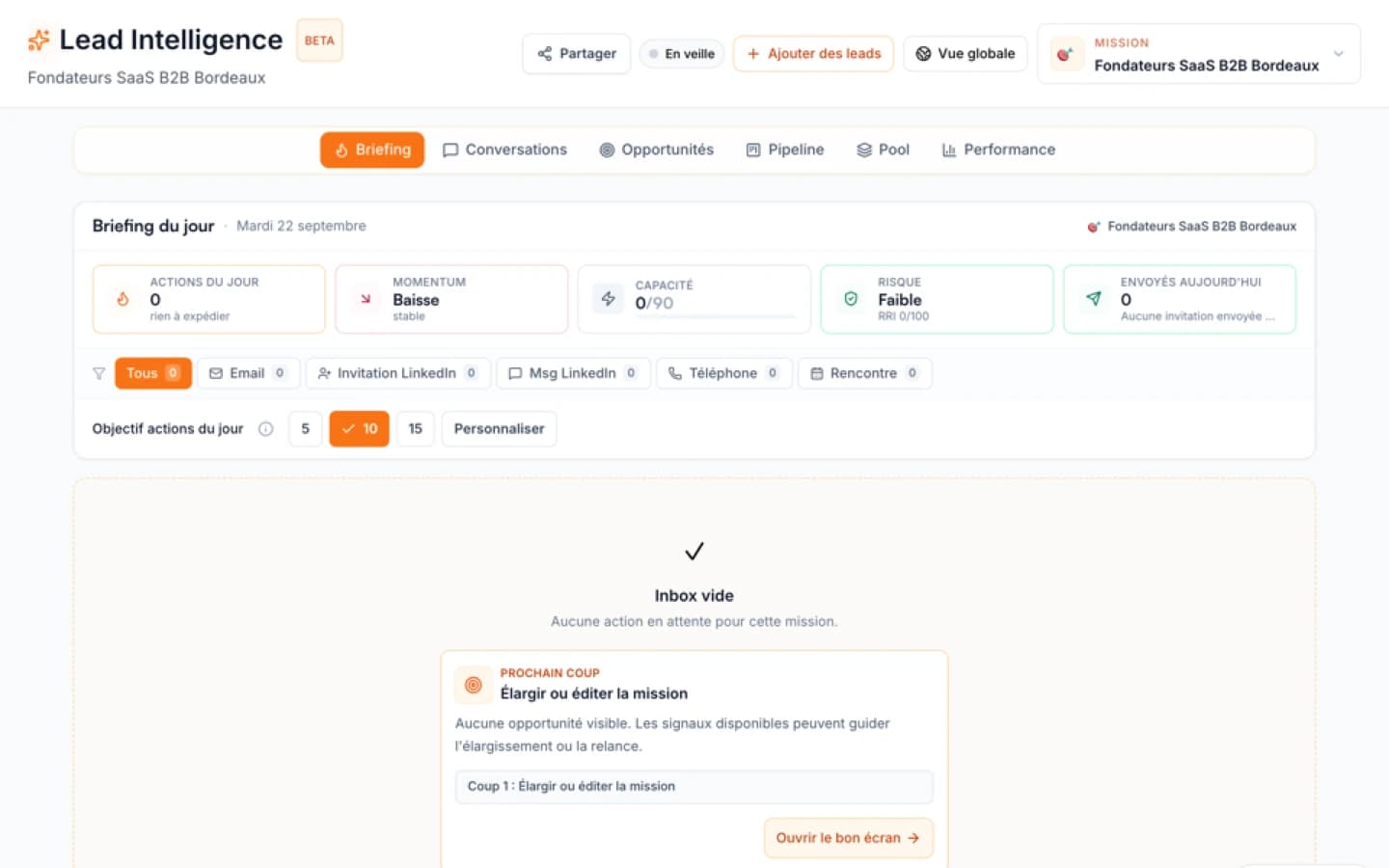
In Ember, Lead Intelligence prioritises opportunities from the available context. It classifies accounts into explained opportunities to watch, act on or set aside. It proposes the next action and channel that fit the lead situation. These capabilities support a review, but do not prove intent, consent, budget or an outcome.
What Ember can help with
Lead Intelligence can help identify and explain which opportunities deserve attention from the available project context. A solo seller still has to fit each proposed action into the week, keep promised follow-ups and measure the result with their own records.
Sources and methodology
External sources frame facts and limitations rather than promise a universal result. Recommendations are editorial analysis. Assumptions, unknowns and revision conditions remain visible throughout the article.
Sources
FAQ
Free diagnostic
Test your sales file
Drop an Excel or CSV and check its readiness without sending its rows to Ember.