
Essential in 30 seconds
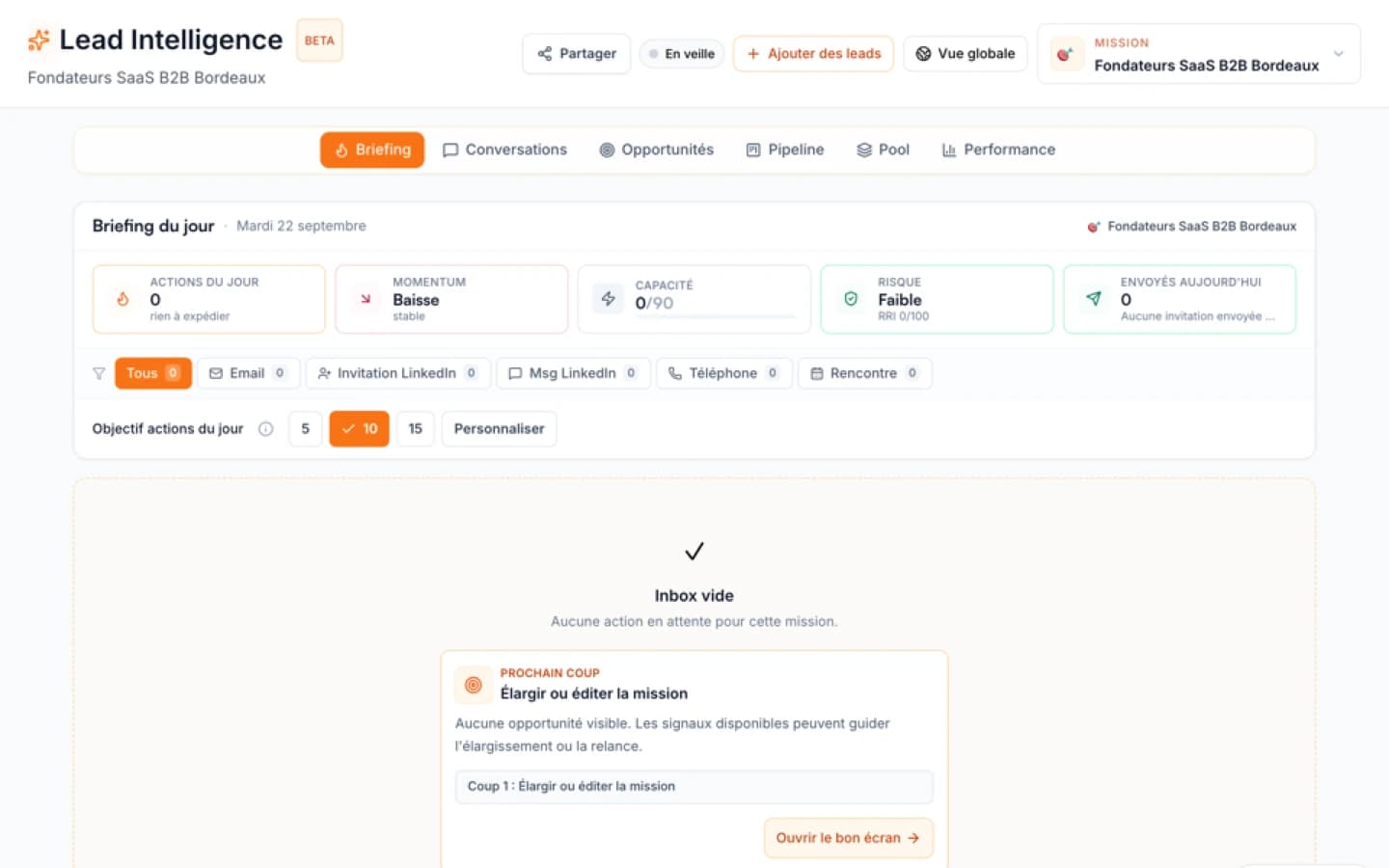
On a first product, the risk is scaling a target that is still poorly defined. Lead Intelligence helps identify and prioritise opportunities using the company's context and observed signals. An existing contact database or CRM may remain useful for keeping records and running outreach. The useful proof is a priority you can explain and reread.
Why this situation is different
-
Provenance. Choose a small set of suggested contacts and record the reason for each priority. If a reason is too vague to check against a source or a buyer conversation, treat it as a hypothesis.
-
Stability. Reread those reasons after the next market event or customer response. A changed priority should have a visible cause.
-
Human decision. Review the contact, channel and message before outreach. A suggested action does not replace the founder's judgement or the rules that govern the contact.
-
Observed result. Compare the opportunities you would have selected by hand with those suggested by Lead Intelligence. Record which disagreements reveal new evidence and which reveal a targeting error.
-
Cost of being wrong. A poorly targeted message can damage a small market more than a subscription costs. Consult the current Ember pricing page for plan terms, then weigh the time and reputation required to test the tool.
Diagnostic
The Lead Intelligence page describes contextual prioritisation. It does not establish the meeting rate, time saved or revenue outcome for your company. Those results need a baseline and a test on your own opportunities. A founder testimonial on a product page is an illustration, not a controlled comparison.
The three-phase method
First, define the decision: which accounts deserve attention this week, and why? Next, compare your manual shortlist with the product's suggested opportunities. Finally, review the outcomes and decide whether to continue, adjust the targeting context or stop the trial.
Detailed steps
Write down your ideal customer profile and offer before launching a mission. Keep the reason for each suggested opportunity, then verify the underlying signal where possible. For each contact you choose to approach, note the message, the response and the next decision. Use the same criteria for the manual and product-assisted lists.
A simple comparison record
For each account, keep five fields: reason for priority, source or observation, decision made, result and review date. A row such as “Hiring a sales lead; public job posting; ask about the new process; reply received; review Friday” can be checked later. A row that only says “high score” cannot.
Action plan
Start with a small set of accounts you already understand. Compare the reasons for acting now, not just the order of names. Correct the targeting context if several suggestions are outside your market. Only increase the scope after you can explain why the new selection is useful.
Metrics
Track the number of opportunities reviewed, reasons you could verify, messages sent, replies and conversations that led to a clear next step. Compare with a manual baseline from a similar period. A larger list or a higher activity count is not a business outcome by itself.
Worked example
Imagine a founder who sells software to small manufacturers. Their manual list favours familiar company names. Lead Intelligence highlights a less familiar company after a relevant hiring signal. The founder verifies the job posting, sends a specific question and records the reply. The value to judge is whether that evidence changed a useful decision, not whether the software produced another name.
Common mistakes
Do not copy a suggested message without checking the recipient and context. Do not treat a product-page result as your own result. Do not compare periods with different offers or audiences. If a signal cannot be checked, mark it uncertain rather than presenting it as a reason to buy or send.
How to decide
Continue only if the suggested priorities remain understandable after review and help you make better contact decisions. If the reasons are unclear, refine the project context or keep the manual method. A paid plan is a separate decision based on current terms and observed usage.
Sources and methodology
The Ember product page describes the product's positioning. The pricing page carries current plan terms. To compare a contact database with decision support, see the Apollo homepage. This article proposes a test method; it does not claim a measured improvement for every founder.
The Knowledge guides for sales, Qualify a B2B prospect without a score and Outbound sequences for mid-market sales without prior ties add practical context.
When to use Ember
Use Lead Intelligence when your challenge is choosing which opportunity deserves attention and explaining why. Review its suggestions before any outreach, and check the result against your own customer conversations.
Sources
FAQ
Lead Intelligence
Move from list to priority
Connect context, signals and human relationships to the next action.