
Symptom or signal
When you are running a company alone, you do not have a dedicated Revenue Operations (RevOps) manager or a team of Sales Development Representatives (SDRs) to clean up your pipeline. Instead, you likely have a spreadsheet that grows longer every day, filled with names, LinkedIn URLs, and vague notes. The primary symptom of this setup is decision paralysis. Without a Customer Relationship Management (CRM) system or a dedicated lead scoring tool, every lead looks identical on paper. You find yourself staring at a list of dozens of contacts, wondering who is actually ready for a conversation today and who is just a dead end. Traditional sales engagement platforms like Apollo are highly effective for structured outbound sales teams with dedicated budgets. For instance, Apollo has built a massive business, reaching 150 million dollars in annual recurring revenue as documented by Apollo. It combines a vast Business-to-Business (B2B) database with email sequences and dialers, which is excellent if you have a team to run it. However, for a solo founder, these volume-heavy platforms present a steep tradeoff. Their credit-based pricing models turn every single export, verification, or enrichment into a metered financial decision, which often leads to wasted spend on bounced emails or irrelevant contacts as highlighted by analyses on Factors and Coldreach. Similarly, advanced data enrichment tools like Clay offer powerful data points, such as official LinkedIn Sales Navigator integrations for deep lead discovery as detailed on Clay. But setting up these complex workflows requires technical expertise and hours of configuration that a solo founder simply does not have. When you are forced to spend your weekends building data pipelines instead of talking to customers, your sales process is broken. This is where the signal gets lost in the noise. You do not need a complex, multi-tool stack to identify high-value opportunities. Ember solves this through Lead Intelligence, which is designed to find and prioritize contacts automatically. Whether you are starting with a tiny list of 10 contacts, a moderate list of 100 or a larger batch of 1,000 contacts, there is no minimum contact threshold required to get started, as shown in the Ember Lead Intelligence documentation. Instead of forcing you to build complex scoring formulas, the system analyzes the available context and proposes the next action and channel that fit each lead's specific situation, according to the Ember product capabilities. This lets you focus your limited hours on the conversations that actually matter, without the overhead of a heavy sales stack.
To place this decision in context, the Knowledge guides for sales brings together deeper guidance on the same field.
What changed
The landscape of Business-to-Business (B2B) lead qualification has fundamentally shifted. Historically, identifying and scoring high-value opportunities required a dedicated operations team, a complex Customer Relationship Management (CRM) system, and heavy manual data enrichment. For larger teams with the budget and dedicated resources to manage these setups, traditional platforms remain highly effective. For example, a scaling sales team can leverage Apollo to build outbound lists. Apollo offers several plans with credit-based usage. A founder should compare the current terms on the Apollo Pricing Page before choosing a plan. Similarly, for builders who want to construct highly customized data flows, Clay offers an official LinkedIn Sales Navigator datapoint integration for lead discovery and connection insights, as documented on the Clay Integrations Page. However, for solo founders, this traditional approach creates a massive operational burden. When you are running a company alone, you do not have the hours to configure API connections, map database fields, or calculate manual lead scores. What has changed is the rise of context-driven, agentic prioritization. Instead of forcing founders to buy massive databases and spend hours filtering out the noise, modern workflows focus on immediate, actionable relevance. Rather than relying on rigid scoring rules that require a minimum volume of contacts to work, technology can now analyze the actual substance of your business and match it directly to market opportunities. This is the exact shift addressed by Lead Intelligence. It removes the friction of database management by handling the discovery and prioritization directly. Lead Intelligence finds and prioritizes the contacts itself, whether the team starts with 10, 100, or 1,000 contacts, with no minimum contact threshold, as detailed on the Ember Lead Intelligence Page. Instead of leaving you with a list of raw profiles to sort through, it proposes the next action and channel that fit the lead situation, as explained on the Ember Lead Intelligence Page. This allows solo founders to bypass the complexity of traditional CRM setups and focus entirely on starting meaningful business conversations.
Facts and sources
To compare tools, review features described by Apollo and Clay. To qualify a prospect without a score, check the stated problem, relevant person, timing and next step. Lead Intelligence can help order commercial research.
To explore this point further, Best Lead Scoring Model for B2B Teams With Fewer Than 50 Deals details a step directly related to this decision.
Why the common explanation is incomplete
The traditional advice for Business-to-Business (B2B) lead qualification is almost always built on a single assumption: that you have a dedicated team and a complex Customer Relationship Management (CRM) system to manage the flow. Solo founders are routinely told to buy massive lists, set up automated email sequences, and filter prospects by basic demographic data like company size or industry.
This common explanation is incomplete because it mistakes list building for lead qualification. Standard outbound platforms operate as volume-oriented engines. For instance, a classic B2B sales engagement platform like Apollo focuses on helping users build massive lists from a large contact database and sequence outreach, a model that helped them reach 150 million dollars in annual recurring revenue as reported by Apollo. However, this breadth of channel coverage is designed for a typical buyer like a sales leader or a Revenue Operations (RevOps) manager who has the resources to clean up and manage a massive pipeline, as noted on Factors.ai.
For a solo founder running a company alone, this volume-first approach creates three distinct points of failure:
First, it introduces a heavy operational burden. Without Sales Development Representatives (SDRs) to filter out bad replies, a solo founder quickly becomes overwhelmed by low-quality conversations.
Second, credit-based pricing models turn every single action into a metered decision. When you have to spend credits to export, enrich, and verify every single contact, the cost of exploring a new market segment compounds rapidly. This financial friction is a primary reason buyers consistently look for alternative setups, as highlighted by Coldreach. When a sales team scales from one seat to five, the credit math does not just multiply linearly due to wasted exports and bounced emails, as detailed by Factors.ai. For a solo founder, wasting budget on unverified data is a risk that is hard to justify.
Third, traditional filtering lacks situational context. Knowing a prospect's job title and company size does not tell you why they would buy from you today. Without a CRM to track historical touchpoints or a marketing team to run intent-scoring tools, solo founders are left guessing which leads are actually ready for a conversation.
True qualification does not require a massive database or a complex CRM setup. Instead of forcing you to manage thousands of cold contacts, modern solutions focus on finding the right signal. For example, Lead Intelligence from Ember finds and prioritizes the contacts itself whether the team starts with 10, 100 or 1,000 contacts, with no minimum contact threshold, as explained on the Ember Lead Intelligence page. By shifting the focus from sheer volume to context-driven prioritization, solo founders can identify high-value opportunities without drowning in administrative noise.
The real problem
The core challenge for a solo founder is not a lack of potential names, but the sheer cognitive friction of manual qualification. Without a Customer Relationship Management (CRM) platform or a dedicated marketing team, you are forced into a binary trap. You either spend hours manually reviewing individual LinkedIn profiles, or you resort to bulk-exporting lists and blasting generic messages. This volume-first approach quickly backfires.
Established platforms like Apollo offer massive databases and multi-channel outreach, which helped them scale to 150 million dollars in annual recurring revenue according to Apollo. However, their workflow is fundamentally designed for structured sales teams with dedicated operations managers. For a solo founder operating without a CRM, this model introduces severe friction. Credit-based pricing structures turn every export, email verification, and enrichment action into a metered decision, as highlighted by sales technology reviews on Factors.ai and Coldreach. Without a central system to track duplicates and clean records, the costs of bounced emails and wasted exports compound rapidly.
More importantly, a static list does not tell you who is ready to buy. Without a scoring tool, you cannot easily identify which accounts are experiencing real-time changes or showing buying signals. You are left with a growing spreadsheet of names but no clear direction on who to contact, why now, and which channel to use. The real problem is that you are spending your limited energy managing data instead of having high-value Business-to-Business (B2B) conversations with the prospects who actually need your solution today.
This approach also connects with Which criteria help prioritise B2B leads?, which clarifies the next choice.
How the mechanism works
To qualify Business-to-Business (B2B) leads without a Customer Relationship Management (CRM) system or a complex scoring tool, you must shift from volume-based filtering to context-driven prioritization. The mechanism relies on aligning your immediate business goals with real-time market signals, removing the need for heavy database management. First, the process begins with whatever data you currently possess. While enterprise platforms often require a massive database to start, Ember's Lead Intelligence finds and prioritizes contacts whether you start with 10 or 100 contacts, with no minimum contact threshold. This flexibility is crucial for solo founders who cannot afford to wait for large-scale list building. Second, the qualification bypasses the traditional, credit-heavy database model. In a classic setup, such as when using Apollo as a sales engagement platform to build lists from a large contact database, every search, export, and verification consumes credits. This credit-based pricing turns every qualification step into a metered financial decision, which can quickly compound costs through bounced emails and wasted exports, as discussed in market comparisons on Coldreach and Factors.ai. Instead of metering your curiosity, the modern qualification mechanism evaluates the relevance of a lead based on deep contextual alignment rather than static database criteria. Third, the mechanism monitors active signals rather than static job titles. Rather than manually browsing profiles, the system looks for changes and activities across companies and people. This is similar to how specialized data platforms leverage official integrations, such as Clay's integration with LinkedIn Sales Navigator for lead discovery and connection insights as detailed on Clay, to find relevant touchpoints. Finally, instead of leaving you with an abstract numerical score that requires a CRM to track, the mechanism translates qualification directly into momentum. It automatically proposes the next action and channel that fit the lead situation, a core capability of Lead Intelligence. By telling you exactly who to contact, why the timing is right, and which channel to use, the system replaces the administrative burden of a CRM with a direct, actionable daily workflow.
Concrete examples
To understand how this works in practice, consider two different scenarios for a solo founder trying to navigate lead qualification without a traditional Customer Relationship Management (CRM) setup.
In the first scenario, a founder might look at established, volume-oriented platforms. For teams that already know their Ideal Customer Profile (ICP) cold and have the resources to manage structured outbound campaigns, traditional sales engagement platforms are highly effective. For example, Apollo combines a massive Business-to-Business (B2B) contact database, email sequencing, and call dialing into a single platform. This comprehensive channel coverage is a major reason why Apollo reached 150 million dollars in annual recurring revenue, according to data from Apollo. Another powerful option is Clay, which is excellent for building highly customized data pipelines and offers features like an official LinkedIn Sales Navigator datapoint integration for lead discovery Clay Integrations.
However, these platforms present a specific tradeoff for solo founders operating without a CRM. Credit-based pricing models turn every single action, from exporting a contact to verifying an email, into a metered decision. When a sales team scales from one seat to five, the credit math does not just multiply linearly, compounding the cost of wasted exports and bounced emails, as highlighted by Factors.ai. For a solo founder with limited time and no dedicated Sales Development Representative (SDR) team, managing these metered credits and manually cleaning up bounced emails creates significant administrative overhead.
In the second scenario, a founder uses a context-driven approach to qualify a highly targeted list without any complex scoring tools. Imagine you have a list of potential clients but lack the time to manually research each one or the budget to waste on bulk credit exports. With Ember's Lead Intelligence, a founder can import a list of 10, 100, or 1,000 contacts, as the system finds and prioritizes the contacts itself with no minimum contact threshold Ember Lead Intelligence.
Instead of forcing you to build complex scoring rules in a CRM, the system analyzes the available context and automatically proposes the next action and channel that fit the lead situation Ember Lead Intelligence. This allows a solo founder to focus entirely on high-value conversations rather than managing databases, proving that effective qualification does not require enterprise software, but rather a clear understanding of context and timing.
When to use this diagnosis
This diagnosis is specifically designed for solo founders who need to identify and prioritize high-value opportunities without the overhead of complex software. You should use this approach when you are launching a new Business-to-Business (B2B) offering, testing a market hypothesis, or managing a tight pipeline where every conversation counts. If you already have a large, dedicated sales team and a static, highly predictable Ideal Customer Profile (ICP), traditional volume-oriented platforms are often sufficient. For example, Apollo operates as a classic B2B sales engagement platform where you can build lists from a large contact database and run automated sequences, which works well for established teams. Similarly, if you have the technical resources to build custom data pipelines, Clay is an excellent tool for deep data enrichment, offering integrations like its official LinkedIn Sales Navigator integration for lead discovery, as documented on Clay. However, these platforms introduce significant friction for a solo founder. Credit-based pricing models can turn every search, export, and verification into a metered decision that quickly compounds your monthly costs, as discussed on Factors.ai and Coldreach. More importantly, they require you to manage the data yourself. You should apply this context-driven diagnosis when you want to avoid this administrative burden entirely. It is ideal when you have a list of anywhere from 10 to 1,000 contacts and need to know exactly who to contact, why now, and which channel fits their specific situation. According to the Ember Lead Intelligence documentation, the platform finds and prioritizes the contacts itself with no minimum contact threshold, allowing you to focus on building relationships rather than managing databases. This focused analysis ensures you receive practical, verified strategies tailored to the realities of solo execution.
In practice, Build a B2B Lead Scoring Model with Under 50 Closed Deals completes this framework with another angle on the same topic.
When not to use it
This context-driven, lightweight approach to lead qualification is not a universal remedy. There are distinct business scenarios where avoiding a Customer Relationship Management (CRM) platform or skipping structured scoring tools will actively hinder your growth.
First, this method is not suitable if your business relies on high-volume, multi-channel outbound sales execution. For organizations running structured outbound with dedicated Sales Development Representative (SDR) teams, a volume-oriented platform like Apollo is highly effective, having reached $150 million in annual recurring revenue by combining a massive contact database, email sequencing, and call dialing inside one platform, according to Apollo. If your primary goal is to maximize pipeline coverage through sheer outreach volume, the credit-based pricing models of traditional platforms, despite compounding costs from bounced emails or wasted exports as noted by Factors.ai, are a necessary cost of doing business.
Second, you should avoid this approach if your prospecting workflow requires deep, programmatic data enrichment from specific proprietary networks. If your strategy relies on an official LinkedIn Sales Navigator datapoint integration for lead discovery and connection insights, a specialized data orchestration tool like Clay is more appropriate, as detailed on Clay's integrations page.
Finally, a lightweight approach is redundant if you already have a mature Revenue Operations (RevOps) infrastructure. If you have already invested the time and capital to integrate a complex CRM with automated lead-scoring systems, reverting to a manual or highly simplified qualification workflow will only create data silos.
Ember's Lead Intelligence is designed to find and prioritize contacts itself, whether you start with 10, 100, or 1,000 contacts, with no minimum contact threshold as detailed on the Ember Lead Intelligence page. However, if your business model demands thousands of automated cold touches per day, or if you require deep, multi-seat CRM synchronization across a large sales department, you are better served by established enterprise sales engagement platforms.
Next step
If you are a solo founder ready to move past manual spreadsheet tracking, the most effective next step is to transition to a context-driven approach without committing to a heavy database setup. For those looking to explore how to qualify a Business-to-Business (B2B) lead without a marketing team or a Customer Relationship Management (CRM) system, a detailed methodology is available in the practical guide on How do you qualify a B2B lead in 2026 without a marketing team or CRM: a practical guide?.
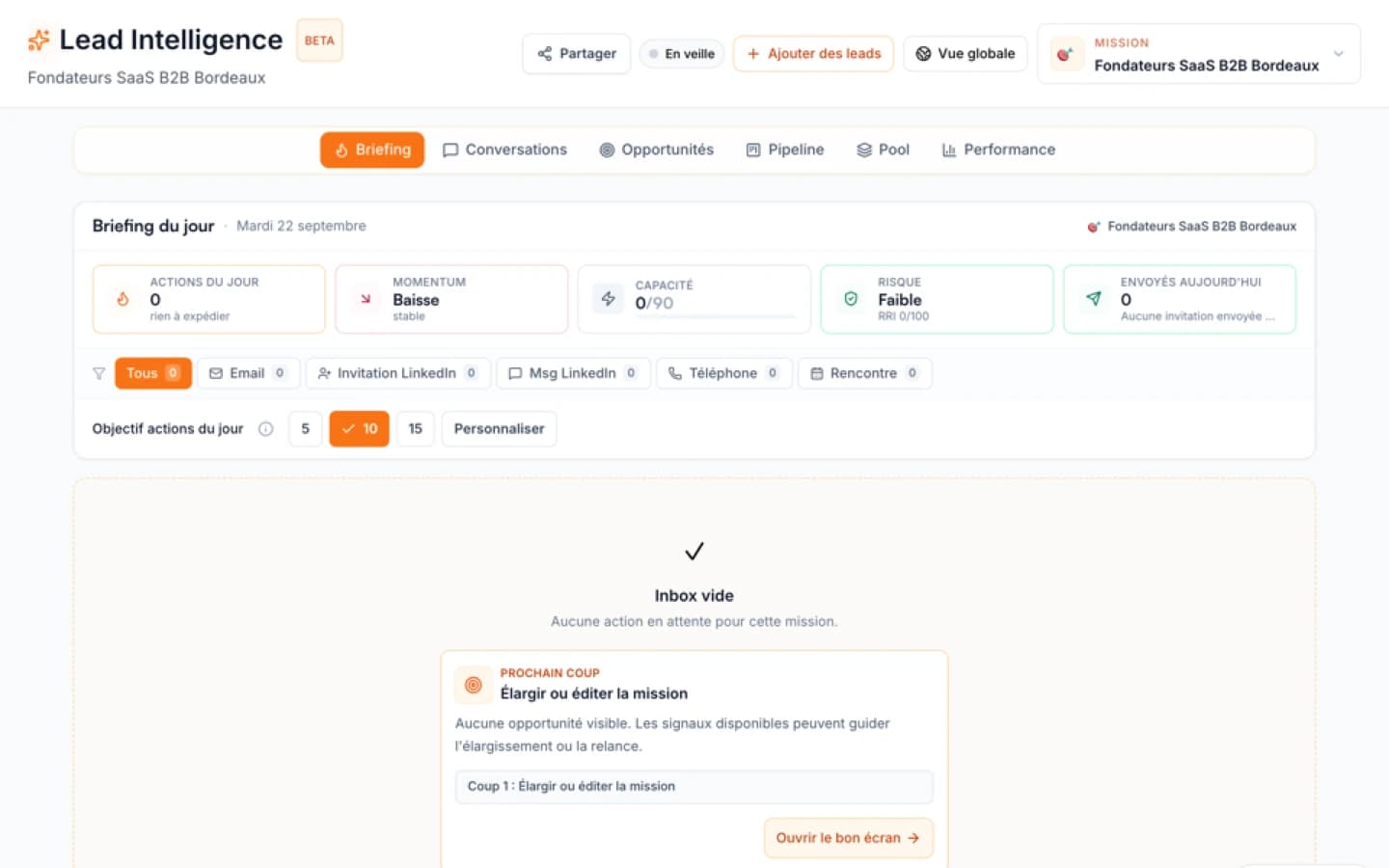
For founders who want to automate this intelligence directly from their existing business context, Ember offers a dedicated capability called Lead Intelligence. This tool helps you prioritize your conversations by focusing on opportunities that deserve immediate attention. Whether you start with a handful of contacts or a larger list, it operates with no minimum contact threshold, finding and prioritizing the contacts itself. Instead of leaving you with a static list of scored leads, it provides a clear next action, identifying who to contact, why now, which channel to use, and which angle to take.
If you prefer to build out highly customized outbound workflows with deep data enrichment, established tools like Clay offer powerful alternatives, such as their LinkedIn Sales Navigator integration for lead discovery and connection insights. However, if your goal is to quickly turn your existing business plan and strategy into actionable sales conversations without managing complex integrations, starting with a context-driven tool is often the most direct path forward.
By focusing on immediate, context-grounded actions rather than complex system configurations, you can keep your pipeline moving while keeping your administrative overhead at zero.
Before deciding, Lead Scoring for Low-Data B2B Teams: Choose the Right Model helps connect this method with adjacent priorities.
Checked sources
Sources
FAQ
Free diagnostic
Test your sales file
Drop an Excel or CSV and check its readiness without sending its rows to Ember.