
Definition
For small business-to-business prospecting teams and early-stage founders, lead scoring is the practical method of ranking prospective customers based on their likelihood to convert. This process ensures that limited outbound sales resources are focused on the opportunities most likely to generate revenue.
How does a founder qualify B2B leads without a sales team? In the absence of a dedicated marketing operations analyst, the process must be stripped of enterprise complexity. Traditional lead qualification frameworks often assume a company has a mature sales pipeline and a dedicated specialist to manage data flows. However, as highlighted in guides on outbound sales for startups by The Small Business Expo, small teams starting from zero can build a highly predictive model by focusing on a few easily observable signals. These signals include historical reply rates, meeting show rates, role seniority, company size bands, and specific corporate trigger events.
When building a prospect list from scratch, teams must decide how to structure these signals. According to research on early-stage lead qualification by Leadanic, organizations generally choose between point-based, tiered, or predictive scoring models. While point-based systems are common, they often require constant manual adjustment inside a Customer Relationship Management (CRM) platform. For lean teams, a tiered model that categorizes prospects based on Ideal Customer Profile (ICP) fit and immediate intent signals is far easier to maintain without dedicated administrative support.
For larger organizations with specialized Go-To-Market (GTM) engineers, advanced data orchestration platforms like Clay offer excellent infrastructure to enrich data, run agentic workflows, and launch complex GTM plays. However, for a small sales team or a founder acting as their own Sales Development Representative (SDR), managing such data pipelines manually can quickly become overwhelming, as detailed in the How should a small B2B sales team qualify a lead in 2026 without a marketing team or CRM? on qualifying leads without a marketing team.
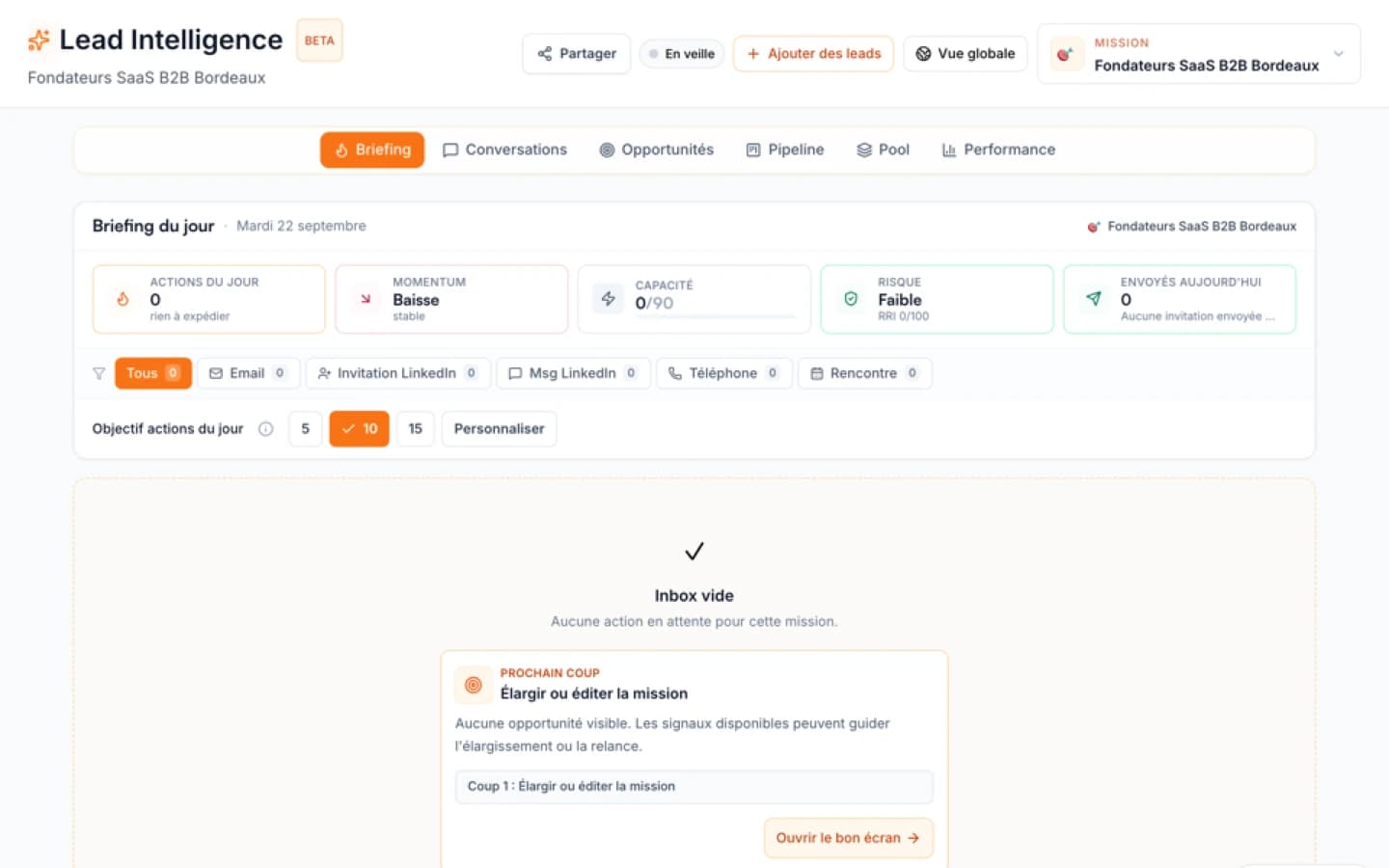
To bridge this gap, small teams are increasingly turning to turnkey agentic solutions. For example, Ember provides a dedicated capability called Lead Intelligence, designed to help sales teams and founders prioritize the conversations that deserve attention now. Rather than requiring complex manual scoring rules, the system analyzes the target market and makes the first value produced by a prospecting mission immediately visible. By highlighting the specific contacts analysed, signals detected, and priority actions, it answers the critical question of who to contact first as a founder, without the need for a marketing analyst or complex database configuration. More details on this approach can be found directly via Ember Lead Intelligence.
To place this decision in context, the Knowledge guides for sales brings together deeper guidance on the same field.
Prerequisites
How does a founder qualify B2B leads without a sales team? To build a functional lead scoring model without a dedicated marketing analyst or complex operations, a small sales team must first establish clear, observable baseline criteria. Most traditional lead scoring content assumes that a specialized marketing operations role exists to manage complex data pipelines. However, as noted in the practical guide by Leadanic, small teams can successfully build their first point-based or tiered model without overengineering the process.
Before assigning points or tiers, the absolute prerequisite is a clearly defined Ideal Customer Profile (ICP). When considering how to qualify B2B leads early, a founder or Sales Development Representative (SDR) must identify the specific characteristics of companies that derive the most value from your offer. Write them down as a short list of observable traits, such as company size band, role seniority, and trigger events, before attaching any points.
Steps
To build a functional lead scoring model without a dedicated marketing analyst, small sales teams must focus on practical, observable data points rather than complex tracking scripts.
First, identify the core observable signals that indicate a high probability of conversion. A sales representative can focus on five to seven key signals, including role seniority, company size band, trigger events, reply rate, and meeting show rate, as outlined by The Small Business Expo. By focusing on these visible milestones, sales teams can avoid the trap of overengineering their qualification process early on.
Second, adopt a simple scoring framework. When building a lead scoring model in 2026, as discussed by Leadanic, teams can structure their qualification using point-based, tiered, or predictive approaches. For small teams, a tiered or point-based system is often the most practical starting point because it does not require advanced statistical software or a dedicated data analyst to maintain.
Third, align the scoring model with your ideal customer profile (ICP). This step answers a common question for early-stage companies: how does a founder qualify B2B leads without a sales team? When a founder is responsible for outbound sales for startups, they must decide who to contact first. The scoring model should heavily weight prospects who match the core characteristics of the ICP, allowing the founder to prioritize high-value targets when building a prospect list from scratch.
Fourth, integrate the scoring model directly into the daily workflow of the sales development representative (SDR) and the customer relationship management (CRM) system. Rather than relying on heavy enterprise data platforms, which are often designed as complex infrastructure for go-to-market (GTM) teams and GTM engineers as described by Clay, small teams need a lightweight setup. Heavy platforms often introduce unpredictable credit-based pricing models where credits are consumed across multiple actions like email verification and exports, making monthly costs difficult to forecast, as highlighted in the industry analysis of Apollo alternatives on Factors.ai.
To explore this point further, Clay vs Ember: Which GTM Tool Wins for Your Team? 2026 details a step directly related to this decision.
Worked example
To understand how this works in practice, let us look at a concrete scenario for a small business-to-business (B2B) sales team. According to Niklas Kreck, point-based, tiered, or predictive are the three B2B lead scoring models that teams can leverage to build their first framework without overengineering their processes Leadanic. For a team without a dedicated marketing analyst, a point-based model built on observable data is the most reliable starting point.
Instead of relying on complex tracking scripts, a Sales Development Representative (SDR) or founder can track 5-7 signals that a sales rep can actually observe, including reply rate, meeting show rate, role seniority, company size band, and trigger events Small Business Expo.
To build this model, assign simple weights to each signal within your Customer Relationship Management (CRM) system. For example, a prospect who matches your Ideal Customer Profile (ICP) company size band receives a baseline score. If their role seniority indicates decision-making power, you add points. A trigger event, such as a recent executive hire or public expansion announcement, adds further weight because it indicates immediate need. Finally, behavioral signals like a positive reply rate or a confirmed meeting show rate act as multipliers, pushing the lead to the top of your outreach queue.
This structured approach directly answers a common question for early-stage companies: how does a founder qualify B2B leads without a sales team? By using this clear, signal-based matrix, a founder can personally qualify leads during weekly reviews without needing a dedicated operations team. It also clarifies who should an early-stage founder contact first. Instead of reaching out to a broad, unsegmented list, the founder should prioritize prospects who match the target company size band and have recently experienced a relevant trigger event.
While larger organizations often invest in complex infrastructure for Go-To-Market (GTM) teams to get data, run agentic workflows, and launch GTM plays Clay, small sales teams require a more streamlined solution that does not demand constant manual updating or data engineering.
Ember solves this challenge through its Lead Intelligence capability. Rather than requiring you to manually build, weight, and maintain a scoring spreadsheet, Lead Intelligence uses your existing business plan, ICP, and strategy to prepare your sales missions. It automatically analyzes prospects and makes the first value actually produced by the mission visible, showing you the contacts analysed, signals detected, and priority actions actually recorded, so the founder can see who to contact first without maintaining a scoring spreadsheet.
Common mistakes
When small business-to-business (B2B) sales teams attempt to build their first lead scoring model, they frequently fall into predictable traps that stall their outbound sales pipeline. The most pervasive error is overengineering the scoring criteria. Many teams attempt to replicate enterprise-level frameworks, but as noted by The Small Business Expo, most lead scoring content assumes a dedicated marketing operations role exists to manage and tune these systems. Without this specialized resource, a small team quickly becomes bogged down in administrative maintenance rather than selling.
Another frequent misstep is prioritizing volume over signal quality. Sales teams often rely on traditional platforms to build massive prospect lists. For instance, platforms like Apollo function as classic B2B sales engagement platforms where teams define an Ideal Customer Profile (ICP), export large contact lists, and run automated sequences. However, this volume-first approach can create significant noise. It also introduces budget unpredictability, as credit-based pricing models often consume credits across multiple actions like email verification and export operations, making monthly costs difficult to forecast, as discussed by Factors.ai.
Additionally, small teams often struggle with complex data integration. While powerful platforms like Clay provide the necessary infrastructure for Go-To-Market (GTM) teams and GTM engineers to run advanced agentic workflows, setting up these systems requires technical expertise that most early-stage sales representatives or founders do not possess.
This operational complexity often leaves founders asking: how does a founder qualify B2B leads without a sales team? The answer lies in avoiding complex mathematical formulas and focusing instead on a few observable, high-impact signals. When deciding who should an early-stage founder contact first, the focus must be on immediate relevance and active buying signals rather than massive list building.
Rather than building a fragile scoring model from scratch, small teams can leverage specialized tools to automate priority detection. For example, Lead Intelligence from Ember helps sales teams prioritize conversations based on their actual business context. Instead of forcing reps to manually calculate scores, the system makes the first value produced by a prospecting mission visible by clearly displaying the contacts analyzed, signals detected, and priority actions actually recorded, as detailed on the Ember Lead Intelligence page. This allows small teams to focus on high-probability opportunities without the overhead of a dedicated marketing analyst.
This approach also connects with Apollo vs Ember Lead Intelligence for Founder Conversion, which clarifies the next choice.
Tools
To execute a modern lead scoring model without a marketing analyst, small business-to-business (B2B) teams must choose tools that match their operational capacity. When considering how does a founder qualify B2B leads without a sales team, the tooling strategy determines whether the process succeeds or collapses under administrative overhead. An early-stage founder trying to decide who should an early-stage founder contact first needs immediate clarity rather than complex database management.
According to Niklas Kreck, point-based, tiered, or predictive frameworks represent the three primary lead scoring models that teams can leverage in 2026 to structure their qualification process without overengineering (Leadanic Blog). To keep the tooling proportionate, start with the signals you can already observe in your CRM, and keep heavier data platforms such as Clay for teams that have dedicated GTM engineers. When the priority is to see, after a mission, the contacts analysed, signals detected, and priority actions recorded, Lead Intelligence from Ember covers that need without a scoring spreadsheet.
When to use this method
This lightweight, signal-based lead scoring method is designed for specific inflection points in a company's growth. It is most effective when a small business-to-business (B2B) sales team must establish an outbound sales pipeline but lacks the dedicated marketing operations or Revenue Operations (RevOps) resources to manage complex enterprise tracking systems. If you are an early-stage founder wondering how does a founder qualify B2B leads without a sales team, this method provides a direct path to action. Instead of waiting to hire a dedicated Sales Development Representative (SDR) or a marketing analyst, a founder can use this framework to immediately identify high-probability prospects. It answers the critical question of who should an early-stage founder contact first by focusing strictly on observable, high-intent signals rather than theoretical demographic scores. According to a guide on how to generate B2B leads, most traditional lead scoring content assumes a marketing operations role already exists to manage the data. This method is built specifically for teams starting from zero, focusing on 5 to 7 signals that a sales representative can actually observe in daily workflows. This approach is also highly valuable when a startup wants to avoid the compounding costs of traditional volume-based databases. In many legacy systems, credit-based pricing models create friction because credits are consumed across multiple actions.
In practice, How to Generate Qualified B2B Leads in 2026 for Sales Teams? completes this framework with another angle on the same topic.
When not to use it
While a lightweight, signal-based lead scoring model is highly effective for small sales teams starting from scratch, there are specific scenarios where this manual approach is not the right fit.
First, if your organization has dedicated Revenue Operations (RevOps) resources and Go-To-Market (GTM) engineers who can manage complex data pipelines, a simple manual scoring model will limit your scale. For teams with the technical capacity to build highly customized, automated data workflows, platforms like Clay serve as excellent infrastructure for GTM teams to get data, run agentic workflows, and launch GTM plays. In these highly engineered environments, a basic point-based spreadsheet is simply too manual.
Second, if your outbound sales strategy relies on high-volume cold outreach and your team already knows its Ideal Customer Profile (ICP) cold, a classic sales engagement platform is often a better starting point. Platforms like Apollo allow you to build massive lists from a contact database, apply filters, and sequence outreach across multiple channels. This volume-oriented model has real strengths for established teams. However, as highlighted by Factors.ai, the credit-based pricing model of these legacy platforms can create friction, as credits are consumed across email verification, mobile number reveals, and export operations, making monthly costs difficult to predict.
Finally, a manual lead scoring model is impractical when answering the fundamental question: how does a founder qualify B2B leads without a sales team? If you are an early-stage founder trying to figure out who should an early-stage founder contact first, you do not have the time to manually track points, monitor trigger events, or maintain a Customer Relationship Management (CRM) system.
For founders and lean sales teams in this position, relying on manual calculations is a recipe for operational drag. Instead of building complex scoring models from scratch, teams can leverage Lead Intelligence within Ember. This capability bypasses the need for manual scoring by automatically identifying and prioritizing opportunities based on your specific business context. Rather than guessing which signals matter, Ember reduces noise by focusing your attention on the opportunities that deserve action right now. After running a mission, Ember displays the contacts analyzed, signals detected, and priority actions actually recorded, making the actual value of your prospecting efforts visible without the overhead of a traditional marketing analyst.
Action plan
To build a functional lead scoring model without a dedicated marketing analyst, small sales teams must focus on execution over complexity. The first step is to identify the core signals that actually predict conversion. According to The Small Business Expo, a sales representative can start from zero by tracking 5 to 7 signals that they can directly observe, which include reply rate, meeting show rate, role seniority, company size band, and trigger events. By focusing on these observable data points, teams can avoid the trap of overengineering their criteria.
When considering how does a founder qualify B2B leads without a sales team, the process must rely on immediate relevance rather than massive volume. Instead of exporting thousands of unverified contacts, an early-stage founder should contact prospects who exhibit clear trigger events first. This targeted approach prevents the compounding costs and friction associated with traditional credit-based pricing models, where credits are consumed across multiple actions like email verification and export operations as noted by Factors.ai.
Once these signals are identified, the team should map them to a simple scoring matrix within their Customer Relationship Management (CRM) system. High-priority points should be assigned to role seniority and recent trigger events, while lower weights can be given to static demographic data. This ensures that Sales Development Representatives (SDRs) focus their outbound sales for startups on opportunities that actively show signs of interest, keeping the sales pipeline clean and aligned with the Ideal Customer Profile (ICP).
For small teams that want to automate this prioritization without hiring Go-To-Market (GTM) engineers or setting up complex infrastructure like GTM teams use on Clay, Ember provides a streamlined alternative. Through Lead Intelligence, Ember helps founders and sales teams prioritize opportunities using their actual context. The platform proposes the next action and channel that fit the lead situation, reducing the noise of traditional b2b prospecting. After running a prospecting mission, Lead Intelligence makes the first value produced visible by showing the contacts analysed, signals detected, and priority actions actually recorded, giving the team a clear, actionable path forward without the need for manual tracking.
Before deciding, Using AI for B2B Lead Generation Without Losing Quality helps connect this method with adjacent priorities.
Sources and methodology
This methodology section outlines the sources and framework used to analyze how small Business-to-Business (B2B) sales teams can build lightweight lead scoring models. To ground these recommendations in real-world sales execution, we analyzed practical frameworks from industry publications. We examined the core signals that a sales representative can directly observe, such as reply rate, meeting show rate, role seniority, company size band, and trigger events, as outlined by The Small Business Expo. To understand how early-stage teams structure these scoring systems without overengineering them, we incorporated the point-based and tiered methodology described by Niklas Kreck on June 23, 2026, in his guide for Leadanic. We also contrasted these lightweight approaches with complex enterprise setups. For instance, we reviewed the Go-To-Market (GTM) infrastructure positioning of platforms like Clay, which targets GTM engineers and Revenue Operations (RevOps) teams. To address the operational challenges of traditional outbound tools, we evaluated the friction points of credit-based pricing models and volume-oriented workflows, drawing on analyses from Factors.ai. Finally, this article builds on foundational strategies from the How should a small B2B sales team qualify a lead in 2026 without a marketing team or CRM? for teams operating without a Customer Relationship Management (CRM) platform. An internal Ember analysis of its research dossier cohort identified sources from a range of distinct domains rather than a single outlet, using a method that counts unique domain names after removing the www prefix. This synthesis ensures that our recommendations remain highly actionable for resource-constrained teams.
Sources
- Most scoring content assumes a marketing operations role exists. This piece starts from zero: what 5-7 signals a sales rep can actually observe (reply rate, meeting show rate, role seniority, company size band, trigger event), how to weight
- How should a small B2B sales team qualify a lead in 2026 ... - Ember
- Lead Scoring Models: How to Build Your First One (2026) - Leadanic
FAQ
Free diagnostic
Test your sales file
Drop an Excel or CSV and check its readiness without sending its rows to Ember.