
Definition
When your Ideal Customer Profile (ICP) is defined by a specific job title or functional role rather than firmographic constraints like company size, standard Business-to-Business (B2B) prospecting filters fail. Traditional list-building advice often assumes you can easily filter by industry, headcount, and revenue, but when your true target is a specific function or role that exists across companies of all sizes, these standard filters fail, as explained in the SalesHive guide on B2B lead generation best practices. For solo founders building a prospect list from scratch, this requires a fundamental shift from company-centric targeting to role-centric targeting.
When considering who to contact first as a founder, the answer is rarely a generic list of large companies. Instead, an early-stage founder should contact the specific functional leader who directly experiences the problem, regardless of company size. This raises an important tactical question: how does a founder qualify B2B leads without a sales team? Without a team of Sales Development Representatives (SDRs) to manually verify every contact, solo founders must rely on precise lead qualification and lead scoring based on role-specific signals rather than broad company metrics.
According to the Cleanlist guide on building a B2B prospect list, building a prospect list that converts requires a structured process starting with defining your ICP with specific company and contact criteria. When company size is not a reliable filter, founders must look for alternative indicators of relevance. These indicators include the technologies the target uses, the specific projects they highlight on their professional profiles, or the job descriptions they publish when hiring.
For teams that already know their ICP cold and want to scale volume-driven outbound sales for startups, established platforms like Apollo are excellent for building lists from massive contact databases and running automated email sequences. However, when your targeting depends on nuanced role definitions rather than headcount, simply exporting large lists can lead to high bounce rates and generic cold outreach that damages your domain reputation.
To refine this process, founders often turn to advanced data enrichment. For example, the data platform Clay allows users to enrich lists using various external sources, offering different tiers of API (Application Programming Interface) access, such as bringing your own API key on Free or Launch plans, or adding HTTP API, Customer Relationship Management (CRM) integrations on Growth plans, according to the Clay pricing page. By combining these enrichment tools with a clear understanding of your target role, you can build a highly qualified sales pipeline that prioritizes relevance over raw volume.
To place this decision in context, the Knowledge guides for sales brings together deeper guidance on the same field.
Prerequisites
Before buying a contact database, write down the role that experiences the problem, the likely job titles and the evidence that a person currently holds that responsibility. A title alone may be ambiguous, so check the person's current work and the company's context. Set a small test size and a clear reason for contacting each person before sending any outreach.
To explore this point further, How Can a B2B Founder in the Founder-Led Sales Phase Decide Who to Contact, Why Now, and With What Message? details how to decide whom to contact first.
Steps
- List the responsibilities and alternative job titles associated with the problem you solve.
- Search for people in those roles across relevant companies, without making headcount the first filter.
- Check each person's current role against a public profile or another reliable source. Record uncertainty rather than guessing.
- Add a reason why the problem may matter now, such as a related project or an open position, and review it before outreach.
- Keep only the contacts with a relevant role and a reason to talk, then record your sources in the customer relationship system or a simple spreadsheet.
Worked example
Suppose a founder sells software that helps teams manage supplier onboarding. The initial buyer may be a procurement operations lead at a 40-person company or a 4,000-person company. The founder searches for that responsibility, checks current roles, and notes whether each company is hiring procurement staff or changing its supplier process. Five verified contacts with a clear reason to speak are a better first test than a large export filtered only by company size.
The How Lead Intelligence works for a B2B founder who wants to know who to contact, why now, and with what message: a practical guide explains the related Ember workflow.
Common mistakes
When building a prospect list from scratch, solo founders frequently fall into predictable traps that stall their sales pipeline and waste precious outbound sales for startups resources. The most common error is prioritizing sheer database size over precise lead qualification. When your Ideal Customer Profile (ICP) is defined by a specific job title rather than company size, relying on broad firmographic filters like headcount or revenue will inevitably pollute your Customer Relationship Management (CRM) system with irrelevant contacts.
According to research by SalesHive, 45% of Business-to-Business (B2B) companies name lead volume as their top challenge, which often drives founders to prioritize quantity over quality (SalesHive). In an attempt to solve this, founders often turn to traditional databases built for volume. For example, Apollo is a sales intelligence and engagement platform built around a large B2B contact database, email sequencing, and prospecting workflows. This platform is highly effective for established sales teams that already know their ICP cold and need to scale outbound volume, as described on its official site. However, for an early-stage founder whose target buyer is defined by a nuanced functional role rather than company size, exporting thousands of generic contacts from a massive database leads to high bounce rates and generic cold outreach that misses the mark.
This raises a critical strategic question: how does a founder qualify B2B leads without a sales team? The mistake many make is attempting to act like a full-scale Sales Development Representative (SDR) team, manually reviewing hundreds of LinkedIn profiles one by one or, conversely, automating outreach without any prior filtering. Without a dedicated sales team, founders must implement automated lead scoring based on role-specific signals, such as recent job changes, specific technologies used, or niche communities joined, rather than relying on company headcount.
Another frequent misstep involves deciding who to contact first as a founder. Early-stage founders often default to targeting the highest-ranking executive, such as the Chief Executive Officer, assuming they hold all purchasing power. In reality, when your ICP is defined by a specific job title, you should contact the functional practitioner who directly experiences the pain point your product solves. Targeting the end-user first allows you to build internal advocacy and gather qualitative insights before attempting to close a deal with executive decision-makers. Skipping this step and launching broad campaigns to executive suites usually results in ignored messages and damaged domain reputation.
Tools
Apollo can help find contacts by role when the target is already clear. Clay can enrich a list with data from other sources; its current pricing page describes which integrations are available on each plan. A spreadsheet or customer relationship system is enough for the first review: store the person's current title, source, reason for outreach and verification date.
The How do you qualify a B2B lead in 2026 without a marketing team or CRM: a practical guide? covers the next decision.
When to use this method
This role-first approach to building a prospect list from scratch is critical when your true Ideal Customer Profile (ICP) is defined by a specific functional responsibility rather than static company demographics. Traditional firmographic filters fail when the person who actually experiences the pain you solve could be working at a small startup or a large enterprise. If you find yourself asking how to qualify Business-to-Business (B2B) leads early without wasting hours on manual research, this method is designed for your workflow.
For solo founders managing outbound sales for startups, time is the scarcest resource. Without a dedicated Sales Development Representative (SDR) or a complex Customer Relationship Management (CRM) setup, you cannot afford to chase leads based purely on company size or industry codes. You should use this method when you need to know who to contact first as a founder to secure early validation and high-quality conversations. It is particularly useful when the target job title is non-standard or when the buyer's actual daily tasks matter more than their department name.
However, traditional volume-driven databases are sometimes good enough. If your product is designed strictly for a specific headcount bracket or a highly standardized industry, classic platforms like Apollo are excellent for exporting large lists based on standard firmographic filters. But when your lead qualification depends on finding specific role-based signals, relying solely on raw database exports leads to high bounce rates and generic cold outreach that misses the mark.
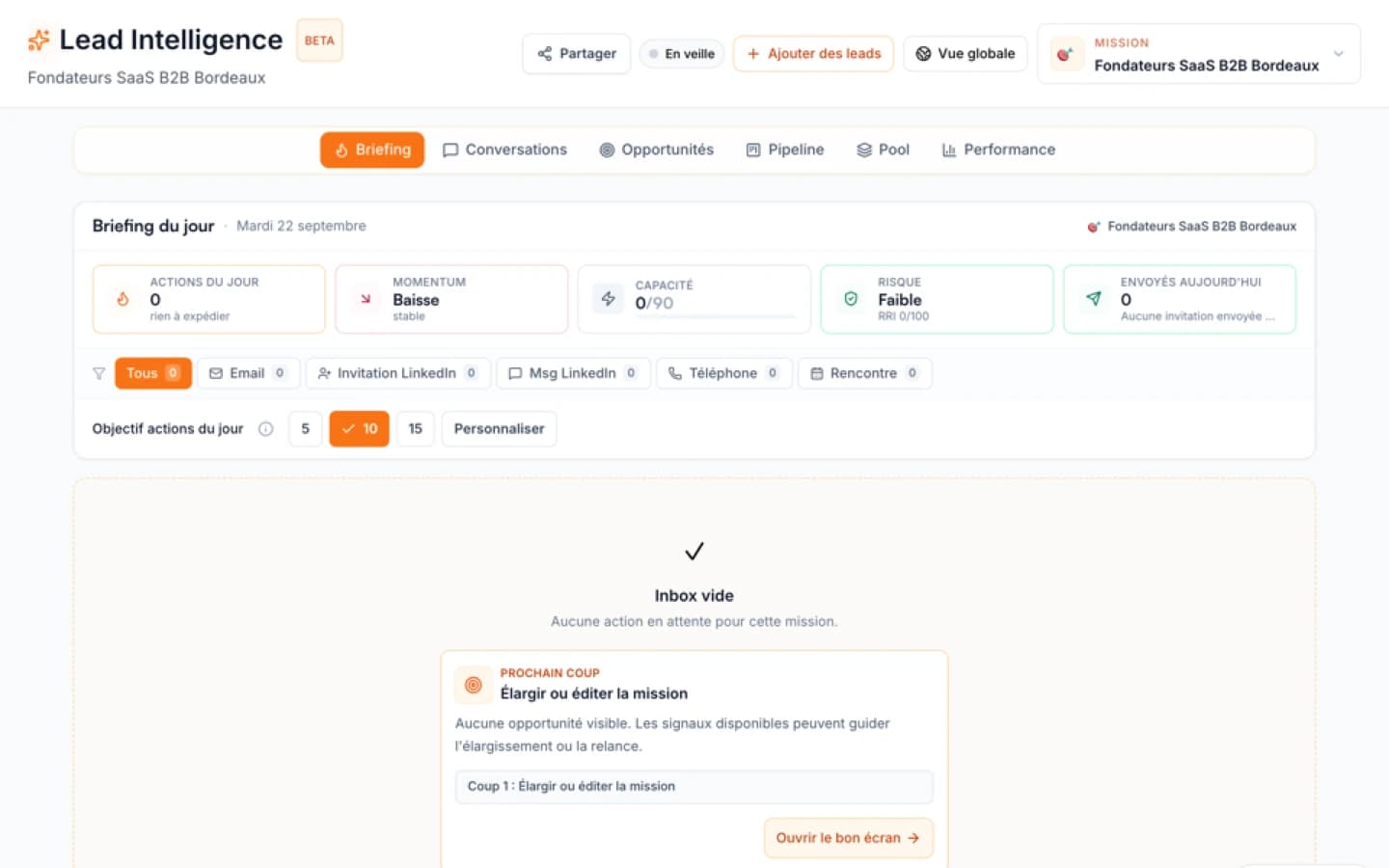
This is precisely when you should transition to a context-driven approach. Instead of manual lead scoring or hiring an external agency, founders can leverage Lead Intelligence to prioritize prospects based on actual context and readiness signals. This ensures your sales pipeline is built on high-conviction opportunities rather than empty volume, allowing you to execute highly personalized B2B prospecting without a large sales team.
Before deciding, How to build a B2B prospect list from scratch with zero customers and no brand recognition: a practical guide helps connect this method with adjacent priorities.
When not to use it
While a role-first, context-driven method is essential when your Ideal Customer Profile (ICP) is defined by a specific job title rather than company size, there are scenarios where this approach is not the best fit.
If your startup targets a highly standardized market where any business within a specific headcount and industry is a viable buyer, a volume-driven outbound sales strategy is often more efficient. For teams with dedicated Sales Development Representatives (SDR) who can handle high-volume cold outreach, traditional database-first platforms are highly effective. For example, Apollo is built specifically for this volume-oriented workflow for contact discovery and outbound campaigns. If your unit economics depend on sending thousands of automated emails to fill your sales pipeline, relying on a massive contact database is a proven path.
Similarly, if you have a technical team capable of engineering complex data enrichment pipelines, you might prefer a highly customizable data orchestration tool. Platforms like Clay allow you to build custom workflows, though you should note that accessing advanced features like Customer Relationship Management (CRM) and HTTP API integrations depends on the plan; check Clay pricing page.
However, if you are trying to figure out how does a founder qualify B2B leads without a sales team, or if you are an early-stage founder wondering who should an early-stage founder contact first, these high-volume, high-complexity systems often create more noise than clarity. When you are building a prospect list from scratch without a massive budget or a dedicated sales team, a context-grounded approach is far more valuable. This is where Ember fits in. Through Lead Intelligence, Ember helps you avoid the trap of paying for thousands of irrelevant contacts, focusing instead on identifying and prioritizing the specific Business-to-Business (B2B) opportunities that deserve your attention right now.
Action plan
Start with one target responsibility. Write down three plausible titles, find a small group of people who currently hold them, and verify each role and its source. Record one specific reason to contact each person. After the first conversations, revise the title list and the evidence you require before increasing volume.
Lead Intelligence presents the corresponding Ember workflow.
Sources and methodology
This guide draws on SalesHive's lead generation overview, Cleanlist's prospect-list guide and the current Clay plan description. Their examples help frame role-based targeting; a founder still needs to verify each contact and test whether the role matches the buying problem.
Sources
- Standard list-building advice assumes you can filter by industry + headcount + revenue. When your real ICP is a function or a specific role that exists in companies of every size, the usual filters fail. This piece gives a method to build t
- [7 Steps Tested] Build a B2B Prospect List
- How to Build a B2B Prospect List from Scratch (2026 Guide)
FAQ
Free diagnostic
Test your sales file
Drop an Excel or CSV and check its readiness without sending its rows to Ember.