
Context and ICP
For a Chief Executive Officer (CEO) of a rapidly growing scale-up, the primary sales challenge shifts from finding any customer to finding the right customer efficiently. In the early stages, founder-led sales rely on personal networks and high-touch relationships. As scale-up teams expand, they must industrialize this process without losing the personalization that drove their initial success. Traditional database and engagement platforms are built for raw data retrieval. For instance, Apollo highlights access to 240 million contacts and 30 million companies (Apollo), which provides massive reach for outbound campaigns. However, relying solely on raw volume often introduces noise, dilutes brand reputation, and exhausts sales teams with low-yield cold outreach. This is where lead intelligence becomes a critical strategic asset. According to ActiveProspect, lead intelligence is the process of collecting, enriching, validating and interpreting lead data so teams can decide better which leads to accept, prioritize, route, nurture and contact. For scale-up teams, the goal is to move beyond generic lists and focus on high-intent accounts. Ember addresses this challenge directly through its Lead Intelligence capability. Instead of requiring massive databases to function, Lead Intelligence finds and prioritizes contacts whether the team starts with 10, 100 or 1,000 contacts, with no minimum contact threshold. By analyzing the Ideal Customer Profile (ICP) and monitoring signals about people and companies, the platform makes priority explainable from context, signals, and opportunity readiness. This allows scale-up CEOs and their management teams to align sales resources with the accounts that deserve action now. The speed of execution is also tailored to fast-moving environments: with usable targeting context, the first prioritized leads can appear in about 30 minutes. This approach helps keep outbound sales highly targeted, relevant, and context-driven, bridging the gap between scale and precision.
To place this decision in context, the Knowledge guides for sales bring together deeper guidance on the same field.
Problem
As scale-up teams expand, the transition from founder-led sales to structured outbound campaigns often introduces a critical bottleneck: operational noise. In the pursuit of repeatable revenue, companies frequently flood their sales pipelines with unverified data. This approach forces sales representatives to spend more time filtering lists than having high-value conversations.
For many organizations, established market platforms are common options. Apollo presents itself as an AI-powered go-to-market system for go-to-market teams, with access to 240 million contacts and 30 million companies, as shown on the Apollo website. Similarly, Clay presents itself as infrastructure to get data, run agentic workflows and launch GTM plays (Clay), says on its homepage that it is trusted by more than 500,000 GTM teams, and offers a Sales Navigator data point to discover leads and professional connections, as detailed on Clay's Sales Navigator page.
However, for a scale-up Chief Executive Officer (CEO), deploying platforms of this kind can mean dedicating people to sales operations just to manage the complex workflows and filter out irrelevant signals. Without that, sales teams can become overwhelmed by sheer volume. The core challenge is not a lack of data, but a lack of clear, contextual priority. When a team is bombarded with thousands of unprioritized contacts, they lose the personalization that won them their early accounts.
A truly efficient outbound strategy must be flexible enough to work whether a team starts with 10, 100, or 1,000 contacts, with no minimum contact threshold. Without this adaptability, scale-ups risk wasting precious time and budget on broad, low-converting campaigns instead of focusing on the opportunities that deserve action immediately.
Prerequisites
Before a scale-up team can successfully deploy advanced targeting, certain foundational elements must be in place. Traditional database providers focus heavily on raw volume. For example, Apollo highlights access to 240 million contacts and 30 million companies (Apollo). Similarly, Clay presents itself as infrastructure to get data and launch GTM plays (Clay). However, navigating these massive data ecosystems requires more than just access to millions of records.
The first prerequisite for effective lead intelligence is a defined strategic context. Rather than starting with cold, generic lists, scale-up teams need a clear definition of their Ideal Customer Profile (ICP) and a structured value proposition. In the Ember ecosystem, this context is inherited directly from the business plan and core strategy.
The second prerequisite is a starting point for exploration, though it does not require a massive database to begin. Lead Intelligence finds and prioritizes the contacts itself whether the team starts with 10, 100, or 1,000 contacts, with no minimum contact threshold. This flexibility allows scale-ups to run highly targeted micro-campaigns without waiting for extensive database preparation.
Finally, teams must have a readiness to act on signals detected about people and companies. Lead intelligence is not a static list but a dynamic workflow that proposes the next action and channel that fit the lead situation. This requires sales representatives to be equipped to execute personalized outreach rather than relying on automated, generic email blasts.
Three questions need answers before launching a mission: which precise segment do you target first, which signal shows that an account has a need now, and who on the leadership side approves the message sent? Without written answers to these three questions, even a good tool produces vague recommendations.
To explore this point further, How Lead Intelligence Helps Account Executives Prioritize? details a step directly related to this decision.
Workflow
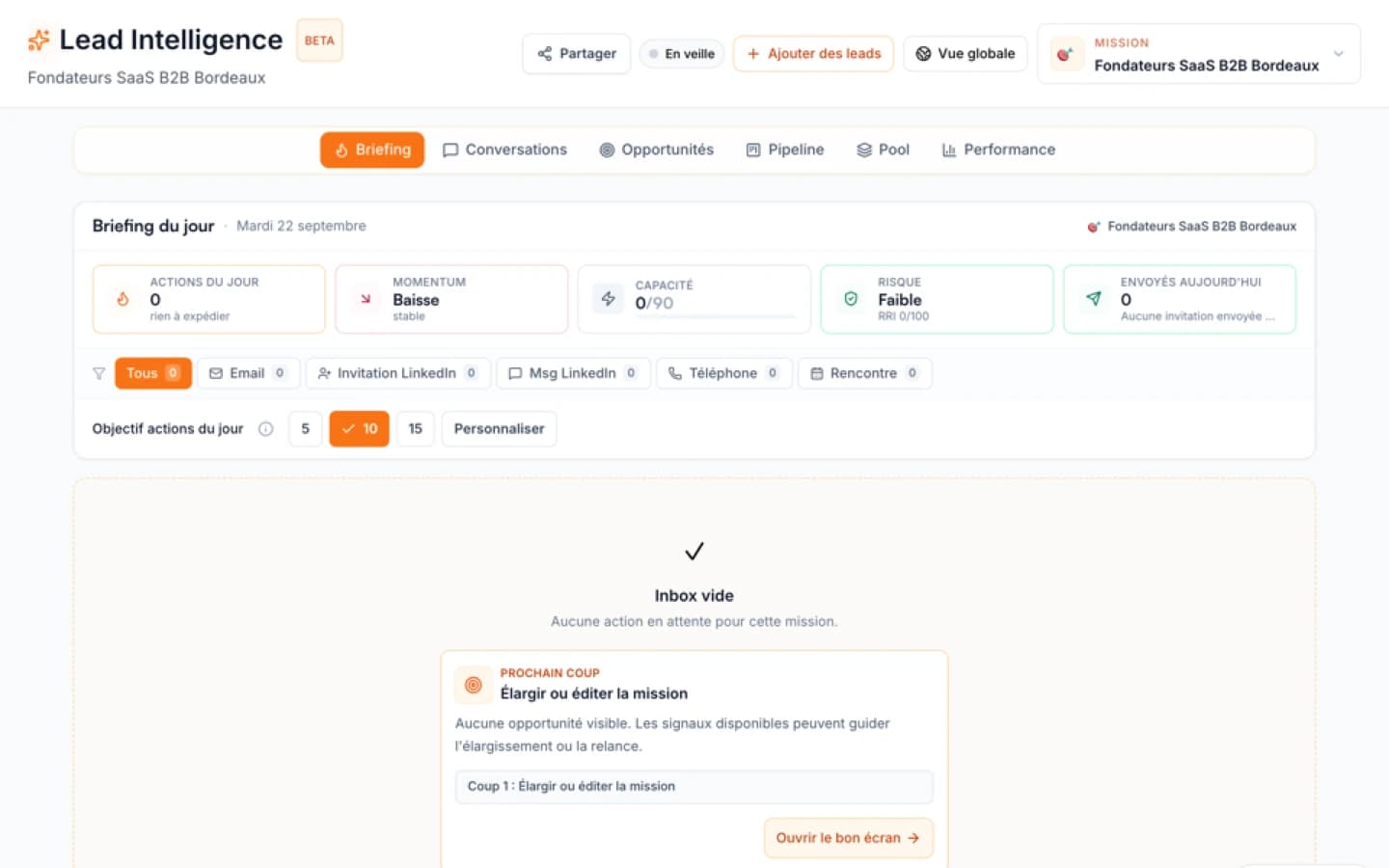
The operational workflow of Lead Intelligence transforms how scale-up teams execute their outbound strategy. Instead of forcing sales development representatives to spend hours cleaning massive databases, the workflow begins with the strategic context of the scale-up. This context guides the discovery process directly. A key advantage of this approach is its flexibility regarding data volume. Lead Intelligence finds and prioritizes the contacts itself whether the team starts with 10, 100, or 1,000 contacts, meaning there is no minimum contact threshold required to generate value.
Once the initial parameters are set, the system analyzes target accounts to identify active buying signals. This workflow is designed to limit manual setup. While a platform like Clay offers data points to assemble, for example Sales Navigator (Clay), Lead Intelligence handles the search: it detects changes across people and companies and sorts accounts into explained opportunities to watch, act on or set aside.
The final step of the workflow delivers immediate, execution-ready insights. Rather than presenting a static list of names and phone numbers, Lead Intelligence proposes the next action and channel that fit the lead situation. This ensures that when a Chief Executive Officer or a sales leader reviews the pipeline, every recommended contact comes with a clear reason for engagement and a tailored messaging angle. By automating this entire sequence, scale-up teams can transition from generic, high-volume email blasts to highly personalized, timely conversations that help protect the brand's reputation.
Expected result
The ultimate expected result of integrating Lead Intelligence into a scale-up sales workflow is the transition from high-volume noise to high-intent conversations. Traditional sales intelligence platforms are built for the case where a company needs to build massive lists. For instance, Apollo presents itself as an AI-powered go-to-market system with 240 million contacts, according to Apollo. Similarly, Clay offers data purchasing from 200+ providers and a Sales Navigator data point, according to the homepage and Sales Navigator page of Clay. While these tools are excellent for database building, scale-up teams can struggle to translate raw records into immediate sales actions. Lead Intelligence by Ember delivers a different outcome by focusing on contextual prioritization. With usable targeting context, the first prioritized leads can appear in about 30 minutes. The system operates independently of volume, meaning it finds and prioritizes contacts itself whether the team starts with 10, 100, or 1,000 contacts, with no minimum contact threshold. For a Chief Executive Officer (CEO) and their management team, the primary result is a clear, explainable next action for every high-value opportunity. The platform proposes the next action and channel that fit the lead situation, allowing sales representatives to know exactly who to contact, why they should reach out now, and which angle to use. By classifying accounts into explained opportunities to watch, act on, or set aside, Lead Intelligence helps replace generic outreach with tailored, signal-driven interactions. This helps direct the scale-up's sales resources toward the accounts that deserve action now.
To judge the result, compare the number of useful conversations per week over four weeks before and after, rather than the number of messages sent. A lower sending volume can be a good sign if useful conversations hold steady.
Example Ember mission
To illustrate how this works in a real-world scenario, consider a scale-up team preparing to expand into a new market segment. Instead of purchasing a static list of unverified emails, the team initiates a targeted mission. The process begins by leveraging existing strategic assets. Lead Intelligence reuses the Ember Business Plan, Ideal Customer Profile (ICP), offer, and strategy to prepare the sales mission. This helps align the outbound effort with the company's core positioning rather than relying on generic templates. Once the mission is defined, Lead Intelligence finds accounts from the mission ICP and signals, then verifies useful sources. The system does not require a massive initial database to be effective. In fact, Lead Intelligence finds and prioritizes the contacts itself whether the team starts with 10, 100 or 1,000 contacts, with no minimum contact threshold. This flexibility allows scale-up teams to run highly focused micro-campaigns or broader discovery phases with equal ease. As the mission progresses, the system monitors signals about people and companies to keep the context up to date and proposes the next action and channel that fit the lead situation. Instead of sending identical automated sequences to every prospect, sales representatives receive specific recommendations on who to contact, when to reach out, and which channel to use. Finally, the scale-up team receives clear proof of the mission's operational impact. After the mission, Ember shows the contacts analysed, signals detected, and priority actions actually recorded by the platform. This transparent reporting makes the first value actually produced by the mission visible, allowing the leadership team to evaluate the relevance of the detected opportunities before committing further sales resources.
This approach also connects with How to qualify B2B leads without a marketing department?, which clarifies the next choice.
Limits and non-fit
Scale-up teams must evaluate where Lead Intelligence fits within their existing sales technology stack and where it does not. While the tool excels at turning strategic context into prioritized sales actions, it is not a universal replacement for every sales tool on the market.
First, Lead Intelligence is not a tool for raw database scraping or high-volume cold blasting. If a scale-up team requires a massive, static directory to execute broad, unsegmented email campaigns, established database providers are a better fit. For instance, Apollo, which highlights 240 million contacts (Apollo), is an example of an established database provider. Lead Intelligence, by contrast, focuses on strategic relevance. It operates independently of initial list size, meaning it can find and prioritize contacts whether a sales team starts with 10, 100, or 1,000 contacts, but its core mechanism is designed to identify high-intent opportunities rather than accumulating millions of raw records.
One last point of caution: prioritization remains a decision aid. The CEO stays responsible for choosing the segments, for setting the number of conversations the team can realistically handle, and for checking every week that the flagged accounts really deserve attention.
Second, complex Go-To-Market (GTM) teams with highly customized, multi-layered data orchestration workflows may hit structural limits. For organizations that need to build intricate data pipelines with dozens of third-party API (Application Programming Interface) integrations, dedicated data enrichment platforms are more appropriate. A platform like Clay, which presents itself as infrastructure to get data and run agentic workflows (Clay), offers a Sales Navigator data point (Clay) among many integrations. Ember is designed for strategic execution and actionability, not for complex data engineering.
Finally, integration depth is a key consideration for scale-ups with rigid Customer Relationship Management (CRM) requirements. Ember does not automatically synchronize every CRM. While Lead Intelligence can analyze, read-only, a sample from Apollo, Lemlist, Clay, HubSpot, Salesforce or Pipedrive through an API (a limited-access feature), its initial version synchronizes no CRM. Scale-up teams that require real-time, automated database mirroring across their entire sales stack will find this operating model to be a limitation. For these teams, Lead Intelligence is best used as a strategic layer to identify who to contact and why now, rather than a primary CRM database manager.
When to use it
For a Chief Executive Officer (CEO) of a rapidly growing company, timing is everything. Deploying Lead Intelligence is particularly useful in three specific business scenarios where traditional, volume-heavy prospecting methods fail to deliver results. The first scenario is when launching a new product or entering an unfamiliar market segment. In this phase, scale-up teams need to validate their Ideal Customer Profile (ICP) without committing massive resources to data acquisition. Lead Intelligence is designed to find and prioritize contacts itself, whether the sales team starts with 10, 100 or 1,000 contacts, with no minimum contact threshold required to begin. This allows the team to run highly targeted, low-volume experiments to test messaging and gather immediate feedback before scaling up. The second scenario occurs when the outbound sales engine is producing too much noise and too few high-value conversations. Traditional Business-to-Business (B2B) databases are built for sheer volume. For example, Apollo, a sales engagement platform that highlights 240 million contacts (Apollo), provides vast lists of contacts. However, when a scale-up needs to move past generic email blasts, Lead Intelligence is used to analyze the specific situation of each prospect. It proposes the next action and channel that fit the lead situation, ensuring that sales representatives reach out with the right angle at the right moment. The third scenario is when the Go-To-Market (GTM) team spends more time cleaning spreadsheets and configuring complex workflows than actually speaking to prospects. Data platforms like Clay, which presents itself as infrastructure to get data and run agentic workflows (Clay), have to be configured and supervised, which takes time for a team without a dedicated profile. Lead Intelligence is deployed when the Chief Executive Officer wants to bypass this operational friction. By automatically monitoring signals and prioritizing opportunities based on the strategic context of the business, it allows the sales team to focus entirely on executing high-impact conversations.
Next step
For a scale-up Chief Executive Officer, the immediate next step is to shift the sales team from a high-volume, low-conversion mindset to a highly targeted, context-driven approach. This transition begins by aligning daily outreach with the company's core strategic goals. Instead of tasking sales representatives with building massive, untargeted lists, leadership can leverage existing strategic assets to define a precise prospecting mission. To start this process, the team can deploy Lead Intelligence to run a targeted sales mission. Because the system operates independently of volume constraints, Lead Intelligence finds and prioritizes the contacts itself whether the team starts with 10, 100 or 1,000 contacts, with no minimum contact threshold. This flexibility allows scale-up teams to test new market hypotheses or target niche enterprise accounts without needing to purchase or clean thousands of cold records beforehand. Once the mission is initiated, the platform analyzes the target accounts against the company's specific Ideal Customer Profile (ICP) and strategic context. Rather than delivering a static spreadsheet, it proposes the next action and channel that fit the lead situation. This provides the sales team with a clear next action, detailing who to contact, why now, which channel to use, and which angle to take. By focusing energy only on opportunities that show genuine readiness, the scale-up can protect its brand reputation and direct its sales resources where they are most useful.
Plan a thirty-minute weekly review: which opportunities were handled, which led to a real conversation, and which criteria should be tightened or widened. This review matters more than the choice of tool.
In practice, How Small Sales Teams Qualify Inbound Leads Without a CRM? completes this framework with another angle on the same topic.
Sources
This analysis is built on a combination of market data, competitor positioning, and product specifications. To understand the broader landscape of lead enrichment and sales intelligence, we examined industry definitions such as those provided by ActiveProspect, which outlines how lead intelligence helps businesses verify quality and optimize acquisition. The product capabilities and use cases of Ember are those of the product: Lead Intelligence finds and prioritizes contacts without a minimum contact threshold, whether starting with 10, 100, or 1,000 contacts, and the first prioritized leads can appear in about 30 minutes with usable targeting context. The descriptions of Apollo and Clay reproduce their official pages (Apollo, Clay, Clay Sales Navigator), consulted on 28 September 2026. This article is published by Ember, the publisher of Lead Intelligence.
Sources
FAQ
Free diagnostic
Test your sales file
Drop an Excel or CSV and check its readiness without sending its rows to Ember.