
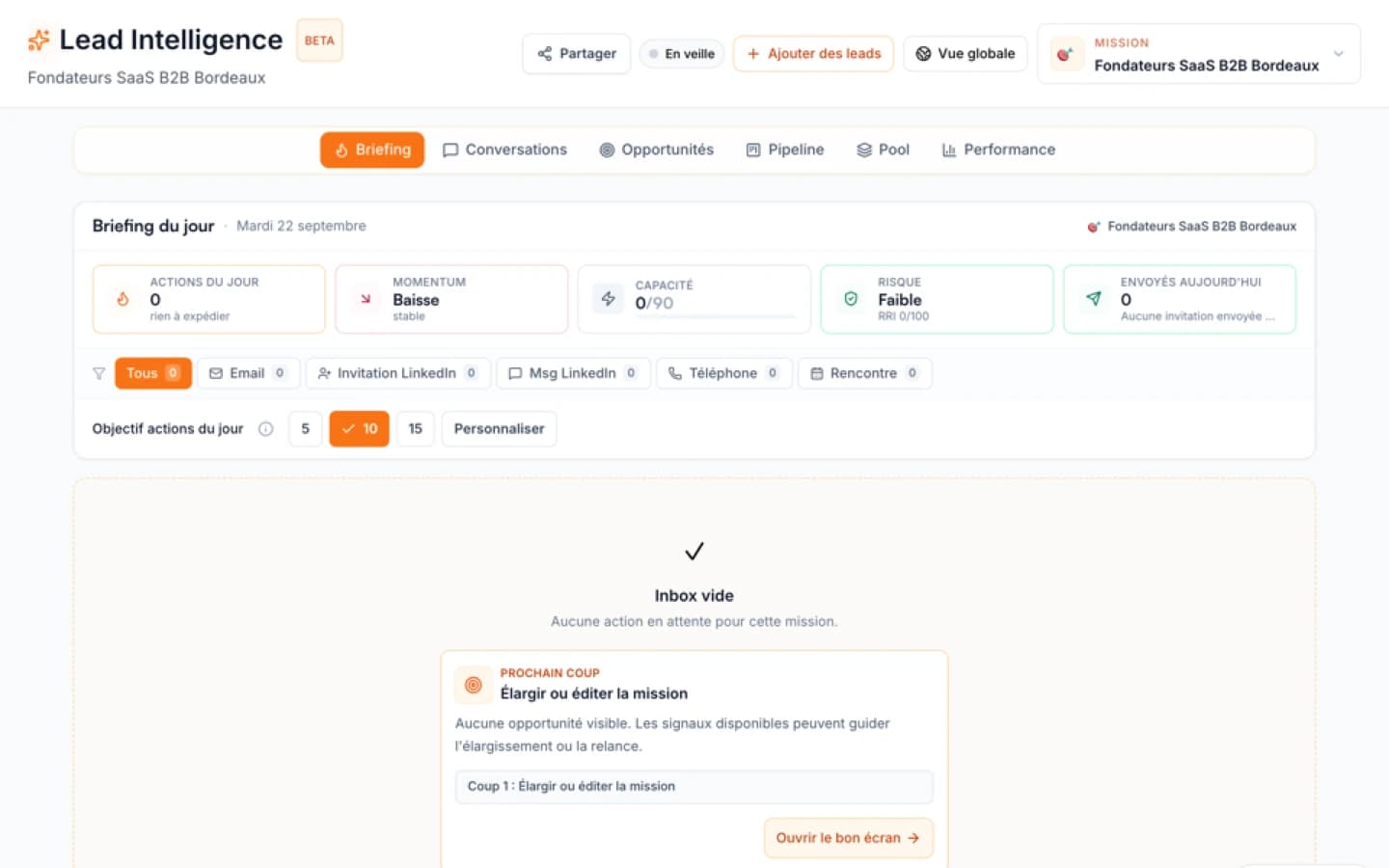
Context and ICP
For leaders of a growing Small and Medium-sized Enterprise (SME) operating in the Business-to-Business (B2B) sector, commercial efficiency is a daily battle. Unlike large corporations with dedicated sales operations teams, a growing SME must maximize every single sales interaction. Traditional prospecting often results in a high volume of cold, unresponsive contacts, which dilutes sales efforts and wastes valuable time. This is where lead intelligence becomes a critical asset, helping teams move away from generic list-building to focus on high-probability opportunities. Leveraging deep buyer insights is essential for driving modern go-to-market performance and ensuring that sales conversations are highly relevant, a necessity highlighted in industry analyses by Highspot.
The primary challenge for an SME leader is knowing exactly where to direct their sales team's energy. Instead of chasing thousands of cold profiles, leaders need to identify which accounts are actually ready to buy. Lead Intelligence by Ember addresses this challenge by analyzing context and human relationships, detecting real-time changes across people and companies to adjust priorities dynamically. The system makes priority explainable from context, signals, and opportunity readiness, ensuring that sales teams understand the precise reason behind every recommendation, as outlined on the Ember Lead Intelligence page.
This approach is highly scalable and adapts to the existing data maturity of the business. SME leaders do not need to possess massive databases to get started. Lead Intelligence finds and prioritizes the contacts itself whether the team starts with 10, 100, or 1,000 contacts, with no minimum contact threshold. This flexibility allows growing businesses to launch targeted campaigns immediately without waiting to build or buy massive contact lists.
Furthermore, speed to execution is vital for SMEs looking to capture market share from larger, slower competitors. When a business leader inputs their targeting criteria, they cannot afford days of manual research or complex software configuration. With usable targeting context, the first prioritized leads can appear in about 30 minutes. By monitoring signals about people and companies to keep the context current, the platform ensures that growing B2B companies can act on fresh, relevant opportunities before their competitors even notice the signal.
To place this decision in context, the Knowledge guides for sales brings together deeper guidance on the same field.
Problem
Lead intelligence is the process of gathering, analyzing, and enriching data about prospective buyers to understand their context, intent, and readiness before reaching out. For a growing Small and Medium-sized Enterprise (SME), the core commercial problem is rarely a lack of raw contact data, but rather a lack of actionable context. When sales teams rely on static lists, they waste valuable hours chasing cold prospects who have no current need for their services, resulting in low conversion rates and demotivated sales representatives.
Traditional unified sales platforms like Apollo.io are highly effective for building massive pipelines and simplifying the sales stack for modern Business-to-Business (B2B) sales and marketing teams. Similarly, data enrichment platforms like Clay offer powerful integrations, such as their official LinkedIn Sales Navigator data point integration, which is excellent for deep lead discovery and connection insights. However, for an SME leader with limited sales resources, managing these highly technical, data-heavy configurations often creates a secondary problem: a flood of raw data that still requires manual prioritization. Without a dedicated sales operations team to filter this data, the sales representatives themselves must spend hours researching LinkedIn profiles or company news to find a relevant angle of approach.
This manual research creates a significant bottleneck. Instead of engaging in high-value conversations, sales teams spend their time trying to determine who to contact, why they should contact them now, and what message to send. This inefficiency is particularly damaging for growing companies that need to maximize the impact of every single sales interaction. Furthermore, many traditional tools require a high volume of data to function effectively, forcing companies into a volume trap. True lead intelligence should find and prioritize contacts automatically, whether a team starts with 10, 100, or 1,000 contacts, eliminating any artificial minimum contact threshold. For an SME leader, solving this problem means shifting from volume-based prospecting to context-driven prioritization, ensuring that sales efforts are focused exclusively on opportunities that deserve action immediately.
Prerequisites
Before a Small and Medium-sized Enterprise (SME) can successfully deploy lead intelligence, certain strategic and operational foundations must be in place. Deploying advanced technology without these prerequisites often leads to automated noise rather than meaningful Business-to-Business (B2B) conversations.
First, the business must have a clear definition of its target market and value proposition. This involves establishing an Ideal Customer Profile (ICP) that outlines the specific industries, company sizes, and decision-maker roles that derive the most value from the offering. Without this strategic alignment, any lead intelligence system will struggle to filter out irrelevant data.
Second, the organization needs a structured way to handle contact volume, though modern solutions have made this requirement highly flexible. Traditional databases often demand massive lists to generate any statistical value. However, advanced systems can operate effectively at any scale. Whether a sales team starts with 10, 100, or 1,000 contacts, modern systems can find and prioritize opportunities without requiring a massive initial database. This flexibility allows SME leaders to initiate targeted campaigns without waiting to build a massive database.
Third, there must be an understanding of what constitutes a meaningful buyer signal. According to the Highspot Guide on Lead Intelligence, leveraging buyer insights is essential for driving go-to-market performance. Leaders must identify which external changes, such as leadership shifts or technology updates, actually indicate a readiness to buy. This aligns with insights from the Blue Frog Guide on B2B Lead Intelligence Platforms, which highlights how platforms help teams focus on high-intent opportunities rather than cold outreach.
Finally, the SME must establish a clear workflow for execution. Gathering intelligence is only valuable if it leads to action. As discussed in the Signal Data Intelligence Guide, lead intelligence must guide growth teams toward concrete next steps. The technology should not just present data, but actively propose the next action and channel that fit the lead situation, a capability built directly into Ember Lead Intelligence. This ensures that sales representatives do not waste time wondering how to initiate contact, but can immediately execute highly personalized outreach.
To explore this point further, Lead Intelligence Use Cases for Consulting Firm Directors details a step directly related to this decision.
Workflow
To implement lead intelligence without drowning in administrative overhead, a Business-to-Business (B2B) Small and Medium-sized Enterprise (SME) leader needs a workflow that connects strategy directly to execution. Instead of treating prospecting as an isolated task, an effective workflow embeds lead intelligence directly into the daily commercial routine of the business.
The process begins by establishing the strategic foundation. Rather than starting with a blank database, the workflow reuses the existing business plan, Ideal Customer Profile (ICP), and core offering. This context ensures that any subsequent search is aligned with the actual commercial goals of the enterprise. For organizations that require highly structured, high-volume outbound campaigns, established platforms are often the right choice. For instance, Apollo.io positions itself as a unified sales and marketing platform, which is highly effective for teams with dedicated Sales Development Representative (SDR) and Revenue Operations (RevOps) roles focused on pipeline coverage, as detailed in the Factors.ai analysis. Similarly, for teams that want to build custom data pipelines, Clay provides powerful options such as their official Clay Sales Navigator integration to discover connections and enrich leads.
For a growing SME where the leader or a small sales team wears multiple hats, the workflow must be simpler and more direct. This is where Ember's Lead Intelligence transforms the approach. The workflow bypasses the need for complex database management. Lead Intelligence finds and prioritizes the contacts itself whether the team starts with 10, 100 or 1,000 contacts, with no minimum contact threshold.
Once the initial contacts are identified, the workflow shifts to continuous monitoring and prioritization. Instead of sending generic email blasts, the system monitors real-time signals about people and target companies. This allows the SME leader to classify opportunities into clear categories: accounts to watch, accounts to act on immediately, or accounts to set aside. The final step of the workflow is translation into action. For every high-priority opportunity, the system proposes the next action and channel that fit the specific lead situation, ensuring that the sales team knows exactly who to contact, why the timing is right, and what message to send. This closed-loop process ensures that commercial time is spent only on conversations that have a genuine reason to happen.
Expected result
When a Business-to-Business (B2B) Small and Medium-sized Enterprise (SME) successfully deploys lead intelligence, the most immediate result is the elimination of commercial noise. Instead of forcing sales teams to sift through thousands of cold, unverified profiles, the commercial operation shifts toward high-value conversations. According to insights on leveraging buyer data from Highspot, lead intelligence helps teams drive go-to-market performance by focusing on buyer engagement rather than raw volume.
For the SME leader, the primary outcome is a predictable, context-driven sales pipeline. Rather than guessing which accounts to target, the system continuously monitors signals across organizations and individuals. As highlighted by Signal Data Intelligence, this approach transforms raw data into actionable intelligence, allowing growth teams to understand buyer intent before making contact. The sales team no longer asks who to call at the start of the week. Instead, they receive a prioritized list of opportunities, complete with the specific reason why each lead is receptive right now.
This transition directly impacts resource allocation. In smaller organizations, sales representatives often spend a significant portion of their day on manual research and data enrichment. Implementing a dedicated platform, as discussed by Blue Frog, streamlines tactical execution and supports strategic growth by ensuring that every outreach is grounded in real-time context.
With Ember, this expected result becomes highly accessible. The Lead Intelligence module understands context and human relationships, detecting changes across people and companies to adjust priorities dynamically. Whether an SME starts with 10, 100, or 1,000 contacts, the system finds and prioritizes the contacts itself with no minimum contact threshold. By proposing the next action and channel that fit the specific lead situation, Ember ensures that the final result of your lead intelligence effort is not just a cleaner database, but a continuous stream of relevant, high-impact business conversations.
This approach also connects with Lead Intelligence Use Cases for Sales Directors: A Decision Guide, which clarifies the next choice.
Example Ember mission
To see how this works in practice, consider a Business-to-Business (B2B) Small and Medium-sized Enterprise (SME) that sells specialized industrial software. The business leader wants to target manufacturing companies undergoing digital transformation but lacks the time to manually track down which companies are actively hiring or expanding.
Instead of starting from scratch with generic databases, the leader launches a targeted mission. Ember prepares this sales mission by reusing the existing Ember Fund Your Growth, Ideal Customer Profile (ICP), offer, and strategy, ensuring that the outreach remains aligned with the core business goals.
Once the mission is configured, the system finds accounts from the mission ICP and signals, then verifies useful sources to ensure data accuracy. Whether the sales team starts with a list of 10, 100, or 1,000 contacts, Lead Intelligence prioritizes the contacts itself with no minimum contact threshold. This flexibility allows the SME to run highly targeted micro-campaigns without needing massive databases to see results.
During the mission, the system analyzes the target accounts and proposes the next action and channel that fit the specific lead situation, as outlined on the Ember Lead Intelligence page. For instance, if a target company has recently updated its software infrastructure, the proposed action might be a personalized LinkedIn message focusing on integration capabilities, rather than a generic cold email.
After the mission completes, the leader does not have to guess what was achieved. Ember makes the first value actually produced by the mission visible by showing the contacts analysed, signals detected, and priority actions actually recorded, as documented on the Ember Lead Intelligence page. This transparent proof helps the SME leader quickly evaluate the relevance of the detected opportunities and direct the sales team toward the conversations that deserve immediate attention.
Limits and non-fit
While lead intelligence platforms offer significant advantages for growth, they are not a universal solution for every commercial setup. Understanding where these tools reach their limits helps Business-to-Business (B2B) Small and Medium-sized Enterprise (SME) leaders make informed software decisions.
First, if your primary requirement is a highly structured, unified sales platform to manage a massive outbound pipeline and simplify your entire software stack, an established player like Apollo is often a more suitable choice. As declared on the Apollo website, their platform is built as a unified Artificial Intelligence (AI) sales platform for modern sales and marketing teams to handle pipeline and closing. For organizations that require highly customized data enrichment workflows, such as utilizing the official LinkedIn Sales Navigator integration, a specialized tool like Clay provides dedicated data point integrations as documented by Clay.
Second, Ember Lead Intelligence is designed to prioritize opportunities based on deep business context rather than executing bulk, automated database synchronization. It does not automatically synchronize with every Customer Relationship Management (CRM) system. To protect sensitive data, the Application Programming Interface (API) connection is never transferred silently and must be entered manually within the Ember account, as detailed in the Ember Lead Intelligence product specifications.
Finally, lead intelligence is not a replacement for human relationship building. While the system understands context and proposes the next action and channel that fit the lead situation, the actual outreach and relationship management remain the responsibility of the sales team. It is highly effective for focused, high-intent prospecting, finding and prioritizing contacts itself whether the team starts with 10, 100, or 1,000 contacts. However, businesses looking for a completely hands-off, fully automated spam engine will find that this context-driven approach does not align with high-volume, low-quality blast campaigns.
In practice, Lead Intelligence Use Cases for Account Executives completes this framework with another angle on the same topic.
When to use it
For a growing Business-to-Business (B2B) Small and Medium-sized Enterprise (SME), timing is often more valuable than raw volume. Implementing a lead intelligence strategy becomes critical in three distinct operational scenarios.
First, use lead intelligence when your sales team is bogged down by manual research. Instead of spending hours cross-referencing profiles or company websites, a lead intelligence platform automates the gathering of buyer insights to drive better go-to-market performance, as highlighted by Highspot. This is particularly useful when you need to understand the deeper context of a prospect before making contact.
Second, deploy these tools when your market signals are highly dynamic. If your ideal customer profile depends on specific triggers, such as leadership changes or company expansion, manual tracking is virtually impossible. According to Signal Data Intelligence, tracking these real-time shifts allows growth teams to identify active buying windows. By understanding context and human relationships, the system detects changes across people and companies to adjust priorities automatically.
Third, lead intelligence is essential when you need to scale a small sales team without adding administrative headcount. In smaller organizations, sales representatives often act as their own operations teams. Platforms like Blue Frog emphasize that centralizing these insights helps teams focus on execution rather than data cleaning. With Ember, this capability is highly flexible. The Lead Intelligence module finds and prioritizes the contacts itself whether the team starts with 10, 100 or 1,000 contacts, with no minimum contact threshold. It then proposes the next action and channel that fit the lead situation, allowing a lean sales team to act with the precision of a much larger enterprise.
Next step
For a Small and Medium-sized Enterprise (SME) leader looking to move past manual prospecting, the logical next step is to run a targeted pilot. Instead of committing to massive database subscriptions or complex integrations, start with a highly defined segment of your Ideal Customer Profile (ICP).
This is where Ember can help. Through its Lead Intelligence capability, the platform helps business leaders understand a changing context, choose the next priority, and take action immediately. You do not need a massive database to begin. In fact, Lead Intelligence finds and prioritizes the contacts itself whether the team starts with 10, 100 or 1,000 contacts, with no minimum contact threshold.
By launching a focused mission, the system analyzes your business context and automatically proposes the next action and channel that fit the lead situation, as detailed on the Ember Lead Intelligence product page. This provides your sales team with a clear next action, defining exactly who to contact, why now, which channel to use, and which angle to take.
To begin, identify your most critical growth segment for the upcoming quarter, gather your existing context, and let Ember turn that strategy into prioritized, actionable conversations.
Before deciding, Lead Intelligence for an accounting firm helps connect this method with adjacent priorities.
Sources
In addition to these foundational guides, this article draws on product and market data to compare modern sales intelligence workflows. We refer to the official Ember Lead Intelligence capabilities, which allow teams to find and prioritize contacts without a minimum contact threshold. For market context and competitor positioning, we examined the unified sales platform model described on the Apollo homepage. Technical integration capabilities, such as the official LinkedIn Sales Navigator data point integration, were sourced directly from Clay, while broader market alternatives were evaluated using analyses from Derrick App.
Sources
FAQ
Free diagnostic
Test your sales file
Drop an Excel or CSV and check its readiness without sending its rows to Ember.