
Context and ICP
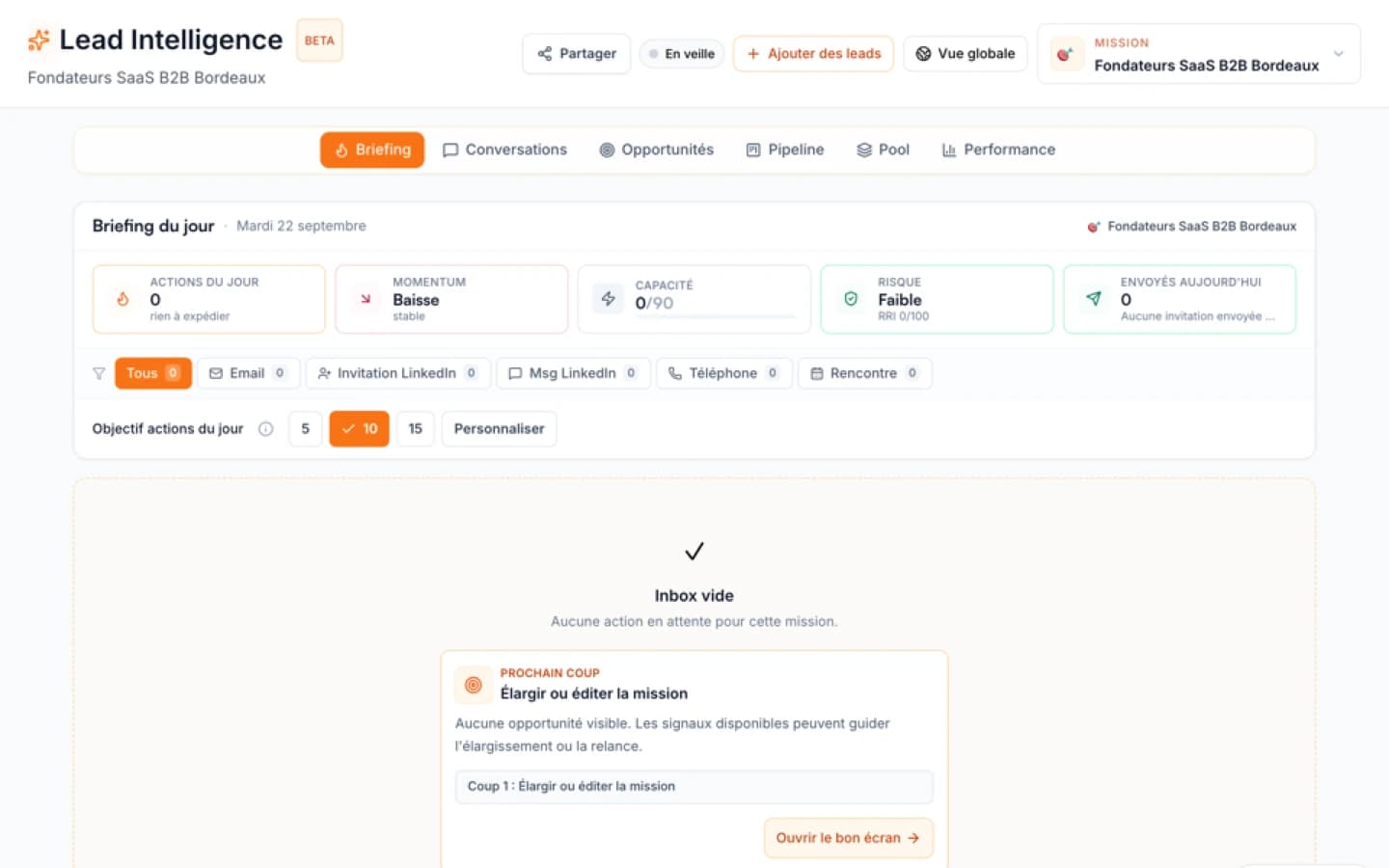
For sales teams, particularly an Account Executive (AE), time is the most valuable asset. Instead of spending hours manually researching accounts or guessing which prospects are ready to buy, AEs need a structured way to identify high-potential opportunities. This is where the concept of lead intelligence becomes critical. According to Highspot, the real advantage of B2B lead intelligence comes from centralizing internal and external insights into one operating layer that informs prioritization, timing and messaging. The primary challenge for sales teams is not a lack of data, but an excess of noise. Traditional prospecting lists often lack the real-time context needed to make a meaningful connection. To solve this, Ember offers Lead Intelligence, a capability designed to help founders and sales teams prioritize opportunities with their context. By analyzing available information, Lead Intelligence prioritizes opportunities from the available context, making the priority explainable from context, signals, and opportunity readiness. This approach is highly relevant for AEs managing complex pipelines. The system understands context and human relationships, and it actively detects changes across people and companies to adjust priorities. It monitors signals about people and companies to keep context current. This means AEs do not have to wait for outdated databases to refresh. In fact, with usable targeting context, the first prioritized leads can appear in about 30 minutes. Furthermore, this capability is highly flexible. Lead Intelligence finds and prioritizes the contacts itself whether the team starts with 10, 100 or 1,000 contacts, with no minimum contact threshold. This allows AEs to run highly targeted micro-campaigns or broader outbound motions, focusing their energy on the conversations that deserve attention now.
To place this decision in context, the Knowledge guides for sales bring together deeper guidance on the same field.
Problem
For an Account Executive (AE), the primary challenge in modern sales is not a lack of prospect data, but an excess of noise. Traditional prospecting often forces sales teams to sift through massive lists of accounts without knowing which prospects are actually ready to engage. Platforms like Apollo, which describes itself as an AI sales platform combining data, intelligence and execution for the whole go-to-market motion (Apollo), address a broader need than prioritization alone. Clay, for its part, offers a Sales Navigator data point to discover potential leads and gain insights into professional connections (Clay). The question that remains is who to contact first and with which message. According to Highspot's blog, citing its 2025 State of Sales Enablement Report, two in five (41%) B2B companies struggle to engage buyers, in part due to a lack of unified GTM analytics. Without context-driven prioritization, AEs spend hours researching companies, looking for trigger events, and drafting personalized messages from scratch. This manual overhead dilutes their focus, pulling them away from high-value closing activities. Whether a sales team starts with 10, 100 or 1,000 contacts, the absence of a clear, context-aware prioritization mechanism makes it incredibly difficult to identify which opportunities deserve immediate action. AEs need a way to cut through the noise and receive clear, explainable recommendations on who to contact, why the timing is right, and which channel to use.
Prerequisites
Before an Account Executive (AE) can successfully leverage lead intelligence to close deals, certain foundational elements must be in place. Lead intelligence is not a tool that replaces sales strategy. Instead, it is an accelerator that requires a clear starting point to deliver maximum value.
First, sales teams must move away from the misconception that they need a massive, pre-cleaned database to begin. A critical prerequisite is simply having a starting list of target accounts or a clear definition of the Ideal Customer Profile (ICP). Whether an AE is starting with a small list of strategic accounts or a broader segment, the technology adapts. For example, Lead Intelligence finds and prioritizes the contacts itself whether the team starts with 10, 100 or 1,000 contacts, meaning there is no minimum contact threshold required to begin.
Second, AEs need the ability to connect their active professional networks to the intelligence tool. Effective lead discovery relies heavily on real-time professional data. A key prerequisite is having active access to professional networks to search and import profiles through LinkedIn or Sales Navigator from a connected account. Clay also offers a Sales Navigator data point, presented on its integration page as a way to discover potential leads and gain insights into professional connections.
Finally, AEs must have a defined workflow for executing follow-ups. Raw intelligence is useless without a clear path to engagement. The sales team must be prepared to act when the system proposes the next action and channel that fit the lead situation. Having these prerequisites in place helps lead intelligence translate into active, high-value sales conversations rather than just another set of unread dashboard metrics.
Workflow
To transform raw data into closed deals, an Account Executive (AE) must follow a structured workflow that replaces manual guessing with context-driven execution. This workflow begins by aligning the sales mission with the strategic foundation of the business. Instead of treating prospecting as an isolated task, the sales team reuses the company's established Ideal Customer Profile (ICP), core offer, and business strategy to prepare a targeted sales mission. This helps root every outbound effort in the value proposition of the company. Once the mission is defined, the process moves to lead discovery and ingestion. Sales teams can search and import profiles through LinkedIn or Sales Navigator from a connected account, or import existing lists from Excel or CSV (up to 3,500 valid contacts). Lead Intelligence adapts to different scales of operation. It finds and prioritizes the contacts itself whether the team starts with 10, 100, or 1,000 contacts, with no minimum contact threshold. This flexibility allows an AE to run highly targeted micro-campaigns without worrying about data volume constraints. After the contacts are in the system, the core prioritization engine takes over. The system continuously monitors signals about people and companies to keep the context current, automatically classifying accounts into explained opportunities to watch, act on, or set aside. This step is crucial for separating active buyers from cold leads. Highspot writes that the advantage of lead intelligence lies in centralized insights that inform prioritization, timing and messaging (Highspot guide). With usable targeting context, the first prioritized leads can appear in about 30 minutes, which lets AEs react quickly to market signals. The final stage of the workflow is execution and optimization. For every high-priority opportunity, the system proposes the next action and channel that fit the lead's specific situation. This eases the decision: send an email, make a phone call or write on LinkedIn. To learn over time, a continuous learning loop connects executed actions, replies, meetings, and final outcomes. This loop helps identify the situations that convert, to inform the next priorities.
To explore this point further, Lead Intelligence for an accounting firm details a step directly related to this decision.
Expected result
When an Account Executive (AE) deploys Lead Intelligence, the primary expected result is a reduction in pipeline noise, shifting the daily focus from manual list-building to high-intent conversations. Instead of spending hours guessing which accounts to target, sales teams receive a prioritized list of opportunities where the priority is explained, grounded in real-time signals and opportunity readiness.
For every prioritized opportunity, the AE receives a clear next action. This includes identifying exactly who to contact, why the timing is right, which channel to use, and the specific angle to take. This gives the AE context to approach each prospect.
This approach is highly flexible and does not require massive databases to be effective. The platform finds and prioritizes contacts itself whether the sales team starts with 10, 100 or 1,000 contacts, with no minimum contact threshold. This allows AEs to run highly targeted micro-campaigns as well as broader market discovery missions.
To streamline this discovery process, AEs can search and import profiles through LinkedIn or Sales Navigator from a connected account. Clay also offers a Sales Navigator data point to discover leads (Clay integrations page).
Ultimately, the expected result is a transparent, observable proof of value. Immediately after running a mission, the AE can review the contacts analyzed, the specific signals detected, and the priority actions recorded. Over time, this feedback loop helps the sales team identify which specific situations and angles convert best.
Example Ember mission
To understand how this works in practice, consider an Account Executive (AE) tasked with expanding into a new mid-market segment. Instead of manually building lists or relying on generic databases, the AE initiates a targeted sales mission within Ember.
The process begins by leveraging existing strategic assets. Lead Intelligence directly reuses the Ember Business Plan, Ideal Customer Profile (ICP), offer, and strategy to prepare the sales mission. This helps ground every search in the positioning of the company rather than generic industry keywords. From there, the system finds accounts based on the mission ICP and active signals, verifying useful sources.
For the AE, this helps avoid a cold start. The sales team can search and import profiles through LinkedIn or Sales Navigator from a connected account. Crucially, Lead Intelligence finds and prioritizes the contacts itself, whether the team starts with 10, 100, or 1,000 contacts, with no minimum contact threshold. This flexibility allows the AE to run highly concentrated micro-campaigns or broader territory reviews.
Once the accounts are identified, the system proposes the next action and channel that fit the specific lead situation. This means the AE receives a clear recommendation, such as reaching out on LinkedIn following a recent hiring signal. After the mission concludes, Ember provides clear visibility into the work performed. The platform shows the contacts analyzed, signals detected, and priority actions actually recorded, which gives the sales team a verifiable record of the work performed. This proof only uses results actually recorded and promises no future gain.
Limits and non-fit
While Lead Intelligence offers significant advantages for prioritizing high-value opportunities, it is not a universal solution for every sales scenario. Understanding where the tool reaches its limits helps sales teams deploy it effectively.
For organizations that require a massive, all-in-one sales infrastructure to manage large-scale outbound volume and marketing automation, dedicated platforms may be a better fit. For example, Apollo describes itself as an AI sales platform combining data, intelligence and execution for the entire go-to-market motion. Similarly, Clay offers a Sales Navigator data point to discover potential leads and gain insights into professional connections. Ember publishes Lead Intelligence, so this comparison is not neutral: test each tool on your own cases.
Ember's Lead Intelligence is built for context-driven prioritization rather than endless database scraping or automated mass emailing. It is important to note the functional boundaries of the current version. This initial version does not synchronize with any Customer Relationship Management (CRM) system. For teams importing data via files, the parsed draft remains entirely local in the browser and resumes after sign-in without requiring a second upload.
Additionally, the performance proof within Ember only displays actual, persisted mission results. It never invents examples to replace missing data, meaning that if no signal is detected for a specific contact, the tool reports this honestly. While Lead Intelligence can find and prioritize contacts whether an AE starts with 10, 100, or 1,000 contacts with no minimum contact threshold, it relies on the quality of the initial strategic context to guide its reasoning. For teams that primarily seek volume, a traditional contact database may be a better fit.
When to use it
Account Executives (AEs) face distinct inflection points where traditional prospecting databases fall short. Deploying Lead Intelligence is particularly effective in four specific scenarios. First, when an Account Executive needs to launch a highly targeted campaign into a new vertical or territory without a pre-existing list. Lead Intelligence operates independently of initial database size. It finds and prioritizes the contacts itself whether the sales team starts with 10, 100 or 1,000 contacts, with no minimum contact threshold. This allows AEs to run highly focused micro-campaigns without wasting time on list cleaning. Second, when transitioning from high-volume cold outreach to high-impact, context-driven conversations. AEs can use Lead Intelligence when they need to leverage deep buyer insights to stand out in crowded inboxes. According to Highspot's guide, the advantage lies in centralized internal and external insights that inform prioritization, timing and messaging. Lead Intelligence goes in that direction by proposing the next action and channel that fit the specific lead situation, so that every touchpoint is relevant and timely. Third, when executing social selling strategies directly on professional networks. Instead of manually copying data or switching between disconnected tools, AEs can use Lead Intelligence to search and import profiles through LinkedIn or Sales Navigator from a connected account. Clay offers a Sales Navigator data point of its own to discover leads; Lead Intelligence pairs profile search with strategic context to propose an angle of approach. Fourth, when aligning daily sales activities with the overarching corporate strategy. When an organization uses Ember to structure its business plan, the sales team can reuse that shared context. This helps avoid the common disconnect where marketing and sales messaging drifts away from the core value proposition. By grounding the sales mission in the same context used to build the business, AEs can align their outreach with the strategic priorities of the company.
This approach also connects with Lead Intelligence Use Cases for SME CEOs: A Structured Guide, which clarifies the next choice.
Next step
To transition from strategic planning to active execution, an Account Executive (AE) should start by defining a single, highly focused sales mission. Instead of attempting to clean an entire legacy database, the most effective approach is to isolate one specific segment, such as a newly targeted vertical or a list of lost opportunities from the previous quarter.
By connecting a LinkedIn account, the Account Executive can search and import profiles through LinkedIn or LinkedIn Sales Navigator to build a highly targeted pool. From there, the platform evaluates opportunities based on real-time signals. Lead Intelligence finds and prioritizes the contacts itself whether the team starts with 10, 100, or 1,000 contacts, with no minimum contact threshold.
Once the initial pool is established, the platform proposes the next action and channel that fit the lead situation. This allows the sales team to transition immediately from manual list building to high-intent conversations. By letting Ember handle the heavy lifting of signal detection and prioritization, Account Executives can stop guessing and start engaging where it matters most.
Sources
- Highspot, "Lead Intelligence: How to Leverage B2B Buyer Insights", updated August 4, 2026, consulted on September 28, 2026: highspot.com.
- Apollo, homepage, consulted on September 28, 2026: apollo.io.
- Clay, Sales Navigator data point page, consulted on September 28, 2026: clay.com.
- Functions of Lead Intelligence: product description by Ember, its publisher.
Sources
FAQ
Free diagnostic
Test your sales file
Drop an Excel or CSV and check its readiness without sending its rows to Ember.