
Context and ICP
For a leader of a Small and Medium-sized Enterprise (SME), especially within the professional services or agency space, business development is often a balancing act between client delivery and active prospecting. Lead intelligence is the practice of gathering, analyzing, and leveraging deep contextual data about prospective clients to turn cold outreach into timely, highly relevant business conversations. Agency directors do not have the luxury of wasting hours on unqualified databases or managing complex, noisy outbound setups. They need to know exactly who to contact, why the timing is right, and what angle to use to initiate a meaningful dialogue. This is where a dedicated approach to lead intelligence changes the dynamic for agency growth. Instead of relying on generic lists, agency leaders can leverage tools that prioritize opportunities from the available context, making the underlying priority explainable from context, signals, and opportunity readiness, as outlined on the Ember Lead Intelligence product page. This allows busy executives to focus their limited business development hours only on the accounts that are actively showing signs of readiness. For an agency, the Ideal Customer Profile (ICP) is often highly specific, meaning that traditional high-volume prospecting tools fail to deliver the necessary precision. According to the Ember Lead Intelligence product specifications, the system finds and prioritizes the contacts itself whether the team starts with 10 or 100 contacts, meaning there is no minimum contact threshold required to start generating value. This flexibility is crucial for agency leaders who prefer targeting a tight, highly curated list of high-value accounts rather than blasting thousands of cold emails. Timing is everything when pitching agency services like marketing, development, or consulting. By monitoring signals about people and companies to keep context current, as detailed on the Ember Lead Intelligence product page, leaders can identify trigger events such as executive departures, new hires, or strategic shifts. This signal-driven approach ensures that outreach is never truly cold. Furthermore, agency leaders do not have to wait days to see the fruits of their setup. With usable targeting context, the first prioritized leads can appear in about 30 minutes, according to the Ember Lead Intelligence product page, allowing agencies to react swiftly to market movements and secure a competitive advantage.
To place this decision in context, the Knowledge guides for sales brings together deeper guidance on the same field.
Problem
For agency directors and leaders of Small and Medium-sized Enterprises (SMEs), business development is rarely a full-time job. Instead, it is an intermittent activity squeezed between client delivery, team management, and daily operations. This creates a structural problem where prospecting is either neglected entirely or executed in sporadic, low-yield bursts. Traditional outbound sales methodologies rely heavily on high-volume campaigns to uncover opportunities. Unified sales platforms like Apollo are built to help modern sales and marketing teams scale their pipelines, but they require continuous attention and a steady stream of outbound activity to work effectively. For a busy agency leader, managing these complex setups is often unrealistic.
Similarly, highly customizable data enrichment tools like Clay, which offers an official LinkedIn Sales Navigator integration for deep connection insights, are excellent for dedicated sales operations teams. However, they demand significant technical configuration to turn raw data points into actual, ready-to-use sales conversations. Without a dedicated sales operations specialist on staff, agency leaders find themselves drowning in data tables rather than talking to qualified prospects.
The core issue is not a lack of data, but a lack of actionable context. Agency leaders do not need thousands of cold, unverified contacts. They need to identify the select few organizations that are experiencing specific pain points right now. When prospecting is treated as a pure numbers game, it creates noise and dilutes the agency's brand. To win high-value consulting, technical, or creative contracts, these leaders need to know exactly who to contact, why the timing is right, and which channel to use. Traditional lead databases fail to provide this level of situational readiness, leaving agency directors to rely on unpredictable word-of-mouth referrals.
Prerequisites
Before an agency director or Small and Medium-sized Enterprise (SME) leader can deploy lead intelligence, certain foundational elements must be in place. This is not about having a complex, fully automated sales department, but rather about establishing the basic inputs that allow intelligent systems to work effectively. First, a clear definition of the target audience and the core offering is essential. Lead intelligence cannot guess who your best clients are without an initial direction. While larger enterprises might rely on massive, unified sales platforms like Apollo to manage extensive pipelines and simplify their marketing stacks, smaller agencies need a more targeted approach. Second, you do not need a massive database to start. A common misconception is that advanced prospecting requires thousands of pre-existing leads. In reality, modern systems are highly adaptable. For example, Lead Intelligence from Ember finds and prioritizes contacts itself whether the team starts with 10 or 100 contacts, meaning there is no minimum contact threshold required to begin, as detailed on the Ember Lead Intelligence page. Third, there must be a shift from collecting raw contact details to seeking contextual insights. Traditional list-building is no longer enough. While data enrichment tools like Clay offer useful technical integrations, such as their LinkedIn Sales Navigator datapoint for connection insights, the real prerequisite for an agency leader is the ability to interpret these signals. The system must be able to understand context and human relationships, detecting changes across people and companies to adjust priorities dynamically. This ensures that when the system proposes the next action and channel that fit the lead situation, as outlined on the Ember Lead Intelligence page, the recommendation is grounded in real-world relevance rather than generic templates.
To explore this point further, Lead Intelligence Use Cases for SME CEOs: A Structured Guide details a step directly related to this decision.
Workflow
An effective lead intelligence workflow for a Small and Medium-sized Enterprise (SME) leader or agency director begins by aligning prospecting with overall business strategy. Instead of starting from scratch with generic search queries, the leader uses existing strategic context, such as the Ideal Customer Profile (ICP) and core offerings defined within their workspace. This integration ensures that any outbound effort directly supports the agency's high-value expertise. By anchoring the prospecting mission in this pre-existing context, the system can target accounts that genuinely match the agency's capacity and positioning.
Once the mission parameters are set, the workflow moves to sourcing. Agency leaders often have fragmented contact lists scattered across spreadsheets, past event sign-ups, or professional networks. Lead Intelligence allows the leader to import these existing contacts or let the system discover new accounts based on active market signals. This approach is highly flexible. According to the Ember Lead Intelligence page, the system finds and prioritizes contacts itself whether the team starts with 10, 100, or 1,000 contacts, meaning there is no minimum contact threshold required to begin. This volume independence is crucial for boutique agencies that prefer highly targeted, low-volume outreach over mass spamming.
After gathering the initial pool of accounts, the system takes over the heavy lifting of research. It monitors real-time signals about companies and individual decision-makers, such as job changes, company growth, or public announcements. By analyzing these signals, the system classifies accounts into clear categories, separating opportunities to watch from opportunities to act on immediately. This automated enrichment replaces hours of manual searching, allowing the agency director to focus entirely on prospects that show actual readiness.
The final and most critical step in the workflow is execution. For a busy SME leader, the primary barrier to prospecting is deciding what to say and which channel to use. The system solves this by proposing the next action and channel that fit the specific situation of the lead, as outlined on the Ember Lead Intelligence page. Whether the recommendation is a personalized email, a specific social media connection angle, or a warm phone call, the leader receives a clear, contextual starting point. This transforms prospecting from a daunting, open-ended chore into a series of quick, actionable tasks that can be completed in short blocks of time between client meetings. Over time, a continuous learning loop connects executed actions and meeting outcomes to identify which situations convert best, refining the agency's approach with every interaction.
Outcome to check
An agency can review accounts ordered by the problem it solves and observed public changes. It checks sources and chooses a useful question before each contact. The ranking does not measure purchase probability. An overseas launch may justify asking about content adaptation, for example, but not claiming the company wants a new agency. Replies show whether targeting should change.
Example Ember mission
To illustrate how this works in practice, consider an agency director who needs to secure new corporate accounts but has limited hours to dedicate to outbound sales. Instead of manually building lists or guessing which companies are ready to buy, the leader launches a targeted mission.
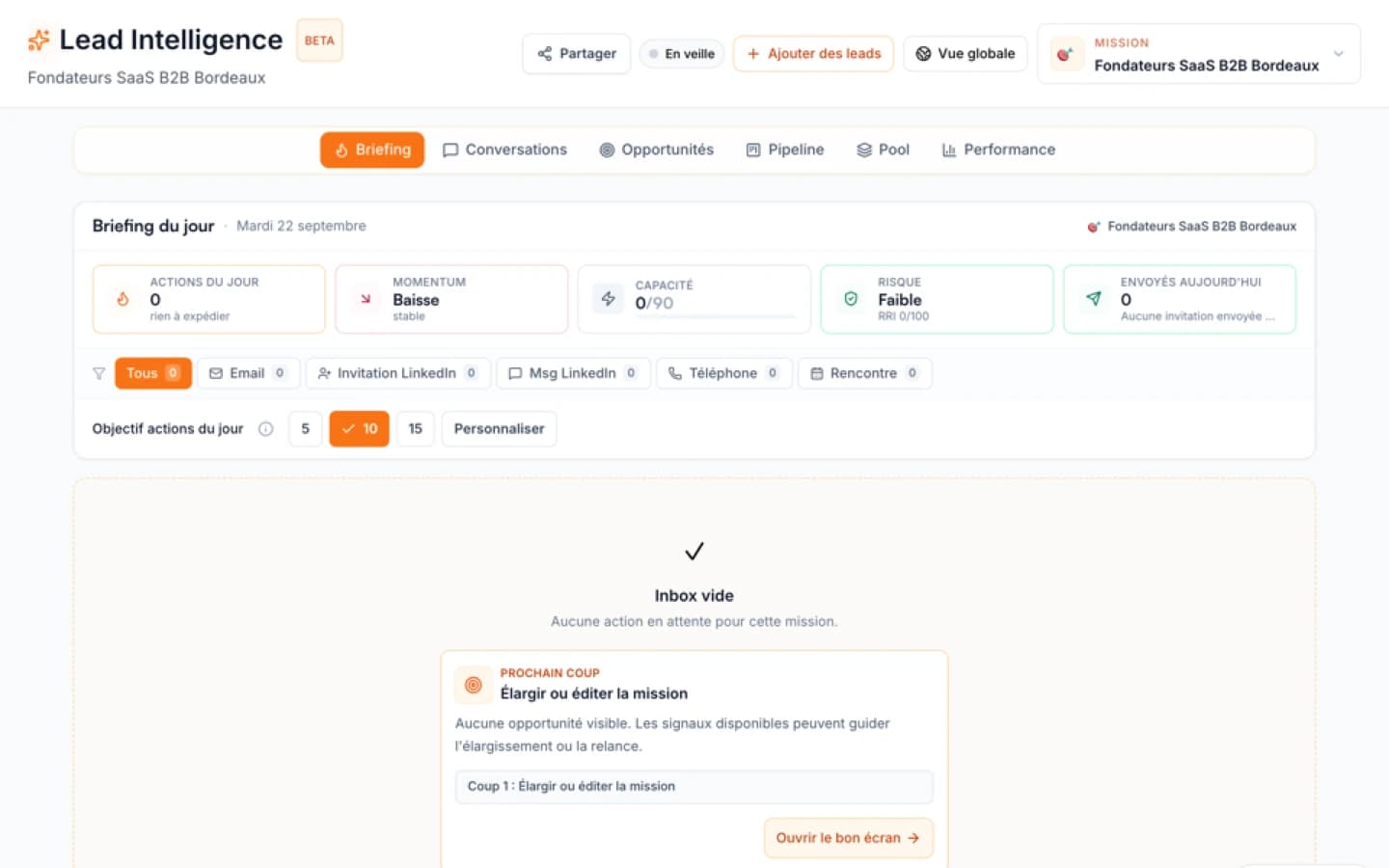
The process begins when Lead Intelligence prepares the sales mission by reusing the existing Ember Fund Your Growth, Ideal Customer Profile (ICP), offer, and strategy, as outlined on the Ember Lead Intelligence page. By anchoring the search in this strategic context, the system avoids generic web scraping and instead finds accounts that match the precise ICP and active signals, verifying useful sources along the way.
A major advantage for busy agency leaders is that they do not need a massive database to see results. According to the Ember product specifications, Lead Intelligence finds and prioritizes the contacts itself whether the team starts with 10, 100 or 1,000 contacts, with no minimum contact threshold. This flexibility allows a Small and Medium-sized Enterprise (SME) leader to run highly focused, small-scale campaigns without any technical friction.
Once the target accounts are identified, the system proposes the next action and channel that fit the specific lead situation, removing the hesitation of what to say and how to reach out. After the mission is complete, Ember shows the contacts analysed, signals detected, and priority actions actually recorded, as detailed on the Ember Lead Intelligence page. This immediate feedback loop makes the first value produced by the mission visible, allowing the agency director to review real, actionable outcomes and move directly into high-value conversations.
This approach also connects with Lead Intelligence Use Cases for Scale-Up CEOs: A Decision Guide, which clarifies the next choice.
Limits and non-fit
While Lead Intelligence offers a powerful way for a Small and Medium-sized Enterprise (SME) leader or agency director to identify high-value opportunities, it is not a universal solution for every sales model. Understanding where the tool fits, and where it does not, is essential for making an informed technology decision. First, Lead Intelligence is not designed for mass, unsegmented outbound volume. If an agency relies entirely on high-volume, automated cold email blasts without regard for relationship context or timing, traditional database providers are often a better fit. For instance, teams looking for an all-in-one sales and marketing platform to manage high-volume pipelines, closing, and overall tech stack simplification may find a dedicated platform like Apollo more suitable, as shown on the Apollo website. Second, if your business development strategy requires highly complex, custom data engineering workflows or programmatic data scraping setups, specialized data enrichment tools are more appropriate. For example, organizations that need deep, technical data orchestration can leverage Clay, which offers an official LinkedIn Sales Navigator data point integration for advanced lead discovery and connection insights, as detailed on the Clay integrations page. Third, Lead Intelligence requires a foundation of strategic intent. It is designed to align with an established Ideal Customer Profile (ICP) and a clear business offering. If an agency has not yet defined its target market or has no clear value proposition, the tool cannot invent these strategic foundations. Ember is built to reduce noise by focusing on context and human relationships, detecting changes across people and companies to adjust priorities. It is highly effective whether an agency starts with 10 or 100 contacts, with no minimum contact threshold, as explained on the Ember Lead Intelligence page. However, for businesses that do not prioritize relationship-driven sales or lack a basic strategic direction, the structured prioritization of Lead Intelligence will not deliver its full value.
When to use it
For an agency director or Small and Medium-sized Enterprise (SME) leader, timing and context are the deciding factors between a successful business relationship and an ignored pitch. Lead Intelligence is most effective in four critical business scenarios where generic, high-volume prospecting fails.
First, use it when launching a highly targeted, niche offer. Traditional sales platforms often require massive databases and broad targeting to function. For example, Apollo serves as a unified sales platform for modern sales and marketing teams aiming to build large pipelines, as described on the Apollo website. However, an agency leader usually needs a precise, high-touch approach rather than bulk emailing. Lead Intelligence finds and prioritizes the contacts itself whether the team starts with 10, 100, or 1,000 contacts, with no minimum contact threshold, as detailed on the Ember Lead Intelligence page. This allows leaders to test a new service on a small, highly qualified cohort without wasting time on massive list-building.
Second, deploy it when you need to monitor key accounts for buying signals. Agency contracts are often won or lost based on timing, such as when a target company hires a new decision-maker or shifts its strategic focus. Lead Intelligence understands context and human relationships, then detects changes across people and companies to adjust priorities. Instead of manually tracking dozens of profiles, the system alerts the leader when an organization is most receptive to a conversation.
Third, use it to revive cold pipelines or old contact lists. Many agencies have databases of past prospects, lost deals, or old event attendees sitting idle in Comma-Separated Values (CSV) files. Instead of letting these contacts gather dust, Lead Intelligence enriches them and classifies accounts into explained opportunities to watch, act on, or set aside. It then proposes the next action and channel that fit the lead situation, allowing the director to re-engage past relationships with a highly relevant, context-driven angle.
Fourth, use it when you want to align your outbound networking with your core business strategy. While tools like Clay provide valuable data points through their official LinkedIn Sales Navigator integration, as detailed on the Clay integration page, Lead Intelligence goes a step further by anchoring this discovery in your actual business plan. By connecting your strategic goals directly to your daily outreach, Ember helps ensure that every conversation you start is a direct step toward your long-term growth.
Next step
For a Small and Medium-sized Enterprise (SME) leader or agency director, the immediate next step is to transition from manual, time-consuming list building to launching a targeted prospecting mission. You do not need a massive database or a dedicated sales operations team to begin. Lead Intelligence finds and prioritizes the contacts itself whether the team starts with 10, 100 or 1,000 contacts, with no minimum contact threshold, as detailed on the Ember Lead Intelligence page. This allows busy leaders to focus their limited business development hours only on high-potential accounts.
To initiate this process, you simply define your target criteria or upload an existing list of high-value accounts. The platform then analyzes the available context and signals to eliminate the noise. Instead of sending generic, cold templates, you receive a clear next action indicating who to contact, why now, which channel to use, and which angle to take. By proposing the next action and channel that fit the lead situation, Ember Lead Intelligence helps you approach prospects with genuine relevance, ensuring that your first interaction is built on context rather than guesswork. Start by defining your primary audience parameters today and let the system surface the conversations that deserve your attention right now.
In practice, How Lead Intelligence Helps Account Executives Prioritize? completes this framework with another angle on the same topic.
Sources
The targeting advice draws on ActiveProspect and Highspot. Ember’s described features can be checked in the Lead Intelligence overview. For each account an agency considers, its director should verify the public signal and date before outreach.
Sources
FAQ
Free diagnostic
Test your sales file
Drop an Excel or CSV and check its readiness without sending its rows to Ember.