
Essential in 30 seconds
In the early stages of a startup, founders are typically the most effective salespeople because they build unparalleled trust and credibility with early adopters, as highlighted in the Founder-Led Sales Guide. Before a team can answer the fundamental questions of who to contact, why now, and with what message, they must recognize the operational symptoms and market signals that indicate their current outbound process is failing.
The first symptom is the noise of raw volume. When sales teams prioritize speed, they often turn to database providers. Relying solely on volume without deep context leads to high transition noise and capped outreach.
The second symptom is data engineering fatigue. Some Go-To-Market (GTM) teams attempt to solve the relevance problem by building complex data pipelines. While this is an excellent solution for technical operations teams, a sales team that spends more time configuring API tokens and mapping data fields than speaking to prospects is experiencing a clear signal that their process has become too complex.
The third signal is the inability to act quickly on business changes. To identify active B2B prospects, teams need to track business signals such as active recruitment, fundraising rounds, website visits or changes among key decision makers, as described by Pharow.
To place this decision in context, the Knowledge guides for sales brings together deeper guidance on the same field.
Why this situation is different
As the sales team takes over, relying solely on founder intuition becomes a bottleneck. The transition to scalable sales requires identifying explicit business signals that indicate a prospect's readiness before initiating contact.
In the early stages, a founder might reach out to anyone within their immediate network. As sales teams take over, they must look for structured business events. These signals, such as active recruitment, company growth, or leadership changes, are essential for identifying high-value prospects, as outlined in the Pharow Guide on Business Signals. Without these indicators, outbound sales quickly devolve into spam.
The market has responded to this need with different approaches. Some platforms focus on sheer database size and automated sequences. This volume-centric approach works well for broad campaigns, but it often lacks the deep context required for highly personalized sales.
The critical change for modern sales teams is the shift from raw data enrichment to contextual prioritization. Knowing who to contact, why now, and which action to take requires more than just a list of names.
By searching and importing profiles through LinkedIn or Sales Navigator from a connected account, sales teams can base their outreach on real, validated business context rather than generic templates.
Diagnostic
To successfully transition from founder-led sales to a repeatable process, sales teams must look beyond basic demographic data and focus on active business signals. According to the business signals guide published by Pharow, critical events such as active recruitment, recent fundraising, website visits, and structural changes in key decision makers serve as the primary indicators of a prospect's immediate needs. Without these triggers, outbound campaigns risk becoming generic noise.
Traditional sales engagement platforms often prioritize raw volume over context. Apollo, for example, promotes “one connected GTM system” on its homepage, and according to Apollo it generated $150M in annual recurring revenue in 2025. However, relying only on database volume has limits: so-called unlimited plans on these platforms remain subject to credit caps set out in their fair use policy (see the Apollo pricing page).
Likewise, data orchestration tools such as Clay let sales teams enrich their lists and connect to external engagement tools, including Salesloft, Outreach, Instantly, Smartlead.ai and HubSpot Sequencer (see the Clay integrations list).
While these integrations help streamline the delivery of messages, they do not automatically solve the strategic question of why a specific prospect should be contacted at this exact moment.
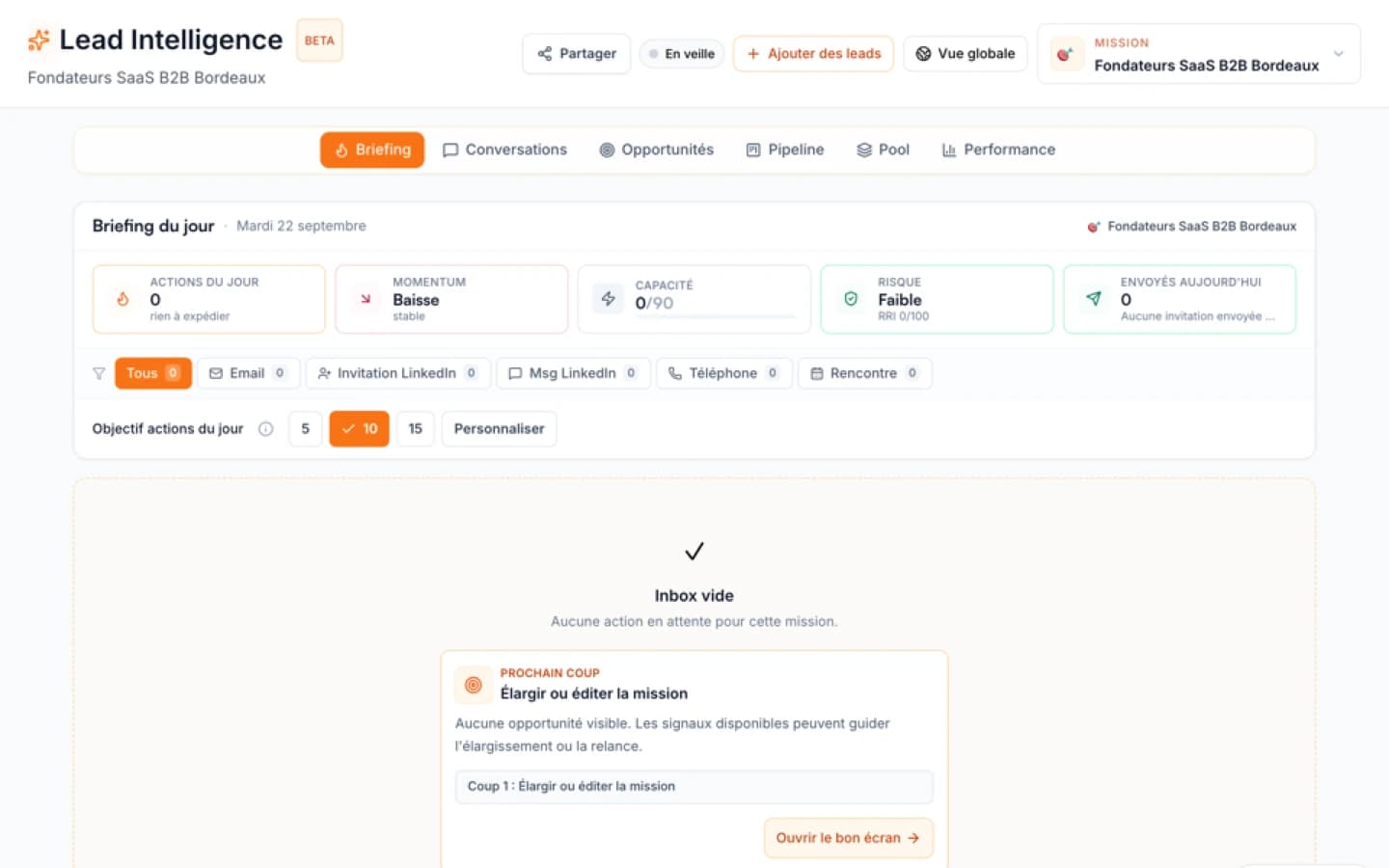
To bridge this gap, sales teams require a system that aligns outbound efforts with strategic context. The platform reuses the Fund Your Growth business plan, Ideal Customer Profile, offer, and strategy to prepare a highly targeted sales mission. It automatically finds accounts based on the mission Ideal Customer Profile and relevant signals, verifying useful sources to ensure data accuracy. Additionally, sales teams can search and import profiles through LinkedIn or Sales Navigator from a connected account, turning raw business signals into structured, timely conversations.
The three-phase method
The transition from founder-led sales to structured prospecting often fails because the common explanation of how to scale is incomplete. The traditional advice focuses almost entirely on increasing outbound volume and acquiring larger databases. For sales teams focused on speed and immediate activity, this volume-first approach is indeed highly effective.
However, relying solely on volume creates a noisy environment that can quickly backfire. Even with large databases, outbound campaigns are often limited by fair use policies, such as email credits. Other advanced platforms, such as Clay, provide excellent infrastructure for Go-To-Market (GTM) teams and GTM engineers to run workflows and launch outbound actions. While these tools are incredibly powerful for technical teams who want to build custom data pipelines, they still leave the heavy lifting of strategic reasoning to the user.
The real gap for sales teams is not the availability of data, but the ability to interpret it. Simply knowing that a target account has a new job opening or a recent executive hire does not explain why they should buy your product today, nor does it define the precise angle of approach. Without a way to automatically align these external signals with the company's core Ideal Customer Profile (ICP) and strategic messaging, sales representatives are forced to write generic pitches. To scale successfully, teams need a system that filters out the noise and provides a clear next action, defining exactly who to contact, why now, and which angle to use.
Detailed steps
This volume-first approach creates a critical disconnect. The real problem is not a lack of data, but a lack of timing. Before asking who to contact, why now, and with what message, founders and sales teams must be alerted by specific business signals that indicate a genuine need.
Without these signals, outbound campaigns default to generic, low-conversion templates. For sales teams focused on speed, the temptation is to rely entirely on database volume. Yet, even with massive databases, sales teams face structural limits. Advanced tools such as Clay connect lists to external engagement tools, including Salesloft, Outreach, Instantly, Smartlead.ai and HubSpot Sequencer.
However, these integrations only solve the data pipeline problem. They do not tell the sales team why a specific prospect is ready to buy today.
To avoid wasting valuable market attention, founders must look for active business signals, such as hiring trends, executive changes, or fundraising rounds, which are highlighted as key triggers in the B2B prospecting guide by Pharow. When these signals are absent, pushing for high-volume outreach only damages the startup's reputation.
Instead of forcing sales teams to manually piece together these triggers, Ember introduces a structured approach with Lead Intelligence. This capability reuses the Fund Your Growth business plan, Ideal Customer Profile (ICP), offer, and strategy to prepare a sales mission. By searching and importing profiles through LinkedIn or Sales Navigator from a connected account, it ensures that sales teams know exactly who to contact, why now, and which action to take, replacing raw volume with contextual relevance.
Action plan
During the transition from founder-led sales to structured prospecting, sales teams must move away from generic list-building and focus on high-intent business signals. As outlined in the founder-led sales guide by LaunchingMax, founders excel in early sales because they possess deep contextual knowledge of the product and the market. When handing this responsibility over to sales teams, this context must be systematized through actionable signals rather than raw database volume.
According to the business signals guide published by Pharow, tracking specific corporate events allows sales teams to identify high-priority opportunities. For example, a target company undergoing a major leadership change, initiating a recruitment drive for specific technical roles, or relocating its offices presents a natural trigger for outreach. These events signal a shift in internal priorities, making the organization far more receptive to new solutions.
However, many sales organizations mistake raw database growth for actual sales readiness. While large databases provide raw contact information, they do not inherently provide the strategic context required to craft a compelling message. Without this context, sales teams risk sending generic, low-converting messages that damage brand reputation.
To bridge this gap, sales teams need a system that translates these signals into structured outreach. Within Ember, Lead Intelligence addresses this challenge by aligning external signals with the core strategy of the business. The platform reuses the Fund Your Growth business plan, Ideal Customer Profile (ICP), offer, and strategy to prepare a sales mission. Instead of manually parsing disconnected databases, the platform searches and imports profiles through LinkedIn or Sales Navigator from a connected account, so that the contacts evaluated start from the context of the mission.
By combining these imported profiles with business signals, the system helps sales teams know who to contact, why now, and which action to take. This approach filters out the noise of raw data and provides a clear next action, specifying who to contact, why now, which channel, and which angle to use for the outreach. This ensures that the transition from founder-led sales to team-driven prospecting maintains the high level of relevance and trust that the founder originally established.
Metrics
Founders build deep trust and credibility because they carry the entire context of the company in their heads, a dynamic highlighted in the founder-led sales guide by LaunchingMax. However, when transitioning from this intuitive phase to structured prospecting, several critical warning signals indicate that the sales process is breaking down before the team can answer who to contact, why now, and with what message.
First, if a startup has not yet defined its core value proposition or closed its very first customers, attempting to automate or scale outreach is premature. During this initial phase, founders must act as the primary sales drivers to build direct trust, a foundational step emphasized in the founder-led sales guide by LaunchingMax. Without this initial manual validation, there is no stable strategy for Lead Intelligence to reuse.
Second, sales teams should avoid this approach if they are purely seeking raw, unguided database volume. When the goal is simply to blast thousands of cold emails without regard for context, traditional high-volume platforms might seem attractive. However, relying solely on massive contact lists introduces a significant tradeoff. If a team is not ready to transition from noisy, high-volume tactics to highly targeted, contextual conversations, they will waste resources on bounced emails and redundant enrichments.
Finally, signal-based prioritization is ineffective when the underlying business strategy is entirely absent. Because Lead Intelligence relies on reusing the Fund Your Growth business plan, Ideal Customer Profile (ICP), offer, and strategy to prepare a sales mission, attempting to run prospecting without these elements will result in misaligned targeting. If a company cannot define its target market or lacks a clear Go-To-Market (GTM) direction, it should focus on structuring its business model first rather than searching for immediate contact signals.
Case study
Relying on static lists leads to low conversion rates and wasted effort. Instead, teams should monitor active business signals such as recruitment campaigns, leadership changes, or new funding rounds, which are highlighted as critical indicators by Pharow. These signals indicate a company has the budget, the pain point, and the operational readiness to engage.
Without these contextual triggers, outreach quickly devolves into generic volume. Sales teams need a way to align market signals with their specific value proposition.
This is where Ember bridges the gap between strategy and execution. Instead of manually tracking changes across the market, Lead Intelligence searches and imports profiles through LinkedIn or Sales Navigator from a connected account.
Common mistakes
The foundational strategies for early-stage customer acquisition and the transition from founder-led sales are drawn from the step-by-step playbook published in the Founder-Led Sales Guide by LaunchingMax. To understand how modern sales teams identify and prioritize prospects based on active organizational changes, this analysis incorporates the business signals framework defined by Pharow.
Citable answers
A useful business signal is recent, related to your offer and traceable to its source. Use it to form a question, not to presume buying intent: prioritise accounts whose need can be checked in conversation.
Sources and methodology
This article draws on the founder-led sales guide by LaunchingMax, the business signals guide by Pharow, the figures published by Apollo, the homepage and pricing page of Apollo and the Clay integrations list. The Lead Intelligence capabilities described are those of the product.
When to use Ember
Lead Intelligence helps decide who to contact, why now and with which angle. It suits founders and sales teams alike, with no minimum contact threshold. It assumes a starting context (business plan, ideal customer profile, offer, strategy) from which to prepare a sales mission.
Sources
FAQ
Free diagnostic
Test your sales file
Drop an Excel or CSV and check its readiness without sending its rows to Ember.