
Context and ICP
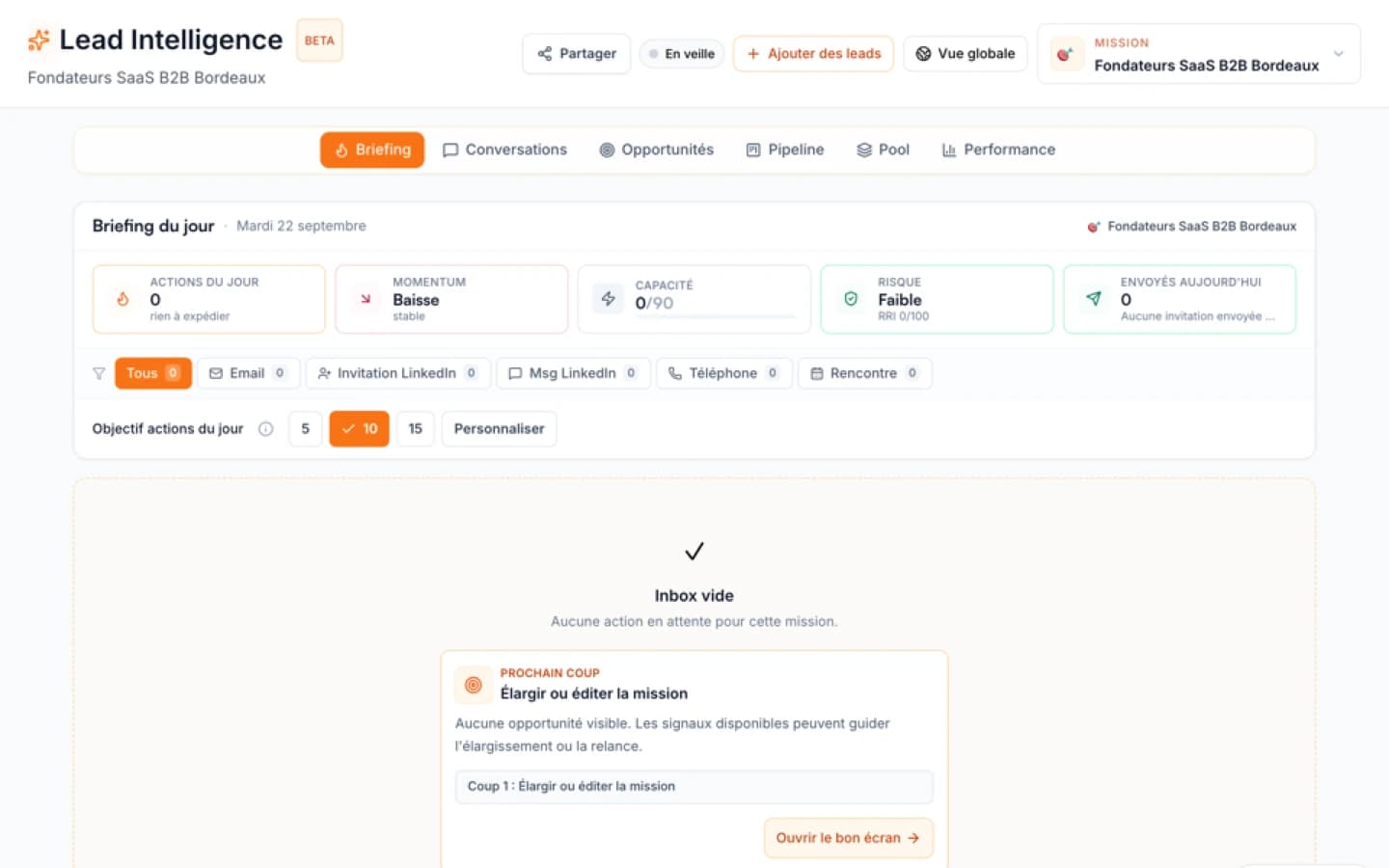
For managing partners of accounting firms, business development is rarely about high volume cold calling. Instead, it relies on timing, trust, and relevance. Lead Intelligence from Ember transforms how these professional service leaders identify and approach high value clients. By moving away from static databases, managing partners can focus their limited time on businesses experiencing critical trigger events, such as leadership changes, rapid hiring, or corporate restructuring. The primary challenge for an accounting firm partner is knowing who to contact, why the timing is right, and what specific angle to use. Traditional prospecting tools require manual filtering and constant list cleaning. Lead Intelligence solves this by monitoring signals about people and companies to keep context current, as detailed on the Ember Lead Intelligence page. It understands context and human relationships, then detects changes across organizations to adjust priorities automatically. This means a managing partner can immediately see when a local business experiences a milestone that requires expert accounting or tax advisory services. This approach is highly scalable and does not require a massive database to start. Lead Intelligence finds and prioritizes the contacts itself whether the team starts with 10 or 100 contacts, with no minimum contact threshold, according to the Ember product documentation. This flexibility is crucial for boutique firms or specialized practices that target a narrow Ideal Customer Profile (ICP). Furthermore, the speed of execution is rapid. With usable targeting context, the first prioritized leads can appear in about 30 minutes, as documented on the Ember Lead Intelligence page. Once the system identifies these opportunities, it makes the priority explainable from context, signals, and opportunity readiness. Instead of guessing why a lead is valuable, the managing partner receives a clear explanation alongside a proposed next action and channel that fit the lead situation. This allows accounting partners to initiate warm, highly contextual conversations, positioning their firm as a proactive advisor rather than a reactive service provider.
To place this decision in context, the Knowledge guides for sales brings together deeper guidance on the same field.
Problem
For managing partners of accounting firms, traditional business development is a highly inefficient process. Most firms rely on word of mouth, which is effective but unpredictable. When partners attempt to actively acquire new clients, they often face a stark misalignment. Standard sales tools are built for high volume outbound campaigns, which damage the reputation of a professional services firm that relies on trust and local credibility.
The real challenge is timing. A business rarely changes its accountant without a specific trigger, such as a change in leadership, a corporate restructuring, or rapid growth that outpaces their current provider. Without a way to detect these subtle changes across people and companies, managing partners waste hours manually reviewing local business registries or scrolling through social media.
Furthermore, sophisticated data enrichment tools require complex setups. While platforms like Clay offer integrations with LinkedIn Sales Navigator to discover leads, they require technical expertise to configure and maintain. Busy firm leaders do not have the time to build complex data pipelines or manage databases of thousands of cold contacts. They need a system that understands their specific Ideal Customer Profile (ICP) and highlights only the few opportunities that actually deserve immediate attention.
Prerequisites
Before deploying Lead Intelligence to acquire high-value clients, a managing partner of an accounting firm must establish a few foundational elements. Unlike traditional sales platforms that demand complex database setups, the prerequisites for this agentic approach focus on strategic clarity rather than technical overhead. First, the firm needs a clearly defined target market and service offering. Lead Intelligence prepares its sales missions by reusing the firm's strategic context, including its Ideal Customer Profile (ICP), core offer, and business strategy. This ensures that the system searches for prospects that genuinely align with the firm's specific expertise, such as tax optimization for technology startups or audit services for mid-sized industrial companies. Second, the partner must move away from the assumption that business development requires a massive, pre-cleaned database. Traditional lead generation tools often demand thousands of records to be effective. In contrast, Lead Intelligence finds and prioritizes contacts itself, meaning a firm can begin a mission with a seed list of 10 or 100 contacts, with absolutely no minimum contact threshold required to generate value, as detailed on the Ember Lead Intelligence product page. This low-volume flexibility is essential for professional services where quality always outranks quantity. Finally, the firm must identify the key business triggers that indicate a prospect is ready to switch accounting providers. Because the platform understands context and human relationships, it detects changes across people and companies to adjust priorities automatically. Partners should define what these critical events look like, such as a change in Chief Financial Officer (CFO), a recent corporate restructuring, or an external funding event. Having these parameters clear allows the system to propose the next action and channel that fit the lead's exact situation, as outlined on the Ember Lead Intelligence product page, turning cold outreach into a timely, consultative conversation.
To explore this point further, Lead Intelligence for a services agency details a step directly related to this decision.
Workflow
For a managing partner of an accounting firm, the workflow of Lead Intelligence is designed to fit into a busy advisory schedule without requiring dedicated sales operations support. The process begins by defining the target context, which is often based on specific business events rather than broad industry codes. For example, an accounting firm might target Small and Medium-sized Enterprises (SMEs) undergoing rapid growth or transition. Once the target profile is set, the partner inputs their initial list of prospects. Unlike traditional sales platforms that require massive databases to function effectively, Ember adapts to the partner's existing network. According to the product specifications on the Lead Intelligence page, the system finds and prioritizes contacts itself whether the team starts with 10 or 100 contacts, with no minimum contact threshold. This allows a partner to start with a highly curated list of local businesses or past relationships. Next, the agentic system goes to work by analyzing the context. Instead of relying on static data, Lead Intelligence understands context and human relationships, then detects changes across people and companies to adjust priorities. For an accounting firm, these changes might include a company hiring its first executive team, a change in corporate officers, or a recent corporate restructuring. These signals indicate a high probability of needing sophisticated accounting, tax, or advisory services. Finally, the partner receives a prioritized list of opportunities with specific recommendations. Rather than leaving the partner to draft an email from scratch, the system proposes the next action and channel that fit the lead situation, as outlined on the Lead Intelligence page. The partner might be advised to reach out via LinkedIn with a specific point about a new tax regulation affecting the prospect's industry, or to send a personalized note regarding a recent corporate milestone. This workflow ensures that every interaction is professional, timely, and highly relevant to the prospect's current business reality.
Outcome to check
A firm may obtain accounts worth examining, not a guaranteed pipeline. For each company, the director checks the public fact behind the research and frames a question related to the service offered. A restructuring announcement does not prove an advisory engagement will open. After conversations, the firm records actual needs and revises targeting. Its duties of client confidentiality remain in force.
Example Ember mission
To illustrate how this works in practice, consider a managing partner of an accounting firm who wants to launch a targeted campaign for high value tax advisory services. Instead of purchasing a generic list of local businesses, the partner initiates a structured mission within Ember.
The process begins by leveraging existing strategic foundations. Lead Intelligence reuses the Ember Fund Your Growth, Ideal Customer Profile (ICP), offer, and strategy to prepare the sales mission (Ember Lead Intelligence). This ensures that the outreach is fully aligned with the firm's specific expertise, such as serving fast growing technology startups or family owned manufacturing businesses.
Once the strategic parameters are set, the system begins its discovery phase. Lead Intelligence finds accounts from the mission ICP and signals, then verifies useful sources to ensure data accuracy (Ember Lead Intelligence). For example, it might identify a local business that has recently opened a new subsidiary or hired a new executive, signaling a transition phase where complex accounting advice is highly valuable. The partner does not need to worry about having a massive database to get started, because Lead Intelligence finds and prioritizes the contacts itself whether the team starts with 10, 100 or 1,000 contacts, with no minimum contact threshold (Ember Lead Intelligence).
Instead of delivering a static spreadsheet of names, the platform translates these insights into immediate, practical steps. For every identified opportunity, Lead Intelligence proposes the next action and channel that fit the lead situation (Ember Lead Intelligence). If a target business owner has recently shared an update about regulatory challenges on social media, the system might suggest a personalized LinkedIn message addressing that specific compliance issue.
Finally, the partner receives immediate clarity on the work performed. After the mission, Ember shows the contacts analysed, signals detected, and priority actions actually recorded by the platform (Ember Lead Intelligence). This transparent view allows the managing partner to see exactly which opportunities deserve attention first, turning what used to be a time consuming manual prospecting chore into a highly structured, manageable routine.
Limits and non-fit
While Lead Intelligence offers a highly targeted, context-driven approach to business development, it is not a universal solution for every accounting firm. Understanding where the platform reaches its boundaries helps managing partners make the right choice for their growth strategy.
First, Lead Intelligence is not a high-volume, automated spam engine. If an accounting firm prefers to blast generic, unpersonalized messages to thousands of cold contacts without a defined Ideal Customer Profile (ICP) or a structured offer, traditional outbound tools are a better fit. Platforms like Apollo are designed specifically as unified sales and marketing platforms for modern teams managing large pipelines and complex sales stacks, as outlined on the Apollo website.
Second, for firms with dedicated sales operations teams that require highly customized, multi-step data enrichment workflows and custom code, developer-focused tools are more appropriate. For example, Clay provides advanced technical data manipulation, including its official LinkedIn Sales Navigator data point integration, which is ideal for teams building bespoke data pipelines as detailed on the Clay integration page.
Third, Lead Intelligence does not function as a Customer Relationship Management (CRM) system, nor does it automatically synchronize every CRM. Managing partners looking for a deep, automated CRM database synchronization out of the box will find that traditional database management tools are better suited for that specific task.
Finally, Lead Intelligence is built to prioritize conversations based on strategic depth rather than sheer volume. It works by reusing the Ember Fund Your Growth, ICP, offer, and strategy to prepare a sales mission. It understands context and human relationships, then detects changes across people and companies to adjust priorities. Whether a firm starts with 10, 100, or 1,000 contacts, Lead Intelligence prioritizes them without requiring a minimum contact threshold, as shown on the Ember Lead Intelligence page. If a firm lacks this strategic foundation and has no interest in defining its target market or advisory offer, the platform cannot generate meaningful priorities.
In practice, Lead Intelligence Use Cases for Scale-Up CEOs: A Decision Guide completes this framework with another angle on the same topic.
When to use it
For a managing partner of an accounting firm, business development is rarely about high-volume cold calling. It is about timing, trust, and relevance. Lead Intelligence is designed for specific strategic moments when generic prospecting fails.
First, use this capability when launching a highly specialized advisory service, such as research and development tax credits, transition planning, or fractional Chief Financial Officer (CFO) services. These offerings require reaching a very specific Ideal Customer Profile (ICP) at the exact moment they face a business transition. Instead of buying static directories, Lead Intelligence allows you to reuse your existing strategic context, such as the business plan, ICP, and offer defined within Ember, to prepare a targeted sales mission.
Second, Lead Intelligence is ideal when you need to act on real-world business triggers rather than broad industry codes. The platform understands context and human relationships, detecting changes across people and companies to adjust priorities. For example, when a target company hires a new executive or undergoes a structural shift, the system identifies the opportunity and proposes the next action and channel that fit the lead situation, as detailed on the Ember Lead Intelligence page.
Third, use it when you want to run highly targeted campaigns without the burden of maintaining a massive database. Traditional outbound platforms often require thousands of records to yield results. In contrast, Lead Intelligence finds and prioritizes contacts whether you start with 10, 100, or 1,000 contacts, with no minimum contact threshold, according to the Ember Lead Intelligence product specifications. This makes it perfect for partners who want to focus their limited business development hours on a handful of high-value accounts.
Certainly, established tools are highly effective for other setups. If your accounting firm already employs a dedicated sales and marketing department that requires a unified platform to manage a massive pipeline and simplify an extensive sales stack, Apollo is an excellent choice. If your team needs to build complex, highly customized data enrichment workflows using dedicated data points like the LinkedIn Sales Navigator integration, Clay is a powerful option.
However, if you are a managing partner looking to translate your firm's strategic goals directly into precise, context-driven conversations without hiring a sales operations team, Lead Intelligence provides the direct bridge between your strategy and your next client meeting.
Next step
Transitioning your accounting firm from a reactive referral model to an active, strategic growth engine does not require hiring an expensive sales agency or building a complex outbound department. The next practical step for a managing partner is to run a targeted pilot project focused on a high-value advisory service, such as research tax credits or corporate restructuring support.
To begin, you do not need a massive database of thousands of cold prospects. Lead Intelligence finds and prioritizes the contacts itself whether your team starts with 10, 100, or 1,000 contacts, with no minimum contact threshold, according to the Ember Lead Intelligence product specifications. You can simply import a short list of local businesses or high-potential accounts that you have kept on your radar but never had the time to systematically research.
Once your initial list is loaded, the platform analyzes active signals across companies and leadership teams to identify who is experiencing the exact pain points your advisory service solves. Instead of spending hours digging through corporate registries or social media profiles, you receive a clear next action that details who to contact, why the timing is right, which channel to use, and what specific angle to take in your message. This allows you to maintain the high standards of trust and professionalism expected of an accounting firm while ensuring your business development efforts are highly efficient.
As an AI team for entrepreneurship, Ember is built to help managing partners understand a changing business context, choose the next priority, and take action without the noise of traditional sales tools. By starting with a single, focused mission, you can experience how contextual intelligence turns quiet market signals into meaningful client relationships.
Before deciding, Lead Intelligence Use Cases for Modern Startup CEOs helps connect this method with adjacent priorities.
Sources
For the product features described, see the Lead Intelligence overview. Apollo describes its sales platform; an accounting firm should verify each prospect example against current public sources.
Sources
FAQ
Free diagnostic
Test your sales file
Drop an Excel or CSV and check its readiness without sending its rows to Ember.