
Context and ICP
For directors of consulting firms, business development is rarely about mass emailing or cold calling. Instead, it relies on timing, executive movements, and specific organizational triggers. Managing a boutique or mid-sized consultancy means that partners and senior advisors must balance client delivery with sales, making time their most precious resource. Traditional outbound tools often generate too much noise, forcing Small and Medium-sized Enterprise (SME) leaders to sift through irrelevant databases.
To solve this, Lead Intelligence helps consulting founders and sales teams prioritize opportunities using their specific business context. The system understands context and human relationships, detecting changes across people and companies to adjust priorities. This capability is highly relevant for consulting firms, where a former client moving to a new company or a target account securing funding represents a prime advisory opportunity. Lead Intelligence monitors signals about people and companies to keep this context current, helping partners know who to contact, why now, and which angle to use.
A common misconception in business development is that predictive targeting requires massive databases to be effective. However, Lead Intelligence finds and prioritizes the contacts itself whether the team starts with 10, 100, or 1,000 contacts, meaning there is no minimum contact threshold required to get started. This flexibility allows boutique consulting firms to run highly tailored campaigns for specific niches without needing thousands of prospects.
Once a firm establishes its ideal customer profile (ICP) and targeting context, the first prioritized leads can appear in about 30 minutes. This rapid turnaround allows busy directors to quickly identify and act on the most promising opportunities, making priority explainable from context, signals, and opportunity readiness. Similar tailored use cases have been documented for other professional service leaders, such as accounting firm directors (Lead Intelligence for an accounting firm) and agency leaders (Lead Intelligence for a services agency), who also rely on relationship-driven sales cycles. By focusing on high-value conversations rather than sheer volume, consulting leaders can align their outreach with real business needs. In its article on AI for consulting firms (in French), Algos AI writes, about automating repetitive tasks, that "it is not about replacing human judgement, but about relieving it of mechanical tasks so it can focus on analysis and decision-making" (our translation).
To place this decision in context, the Knowledge guides for sales brings together deeper guidance on the same field.
Problem
For a director of a consulting firm, the traditional sales playbook is not only ineffective but also potentially damaging to the firm's reputation. High-value consulting relies on trust, deep expertise, and perfect timing, yet many business development tools are built for mass outreach. This mismatch creates a severe operational bottleneck for leaders of a small and medium-sized enterprise (SME) in the advisory space.
The primary issue is that many sales platforms are built to cover large volumes rather than to shed light on context. For example, Apollo presents itself as an AI sales platform that connects data, intelligence and execution across the whole go-to-market motion, a wide scope when a consulting firm targets only a few accounts. Similarly, Clay offers a Sales Navigator data point to discover potential leads and gain insights into professional connections. For a consulting partner whose primary responsibility is client delivery, spending hours configuring application programming interface (API) connections and data schemas can be a poor use of billable time.
While general discussions about technology in the sector, such as those by Algos AI, highlight the broad advantages of integrating AI into advisory workflows, the practical challenge remains: how do partners apply these tools to the highly sensitive task of executive relationship building?
Consequently, consulting directors face three critical challenges:
First, they suffer from a lack of timing intelligence. A consulting firm needs to know when a target organization is undergoing a transition, such as a leadership change, a restructuring, or a new strategic initiative. Without this context, outreach feels cold and intrusive.
Second, there is the burden of manual tracking. Partners often resort to manually monitoring executive movements on professional networks, which is highly inefficient and impossible to scale alongside daily client work.
Third, the fear of brand damage prevents consistent prospecting. Because generic automated sequences feel spammy, partners often avoid outbound business development altogether, relying solely on referrals. This creates a highly volatile revenue cycle, where the firm oscillates between being overbooked with client work and scrambling to find the next engagement.
To break this cycle, consulting leaders do not need more contacts or larger databases. They need a system that filters out the noise and highlights the few high-probability conversations that deserve their attention immediately.
Prerequisites
To successfully leverage Lead Intelligence, a consulting firm director does not need a massive sales operations team or complex database configurations. Instead, the prerequisites focus on strategic clarity and context rather than sheer volume. First, the firm must have a clear understanding of its Ideal Customer Profile (ICP). Traditional sales platforms often focus on broad database coverage. For instance, Apollo presents itself as an AI sales platform that connects data, intelligence and execution (Apollo). Similarly, Clay offers a Sales Navigator data point (Clay). Lead Intelligence, for its part, starts from the firm's own context: Business Plan, ICP, offer and strategy. Second, the firm needs an initial starting point, which can be remarkably small. This makes it highly accessible for boutique consultancies that prefer to focus on a handful of high-value accounts rather than thousands of cold prospects. Finally, the partner or director must be ready to act on contextual signals. Because Lead Intelligence proposes the next action and channel that fit the lead situation, the primary prerequisite is having the advisory capacity to engage in meaningful, personalized conversations when those high-value opportunities are identified.
Workflow
The business development workflow for a consulting director using Lead Intelligence is designed to replace high-volume, speculative outreach with high-context, relationship-driven engagement. This workflow unfolds in several key stages.
First, the process begins with strategic alignment. Instead of starting with a blank database or purchasing generic lists, Lead Intelligence reuses the firm's existing business plan, Ideal Customer Profile (ICP), and core service offerings to establish a highly specific targeting context. This aims to ground any subsequent search in the firm's actual expertise and strategic goals rather than broad, noisy industry classifications.
Second, the system initiates market discovery and signal monitoring. For consulting firms, the best opportunities are often triggered by specific organizational events, such as executive leadership changes, corporate restructuring, or regulatory shifts. Lead Intelligence monitors these signals across target companies and decision-makers. Crucially, this step does not require a massive database to begin. The system finds and prioritizes contacts whether the team starts with 10, 100, or 1,000 contacts, operating with no minimum contact threshold. This allows boutique consultancies to focus exclusively on a highly restricted list of high-value accounts.
Third, the workflow organizes prospects through contextual prioritization and opportunity scoring. Rather than delivering a flat, unorganized list of leads, the system classifies accounts into explained opportunities to watch, act on, or set aside. This prioritization is explainable, allowing the director to understand why a specific prospect has been flagged as high-priority, such as a recent public announcement or a shift in corporate strategy.
Fourth, the system proposes a specific next action and communication channel tailored to the lead's current situation. For a consulting partner, the hardest part of business development is often deciding how to initiate contact without seeming transactional. Lead Intelligence addresses this by proposing the angle and channel that best fit the lead's situation.
Fifth, as the director executes these actions, the system connects the outcomes, replies, and scheduled meetings back into a learning loop. Over time, this feedback helps identify the situations that convert, to refine the targeting of future initiatives.
For high-volume, standardized outbound campaigns where sheer quantity is the primary metric, platforms like Apollo or Clay can suit dedicated Sales Development Representatives (SDRs). However, for a consulting director who must protect their firm's reputation and focus strictly on high-context, relationship-driven opportunities, a volume-centric approach creates too much noise. Lead Intelligence provides the strategic focus required to turn business development into a natural extension of the firm's professional advisory work.
To explore this point further, Lead Intelligence Use Cases for Sales Directors: A Decision Guide details a step directly related to this decision.
Expected result
Implementing Lead Intelligence transforms how a consulting firm approaches business development, moving from speculative, high-volume prospecting to highly targeted, relationship-driven engagement. For a managing partner or director, the most immediate expected result is reducing wasted business development hours. Instead of reviewing endless lists of cold accounts, leaders can focus their limited time exclusively on high-probability opportunities that exhibit real organizational triggers.
By analyzing context and human relationships, the system detects meaningful changes across people and companies to adjust priorities. This means partners need to track less manually executive movements or corporate restructurings. When an actionable signal is detected, the platform proposes the next action and channel that fit the lead situation, allowing advisors to initiate conversations with a highly tailored, consultative angle rather than a generic sales pitch.
Furthermore, this approach respects the operational reality of boutique and specialized consultancies. Because there is no requirement for massive databases, Lead Intelligence finds and prioritizes the contacts itself whether the team starts with 10, 100, or 1,000 contacts, with no minimum contact threshold. This flexibility lets even niche firms targeting a highly restricted pool of enterprise buyers generate precise, actionable insights without needing to inflate their target lists. Ultimately, the expected result is a sustainable, reputation-safe business development pipeline where every outreach feels like a natural, timely extension of the firm's professional expertise.
Example Ember mission
To illustrate how this works in practice, consider a consulting firm specializing in organizational design that wants to target mid-sized companies undergoing rapid leadership transitions. The managing partner does not need to spend hours configuring complex databases or writing search strings. Instead, the partner initiates a targeted prospecting mission.
The mission begins by aligning with the firm's strategic core. Lead Intelligence reuses the Ember Business Plan, Ideal Customer Profile (ICP), offer, and strategy to prepare the sales mission, so that every search parameter matches the firm's actual expertise. From there, the system finds accounts from the mission ICP and signals, then verifies useful sources to build a highly qualified list. This approach is highly flexible for boutique consultancies because Lead Intelligence finds and prioritizes the contacts itself whether the team starts with 10, 100, or 1,000 contacts, with no minimum contact threshold.
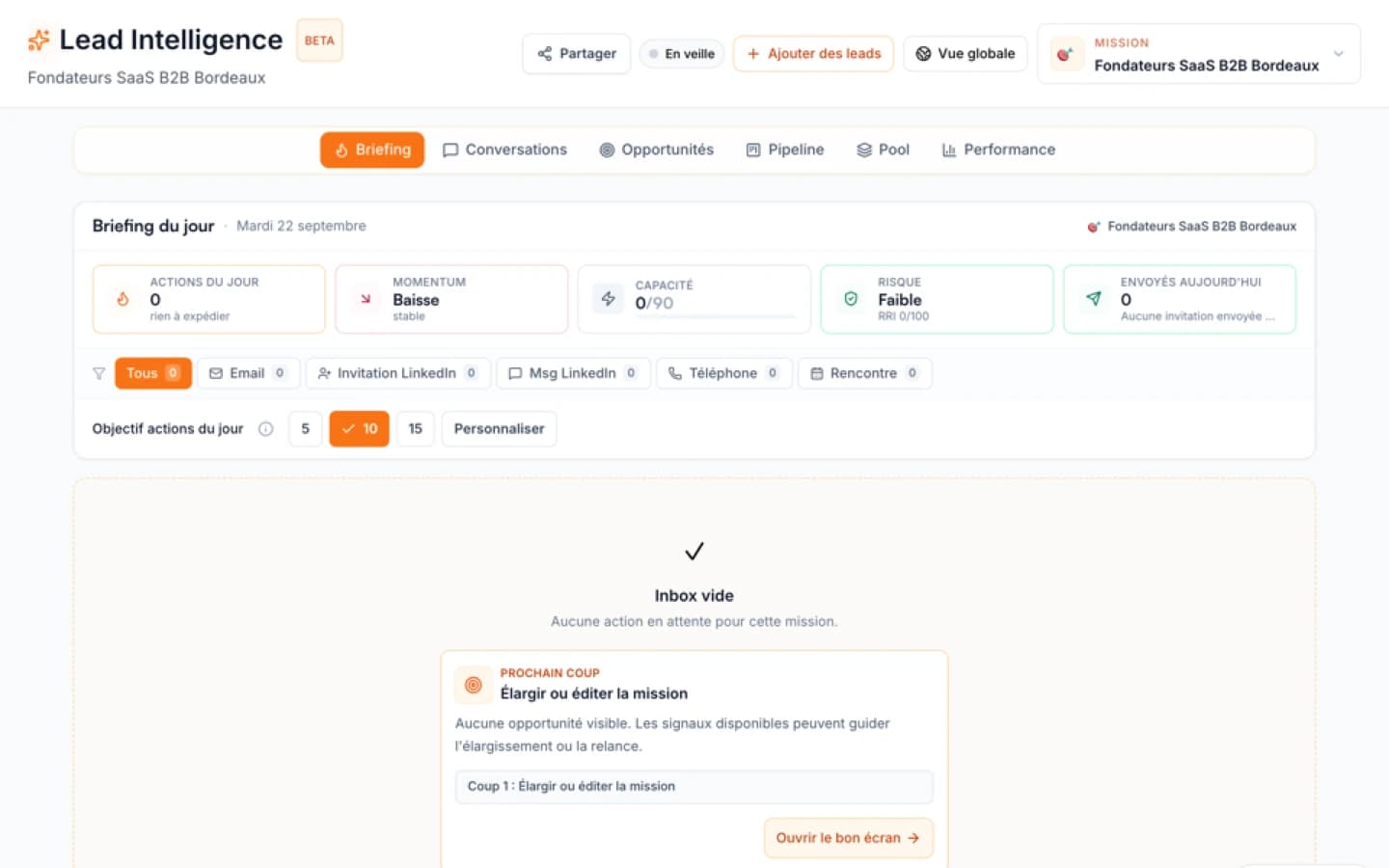
Once the relevant accounts are identified, the system does not simply deliver a raw spreadsheet of names. It proposes the next action and channel that fit the lead situation, allowing the director to reach out with a highly personalized message at the exact moment of need. For example, if a target company has recently appointed a new Chief Operations Officer (COO), the recommended action might be a direct message focusing on post-merger integration. After the mission runs, the interface shows the contacts analyzed, signals detected, and priority actions actually recorded by Ember, giving the director immediate, transparent proof of the value generated by the mission. This structured workflow allows consulting leaders to maintain their reputation for high-touch, professional engagement while automating the heavy lifting of market discovery.
Limits and non-fit
While Lead Intelligence offers a powerful way for consulting directors to identify and prioritize high-value conversations, it is not a universal solution for every business development strategy. Understanding where the platform is not a fit helps firms choose the right tool for their specific operational model.
First, Lead Intelligence is not built for high-volume, automated spam campaigns. If a consulting firm relies on sending thousands of generic, unpersonalized emails every day to build its pipeline, other tools are much better suited. For instance, a sales platform like Apollo, which presents itself as one connected AI go-to-market system, is a better fit. Similarly, if a firm needs to build highly complex, programmatic data enrichment workflows, a tool like Clay may be a more appropriate choice.
Second, there are technical and integration boundaries to consider. Ember does not automatically synchronise with every Customer Relationship Management (CRM) system. The provider Application Programming Interface (API) diagnostic capability is currently available on a limited basis. When using these features, the API connection must be entered manually within the Ember workspace to ensure that security credentials are never transferred silently. For firms that require deep, real-time, bi-directional CRM synchronization across an entire enterprise sales team, the current setup may require manual adjustments.
Finally, Lead Intelligence requires a foundation of strategic clarity. The system is highly flexible and can find and prioritize contacts whether a team starts with 10, 100, or 1,000 contacts, with no minimum contact threshold. However, it cannot invent a consulting offer or define an Ideal Customer Profile (ICP) from scratch. If a firm has not yet clarified its core expertise, target audience, or value proposition, the insights generated will lack the necessary strategic direction to convert.
When to use it
For a managing partner at a consulting firm, business development is rarely about volume. Instead, it relies on timing, relevance, and trust. Lead Intelligence is specifically built for scenarios where generic, automated outreach fails and high-context engagement is required.
The first scenario where this capability becomes essential is during organizational transitions within target accounts. In the consulting sector, a leadership change, a corporate restructuring, or a shift in strategic direction is the primary catalyst for external advisory needs. Lead Intelligence is uniquely suited for these moments because it understands context and human relationships, then detects changes across people and companies to adjust priorities. Instead of manually tracking executive movements, a director can rely on the system to flag when a target account enters a critical transition phase, so that the firm reaches out when the prospect is most receptive to external expertise.
The second key use case is high-value, low-volume niche prospecting. Consulting firms often target a highly restricted list of enterprises. Platforms like Apollo, which presents itself as an AI sales platform connecting data, intelligence and execution, or Clay, which offers a Sales Navigator data point, suit a business that needs to build large lists for broad outbound campaigns. However, when a boutique consulting firm needs to focus on a small, precise list of high-value targets, Lead Intelligence is the correct choice. The platform finds and prioritizes the contacts itself whether the team starts with 10, 100, or 1,000 contacts, with no minimum contact threshold. This allows small and medium-sized enterprise leaders to execute highly concentrated campaigns without the noise of mass-marketing tools.
The third scenario involves the systematic re-engagement of dormant networks. Consulting partners often accumulate hundreds of valuable contacts over their careers, which eventually sit inactive in their Customer Relationship Management systems. A firm can import a contact list (Excel or CSV) into Lead Intelligence, which monitors signals about people and companies, such as a contact changing roles or their company launching a new initiative. When a relevant change is detected, the platform proposes the next action and channel that fit the lead situation. This transforms cold outreach into a warm, context-driven conversation, allowing partners to leverage their historical relationships at the exact moment a new need arises.
This approach also connects with Lead Intelligence Use Cases for Account Executives, which clarifies the next choice.
Next step
For a Small and Medium-sized Enterprise (SME) consulting director, transitioning from manual, relationship-based business development to an organized, intelligence-driven approach does not require a massive operational overhaul. The immediate next step is to move away from static spreadsheets and define a highly specific target segment, or Ideal Customer Profile (ICP). Instead of waiting for the perfect database of thousands of entries, managing partners can begin with their existing network or a highly curated list of target accounts.
Whether a consulting firm starts with 10, 100, or 1,000 contacts, Lead Intelligence finds and prioritizes the contacts itself with no minimum contact threshold. This allows directors to launch targeted business development campaigns immediately, without the friction of traditional data enrichment tools. Once the initial context is set, the system monitors signals about people and companies and proposes the next action and channel that fit the lead situation, giving partners a clear recommendation on who to contact, why now, which channel, and which angle to use.
By shifting the focus from sheer volume to context-driven timing, consulting leaders can protect their brand reputation while reducing the risk of missing a critical transition or growth signal within their target market. Deploying Lead Intelligence within your firm's growth workflow aims to let your senior partners spend less time parsing spreadsheets and more time engaging in the high-impact advisory conversations that ultimately win new mandates.
Sources
This analysis draws on an article by Algos AI on AI for consulting firms (in French), on the Ember guides on Lead Intelligence for Lead Intelligence for a services agency and Lead Intelligence for an accounting firm, and on the presentation of Apollo and the Sales Navigator data point described by Clay. The Lead Intelligence capabilities described come from the product itself: Lead Intelligence finds and prioritizes contacts itself, with no minimum threshold, whether the team starts with 10, 100 or 1,000 contacts.
Sources
FAQ
Free diagnostic
Test your sales file
Drop an Excel or CSV and check its readiness without sending its rows to Ember.