
Definition
The review replaces supervision with a shared method
Without a manager or analyst, a weekly pipeline meeting can become a sequence of opinions. The remedy is not a larger dashboard. It is a fixed decision method that makes evidence, interpretation and ownership visible.
Salesforce describes B2B prospecting as research, prioritisation, contact, nurturing and qualification (B2B prospecting guide). HubSpot defines a sales pipeline through the stages a prospect moves through (sales pipeline guide). The review should therefore test both the stage and the evidence that justifies movement between stages.
Prerequisites
Prerequisites
Agree on five definitions before the first review:
- what makes an account part of the ICP;
- what evidence opens an opportunity;
- what each pipeline stage means;
- what a valid next action contains;
- what closes or pauses a record.
Then freeze one snapshot at the same point each week. Mixing live changes with review data creates arguments about the number instead of the decision.
Choose one rotating facilitator. The facilitator owns the agenda, not the outcome. Another participant acts as evidence challenger and asks whether each conclusion follows from a verified fact.
Steps
The decision ledger
Keep one line for every decision made in the review:
- account or opportunity;
- last verified fact;
- interpretation;
- decision: continue, pause, close or investigate;
- owner;
- dated next action or review condition;
- evidence source;
- assumption still unverified.
The ledger is not a meeting transcript. It records the reasoning needed to understand why the state changed. If a later result contradicts the decision, the team can inspect the original evidence instead of rewriting history.
A fixed review sequence
1. Reconcile the record
Start with missing and contradictory data. Which active opportunity has no owner, next action or last contact? Which stage conflicts with the latest buyer message? Correct the record before forecasting from it.
2. Inspect transitions
Review records that entered, advanced, regressed or closed during the week. Ask what verified fact caused the movement. Activity alone is not evidence of progress. A sent message does not move a buyer closer to a decision.
3. Inspect stalled records
For every record without movement, choose one explanation to test:
- no relevant person reached;
- no current problem confirmed;
- no priority or timing evidence;
- promised action missing;
- buyer explicitly paused or declined;
- internal data is incomplete.
Do not keep "waiting" as a default. Either identify a review condition or close the active state.
4. Challenge the interpretation
The evidence challenger asks:
- Is this a fact or an inference?
- Would another person reach the same stage from this information?
- What evidence would reverse the decision?
- Are we protecting a favourite account from the normal rule?
The goal is not debate for its own sake. It is to expose assumptions before they become forecasts.
5. Commit the next actions
Every exception ends in one of four states: assigned action, pause condition, closure reason or research question. Record the owner and date before moving to the next item.
What belongs outside the meeting
Do not write messages, clean entire account lists or conduct open-ended research during the review. Assign that work with a clear question and deadline.
Do not spend time on records that already have recent evidence, a valid stage and a dated owner. The review should concentrate on exceptions and changes.
Do not use the meeting to change definitions for one convenient deal. Amend stage or qualification rules after the review and apply the new rule to every relevant record.
Metrics for the review itself
Track whether the method is becoming more reliable:
- active records with a dated next action;
- decisions linked to a source;
- assumptions left without an owner;
- records reopened after a premature closure;
- stale opportunities closed or paused;
- decisions reversed when new evidence arrived.
A reversed decision is not automatically a failure. It can show that the team updated correctly when the facts changed.
Worked example
A worked example
The pipeline shows an account in "proposal". The last verified fact is only that a product document was sent. No buyer has requested pricing, confirmed a decision process or agreed to a next meeting.
The team separates fact from interpretation:
- Fact: the document was delivered and opened.
- Unsupported interpretation: the buyer is evaluating a proposal.
- Decision: move the account back to discovery.
- Next action: ask which problem, decision process and timeline the buyer is actually evaluating.
- Reversal evidence: a confirmed request for a commercial proposal and an agreed review step.
This correction may reduce the apparent pipeline. It improves the reliability of the next decision.
Common mistakes
Common mistakes include confusing activity with progression, turning an unknown into certainty, changing several variables in one test and postponing an action without revisiting its reason. Each mistake should leave a visible correction.
Tools
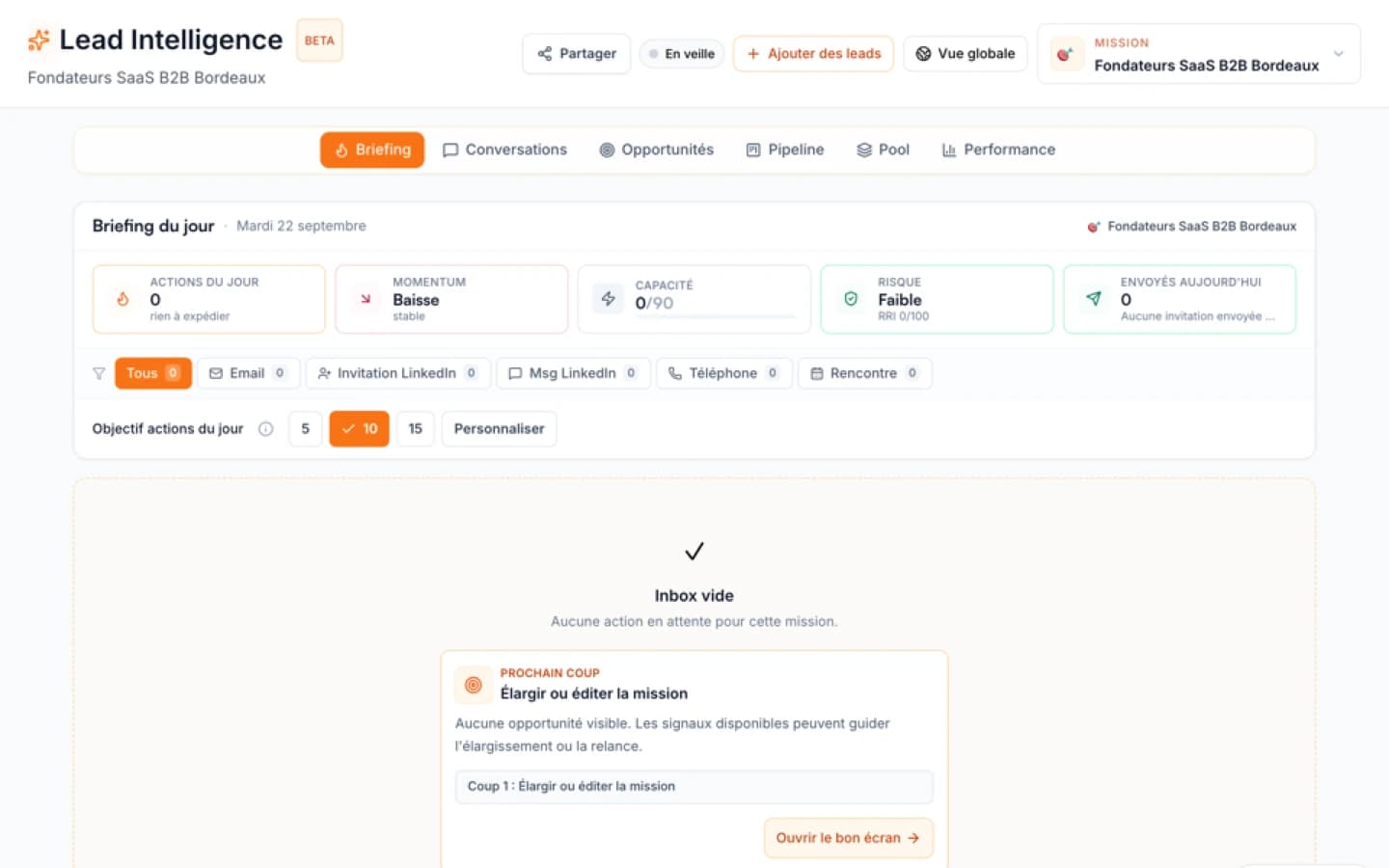
In Ember, Lead Intelligence prioritises opportunities from the available context. It classifies accounts into explained opportunities to watch, act on or set aside. It proposes the next action and channel that fit the lead situation. These capabilities support the method but do not prove buyer intent, consent, budget or an outcome.
Where Lead Intelligence fits
The ledger should preserve the source and the human decision. A detected signal may justify research or contact, but it does not prove stage, budget or buying authority.
Use the Defensible B2B Lead Qualification Framework for Small Sales to define the entry rule. The managerless review then audits whether the team applied that rule consistently.
When to use this method
Use this method when several options appear plausible, evidence is scattered or the team must explain why one action comes before another. It is most useful for decisions that can be reviewed against an observable result.
When not to use it
Stop rules
Stop the review and repair the process when:
- participants use different stage definitions;
- no stable snapshot exists;
- source links or buyer messages are unavailable;
- decisions have no owner;
- an objection or do-not-contact state is disputed;
- the meeting changes records without preserving the reason.
Action plan
Start with a small set of records. Apply the same decision contract, record exceptions and review outcomes on the chosen date. Keep what remains reproducible, change one rule at a time and explicitly close actions that no longer produce useful learning.
Sources and methodology
External sources are listed with their URLs to separate published facts from editorial recommendations. They frame the method rather than promise a universal outcome. Assumptions and limitations remain identified in the article.
Sources
FAQ
Free diagnostic
Test your sales file
Drop an Excel or CSV and check its readiness without sending its rows to Ember.