
Definition
This method turns “Weekly Outbound Review: Turn Evidence Into Three Decisions” into an explicit, reviewable decision. It separates facts, assumptions, choices and the next action. Its purpose is not to create a magic score, but to make the reasoning visible so a small team can correct it from its own results.
Prerequisites
Prepare a change queue before the meeting
Create the queue before the session. Include an opportunity only when at least one of these facts changed:
- a new account, person or relationship source appeared;
- the buyer replied, objected or supplied a constraint;
- an external event changed relevance or timing;
- a promised next step happened or became overdue;
- a research test resolved an explicit unknown;
- a previous assumption was corrected.
For each item, bring the previous state, the new fact, its source and the decision that may change. Do not bring a slide deck. A compact record is easier to challenge.
Steps
Separate evidence from interpretation
Read the evidence first. State the interpretation second. Decide third.
For example, a new executive appointment is a dated fact. "The company now needs our product" is an interpretation. The review may authorise a test to learn whether the new responsibility creates a relevant problem. It may not promote the account as qualified on the event alone.
Salesforce describes qualification as gathering information about need, budget, buying authority and fit so sales can focus on promising leads (official documentation). Keep those dimensions visible instead of hiding them behind one unexplained score.
Run a 30 minute decision sequence
Minutes 0 to 5: check the previous commitments
List last week's tests and advances. Mark each completed, still valid, contradicted or overdue. An overdue action needs a new reason, not an automatic new date.
Minutes 5 to 20: decide on changed records
Spend at most two minutes on a record. Ask four questions:
- What changed and where is the source?
- Which previous assumption does it support or contradict?
- Is the decision stop, advance or test?
- What exact action, owner and date follow?
Park any debate that requires missing evidence. Turn it into a test rather than extending the meeting.
Minutes 20 to 25: diagnose the motion
Now inspect activity measures such as attempts, replies, conversations and meetings. Use them to locate a problem in targeting, evidence, message, channel or follow through.
Volume is diagnostic. It does not prove opportunity progression. A high reply count can expose weak qualification, while a low count can indicate either a poor segment or an unhelpful angle. The next experiment must distinguish between those explanations.
Minutes 25 to 30: choose one weekly experiment
Select one change for a bounded segment. Write the current belief, the change, the eligible records, the observable result and the stopping condition.
Examples include testing a different proof asset for one role, tightening a timing condition or researching a second stakeholder before first contact. Do not change the segment, message, channel and cadence at the same time.
Write a complete decision record
Use the same fields for every item:
- record and previous state;
- new evidence and source date;
- interpretation, marked as such;
- stop, advance or test;
- reason and unresolved unknown;
- owner, next action and due date;
- correction history;
- result to review next week.
This record makes the meeting auditable. A seller can disagree with the interpretation without erasing the fact that led to it.
Worked example
Example: the team reviews a record whose context changed. It retains the fact and source, marks the interpretation as an assumption, chooses one next action and sets the condition that will continue, correct or stop the work.
Common mistakes
Common failure modes
- reviewing every open record instead of changed evidence;
- ranking sellers by activity during the decision segment;
- treating an event as proof of need or urgency;
- accepting "follow up" without a condition, owner and date;
- changing several variables in one experiment;
- carrying an overdue action forward without revisiting its premise;
- removing a stopped record and losing the reason.
Tools
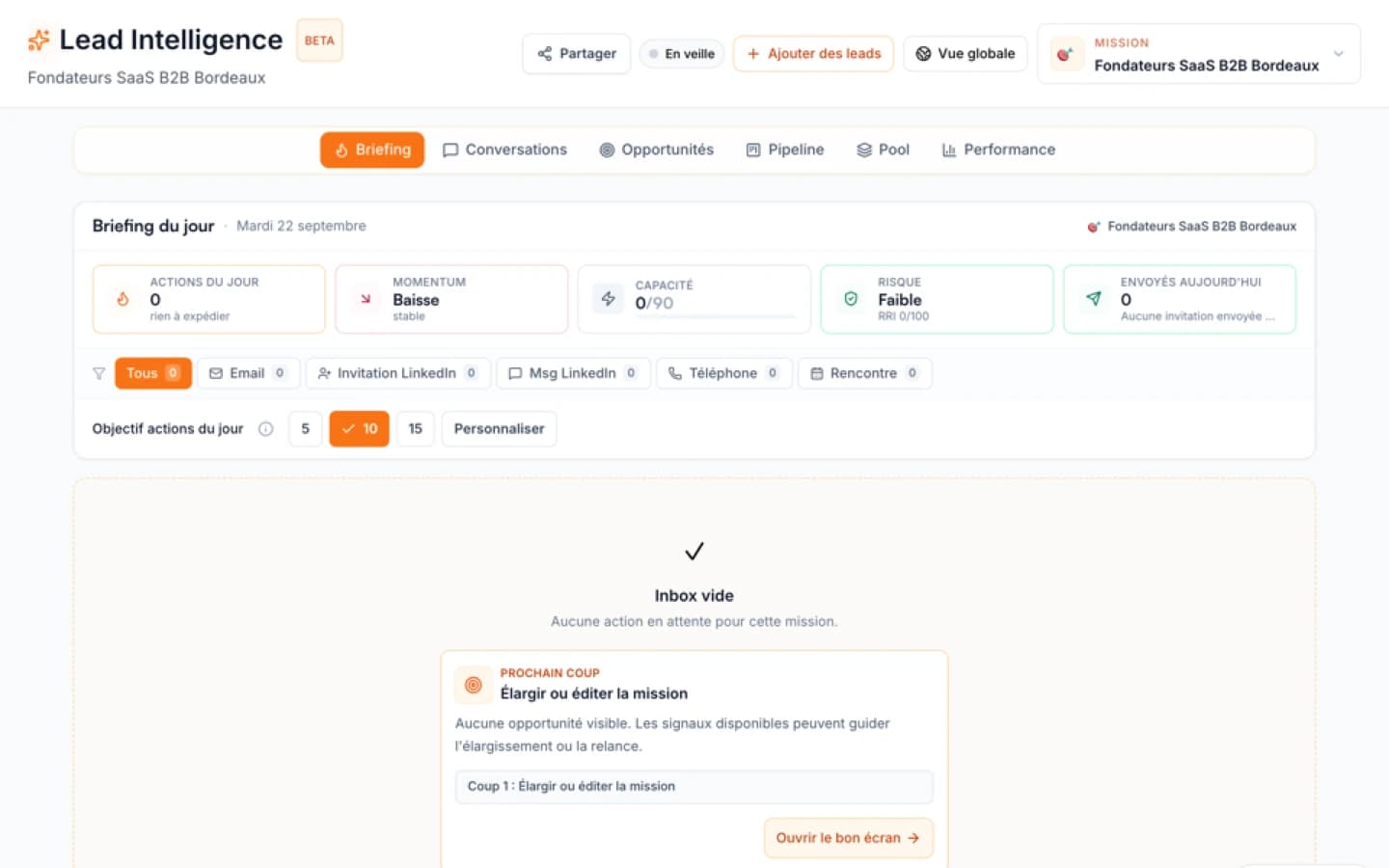
In Ember, Lead Intelligence prioritises opportunities from the available context. It classifies accounts into explained opportunities to watch, act on or set aside. It proposes the next action and channel that fit the lead situation. These capabilities support the method but do not prove buyer intent, consent, budget or an outcome.
Where Lead Intelligence fits
It cannot turn an external event into confirmed buyer need or replace the team's decision. Keep the source beside the recommendation, allow a seller to correct it and record why the state changed.
For a broader qualification contract, read Defensible B2B Lead Qualification Framework for Small Sales. For a lighter review when there is no pipeline meeting, see Structure a Weekly Outbound Review for Small B2B Sales Teams.
When to use this method
Use this method when several options appear plausible, evidence is scattered or the team must explain why one action comes before another. It is most useful for decisions that can be reviewed against an observable result.
When not to use it
Decide what stop, advance and test mean
Stop
Stop when a hard condition is contradicted, the professional contact path is inappropriate, the buyer declines or the timing condition has no credible return point. Keep the reason so future targeting can learn from it.
Advance
Advance only toward a named buyer decision, such as confirming a diagnostic, reviewing evidence, inviting another stakeholder or deciding whether a pilot is warranted. "Book another call" is incomplete without its decision purpose.
Test
Test when one uncertain point could change the decision. A good test has one owner, a small eligible set, a deadline and a stop condition. Research without a question is not a test.
Limits
This method does not predict revenue or remove buyer uncertainty. The right hard conditions depend on the product, contract, market and contact rules. A well supported advance can still end in a refusal.
Action plan
The review exists to change next week
Salesforce presents B2B prospecting as identifying potential business customers and starting relationships that may become sales opportunities (official guide). A weekly review should therefore improve which relationships the team starts, continues or stops. It should not merely describe last week.
The useful unit is not a seller, a dashboard or a campaign. It is a decision whose supporting evidence changed. If nothing changed, the record does not need meeting time.
Use three possible decisions:
- Stop: current evidence contradicts a hard fit, rights or timing condition.
- Advance: enough evidence supports a specific next decision with the buyer.
- Test: one important unknown can be resolved by a bounded action.
Every reviewed record must leave with one of these states. "Keep working it" is not a decision.
Sources and methodology
External sources are listed with their URLs to separate published facts from editorial recommendations. They frame the method rather than promise a universal outcome. Assumptions and limitations remain identified in the article.
Sources
FAQ
Free diagnostic
Test your sales file
Drop an Excel or CSV and check its readiness without sending its rows to Ember.