
Definition
Lead qualification in a small Business-to-Business (B2B) sales team operating without a marketing department or a Customer Relationship Management (CRM) system requires a shift from automated tracking to manual, signal-based evaluation. Qualifying a lead means determining whether a prospect has an immediate, verifiable reason to buy before initiating any outreach. Instead of relying on complex software, small teams must focus on real-time external indicators to build a lean, functional sales pipeline.
For an early-stage founder wondering how does a founder qualify B2B leads without a sales team, or who should an early-stage founder contact first, the answer lies in identifying high-intent triggers rather than mass-emailing a broad list. According to a practical framework outlined by Salesmotion, small teams should focus manually on high-value signals such as recent job changes, hiring spikes, new funding, or specific technology installations, while ignoring generic demographic noise. This approach allows Sales Development Representatives (SDRs) and founders to create a simple, single-page qualification rubric that replaces the need for expensive database setups. This lean checklist aligns with modern Go-To-Market (GTM) enablement strategies, such as those highlighted in the Highspot Lead Qualification Checklist, which emphasize GTM productivity and structured buyer engagement over administrative overhead.
Furthermore, as detailed by the Small Business Expo, basic lead scoring for small businesses does not require enterprise-grade platforms to be effective. Instead of deploying complex scoring algorithms, small teams can manually rank prospects based on fit and timing. By focusing on the immediate needs of the buyer, a small team can maintain a healthy pipeline without the administrative burden of a traditional CRM.
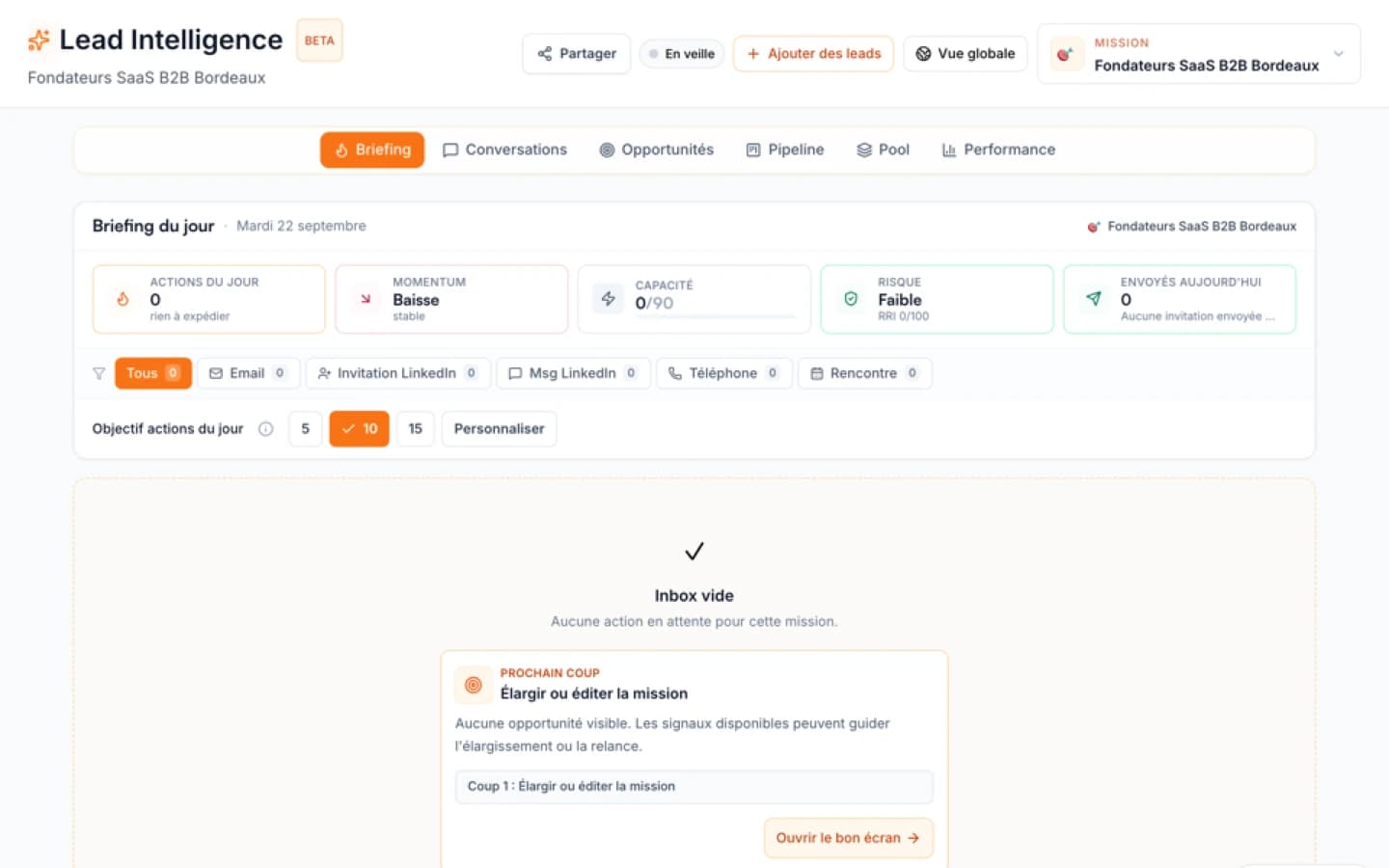
For teams looking to automate this prioritization without the friction of setting up a heavy CRM, Ember offers a streamlined alternative. Through its Lead Intelligence capability, Ember helps teams identify who to contact, why now, and which angle to use. The platform finds and prioritizes the contacts itself whether the team starts with 10, 100 or 1,000 contacts, with no minimum contact threshold, as documented in the Ember Lead Intelligence overview. This allows small sales teams to bypass the credit-heavy, volume-driven outbound models typical of legacy databases and focus purely on high-conviction opportunities.
To place this decision in context, the Knowledge guides for sales brings together deeper guidance on the same field.
Prerequisites
To establish a functional lead qualification process without a marketing department or a Customer Relationship Management (CRM) system, a small team must first define its Ideal Customer Profile (ICP). When building a prospect list from scratch, an early-stage founder often asks: who should an early-stage founder contact first? The answer lies in identifying high-intent accounts by looking at manual, real-time signals such as job changes, hiring spikes, funding rounds, or specific technology installations, while ignoring vanity metrics, according to the framework guide on Salesmotion. This manual approach allows startups to execute effective outbound sales for startups, cold outreach, and B2B prospecting without needing a dedicated Sales Development Representative (SDR) team.
Steps
To establish a systematic lead qualification workflow without a marketing department or a Customer Relationship Management (CRM) system, a small team must execute a series of manual, signal-based steps.
First, the team must identify and monitor real-time trigger signals that indicate an immediate need. Instead of trying to track every digital footprint, focus on highly visible external changes. According to a practical qualification framework by Salesmotion, the most reliable manual signals to monitor include job changes, hiring spikes, funding announcements, and technology installations, while general web traffic noise should be ignored. When a founder qualifies Business-to-Business (B2B) leads without a sales team, focusing on these specific events prevents wasted outreach. To determine who to contact first, an early-stage founder should prioritize prospects undergoing these exact transitions, as they are the most receptive to new solutions.
Second, the sales team needs to translate these signals into a lightweight, actionable evaluation tool. Rather than deploying complex software, write a simple, one-page qualification rubric to guide every conversation, as recommended by Salesmotion. This rubric acts as a manual checklist for the Sales Development Representative (SDR) to verify fit and intent. Utilizing a structured checklist ensures that Go-To-Market (GTM) productivity remains high even without automated systems, aligning with the qualification principles highlighted by Highspot. In 2026, small businesses must adapt their lead scoring models to focus on these high-intent signals rather than arbitrary demographic points, as discussed by the Small Business Expo.
Third, the team must evaluate their data acquisition strategy to avoid common budget traps. Many small teams turn to large contact databases like Apollo, which is positioned as a unified sales platform to simplify the sales stack, as detailed on Apollo.For a small team without a CRM, this volume creates immense noise. Furthermore, credit-based pricing models turn every single export, enrichment, and verification into a metered, costly decision that can quickly drain resources, according to Factors.ai.
Finally, instead of building complex data pipelines or using platforms designed for dedicated Revenue Operations (RevOps) engineers to run agentic workflows, keep the qualification rubric on one page and review the signals by hand, as described above.
To explore this point further, Apollo vs Ember Lead Intelligence for Founder Conversion details a step directly related to this decision.
Worked example
To understand how this works in practice, consider a small software startup with two founders, no dedicated Sales Development Representative (SDR) team, and no Customer Relationship Management (CRM) system. When deciding how does a founder qualify B2B leads without a sales team, the process must rely on highly visible, external triggers rather than complex internal tracking. Instead of purchasing a massive database and risking high bounce rates, the founders must build a simplified, signal-based qualification framework. According to the Salesmotion guide on B2B lead qualification, a practical Business-to-Business (B2B) qualification framework for teams without a marketing function should focus on manual signals such as job changes, hiring spikes, funding, and technology installations, while ignoring generic indicators. The founders then list the few accounts showing those triggers and contact them first.
Common mistakes
When small Business-to-Business (B2B) sales teams operate without a marketing department or a Customer Relationship Management (CRM) system, they frequently fall into predictable traps that stall their outbound sales pipeline.
The first common mistake is treating lead qualification as a pure volume game, which is often driven by the temptation to build a massive prospect list from scratch. Teams frequently rely on large contact databases like Apollo, which positions itself as a unified Artificial Intelligence (AI) sales platform for modern sales and marketing teams, as detailed on the Apollo website. However, this volume-first approach introduces a major financial and operational tradeoff. Because credit-based pricing turns every action into a metered decision, tasks like exporting contacts, enriching records, and verifying emails each consume credits. When a sales team scales from one seat to five, the credit math does not just multiply linearly because wasted exports, bounced emails, and re-enrichment compound the cost, according to Factors.ai. This dynamic is also highlighted by Coldreach, noting that these compounding costs often frustrate buyers who are looking for alternatives to traditional database providers.
The second mistake is ignoring real-time, manual trigger signals in favor of static data. When considering how does a founder qualify B2B leads without a sales team, the founder must essentially act as the signal monitor, watching for job changes, hiring spikes, funding and technology installations instead of relying on static lists.
This approach also connects with Which signals should alert a bootstrapped founder?, which clarifies the next choice.
Tools
To build an effective lead qualification stack without a traditional Customer Relationship Management (CRM) system or a dedicated marketing department, small Business-to-Business (B2B) sales teams must choose tools that match their operational capacity. Traditional enterprise platforms often require extensive setup, but several specialized tools can help small teams discover and qualify leads manually.
For teams focused on high-volume outbound prospecting, Apollo serves as a unified Artificial Intelligence (AI) sales platform designed to simplify the sales stack by combining a massive contact database with sequence automation Apollo.However, small teams must consider the financial trade-offs of this approach. The credit-based pricing model means that exporting contacts, enriching records, and verifying emails each consume credits, which can cause costs to compound quickly when a sales team scales from one seat to five Factors.ai.
For teams that prefer to build highly customized, data-rich workflows, Clay provides a powerful alternative. Clay operates as data infrastructure for Go-To-Market (GTM) teams and GTM engineers, allowing them to run agentic workflows and launch targeted GTM plays Clay. It offers deep flexibility by integrating with popular sales engagement tools such as Salesloft, Outreach, Instantly, Smartlead.ai, and HubSpot Sequencer Clay Integrations. Additionally, its official LinkedIn Sales Navigator integration allows teams to pull real-time lead discovery and connection insights directly into their workflows Clay Sales Navigator. While Clay is exceptional for complex data enrichment, it requires a certain level of technical comfort to configure and maintain without dedicated Revenue Operations (RevOps) support.
When a small sales team or an early-stage founder wants to qualify B2B leads without a sales team or a heavy CRM, they need a solution that bypasses complex credit math and technical engineering. This is where Ember provides a streamlined path. Through its Lead Intelligence capability, Ember helps small teams focus on high-priority opportunities without requiring a massive database or complex setup. Instead of forcing users to manage credit limits or build intricate data pipelines, Lead Intelligence finds and prioritizes the contacts itself, whether the team starts with 10, 100, or 1,000 contacts, with no minimum contact threshold Ember Lead Intelligence. This allows lean teams to identify exactly who to contact first based on real-time signals, keeping the qualification process simple, actionable, and entirely manageable without a marketing team.
When to use this method
This manual, signal-based lead qualification method is designed for lean Business-to-Business (B2B) sales teams and early-stage founders who must build a high-performing sales pipeline without the support of a dedicated marketing department or a complex Customer Relationship Management (CRM) system.
If you are wondering how to qualify B2B leads early or trying to figure out who should an early-stage founder contact first, this approach is highly effective. Instead of buying massive, unverified lists that quickly drain your budget, this method focuses on identifying immediate "why now" triggers. This is particularly crucial because credit-based pricing models in traditional databases turn every export, email verification, and record enrichment into a metered decision, which can compound costs rapidly as a team scales (Factors.ai).
In practice, How should a B2B sales team use AI and intent signals in 2026 without losing the human read on a prospect? completes this framework with another angle on the same topic.
When not to use it
This lightweight, spreadsheet-driven qualification methodology is highly effective for lean teams, but it has clear operational boundaries. You should not use this manual approach if your Business-to-Business (B2B) organization is moving toward a high-volume, automated outbound sales model. When a company scales its outreach to thousands of prospects per week, manual tracking in spreadsheets quickly breaks down. For organizations that rely on sheer volume, a unified sales platform designed for pipeline generation and closing, such as Apollo, is more appropriate because it provides a massive contact database and sequence automation Apollo. In those high-volume environments, however, teams must accept that credit-based pricing models turn every export and email verification into a metered decision, which can compound costs as the team scales Factors.ai.
Additionally, this method is not suitable if your team includes dedicated Go-To-Market (GTM) engineers or Revenue Operations (RevOps) specialists who require complex data orchestration. If your strategy demands building intricate, multi-source data pipelines and launching highly customized agentic workflows, you require a dedicated GTM infrastructure platform like Clay Clay. Such platforms are built specifically to integrate deep data points, such as official LinkedIn Sales Navigator data Clay, into complex programmatic plays. Trying to force-fit a simple, manual qualification rubric into a highly engineered data stack will only frustrate your operations team.
If you are asking how does a founder qualify B2B leads without a sales team, the manual approach works well in the earliest days when you are personally managing every relationship. When considering who should an early-stage founder contact first, the answer is always the small group of high-intent accounts showing immediate, real-time buying signals. However, as soon as you need to scale this process without hiring a massive Sales Development Representative (SDR) team or purchasing an expensive Customer Relationship Management (CRM) system, manual spreadsheets become a bottleneck.
Instead of reverting to complex enterprise software or manual data entry, teams can leverage Ember. With the Lead Intelligence capability, you can bypass the manual grind of lead scoring and signal tracking. Lead Intelligence finds and prioritizes the contacts itself, whether the team starts with 10, 100, or 1,000 contacts, with no minimum contact threshold Lead Intelligence. This allows lean teams to maintain a highly targeted, context-driven sales pipeline without the administrative burden of a traditional CRM or the chaotic noise of high-volume database tools.
Action plan
To establish a reliable sales pipeline without a dedicated marketing team or a complex Customer Relationship Management (CRM) system, small Business-to-Business (B2B) sales teams and early-stage founders must execute a highly disciplined, signal-based qualification workflow.
First, you must build a one-page qualification rubric to replace the automated lead scoring models typically managed by marketing operations. According to a guide on Salesmotion, a practical qualification framework for teams without a marketing function or CRM should focus on manual, real-time signals such as job changes, hiring spikes, funding events, or specific technology installations, while ignoring vanity metrics. This rubric acts as your checklist to ensure every prospect matches your Ideal Customer Profile (ICP) before any outreach begins. For teams looking to structure this process further, the Highspot Lead Qualification Checklist provides a structured framework to keep Go-To-Market (GTM) productivity high and ensure predictable pipeline growth.
If you are wondering how does a founder qualify B2B leads without a sales team, the answer lies in ruthless prioritization. Instead of trying to manage a massive database, a founder acting as their own Sales Development Representative (SDR) must manually track these high-intent triggers. When considering who should an early-stage founder contact first, the priority must always go to prospects experiencing immediate change. A decision-maker who has recently changed jobs or a company experiencing a sudden hiring spike is far more likely to engage in a conversation about new solutions than a static contact. You can gather these insights by manually reviewing professional networks or using specialized data platforms. For example, platforms like Clay provide an infrastructure for GTM teams to run workflows and launch GTM plays, as outlined on the Clay homepage, including official integrations to pull data points directly from LinkedIn Sales Navigator, as shown on the Clay Sales Navigator integration page.
However, small teams must be cautious about the tools they choose to support this workflow: credit-based platforms can add cost and setup effort before the team has validated its qualification rubric.
Before deciding, Apollo vs Ember Lead Intelligence for Founder Conversion helps connect this method with adjacent priorities.
Sources and methodology
This methodology is built on modern sales frameworks established for 2026, drawing from the lead qualification checklist compiled by Highspot at Highspot and the Business-to-Business (B2B) lead scoring principles outlined by the Small Business Expo at Small Business Expo. To address how does a founder qualify B2B leads without a sales team, this framework prioritizes real-time signals over heavy software infrastructure. Practical qualification guidelines from Salesmotion show that lean teams can successfully qualify prospects by manually tracking job changes, hiring spikes, and funding rounds instead of relying on complex marketing automation.
When deciding who should an early-stage founder contact first, the methodology focuses on high-intent accounts showing immediate trigger events. Traditional database platforms like Apollo offer unified sales platforms for modern sales teams, but their credit-based pricing model can turn every enrichment action into a metered decision, as analyzed by Factors.ai at Factors.ai and Coldreach at Coldreach. Similarly, while advanced Go-To-Market (GTM) infrastructure tools like Clay allow Revenue Operations (RevOps) teams to run agentic workflows with integrations like LinkedIn Sales Navigator at Clay Integrations, they often require dedicated technical setup.
For small teams that need to build a prospect list from scratch without complex Customer Relationship Management (CRM) systems, Ember provides Lead Intelligence, which finds and prioritizes the contacts itself with no minimum contact threshold.
Sources
- A practical qualification framework for teams that have no marketing function and no CRM: which signals to look at manually (job change, hiring spike, funding, tech install), which to ignore, and how to write a one-page qualification rubric
- B2B Lead Scoring 101 For Small Businesses In 2026
- Lead Qualification Process: The 2026 Sales Checklist
FAQ
Free diagnostic
Test your sales file
Drop an Excel or CSV and check its readiness without sending its rows to Ember.