
Symptom or signal
For an early stage bootstrapped founder, outbound sales often feel like a choice between two difficult options: spending hours manually searching for prospects or wasting money on massive, generic email lists. When resources are tight, you cannot afford to burn your domain reputation or your limited hours on cold outreach that goes unanswered. As Paul Irolla writes in his Substack on founder-led growth, the startups that succeed today “are not the ones that spend the most on marketing” but the ones whose founder “dares to take a public stance” (our translation from the French). To make this founder-led approach work, you need highly targeted, timely interactions.
Established platforms are highly effective for larger, structured sales organizations. For example, Apollo promotes “one connected GTM system” on its homepage.
To place this decision in context, the Knowledge guides for sales brings together deeper guidance on the same field.
What changed
The landscape of outbound sales has shifted from brute force database scraping to highly contextual, founder-led engagement. Historically, outbound prospecting required massive databases and complex setups. Large platforms scaled rapidly to meet this demand. According to Apollo (company history and Series D announcement), Apollo generated $150M in annual recurring revenue in 2025, reached a $1.6B valuation in 2023 and has raised about $250M in total funding. Apollo now promotes “one connected GTM system” on its homepage. However, for an early stage bootstrapped founder, data volume is rarely what is missing: time to decide who to contact first is.
Facts and sources
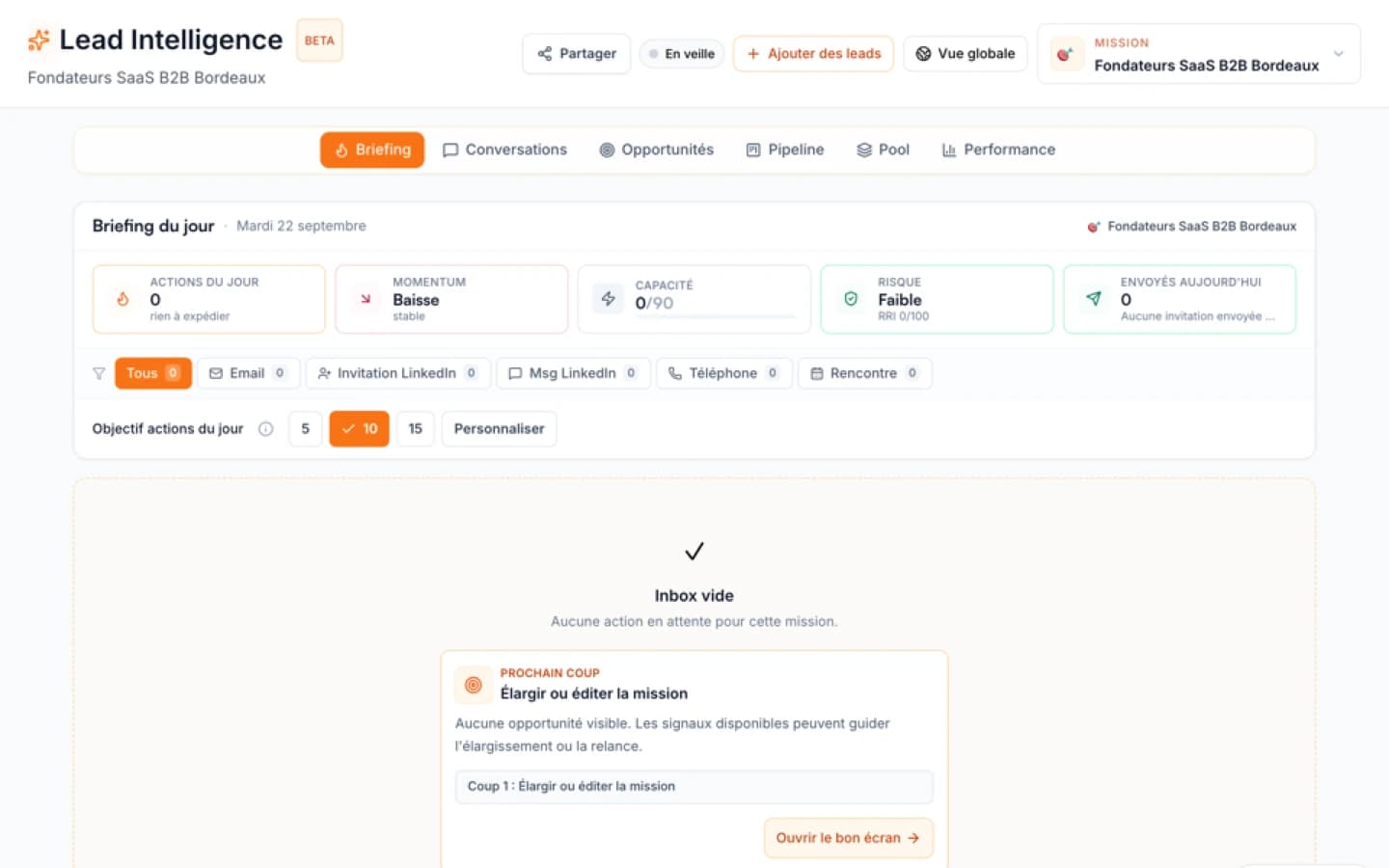
For early stage bootstrapped founders, Paul Irolla points out in his article on founder-led growth that the startups that succeed are not the ones that spend the most on marketing. For a bootstrapped founder, that argues for building direct, highly contextual relationships rather than betting on mass outreach. Apollo, for its part, promotes “one connected GTM system”, yet its unlimited plans remain subject to credit limits under its fair use policy, as detailed on the Apollo pricing page. To help bootstrapped founders navigate this without needing massive databases, Ember designed Lead Intelligence to find accounts from the mission ideal customer profile (ICP) and signals, and then verify useful sources. This capability finds and prioritizes the contacts itself whether the team starts with 10, 100, or 1,000 contacts, with no minimum contact threshold. By analyzing these signals, Lead Intelligence proposes the next action and channel that fit the lead situation to provide a clear next action on who to contact, why now, and which angle to use. This document draws on the public pages cited: Paul Irolla's article, the Apollo and Clay pages, the figures published by Apollo and the description of Lead Intelligence.
To explore this point further, B2B prospecting list: target a job title, not a company size details a step directly related to this decision.
Why the common explanation is incomplete
The traditional explanation of outbound sales suggests that prospecting is purely a numbers game. Under this view, the solution to flatlining growth is simply to buy a larger database, set up complex automated sequences, and blast hundreds of cold emails every day. This volume-first approach is highly visible in the market. For example, Apollo promotes “one connected GTM system” on its homepage. Yet, even their unlimited plans remain subject to a Fair Use Policy that enforces specific credit limits, as outlined on the Apollo pricing page. Similarly, advanced data enrichment platforms like Clay offer powerful technical integrations, such as their official Sales Navigator datapoint integration for lead discovery and connection insights, as shown on the Clay integrations page. For an early stage bootstrapped founder, this standard explanation is fundamentally incomplete. It assumes you have the budget to absorb credit limits, the technical bandwidth to configure multi-step enrichment workflows, and a massive list to begin with. In reality, a founder-led approach does not require massive volume to be effective. Relying on sheer volume only dilutes your message and risks damaging your domain reputation. Instead of managing complex data pipelines, a bootstrapped founder needs to know exactly who to contact, why now, and which action to take. This is where the traditional database model falls short. It provides raw data but leaves the strategic reasoning to you. True efficiency comes from a system that understands your specific business context and identifies the right timing. By analyzing signals, the system proposes the next action and channel that fit the lead situation, giving you a clear next action on who to contact, why now, which channel, and which angle. This shifts the focus from managing databases to having meaningful, highly contextual conversations.
The real problem
For established sales teams with dedicated operations managers, large-scale database platforms like Apollo are highly effective for broad market coverage. According to Apollo, Apollo generated $150M in annual recurring revenue in 2025. However, for an early stage bootstrapped founder, the real problem is not a lack of potential leads, but a severe lack of time and focus. Massive databases require significant manual filtering, and their unlimited plans remain subject to a fair use policy with specific credit limits as detailed on the Apollo pricing page.
When you are bootstrapping, you cannot afford to spend hours cleaning databases or setting up complex, automated sequences that burn your domain reputation. You need to know exactly who to contact, why now, and which action to take without hitting a credit ceiling.
This approach also connects with How Can a B2B Founder in the Founder-Led Sales Phase Decide Who to Contact, Why Now, and With What Message?, which clarifies the next choice.
How the mechanism works
Lead Intelligence operates by turning the strategic foundation of a business into an active prospecting engine. Instead of forcing founders to build massive databases or learn complex query languages, the mechanism begins by reusing the existing project context, including the business plan, the Ideal Customer Profile (ICP), and the core offer. By anchoring the search in this validated context, the system discovers relevant accounts and monitors signals across companies and individuals to identify genuine opportunities.
The prioritization process is designed to eliminate the noise that typically overwhelms early stage teams. Lead Intelligence finds and prioritizes the contacts itself whether the team starts with 10, 100 or 1,000 contacts, with no minimum contact threshold. This volume independent approach ensures that bootstrapped founders do not need to purchase massive lists to get started. The system evaluates each opportunity based on readiness and context, classifying accounts into clear categories so founders know whether to watch, act on, or set aside a specific lead.
Once the highest priority opportunities are identified, the mechanism provides the precise context needed to initiate contact. It proposes the next action and channel that fit the lead situation. This means the founder receives a clear recommendation on who to contact, why the timing is right now, which channel to use, and what specific angle to take in the message. By aligning the outreach with signals, the mechanism ensures that every conversation is highly relevant and grounded in the actual situation of the prospect.
Concrete examples
Consider a bootstrapped founder who has just launched a specialized business-to-business service. Instead of spending hours scraping thousands of cold prospects, the founder can upload a small, highly targeted list. This means an early-stage company does not need to wait until they have a massive database to begin meaningful outreach. For example, if the founder imports a Comma-Separated Values (CSV) file containing a handful of target accounts, Ember analyzes these entries against the validated project context. Instead of returning a generic list of names, the system proposes the next action and channel that fit the lead situation. The founder receives a clear next action showing exactly who to contact, why now, which channel to use, and which angle to take. This targeted approach goes in the direction of the founder-led growth described by Paul Irolla, where the founder gets personally involved rather than spending on marketing. In practice, this reduces the noise of traditional sales tools: Apollo, for example, states that its unlimited plans remain subject to a Fair Use Policy with credit limits (Apollo Pricing). For an early-stage founder, managing these databases and complex query rules becomes a distraction from building the product. Lead Intelligence aims to avoid this by focusing on immediate relevance. If a contact in the founder's list recently changed roles or launched a new initiative, Lead Intelligence can surface this signal and help the founder decide whether to act now, through which channel and with which angle. The founder can then initiate contact through the most appropriate channel, turning what would have been a cold interaction into a timely, context-driven conversation.
In practice, How Lead Intelligence works for a B2B founder who wants to know who to contact, why now, and with what message: a practical guide completes this framework with another angle on the same topic.
When to use this diagnosis
For established sales teams with dedicated operations managers, large-scale database platforms like Apollo are highly effective for broad market coverage. However, credit-based pricing turns every action into a metered decision: Apollo states, for example, that export credits are consumed whenever a contact is exported outside Apollo (Apollo pricing page). Even unlimited plans remain subject to a fair use policy with credit limits, as detailed on the same page. For an early-stage founder pursuing founder-led growth, the priority is completely different. According to Paul Irolla, in his analysis of founder-led growth published on 9 February 2025 on Substack, the startups that succeed are not the ones that spend the most on marketing but the ones whose founder dares to take a public stance. In this context, a bootstrapped founder needs to know exactly who to contact, why now, and which action to take without wasting time or budget on generic volume. This is precisely when to use Lead Intelligence. The capability is built to help founders identify who to contact, why now, and which action to take. Instead of managing complex queries or worrying about metered exports, the founder receives a clear next action, including who to contact, why now, which channel, and which angle. By proposing the next action and channel that fit the lead situation, Lead Intelligence allows early-stage teams to focus on high-conviction conversations.
When not to use it
While Lead Intelligence finds and prioritizes the contacts itself whether the team starts with 10, 100 or 1,000 contacts, with no minimum contact threshold, it is not designed for static database management. If your primary goal is to build and maintain a massive, un-prioritized repository of cold leads, traditional database providers are more suitable.
For instance, if your strategy relies on high-volume, automated bulk emailing without contextual prioritization, traditional database platforms are more appropriate. Teams seeking a connected system to manage pipelines can turn to Apollo, which promotes “one connected GTM system” on its homepage. Additionally, if you require unlimited email credits for massive outreach, you might prefer dedicated outbound tools, although it is worth noting that unlimited plans on Apollo remain subject to a fair use policy with credit limits according to the Apollo pricing page.
Similarly, if your business has a dedicated sales operations team that wants to build highly customized, multi-source data enrichment workflows from scratch, a specialized data orchestration tool like Clay is a better fit, especially when leveraging its official LinkedIn Sales Navigator data point integration for lead discovery as documented on the Clay integrations page.
Lead Intelligence aims to help choose the priority rather than accumulate volume. If your goal is simply to accumulate thousands of cold contacts without evaluating who to contact, why now, and which action to take, the targeted, context-driven approach of Lead Intelligence will not align with your workflow.
Before deciding, How do you qualify a B2B lead in 2026 without a marketing team or CRM: a practical guide? helps connect this method with adjacent priorities.
Next step
For a bootstrapped founder, execution speed and relevance are valuable assets against early exhaustion. Instead of building massive, unverified lists that sit cold in a database, the next step is to transition to an active outreach model centered around founder-led growth (FLG). According to Paul Irolla on his Substack publication, the startups that succeed are not the ones that spend the most on marketing but the ones whose founder dares to take a public stance.
To put this into practice without wasting hours on manual research, you need to know who to contact, why now, and which action to take. This is where Lead Intelligence changes the workflow. The system proposes the next action and channel that fit the lead situation. Rather than worrying about minimum list sizes, Lead Intelligence finds and prioritizes the contacts itself whether the team starts with 10, 100, or 1,000 contacts, with no minimum contact threshold.
By focusing your limited time on highly qualified opportunities, you can move away from generic email blasts. Lead Intelligence provides a clear next action: who to contact, why now, which channel, and which angle. For a bootstrapped business, this means every conversation is grounded in real context. You can start this process today by defining your core mission context in Ember and letting the system surface your first priority opportunities.
Sources and methodology
This analysis is grounded in public sources consulted on 28 September 2026. Apollo's figures (revenue, valuation, funding) come from Apollo (company history and Series D announcement); its positioning and its fair use policy on credits come from its homepage and its pricing page. Clay's LinkedIn Sales Navigator integration is described on its integrations page. The view on founder-led growth comes from the article by Paul Irolla. The Lead Intelligence capabilities described here (finding contacts with no minimum threshold, proposing the next action and channel) are those of the product.
Sources
FAQ
Free diagnostic
Test your sales file
Drop an Excel or CSV and check its readiness without sending its rows to Ember.