
Essential in 30 seconds
For early-stage founders, this process forms the bedrock of outbound sales for startups.
Instead of exporting massive, unverified lists, founders must focus on lead qualification based on real-time signals and organizational changes.
Other modern tools like Clay are highly suited for growth teams that want to combine multiple data sources and write custom enrichment logic. While Clay offers incredible breadth for builders who have the technical bandwidth to design and maintain these workflows, it can introduce unnecessary complexity for an early-stage founder who needs to focus on conversations rather than data engineering.
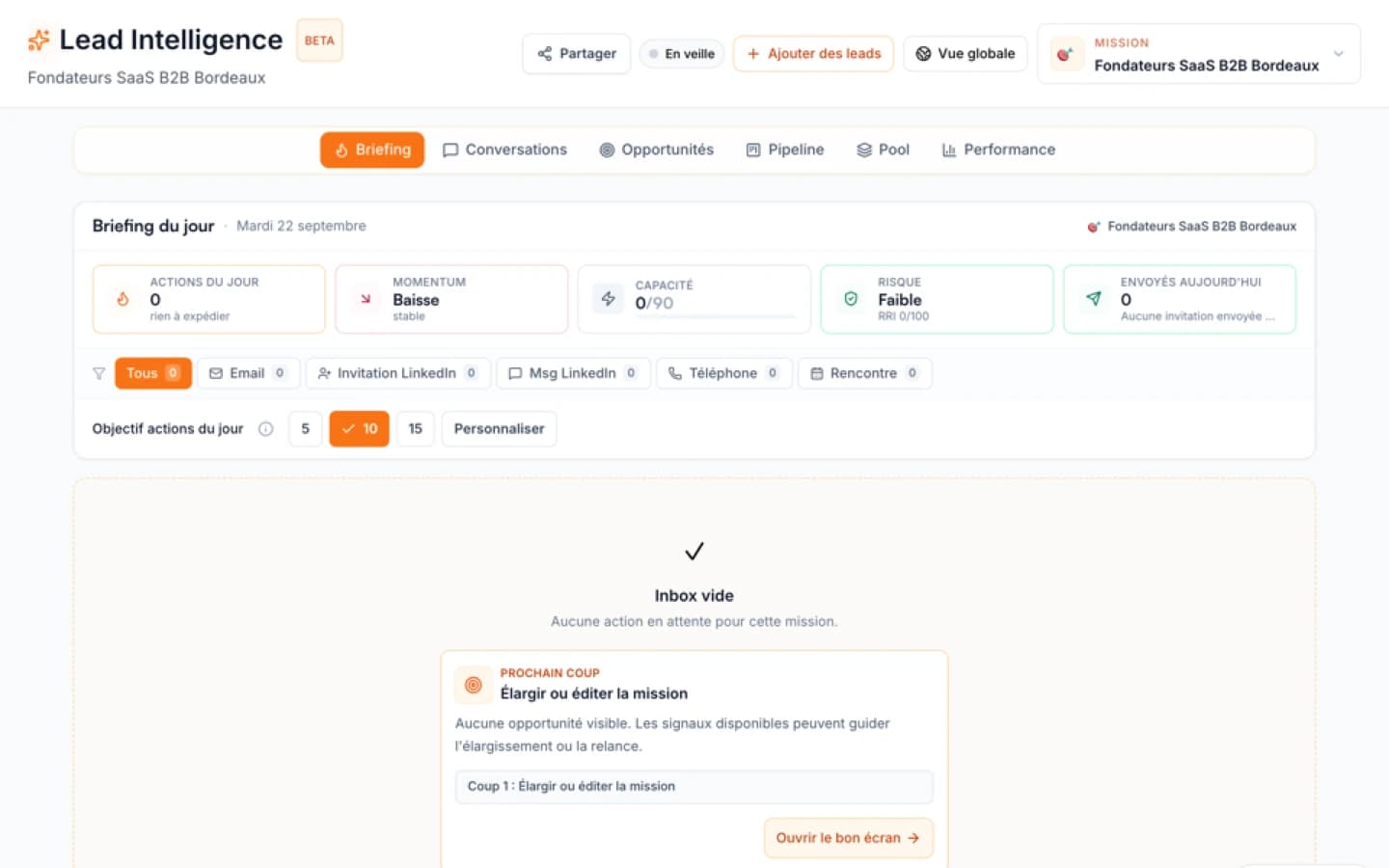
A founder can use a tool to organize candidate accounts and the reasons for prioritising them. For example, Ember's Lead Intelligence uses your specific business context to find accounts, monitor signals, and prioritize opportunities. The suggested priority is useful only if its evidence is current and the founder verifies the contact context.
To place this decision in context, the Knowledge guides for sales brings together deeper guidance on the same field.
Why this situation is different
Without historical sales data to guide you, building a prospect list from scratch requires a structured set of prerequisites to avoid wasting time on dead-end leads. Before you write a single cold outreach email or configure a Customer Relationship Management (CRM) system, you must establish a clear foundation. This foundation relies on defining your Ideal Customer Profile (ICP), identifying your initial targets, and setting up a lean process for lead qualification.
When starting from zero, the first critical question is: who should an early-stage founder contact first? The temptation is to target the largest, most recognizable brands in your industry. However, without a warm introduction or case studies, these accounts are rarely receptive. Instead, founders should target early adopters who are actively experiencing the specific pain point their product solves. This means looking for companies that have recently raised funding, expanded their teams, or adopted adjacent technologies. These situational triggers indicate a willingness to change and make these accounts the ideal starting point for outbound sales for startups.
In the early days, you do not have a dedicated team of Sales Development Representatives (SDRs) to filter out bad fits. This involves verifying that the target account has the budget, the technical environment, and a decision-maker with the authority to buy. By focusing on high-intent signals instead of raw volume, you can maintain a healthy sales pipeline without burning through your limited time.
To execute this strategy, founders need the right data infrastructure. Traditional tools approach this through sheer volume.
For founders who need to review opportunities against business context, Lead Intelligence offers contextual prioritisation. This allows you to prioritize opportunities based on real context and opportunity readiness, while leaving the conversion outcome uncertain.
Diagnostic
This process transforms a blank spreadsheet into a highly targeted sales pipeline, allowing you to initiate outbound sales for startups and execute cold outreach with confidence.
Translate your Ideal Customer Profile into search parameters
The first phase of building a prospect list from scratch is defining exactly who you need to reach. When considering who to contact first as a founder, the answer is not the largest enterprise accounts on the market. Instead, founders should target early adopters who experience the specific pain point acutely and have the agility to make quick decisions. You must translate your Ideal Customer Profile (ICP) into concrete search parameters such as specific job titles, company sizes, geographic regions, and technology stacks. This structured definition prevents you from wasting time on broad, irrelevant audiences.
Source raw accounts and profiles
Once your parameters are set, you need to gather raw data. Traditional approaches often rely on legacy databases.
For founders seeking a more context-driven approach, Ember provides a streamlined alternative.
Qualify and prioritize your leads
Gathering names is only half the battle; the critical next step is lead qualification. Without a dedicated Sales Development Representative (SDR) team, founders must rely on intelligent prioritization rather than brute-force volume.
Ember simplifies this process by removing the manual overhead.
Organize data for your sales pipeline
The final step is structuring your qualified leads so they can be easily managed within a Customer Relationship Management (CRM) system or a tracking spreadsheet. Each contact should have clear, actionable context attached to their profile, including the specific reason they were prioritized and the exact angle you plan to use for your outreach. This structured preparation ensures that when you finally launch your cold outreach campaigns, your messaging is highly personalized, relevant, and designed to convert cold prospects into active sales conversations.
A three-phase example
To understand how this works in practice, let us walk through a concrete scenario. This founder has zero existing customers, no industry network, and no dedicated sales team. The goal is to build a highly targeted sales pipeline and initiate outbound sales for startups from absolute scratch. When building a prospect list from scratch, the first critical question is: who should an early-stage founder contact first? Instead of exporting thousands of generic human resource managers, the founder must look for specific trigger events that indicate an immediate need. For an onboarding software provider, the ideal trigger is a company that has recently announced a shift to a fully remote work model or is actively hiring for multiple remote engineering roles. These signals indicate that their existing onboarding processes are likely under strain, making them highly receptive to a tailored solution. To source these accounts, the founder might initially look at traditional databases. While highly powerful for teams with the technical bandwidth to design these workflows, it requires a significant financial commitment. For an early-stage founder, managing these complex, metered workflows can quickly become a full-time job. This is where Ember Lead Intelligence simplifies the cold outreach process. The founder should verify candidate accounts and contact rights. If a tool supplies suggestions, inspect the evidence before outreach. With reviewed candidates, the platform prioritises opportunities from the available context and makes the priority explainable from context, signals, and opportunity readiness. Instead of staring at a massive spreadsheet of unranked names, the founder receives a curated list of high-priority conversations to start immediately, complete with the context of why each lead is ready for outreach.
Avoid false starts
Without an established network or historical data, the pressure to generate immediate pipeline can lead to strategic missteps in outbound sales for startups.
The most frequent mistake is prioritizing raw volume over deep context. Many founders turn to legacy databases to execute broad cold outreach campaigns. While this volume-oriented model has real strengths for established teams, it often backfires for early-stage startups. For a founder without a dedicated Sales Development Representative (SDR) or a massive budget, this leads to high spend with very little relevance.
Another common error is over-engineering the data enrichment stack too early. However, this breadth requires significant technical bandwidth to design and maintain workflows. It also comes with a financial commitment.
The key is to shift from static list-building to signal-based lead qualification. Instead of filtering purely by company size or job title, founders must look for active triggers, such as recent hiring patterns, technology shifts, or public company announcements, that indicate an immediate need.
A related pitfall involves targeting the wrong people. When deciding who should an early-stage founder contact first, the natural instinct is to target the highest-ranking executive at the largest possible enterprise. However, enterprise buyers rarely buy unproven software from startups with no case studies. Instead, founders should contact early-adopter profiles, often found in mid-market companies, who have the authority to make quick decisions and are actively feeling the pain point.
A founder may use contextual prioritisation to review a smaller candidate set. Compare tools using current official terms and the amount of manual verification required; no price or conversion advantage is assumed here.
Choosing a discovery tool
Without an established network or historical sales data, the software you select will dictate how effectively you can execute lead qualification and build a clean sales pipeline.
For many startups, established platforms like Apollo offer a functional starting point. This model has real strengths for teams that already know their target market.
For founders with more technical resources, Clay provides a highly customizable alternative.
Qualifying leads early without a dedicated Sales Development Representative (SDR) team requires shifting from manual lead scoring to automated, context-driven validation. Instead of relying on raw volume, founders must use systems that evaluate opportunity readiness and explain why a specific account is worth pursuing right now.
This raises another critical question: who should an early-stage founder contact first? When building a prospect list from scratch, you should contact high-intent, highly specific accounts that fit your tightest ICP definition first. Instead of chasing broad volume, the focus must be on finding companies experiencing the exact pain point your product solves, allowing you to execute cold outreach with highly tailored angles.
Ember offers a different path through its Lead Intelligence capability, designed specifically to help founders prioritize the conversations that deserve attention now. The public product page describes contextual opportunity prioritisation and a recommended next action. Use those suggestions as leads for human review; the page does not establish a guaranteed reply rate or a complete source-to-contact workflow.
When the method helps
This methodical approach to building a prospect list from scratch is designed for specific inflection points in a company's growth. It is not a replacement for high-volume marketing campaigns, but rather a targeted strategy for founders who must establish their initial sales pipeline with precision.
First, this method is essential when you are figuring out who to contact first as a founder. When you have no existing customers and no industry network, you cannot rely on warm introductions or historical sales data. Instead of guessing, you need a structured way to identify accounts that fit your Ideal Customer Profile (ICP). By focusing on highly specific triggers and situational context, you can initiate outbound sales for startups without wasting precious time on cold accounts that have no immediate need for your solution.
Early-stage startups rarely have the budget for a dedicated Sales Development Representative (SDR) or a complex Customer Relationship Management (CRM) system with automated lead scoring. This allows you to gather deep context on individual prospects and prioritize your cold outreach based on real-time signals rather than raw volume.
Finally, this approach is ideal when you want to avoid the financial traps of traditional database platforms. However, when you are building a prospect list from scratch, paying for wasted exports and unverified contacts can quickly drain your budget.
When it does not fit
First, if your product has a low Average Contract Value (ACV) and relies on high-volume, transactional sales, spending hours researching individual accounts is counterproductive. This model is highly effective for teams that already know their ICP cold and have the budget to support the provider’s current commercial terms. Second, this method is not designed for advanced revenue operations teams that require highly customized, programmatic data pipelines. If your startup already has a dedicated Sales Development Representative (SDR) team and the technical bandwidth to orchestrate multiple data providers, a platform like Clay is a better fit. Clay allows growth teams to write custom enrichment logic and push results directly into an existing Customer Relationship Management (CRM) stack. Blasting thousands of cold emails without context will damage your domain reputation and yield poor results. When deciding who to contact first, early-stage founders should prioritize high-signal opportunities where there is a clear, explainable reason to reach out today. If you want to move beyond manual spreadsheets while keeping human review of evidence and contact rights, contextual prioritisation can help organise the next accounts to inspect.
First-list checklist
This process shifts the focus from raw volume to high-intent relevance, so the founder can use limited research time on accounts with a stated reason for contact.
First, you must determine who to contact first as a founder. When starting from zero, the temptation is to target the largest companies or the broadest possible market. Instead, an early-stage founder should contact first those specific buyers who suffer from the most acute, immediate version of the problem your product solves. This means defining a highly narrow Ideal Customer Profile (ICP) based on specific triggers, such as recent leadership changes, technology migrations, or public growth milestones, rather than generic industry classifications.
Second, you need to source and import your initial targets. Founders can leverage specialized platforms depending on their technical bandwidth and budget.
Without a dedicated team of Sales Development Representatives (SDRs) or historical Customer Relationship Management (CRM) data, you cannot rely on traditional automated lead scoring. Instead, lead qualification must be handled through manual, context-driven validation. This involves reviewing the prospect's public posts, job openings, and company news to find a logical bridge for your outreach.
Finally, this initial outbound sales for startups effort must be connected back to your broader business strategy. The insights gained from these early qualification conversations should not live in isolation. Keep the qualitative feedback from the first conversations beside the account hypothesis and update the target profile when the evidence changes. Do not assume a sales signal has automatically changed the funding plan.
What to verify
To establish a reliable framework for outbound sales for startups, this analysis evaluates how early-stage founders can build a high-quality sales pipeline from scratch. And who should an early-stage founder contact first?
Finally, we assessed modern agentic alternatives like Ember's Lead Intelligence, which bypasses complex manual orchestration by using the founder's business plan and strategic context to find accounts and verify sources. The founder still needs to verify the accounts, the contact basis and what happened after outreach. A product description does not prove a sales outcome.
Practical answer
Begin with a short list of companies that match a defined buyer problem. Record why each account might need the product, where the signal came from and what still needs confirmation. Do not treat a contact export as evidence of buyer intent.
Sources and methodology
The account-selection steps are editorial guidance, not measured conversion claims. Apollo describes a broad sales data and execution platform, while Clay describes configurable data workflows. Ember’s Lead Intelligence page describes contextual opportunity prioritisation. Check each provider’s current scope and terms before choosing a tool. No public source used here proves that one will convert better for your company.
Where Ember fits
Use Lead Intelligence when the problem is deciding which account merits attention and why. Bring a clear target profile and review the evidence behind each suggested priority. Continue to decide whether contact is appropriate and permitted. An opportunity score is a prompt for examination, not a promise of a meeting.
FAQ
Free diagnostic
Test your sales file
Drop an Excel or CSV and check its readiness without sending its rows to Ember.